


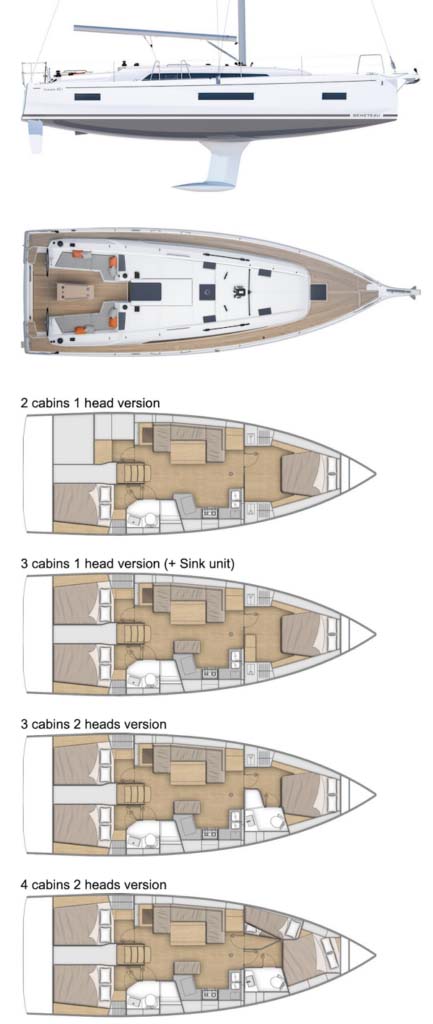
The Beneteau Oceanis 40.1 is a modern cruising sailboat designed with versatility and liveability at its core. Launched in the late 2010s by Beneteau, one of the world’s most prolific boatbuilders, the 40.1 was crafted by Marc Lombard with interiors by Nauta Design. It succeeds earlier Oceanis 40 iterations by offering a refined hull shape, more interior volume, and contemporary sailing ergonomics aimed at today’s discerning cruisers.
Designed primarily for coastal and semi-offshore cruising, the 40.1 strikes a balance between comfort and performance, appealing to private owners, charter companies, and sailing schools alike. On the used market, it’s gaining strong traction thanks to its fresh design, ease of handling, and adaptable layout options, making it especially popular among young cruising couples and families looking for a manageable yet roomy platform.
Design and Construction
The Oceanis 40.1 features a wide-beam, hard-chined hull with a plumb bow and broad transom—elements that maximize interior volume and improve form stability. Underwater, the fin keel with a bulb and a balanced spade rudder provide responsive handling and reliable upwind performance. A twin-wheel cockpit ensures visibility and maneuverability, particularly under sail or while docking.
The rig is a fractional sloop, favoring simplicity and balance, especially under short-handed conditions. Construction is traditional Beneteau: vacuum-infused fiberglass hull and deck, with structural grid reinforcement. Deck and hull are bonded and laminated, ensuring strength and rigidity. The ballast is cast iron—more cost-effective than lead, though with slightly less density. These choices make for a hull that is both durable and relatively easy to repair, which contributes to long-term resale value.
Overall, the design reflects contemporary naval architecture principles: high form stability, minimal wetted surface, and efficient sail area-to-displacement ratios. The result is a boat that’s not just forgiving at sea, but also fast enough to please performance-oriented cruisers.
Performance
Under sail, the Oceanis 40.1 performs admirably across a wide range of conditions. In light airs, the hull accelerates well, especially when equipped with the optional furling Code 0 or asymmetric spinnaker. With a hull speed around 7.8 knots and a calculated SA/Displ. ratio of 15.8 (or higher depending on sail configuration), it’s not a racer, but it offers engaging cruising performance.
In moderate wind and sea, the boat tracks well and offers a solid ride thanks to its wide stern and chined hull. Upwind angles are competitive for a cruiser of this type, particularly with proper sail trim and a well-balanced rig. Compared to similarly sized boats—like the Jeanneau Sun Odyssey 410 or Catalina 425—the 40.1 is more agile and responsive, though not quite as sporty as a performance-cruiser hybrid like the Dehler 38 SQ.
Downwind, the broad hull promotes stable surfing in swells and following seas. The twin rudders maintain good control even when heeled, adding to its forgiving nature—ideal for less experienced helms.
Comfort and Accommodations
One of the Oceanis 40.1’s strongest selling points is its voluminous, flexible interior. Thanks to the beam carried well aft and generous freeboard, the interior feels closer to a 43-footer than a typical 40-footer. Layouts range from two to four cabins, making it highly configurable for couples, families, or charter fleets.
The saloon is open and bright, with large hull windows and hatches for excellent ventilation. The L-shaped galley offers substantial counter space and storage, while the saloon table and settees can comfortably seat 6–8 people. Forward, the owner’s cabin features an island berth and en-suite head—rare for a boat this size.
Beneteau’s use of modern materials and finishes—like light oak or walnut veneers and neutral fabrics—give the boat a contemporary, airy feel. Most owners report that the interior ages well with proper maintenance, though heavily chartered versions may show wear around high-traffic cabinetry and flooring.
Safety and Practicality
The deck layout is clean and functional, with wide side decks and inboard shrouds that allow easy forward movement. Handholds are well-placed, and the cockpit is deep enough to feel secure offshore. The twin helms and fold-down swim platform create a versatile space for both sailing and anchorage life.
With in-mast furling or slab-reefed mains and a self-tacking jib option, the 40.1 can be sailed easily by two people. All sail controls are led aft, and visibility from either helm is excellent. Engine and systems access is straightforward, with the Yanmar diesel mounted beneath the companionway and accessible from multiple sides—a plus for ongoing maintenance.
While the boat is primarily designed for coastal use, many owners have completed longer passages. For serious offshore cruising, some upgrades—like storm sails, stronger ground tackle, and enhanced tankage—would be advisable.
Known Issues with the Beneteau Oceanis 40.1
Thus far, the Oceanis 40.1 has a positive track record in terms of reliability. That said, a few common points have emerged in owner forums and surveys:
- Deck gear (winches, clutches) on charter versions may wear quickly and need replacement.
- Cast iron keels can show rust over time if the epoxy coating is compromised.
- Some electrical panels have had minor issues with moisture ingress, especially in high-humidity regions.
- As with many modern boats, hull-to-deck joint leaks may appear if not properly maintained.
Recommended upgrades include improved anchor tackle, secondary chartplotters or radar for bluewater navigation, and upgraded batteries or solar for energy independence. Some owners also replace standard propellers with folding or feathering types to improve motoring performance and sailing speede. Most owners recommend regular rig checks and upgrading the original electronics suite for modern navigationdes include improved ventilation, modern electronics, a feathering prop, and LED lighting throughout.
Market Availability and Pricing in the U.S.
The Oceanis 40.1 is still in production and available new from Beneteau dealers across the U.S., especially in Florida, the Chesapeake Bay, and Southern California. On the second-hand market, lightly used models (2020–2023) are becoming more available as early adopters trade up or change plans.
Typical used prices (as of 2025) range from $265,000 to $330,000, depending on configuration, engine hours, and equipment. Ex-charter boats may be listed around $240,000 but often require updates. Here’s how it stacks up against contemporaries:
| Model | LOA | Year | Typical Price (Used) | Main Differences |
|---|---|---|---|---|
| Beneteau Oceanis 40.1 | 39.9 ft | 2020–present | $265,000–$330,000 | Modern design, twin rudders, wide beam |
| Catalina 425 | 43.5 ft | 2016–present | $250,000–$320,000 | More traditional styling, American build, larger tankage |
| Jeanneau Sun Odyssey 410 | 40.5 ft | 2018–present | $240,000–$310,000 | Similar performance, walk-around deck |
| Hanse 418 | 40.0 ft | 2018–present | $230,000–$295,000 | Minimalist interior, self-tacking jib standard |
Conclusion
The Oceanis 40.1 offers an exceptional balance of modern design, comfortable living space, and manageable sailing performance. Its strengths include a spacious and flexible interior, responsive helm, and up-to-date construction techniques. Weaknesses are few but include its cast iron keel and relatively light tankage for serious offshore passages.
It’s a compelling option for coastal cruisers, couples planning extended voyages, or families wanting a safe and stylish weekend boat. With high resale potential, wide availability, and a growing fan base, the Oceanis 40.1 is not only worth considering—it might just be one of the most well-rounded cruisers in its class.
If you’re evaluating your next step into mid-sized cruising sailboats, the Oceanis 40.1 is definitely worth a close look.
Specifications
| Hull Type: | Fin w/bulb & dual rudders |
| Rigging Type: | Fractional Sloop |
| LOA: | 42.22 ft / 12.87 m |
| LWL: | 38.39 ft / 11.70 m |
| Beam: | 13.71 ft / 4.18 m |
| Max Draft: | 7.12 ft / 2.17 m |
| Displacement: | 17,604 lb / 7,985 kg |
| Ballast: | 4,425 lb / 2,007 kg |
| Ballast Type: | Cast iron |
| Construction: | Monolithic polyester contact |
| First Built: | 2020 |
| Builder: | Beneteau (FRA) |
| Designer: | Marc Lombard |
| Auxiliary Power: | Yanmar 4JH45, 45 HP Diesel, Shaft Drive |
| Fuel Capacity: | 52 gal / 195 L |
| Water Capacity: | 62 gal / 235 L |
| Sail Area (reported): | 663.06 ft² / 61.60 m² |
| S.A. Main: | 401.75 ft² / 37.32 m² |
| S.A. Fore: | 388.43 ft² / 36.09 m² |
| Total Sail Area: | 790.18 ft² / 73.41 m² |
| I / J / P / E: | I: 49.64 ft | J: 15.65 ft | P: 48.20 ft | E: 16.67 ft |
| Est. Forestay Length: | 52.05 ft / 15.86 m |
| Mast Height from DWL: | 60.14 ft / 18.33 m |
| Hull Speed: | 8.30 knots |
| S.A./Displ. (calc): | 18.75 |
| Bal./Displ. Ratio: | 25.14% |
| Displ./Len. Ratio: | 138.90 |
| Comfort Ratio: | 21.06 |
| Capsize Screening Formula: | 2.11 |
| S# (Stability Index): | 3.80 |
| Pounds/Inch Immersion: | 1,880.62 pounds/inch |
Disclaimer
The considerations and analyses presented regarding the Beneteau Oceanis 40.1 sailboat are of a general nature and are based on the available information and technical data on this model, interpreted to the best of our knowledge and understanding. It is important to note that the specific characteristics of any particular sailboat may vary due to custom modifications, maintenance performed, and conditions of use over time, among other factors. Therefore, the details and performance of the boat you are considering may not exactly match the information provided here.
We strongly recommend that, before making any purchasing or usage decisions, you conduct a detailed inspection of the boat in question, consult with nautical professionals and other sailors, and consider your personal needs, expectations, and capabilities. Each sailboat may have unique particularities that affect its performance and suitability for different types of sailing and sailors.
The information contained in this analysis should be used as a general guide and not as a definitive reference. Professional evaluation and personal inspection are essential to ensure that the boat meets your specific requirements and expectations.