


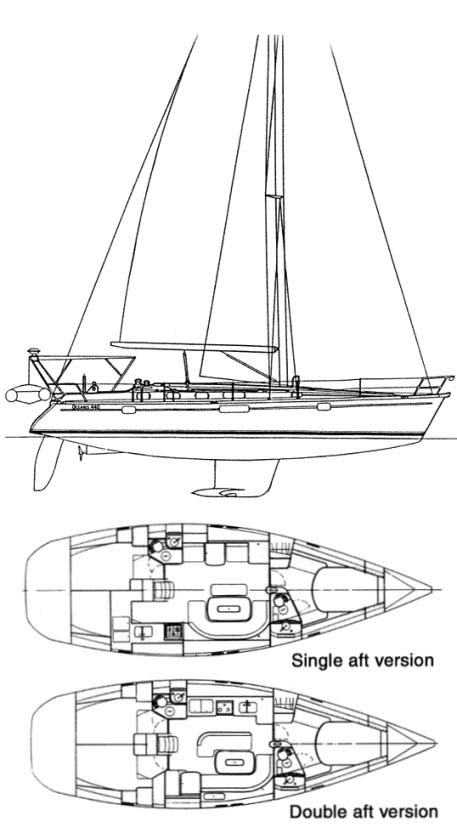
The Beneteau Oceanis 440 is a cruising sailboat designed with long-range comfort and easy handling in mind. Introduced in the mid-1990s by the French shipyard Beneteau and drawn by renowned designer Bruce Farr, the Oceanis 440 belongs to the new wave of performance cruisers that prioritized livability without fully sacrificing sailing efficiency. Aimed at the cruising family or couple seeking bluewater potential with coastal simplicity, the 440 quickly became a favorite among private owners and charter fleets alike.
Today, the model remains popular on the secondhand market, often sought after by cruisers looking for a well-priced, spacious yacht with a solid sailing pedigree. It’s particularly attractive to those considering liveaboard life or extended voyages without the budget for newer production boats.
Design and Construction
The Oceanis 440 features a modern hull with moderate beam and a slightly raked stern. It uses a fin keel with a bulb and a spade rudder, a combination that offers decent lift and maneuverability without excessive draft (5.75 ft), making it suitable for shallow coastal areas. The hull is constructed from fiberglass (FG), using a monolithic layup for strength, while the deck is balsa-cored for rigidity and reduced weight.
Its masthead sloop rig with in-mast furling (in many units) was intended to simplify handling for cruising crews. While this limits sail shape compared to full-batten systems, it prioritizes ease of use—especially for short-handed sailing.
Interior layouts are typically three or four cabins, depending on whether it was built for private use or charter. This flexibility makes the model attractive to both family cruisers and resale in the charter market. The boat’s construction reflects the balance typical of the 90s: robust but simple, with fewer composites and lightweight plastics than found in later models, favoring durability and repairability.
Performance
With a reported sail area of 750 sq ft and a displacement of 23,369 lbs, the Oceanis 440 delivers a Sail Area/Displacement ratio of ~14.7, placing it on the moderate side of the performance-cruising spectrum. It’s not a racer, but it moves steadily in medium airs and maintains decent pace when loaded for cruising.
Her Comfort Ratio of 27.5 and Capsize Screening Factor of 1.96 suggest she’s capable and comfortable offshore. In practical use, owners report good directional stability and forgiving behavior in moderate seas. In higher winds, she can feel underpowered unless equipped with a full-batten mainsail and larger headsail. Compared to similar boats like the Jeanneau Sun Odyssey 45.1 or the Catalina 445, the Oceanis 440 tends to be slightly stiffer and more forgiving, especially when reefed early.
She’s well regarded for her ease of handling, often sailed by couples, and can average over 7 knots under sail when trimmed properly.
Comfort and Accommodations
The interior volume is a standout feature of the Oceanis 440. With a 14 ft beam and well-utilized headroom, the boat offers a bright, open saloon and functional galley, often in a “U” shape for safer cooking underway. The owner’s cabin forward is generous, while aft cabins offer good berth sizes for guests or family. Storage is ample, especially in private layouts.
Ventilation is solid, with numerous hatches and portholes, though original portlight seals may need replacement on older models. Most interiors have aged reasonably well, though charter units may show wear unless upgraded. Many privately-owned boats have been refitted with LED lighting, new upholstery, or upgraded navigation systems.
Overall, the layout supports liveaboard comfort for a couple or small family, and is more than adequate for extended seasonal cruising..
Safety and Practicality
The deck layout is straightforward, with wide side decks, handrails, and molded nonskid, which contribute to safety under way. The cockpit is spacious and includes a fold-down transom/swim platform—innovative at the time—that enhances access to the water or dock.
With its balanced rudder and moderate displacement, the boat is responsive under power, especially when paired with a reliable Volvo or Yanmar diesel. Systems access is generally good, with removable panels around the engine and batteries. Electrical and plumbing are typical of 90s-era boats—functional but possibly in need of modernization.
Thanks to its manageable size, the Oceanis 440 is well-suited to shorthanded sailing, with most controls led aft and a conservative sail plan. For those planning offshore passages, some upgrades may be necessary (e.g., adding storm sails, replacing original standing rigging, or improving ground tackle).
Known Issues with the Beneteau Oceanis 440
Common issues on the Oceanis 440 include:
- Portlight and hatch leaks: Aging seals can lead to water intrusion; many boats have upgraded to Lewmar replacements.
- Deck delamination or soft spots: Often around chainplates or under mast compression post.
- Osmosis: While not widespread, it has been reported in some hulls depending on maintenance history.
- Original electronics: Units from the 1990s (Raymarine, Autohelm) are generally obsolete.
- Rudder bearings: Some owners report play or water intrusion after two decades or more of use.
Typical upgrades include new electronics, solar panels, wind generators, and in some cases, lithium battery systems and bow thrusters for easier docking.ing design, adding solar panels, increasing battery bank capacity, and modernizing navigation systems.
Market Availability and Pricing in the U.S.
The Beneteau Oceanis 440 is no longer in production, and is available only on the used market. It’s most commonly found in Florida, the Chesapeake, and the Pacific Northwest, with ex-charter versions appearing in New England and the Caribbean. Condition varies widely: some boats are well-kept private yachts, others ex-charter refits.
Typical asking prices in the U.S. range from $80,000 to $120,000, depending on condition, upgrades, and engine hours. For buyers, this represents a strong value for a full-size cruiser with offshore potential, often priced below newer but smaller boats.
Below is a comparison with other cruising sailboats of similar size, age, and purpose:
| Model | LOA | Year Built | Typical Price (USD) | Main Differences |
|---|---|---|---|---|
| Beneteau Oceanis 440 | 44.6 ft | 1994–1998 | $80,000–$120,000 | Spacious, easy to sail, great for liveaboard |
| Jeanneau Sun Odyssey 45.1 | 45.1 ft | 1995–2000 | $90,000–$130,000 | Similar layout, slightly faster under sail |
| Catalina 445 | 44.5 ft | 2009–2019 | $210,000–$280,000 | Newer model, modern systems, better resale |
| Hunter Passage 450 | 45.0 ft | 1997–2002 | $100,000–$140,000 | Center cockpit, larger aft cabin, comfort focus |
Conclusion
The Beneteau Oceanis 440 stands out as a practical, comfortable, and affordable bluewater-capable cruiser. Its design strikes a smart balance between ease of handling, interior comfort, and solid sailing performance. While older systems and common maintenance issues are to be expected, the boat remains a smart choice for those looking to cruise on a reasonable budget.
For cruisers prioritizing livability, simplicity, and value, the Oceanis 440 is well worth considering. It won’t win races, but it will take you far in comfort. With the right upgrades, it can serve reliably for years to come—making it a potentially underestimated gem in the mid-size cruiser market.
If you’re looking for a capable cruiser for coastal or offshore use that won’t break the bank—and you’re open to doing some refitting—it’s a boat that offers genuine long-term potential.
Specifications
| Hull Type | Wing Keel |
| Rigging Type | Masthead Sloop |
| LOA | 44.83 ft / 13.66 m |
| LWL | 36.42 ft / 11.10 m |
| Beam | 14.00 ft / 4.27 m |
| Max Draft | 5.75 ft / 1.75 m |
| Displacement | 20,500 lb / 9,299 kg |
| Ballast | 7,055 lb / 3,200 kg |
| Construction | FG (Fiberglass) |
| First Built | 1990 |
| Builder | Beneteau |
| Designer | Bruce Farr |
Auxiliary Power/Tanks | |
| Make | Perkins or Yanmar |
| Type | Diesel |
| Fuel Capacity | 52 gals / 197 L |
| Water Capacity | 120 gals / 454 L |
Sailboat Calculations | |
| S.A. / Displ. | 17.48 |
| Bal. / Displ. | 34.41 |
| Disp. / Len. | 189.45 |
| Comfort Ratio | 24.21 |
| Capsize Screening Formula | 2.05 |
| Stability Index (S#) | 2.86 |
| Hull Speed | 8.09 kn |
| Pounds/Inch Immersion | 1,821.86 lb/inch |
Rig and Sail Particulars | |
| I | 53.15 ft / 16.20 m |
| J | 15.09 ft / 4.60 m |
| P | 47.05 ft / 14.34 m |
| E | 17.06 ft / 5.20 m |
| S.A. Fore | 401.02 ft² / 37.26 m² |
| S.A. Main | 401.34 ft² / 37.29 m² |
| S.A. Total (100% Fore + Main) | 802.36 ft² / 74.54 m² |
| S.A. / Displ. (calculated) | 17.21 |
| Estimated Forestay Length | 55.25 ft / 16.84 m |
Disclaimer
The considerations and analyses presented regarding the Beneteau Oceanis 440 sailboat are of a general nature and are based on the available information and technical data on this model, interpreted to the best of our knowledge and understanding. It is important to note that the specific characteristics of any particular sailboat may vary due to custom modifications, maintenance performed, and conditions of use over time, among other factors. Therefore, the details and performance of the boat you are considering may not exactly match the information provided here.
We strongly recommend that, before making any purchasing or usage decisions, you conduct a detailed inspection of the boat in question, consult with nautical professionals and other sailors, and consider your personal needs, expectations, and capabilities. Each sailboat may have unique particularities that affect its performance and suitability for different types of sailing and sailors.
The information contained in this analysis should be used as a general guide and not as a definitive reference. Professional evaluation and personal inspection are essential to ensure that the boat meets your specific requirements and expectations.