


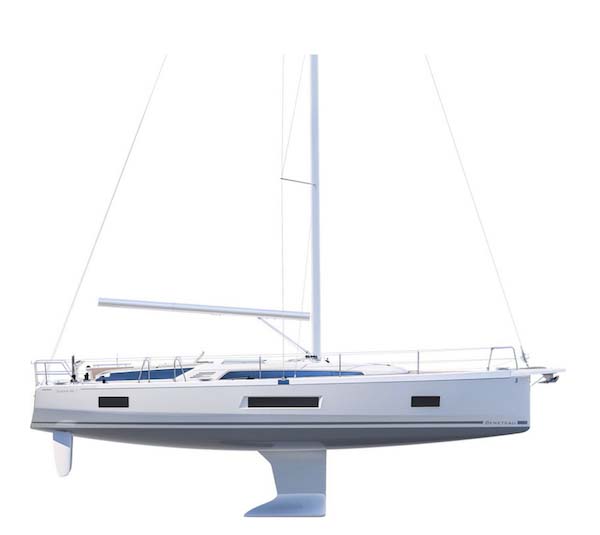
The Beneteau Oceanis 46.1 is a modern cruising sailboat launched in 2018 by the renowned French shipyard Beneteau and designed by the naval architecture firm Berret-Racoupeau. Positioned as a performance cruiser, the 46.1 aims to deliver comfort and volume without compromising sailing capabilities, targeting owners who want a capable long-distance vessel that can also be handled by a couple or small crew.
This model builds upon the success of its predecessor, the Oceanis 45, but introduces a sleeker hull form, wider beam carried aft, and more customization options. Designed primarily for private cruising, it has also gained traction in the charter market due to its versatile layout and modern appeal. On the used boat market, demand is strong among families, weekend cruisers, and sailing schools looking for a newer, more performance-oriented platform with liveaboard potential.
Design and Construction
The hull of the Oceanis 46.1 features a modern plumb bow, a hard chine along the hull sides for added form stability, and a wide transom. The beam of 4.50 meters (14.76 ft) is carried well aft, maximizing interior volume and cockpit space. The keel options include a deep draft fin keel and a shoal version, with a standard cast iron bulb for balance. Steering is managed via twin rudders and dual wheels, allowing excellent control at heel and good feedback under sail.
Rigged as a fractional sloop with an aluminum mast and swept-back spreaders, the 46.1 supports a generous sail area, and is available with a self-tacking jib or a classic genoa setup. An optional furling code zero or asymmetric spinnaker makes it flexible for light-wind cruising.
Construction is primarily fiberglass with an injection-molded deck for weight savings and structural integrity. The deck and hull are joined via glued and fastened flanges, typical of Beneteau’s industrial approach. While this construction isn’t as robust as hand-laid custom builds, it allows for consistent quality and lower maintenance. For most cruisers, the balance between durability, repairability, and cost is well struck, and the resale value remains strong.
Performance
Under sail, the Oceanis 46.1 performs admirably for a cruising yacht of its size. It accelerates quickly in light to moderate winds, thanks to its efficient hull shape and ample sail area (approx. 1050 ft²). In heavier air, the hard chine and twin rudder setup contribute to stability and control, keeping the boat composed under heel. The boat points reasonably well upwind, although not to the level of a performance racer or cruiser-racer hybrid. Off the wind, with a code zero or gennaker, speeds in excess of 8 knots are common.
Compared to similar boats in its class, such as the Jeanneau Sun Odyssey 490 or Catalina 445, the Oceanis 46.1 offers a slightly livelier helm and feels more modern under sail, particularly in light wind coastal cruising scenarios. It’s well-balanced and forgiving, ideal for shorthanded sailing and comfortable for long passages.
Comfort and Accommodations
The interior of the 46.1 is where it truly shines. Designed by Nauta Design, the layout is bright, spacious, and highly customizable. Depending on the owner’s needs, it can be configured with 3 to 5 cabins, making it suitable for a cruising couple, a family, or a small charter operation.
The saloon features large hull windows, a comfortable U-shaped settee, and ample storage. The galley, often located forward of the companionway, is ergonomic and offers generous countertop space. Headroom throughout exceeds 6’5”, and the layout offers good traffic flow, even underway.
Ventilation is effective thanks to numerous opening hatches and ports, and insulation keeps interior temperatures moderate. Owners report that the furniture and fittings age reasonably well, although charter boats may show cosmetic wear faster. The boat can comfortably support life aboard for extended periods, particularly with the optional generator, air conditioning, and solar upgrades.
Safety and Practicality
On deck, the Oceanis 46.1 prioritizes safety and ease of movement. The wide beam allows for spacious side decks and uncluttered lines. The cockpit is deep and well-protected, with solid coamings and space for both lounging and active sailing. A large drop-down swim platform and optional dinghy garage enhance water access and usability at anchor.
Sailing with a small crew is easy: all lines are led aft, and the standard electric winches and bow thruster simplify docking and sail handling. The twin rudders offer strong tracking even when heeled, and the boat’s behavior in rough conditions is predictable and stable.
System accessibility is generally good. The engine compartment has decent access panels, and most routine maintenance items are reachable. Electrical and plumbing runs are neatly organized, which helps keep long-term ownership costs in check.
Known Issues with the Beneteau Oceanis 46.1
As a relatively new model, the Oceanis 46.1 does not suffer from widespread structural issues. However, some owners have reported minor problems such as:
- Leaks at deck hardware due to bedding issues (especially in heavily chartered boats)
- Early wear on factory upholstery in high-use environments
- Inconsistent quality control on woodwork and finish in some production years
- Occasional issues with electrical panel grounding or software glitches in digital systems
Recommended upgrades include:
- Upgrading to lithium batteries and improved solar for extended off-grid capability
- Changing the folding propeller to a feathering model for improved motoring performance
- Reinforcing bimini/dodger structures for heavy-weather use
None of these issues are deal-breakers, but they are worth inspecting closely during a survey.sail, upgrading the house battery bank, or retrofitting solar panels and a watermaker for longer passages.
Market Availability and Pricing in the U.S.
The Oceanis 46.1 is still in production and widely available both new and on the secondhand market. In the U.S., listings are most common in Florida, Southern California, and the Chesapeake Bay, with some ex-charter versions appearing from the Caribbean.
As of 2025, used models (2019–2023) typically range from $330,000 to $460,000, depending on condition, equipment, and layout. Well-equipped private boats command a premium, while ex-charter models are often priced 10–15% lower but may require cosmetic updates.
Compared to similarly sized and purposed models, the Oceanis 46.1 offers a compelling value proposition, especially in the lightly used private-owner segment.
| Model | LOA | Year Built | Typical Used Price (USD) | Notable Differences |
|---|---|---|---|---|
| Beneteau Oceanis 46.1 | 47.9 ft | 2018–Present | $330,000–$460,000 | Modern hull, twin rudders, performance options |
| Jeanneau Sun Odyssey 490 | 47.3 ft | 2018–Present | $310,000–$440,000 | Walk-around decks, slightly more volume |
| Catalina 445 | 44.7 ft | 2010–2021 | $280,000–$350,000 | Traditional layout, excellent build quality |
| Hanse 458 | 45.2 ft | 2018–2022 | $320,000–$420,000 | Straight-line design, self-tacking rig standard |
Conclusion
The Beneteau Oceanis 46.1 strikes an admirable balance between modern design, practical cruising features, and enjoyable sailing performance. It’s a solid choice for families, couples, or small groups looking for a boat capable of extended cruising without stepping into the complexity and cost of true bluewater yachts.
While it doesn’t offer the tankage or build strength for heavy offshore passage-making without some upgrades, it excels in the coastal and near-ocean cruising niche. For those seeking a stylish, fast, and comfortable platform with strong resale value and global dealer support, the Oceanis 46.1 is absolutely worth considering.
If you’re evaluating boats in the 45–50 ft segment, the Oceanis 46.1 stands out as a forward-thinking, user-friendly, and relatively low-maintenance option with growing popularity on the resale market.
Specifications
| Hull Type | Fin w/bulb & dual rudders |
|---|---|
| Rigging Type | Fractional Sloop |
| LOA | 47.90 ft / 14.60 m |
| LWL | 43.44 ft / 13.24 m |
| Beam | 14.76 ft / 4.50 m |
| Draft (Max) | 7.71 ft / 2.35 m |
| Displacement | 23,362.00 lb / 10,597 kg |
| Ballast | 6,030.00 lb / 2,735 kg |
| Ballast Type | Cast Iron |
| Construction | Monolithic polyester contact hull |
| First Built | 2017 |
| Builder | Beneteau (FRA) |
| Designer | Pascal Conq |
| Engine Make | Yanmar |
| Engine Type | Diesel |
| Engine HP | 57 |
| Fuel Capacity | 53 gals / 200 L |
| Water Capacity | 98 gals / 370 L |
| Sail Area (Reported) | 953.68 ft² / 88.60 m² |
| S.A. Fore | 543.61 ft² / 50.50 m² |
| S.A. Main | 502.01 ft² / 46.64 m² |
| S.A. Total (100% Fore + Main) | 1,045.62 ft² / 97.14 m² |
| S.A./Displ. (calc.) | 20.55 |
| S.A./Displ. (reported) | 18.75 |
| Bal./Displ. | 25.81 |
| Disp./Len. | 127.23 |
| Comfort Ratio | 22.37 |
| Capsize Screening Formula | 2.07 |
| Stability Index (S#) | 4.26 |
| Hull Speed | 8.83 kn |
| Pounds/Inch Immersion | 2,290.99 pounds/inch |
| I | 58.14 ft / 17.72 m |
| J | 18.70 ft / 5.70 m |
| P | 54.36 ft / 16.57 m |
| E | 18.47 ft / 5.63 m |
| Estimated Forestay Length | 61.07 ft / 18.61 m |
| Mast Height from DWL | 66.63 ft / 20.31 m |
Disclaimer
The considerations and analyses presented regarding the Beneteau Oceanis 46.1 sailboat are of a general nature and are based on the available information and technical data on this model, interpreted to the best of our knowledge and understanding. It is important to note that the specific characteristics of any particular sailboat may vary due to custom modifications, maintenance performed, and conditions of use over time, among other factors. Therefore, the details and performance of the boat you are considering may not exactly match the information provided here.
We strongly recommend that, before making any purchasing or usage decisions, you conduct a detailed inspection of the boat in question, consult with nautical professionals and other sailors, and consider your personal needs, expectations, and capabilities. Each sailboat may have unique particularities that affect its performance and suitability for different types of sailing and sailors.
The information contained in this analysis should be used as a general guide and not as a definitive reference. Professional evaluation and personal inspection are essential to ensure that the boat meets your specific requirements and expectations.