


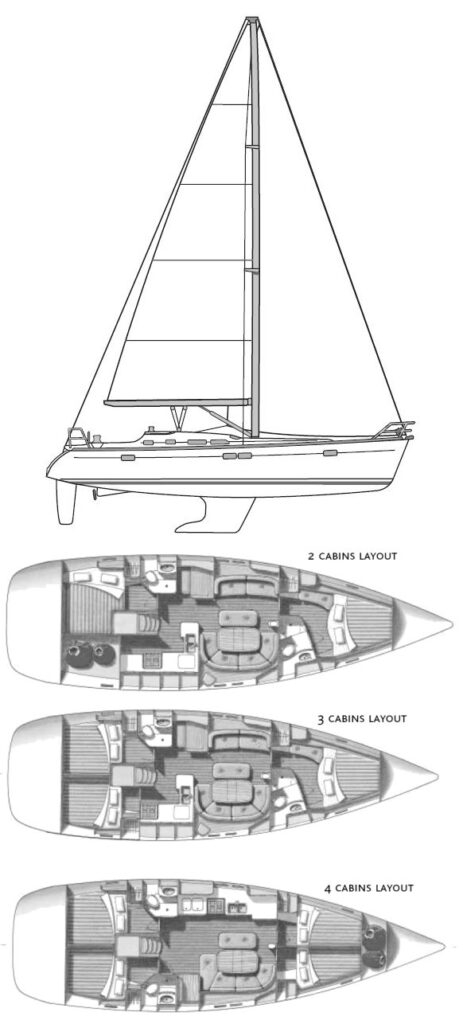
The Beneteau Oceanis 473 is a cruising sailboat that strikes a thoughtful balance between offshore capability and onboard comfort, designed for sailors who prioritize liveability without giving up reliable sailing performance. Launched in the early 2000s by the French shipyard Beneteau and designed by the renowned Groupe Finot (now Finot-Conq), this model was aimed at the serious cruising market—ideal for couples, families, or small crews looking to cover coastal and offshore miles in comfort. Its generous interior space and easy handling quickly made it popular among private owners and charter companies alike.
Although production has ended, the Oceanis 473 remains highly sought-after on the secondhand market. It’s especially appealing to bluewater-minded cruisers, sailing schools, and charter operators looking for a spacious, robust platform with a proven track record.
Design and Construction
The Oceanis 473 features a moderate displacement hull with a relatively beamy design (around 14 feet), a fin keel (with shoal and deep options), and a spade rudder. This hull form contributes to good initial stability and abundant interior volume, key priorities in cruising design. The hull and deck are constructed from fiberglass with balsa core in the deck for weight savings and insulation. The build quality is typical of Beneteau’s production methods of the time—reliable, though not luxurious—with molded liners and accessible service panels.
Its rig is a conventional masthead sloop with swept-back spreaders and a large genoa, favoring simplicity and ease of handling over performance complexity. The moderate sail plan keeps loads manageable, even for shorthanded crews. Deck layout is clean and ergonomic, with wide side decks and a spacious cockpit well protected by coamings and optional dodger/bimini combinations.
From a naval architecture perspective, the hull’s form stability, moderate overhangs, and balanced rig make it forgiving and predictable, with an emphasis on comfort at anchor and while under sail rather than sporty responsiveness. Its fiberglass layup makes repairs straightforward and contributes to decent long-term durability when maintained properly.
Performance
Under sail, the Oceanis 473 offers respectable cruising performance. It’s not a racer, but it’s certainly no slug. The boat performs best in moderate wind conditions (10–20 knots), where it comfortably reaches 6–8 knots on a reach. Upwind ability is acceptable for a cruising boat of its class, though pointing angles are wider compared to performance cruisers.
In heavier seas, its weight and hull shape deliver a solid ride, and it handles downwind with confidence. While not particularly light on the helm, the spade rudder ensures good responsiveness, and autopilot use is typically reliable. Compared to contemporaries like the Hunter 466 or Catalina 470, it feels more composed in a blow and is better suited for offshore passages.
Owners praise it for being easy to handle with a small crew, thanks to features like in-mast furling (on some versions), electric winches, and sensible deck gear. It’s not unusual to hear it described as “cruiser-friendly” and “low-stress,” especially for sailors transitioning from smaller coastal boats.
Comfort and Accommodations
Interior volume is one of the Oceanis 473’s standout features. Offered in 2-, 3-, and 4-cabin configurations, its layout flexibility allows for tailored use—be it long-term cruising as a couple or operating as a charter boat with multiple guests. The salon is bright and inviting, with ample seating, a large dining table, and generous headroom. The galley is L-shaped and well-equipped, with good counter space, a double sink, and accessible refrigeration.
Cabins are well-proportioned, especially the owner’s stateroom forward in the 2-cabin version, which includes an ensuite head with separate shower stall. Ventilation is generally good, with multiple opening hatches and ports, though like many boats of its era, tropical airflow can be a limitation in hotter climates without added fans or air conditioning.
Storage throughout is ample for extended cruising. Upholstery and cabinetry materials are utilitarian rather than opulent, and while many interiors hold up well, refits and upgrades (cushions, lighting, veneers) are common in models over 15 years old.
Safety and Practicality
Safety on deck is well addressed: wide sidedecks with molded nonskid, good handholds, and a deep cockpit with high coamings offer security in rougher conditions. Twin wheels provide excellent visibility when docking or maneuvering under power. The transom opens to a swim platform, which eases dinghy access and man-overboard recovery.
The layout supports shorthanded sailing, and many systems—winches, furlers, and mainsail controls—are within reach from the helm. Systems access is decent: engine service points are reachable through the companionway steps, and major systems (plumbing, wiring) are serviceable with some disassembly.
The boat is suitable for both coastal and offshore cruising, and many owners have completed ocean crossings with minimal modifications. For bluewater use, common upgrades include storm sails, solar arrays, and reinforced rigging. It’s built to Category A (Ocean) CE standards, giving confidence for extended voyaging.
Known Issues with the Beneteau Oceanis 473
While generally considered reliable, the Oceanis 473 has a few recurring issues:
- Deck hardware leaks: Over time, chainplates and deck fittings may leak if not properly rebedded, especially in humid climates.
- Rudder post corrosion: Some early models showed signs of galvanic corrosion around the rudder post bearings.
- Electronics: Original navigation systems are often outdated. Most owners opt for full electronics upgrades, including chartplotters, autopilot, and radar.
- Engine access: Though reachable, deeper engine repairs may require significant disassembly. Some owners report difficulties replacing exhaust elbows and accessing the saildrive.
- Osmosis: Not widespread, but any hull from this era should be surveyed for moisture intrusion.
Upgrades often seen in well-kept models include feathering props, lithium battery systems, and reinforced mainsheet traveler setups. These not only enhance usability but also improve resale value.
Market Availability and Pricing in the U.S.
The Oceanis 473 is no longer in production, but it remains widely available on the U.S. used boat market, especially in cruising hubs like Florida, the Chesapeake Bay, and California. Many were ex-charter boats, particularly from the Caribbean, and may require more thorough inspections. However, a good number of privately owned, well-maintained models exist and are often updated with modern cruising gear.
Typical asking prices range from $120,000 to $180,000, depending on condition, refit status, and layout. This puts it in competitive territory for buyers seeking a large-volume cruiser under $200K. Compared to similarly sized boats, it offers excellent value per foot.
Here’s a comparison with other models from the same era and purpose:
| Model | LOA | Year | Typical Price (USD) | Notable Differences |
|---|---|---|---|---|
| Beneteau Oceanis 473 | 46’11” | 2001–2005 | $120,000–$180,000 | Spacious, cruiser-focused, popular in charter fleets |
| Catalina 470 | 47’7″ | 1998–2007 | $130,000–$190,000 | Heavier, more traditional, strong U.S. support |
| Hunter 466 | 46’1″ | 2002–2006 | $110,000–$160,000 | Innovative interiors, B&R rig, easier singlehanding |
| Jeanneau Sun Odyssey 49 | 49’1″ | 2003–2007 | $140,000–$200,000 | Performance edge, sleeker lines, quality finish |
Conclusion
The Beneteau Oceanis 473 remains a compelling option for sailors seeking a roomy, capable cruiser without venturing into custom or luxury yacht territory. Its generous interior, manageable sailing characteristics, and robust construction make it ideal for couples and families planning extended coastal cruising or even bluewater passages with sensible upgrades.
While some models may need updates or show their age, the boat holds its value well and offers excellent comfort at anchor or under way. For buyers evaluating whether it’s worth seeking out: yes—if you’re looking for a proven cruiser with ample space and a friendly price tag, the Oceanis 473 is one of the most underappreciated production boats in its size class.
Specifications
| Hull Type | Fin w/bulb & spade rudder |
| Rigging Type | Masthead Sloop |
| LOA | 46.92 ft / 14.30 m |
| LWL | 43.83 ft / 13.36 m |
| Beam | 14.16 ft / 4.32 m |
| Draft (Max) | 5.58 ft / 1.70 m |
| Displacement | 24,277 lb / 11,012 kg |
| Ballast | 8,157 lb / 3,700 kg (Iron) |
| Construction | Fiberglass (FG) |
| Designer | Groupe Finot |
| Builder | Beneteau |
| First Built | 2000 |
| Last Built | 2005 |
| Auxiliary Power | Diesel |
| Fuel Capacity | 57 gal / 216 L |
| Water Capacity | 222 gal / 840 L |
| Hull Speed | 8.87 knots |
| Pounds/Inch Immersion | 2,217.59 lb/in |
| Sail Area (Total) | 898.3 ft² / 83.45 m² |
| S.A./Displ. Ratio | 17.21 |
| Ballast/Displ. Ratio | 33.60% |
| Comfort Ratio | 24.58 |
| Capsize Screening Formula | 1.96 |
| Displ./Length Ratio | 128.72 |
| S# (Stability Index) | 3.73 |
| Rig Dimensions (I / J / P / E) |
I: 53.83 ft / 16.41 m J: 18.25 ft / 5.56 m P: 47.67 ft / 14.53 m E: 17.08 ft / 5.21 m |
| Sail Area – Foretriangle | 491.20 ft² / 45.63 m² |
| Sail Area – Mainsail | 407.10 ft² / 37.82 m² |
| Estimated Forestay Length | 56.84 ft / 17.32 m |
Disclaimer
The considerations and analyses presented regarding the Beneteau Oceanis 473 sailboat are of a general nature and are based on the available information and technical data on this model, interpreted to the best of our knowledge and understanding. It is important to note that the specific characteristics of any particular sailboat may vary due to custom modifications, maintenance performed, and conditions of use over time, among other factors. Therefore, the details and performance of the boat you are considering may not exactly match the information provided here.
We strongly recommend that, before making any purchasing or usage decisions, you conduct a detailed inspection of the boat in question, consult with nautical professionals and other sailors, and consider your personal needs, expectations, and capabilities. Each sailboat may have unique particularities that affect its performance and suitability for different types of sailing and sailors.
The information contained in this analysis should be used as a general guide and not as a definitive reference. Professional evaluation and personal inspection are essential to ensure that the boat meets your specific requirements and expectations.