


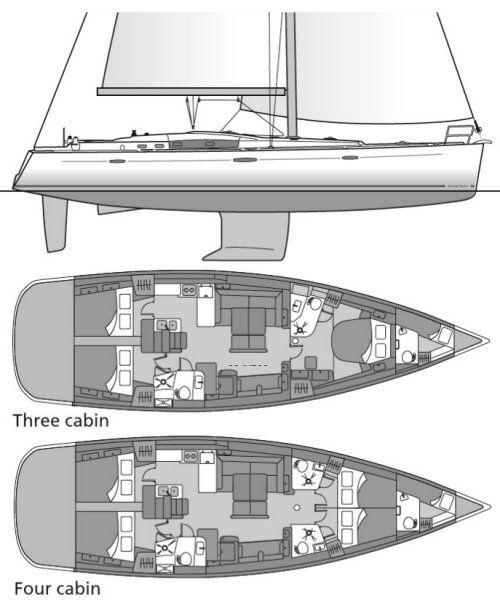
The Beneteau Oceanis 54 was introduced in the late 2000s as part of Beneteau’s effort to merge performance cruising with luxury comfort, targeting experienced sailors seeking a capable long-distance cruiser without sacrificing interior livability. Designed by Berret-Racoupeau and built by Beneteau in France, the Oceanis 54 was conceived primarily for bluewater cruising with a strong emphasis on modern aesthetics and charter-ready functionality. Its generous volume, ease of handling, and smart systems made it popular not only among private owners but also in the charter market—particularly in the Mediterranean and Caribbean. On the secondhand market, the Oceanis 54 maintains steady demand, especially among cruising couples, sailing schools offering offshore training, and liveaboard families seeking a ready-to-sail platform.
Design and Construction
The Oceanis 54 features a modern hull design with a moderate displacement and a pronounced beam carried well aft, maximizing interior volume. The hull is fiberglass-reinforced plastic (FRP) with a balsa-cored deck for weight savings and rigidity. A deep fin keel with a bulb improves righting moment, while a balanced spade rudder provides precise steering and maneuverability.
Rigged as a masthead sloop with a large mainsail and genoa configuration, the boat benefits from a relatively simple and proven sail plan. The deck layout includes in-mast furling on many models and all lines led aft to the cockpit, enhancing single- or shorthanded sailing capabilities. These construction and rigging choices reflect a balance between durability, performance, and ease of maintenance—important for long-term ownership, especially in remote cruising areas.
Naval architecture principles applied in the Oceanis 54 prioritize comfort over maximum speed, with a Displacement/Length ratio in the moderate range and a Ballast/Displacement ratio around 33–35%, offering a solid compromise between stiffness and weight. This translates into a hull that is robust, easily repairable with standard materials, and with decent long-term resale value thanks to the brand’s widespread dealer network.
Performance
Under sail, the Oceanis 54 delivers respectable performance for a cruiser of its size and purpose. With a sail area of roughly 1,360 sq ft and a hull speed of just over 9 knots, it handles well in moderate breezes and maintains speed effectively on a reach. While not a racer, it tracks well to windward and doesn’t shy away from 6- to 8-foot seas. It performs better in beam and broad reaches, where the large genoa and ample waterline length allow it to cruise comfortably at 7–8 knots.
Compared to similarly sized boats like the Jeanneau 53 or the Hunter 50CC, the Oceanis 54 is more performance-oriented in its hull shape and weight distribution, though it may lack the hull stiffness and tankage of some bluewater-optimized yachts like the Amel 54. Still, it has earned a reputation among owners for its reliability offshore, with many documented passages across the Atlantic and in the Pacific.
Comfort and Accommodations
The interior of the Oceanis 54 is one of its strongest selling points. Offered in multiple layouts (typically three or four cabins), the boat can be tailored to both private cruising and charter applications. A central saloon with abundant natural light, thanks to overhead hatches and hull ports, gives an open, airy feel. The galley is L-shaped and well equipped for offshore use, and the navigation station is large enough for serious passage planning.
Cabins are spacious, with queen or double berths, ample headroom, and multiple heads (often electric), which makes the boat suitable for liveaboards or extended family cruising. Storage is abundant in both the cabins and galley, and ventilation is good thanks to numerous opening hatches and vents.
The interior finish, typically in light or dark Alpi wood, holds up well with regular maintenance, though charter models may show more wear. It’s common to find private boats with tasteful upgrades to upholstery, lighting, and electronics.
Safety and Practicality
On deck, the wide beam and twin wheel layout provide excellent movement in the cockpit, with high coamings offering protection under way. The walk-through transom and electric swim platform make water access easy, while high lifelines and molded non-skid provide good footing in heavy weather.
The boat is well-suited to shorthanded sailing, with all halyards and sheets led to the cockpit and many models equipped with electric winches and bow thrusters. System accessibility is good, with dedicated engine access and decent service points for the generator, watermaker (if installed), and electronics—though reaching some plumbing runs can be tight, as in many production cruisers.
The Oceanis 54 is generally considered suitable for offshore passages with minor upgrades (like additional tankage, heavier ground tackle, or storm sails), making it a practical platform for both coastal and bluewater cruising.
Known Issues with the Beneteau Oceanis 54
While the Oceanis 54 is generally well-built, a few common issues have emerged over the years. Some owners report minor deck flexing near the mast step due to localized compression, especially in early models—best addressed through inspection and, if needed, reinforcement.
Like many boats with balsa-cored decks, water intrusion from poorly sealed hardware (especially in the cockpit area and under stanchions) can lead to core delamination if not promptly addressed. Osmosis is not widespread but may occur in hulls left in tropical waters without bottom maintenance.
The original electronics packages (Raymarine or Simrad) are often outdated by today’s standards, and many owners choose to upgrade to modern NMEA 2000 systems. Propeller upgrades (e.g., folding or feathering props) are also common to improve sailing performance under sail types for performance), electronics replacements, and additions like solar arch installations.
Market Availability and Pricing in the U.S.
The Oceanis 54 is no longer in production, having been succeeded by the Oceanis 55 and 55.1. On the U.S. secondhand market, it is most frequently found in Florida, the Chesapeake Bay, and Southern California, often as ex-charter boats or owner-kept vessels imported from the Caribbean.
Pricing typically ranges from $240,000 to $330,000 USD depending on condition, year, equipment, and layout. Well-maintained, privately owned models fetch a premium, while former charter vessels with cosmetic wear may be priced lower but offer good value with post-charter refits.
Compared to similar models like the Jeanneau 53, Catalina 470, or Bavaria 55 Cruiser, the Oceanis 54 is competitively priced and often offers better volume and resale appeal, particularly due to Beneteau’s global brand support and parts availability.
Here’s a comparative table of similar sailboats on the U.S. used market:
| Model | LOA | Year Built | Typical Price (USD) | Key Differences |
|---|---|---|---|---|
| Beneteau Oceanis 54 | 54 ft | 2008–2012 | $240,000–$330,000 | Great volume, comfortable cruiser, good value in resale |
| Jeanneau 53 | 52.7 ft | 2010–2015 | $280,000–$370,000 | Sleeker lines, more modern interior, slightly faster |
| Catalina 470 | 47 ft | 2000–2008 | $180,000–$240,000 | Solid U.S. build, less volume, better for DIY maintenance |
| Bavaria Cruiser 55 | 53.7 ft | 2009–2014 | $220,000–$310,000 | More European styling, spacious, but less brand support in U.S. |
Conclusion
The Beneteau Oceanis 54 stands out as a well-balanced cruiser that successfully bridges the gap between performance, comfort, and affordability. Its spacious layout, reliable sailing behavior, and support from a major global builder make it an excellent choice for long-term cruisers, liveaboards, or those seeking a capable yacht for occasional offshore passages.
While it may not be a purist’s bluewater tank, it offers significant real-world value—particularly when well maintained and sensibly upgraded. For buyers looking for a modern 50+ foot sailboat without jumping into the price bracket of custom or semi-custom builds, the Oceanis 54 is absolutely worth considering. Its strong resale value and versatility ensure it remains a relevant and attractive option on the brokerage market today.
Specifications
| Hull Type | Fin Keel w/ bulb |
| Rigging Type | Fractional Sloop |
| LOA | 54.75 ft / 16.69 m |
| LWL | 49.17 ft / 14.99 m |
| Beam | 16.08 ft / 4.90 m |
| Displacement | 31,574 lb / 14,322 kg |
| Ballast | 11,000 lb / 4,990 kg |
| Max Draft | 7.58 ft / 2.31 m |
| Construction | Fiberglass (FG) |
| First Built | 2008 |
| Builder | Beneteau |
| Designer | Berret Racoupeau |
| Auxiliary Power | Yanmar 4JH4HTE, 110 HP Diesel |
| Fuel Capacity | 125 gals / 473 L |
| Water Capacity | 256 gals / 969 L |
| Sail Area (Reported) | 1,329.00 ft² / 123.47 m² |
| S.A. / Displ. | 21.37 |
| Bal. / Displ. | 34.84 |
| Disp. / Len. | 118.57 |
| Comfort Ratio | 23.76 |
| Capsize Screening Formula | 2.04 |
| S# | 4.55 |
| Hull Speed | 9.40 kn |
| Pounds/Inch Immersion | 2,825.09 lb/in |
| I | 64.00 ft / 19.51 m |
| J | 21.25 ft / 6.48 m |
| P | 62.33 ft / 19.00 m |
| E | 20.83 ft / 6.35 m |
| S.A. Fore | 680.00 ft² / 63.17 m² |
| S.A. Main | 649.17 ft² / 60.31 m² |
| Total Sail Area (100% Triangles) | 1,329.17 ft² / 123.48 m² |
| S.A./Displ. (calc.) | 21.38 |
| Est. Forestay Length | 67.44 ft / 20.56 m |
| Mast Height from DWL | 75.42 ft / 22.99 m |
Disclaimer
The considerations and analyses presented regarding the Beneteau Oceanis 54 sailboat are of a general nature and are based on the available information and technical data on this model, interpreted to the best of our knowledge and understanding. It is important to note that the specific characteristics of any particular sailboat may vary due to custom modifications, maintenance performed, and conditions of use over time, among other factors. Therefore, the details and performance of the boat you are considering may not exactly match the information provided here.
We strongly recommend that, before making any purchasing or usage decisions, you conduct a detailed inspection of the boat in question, consult with nautical professionals and other sailors, and consider your personal needs, expectations, and capabilities. Each sailboat may have unique particularities that affect its performance and suitability for different types of sailing and sailors.
The information contained in this analysis should be used as a general guide and not as a definitive reference. Professional evaluation and personal inspection are essential to ensure that the boat meets your specific requirements and expectations.