


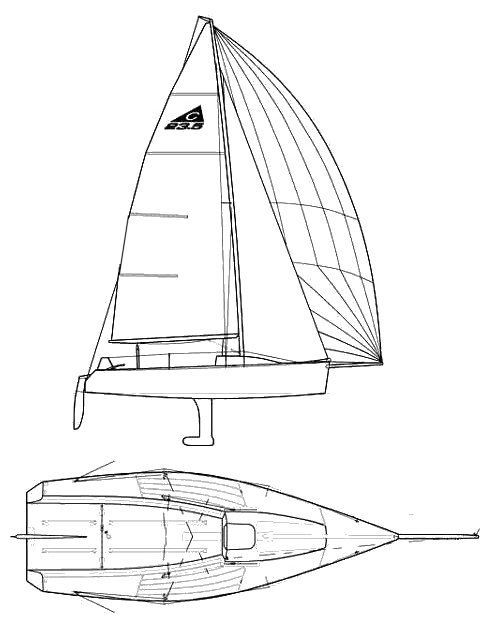
The Catalina Capri 23.5 is a trailerable pocket cruiser designed primarily for coastal cruising and weekend getaways. Launched in the early 1990s by Catalina Yachts—one of the most reputable American boatbuilders—the Capri 23.5 was created to appeal to sailors looking for a manageable, family-friendly sailboat that could offer genuine sailing performance without the complexity or expense of larger yachts. Designed by Gerry Douglas, the model aimed to balance simplicity with comfort, offering trailerability, ease of handling, and enough accommodations for a small crew.
Today, the Capri 23.5 enjoys a modest but steady presence on the second-hand market. Its affordability and manageable size make it particularly attractive to first-time buyers, sailing schools, and cruising couples. While it’s not a common choice for charter fleets, it is favored by private owners looking for a low-maintenance cruiser with enough charm to spend a few nights aboard.
Design and Construction
The hull of the Capri 23.5 features a moderately wide beam and a flat-bottomed underbody, which contributes to form stability and makes the boat feel larger than its dimensions suggest. One of its defining features is the water ballast system, which keeps the boat light enough for trailering while still offering sufficient righting moment under sail. The swing keel (centerboard) enhances shallow water access and ramp launching, though it requires periodic inspection and maintenance.
The rudder is a transom-mounted kick-up type—ideal for beaching or shallow cruising—but it can flex under load and may need reinforcement in heavy air. The Capri 23.5 is rigged as a fractional sloop, with a simple deck-stepped mast and minimal standing rigging. This configuration reduces weight aloft and enhances ease of sail handling, particularly beneficial for short-handed crews.
Construction is predominantly hand-laid fiberglass with marine plywood coring in key structural areas. While robust for a boat this size, owners should be mindful of potential water intrusion in older models, especially in the chainplate and deck hardware areas. The boat’s light displacement and ballast-to-displacement ratio reflect its design for protected coastal waters rather than offshore endurance.
Performance
Under sail, the Capri 23.5 offers lively performance in light to moderate winds. Thanks to its fractional rig and light weight, it accelerates quickly and responds well to trim. In 8–15 knots of breeze, it sails efficiently and provides a satisfying helm feel, especially when well-trimmed. However, in heavier conditions or choppy seas, the boat’s limited displacement and high freeboard can result in pounding and weather helm, requiring reefing earlier than on heavier displacement cruisers.
Upwind, the boat points reasonably well for a shoal-draft cruiser, though not as tightly as deeper-keeled alternatives. Downwind and reaching, its lightness can make for a playful ride, but sailors should be cautious with sail area in gusty conditions. Compared to peers like the Hunter 23.5 or the Precision 23, the Catalina Capri 23.5 is considered slightly stiffer and more responsive. It’s praised in owner circles for its enjoyable day-sailing characteristics and forgiving nature—an excellent learning platform without sacrificing fun.
Comfort and Accommodations
Despite its compact size, the interior of the Capri 23.5 is cleverly laid out. The cabin offers sleeping space for up to four with a V-berth forward and two quarter berths aft, though realistically, it’s best suited for two adults and perhaps a child or two. Headroom is limited, as expected, but large windows and good ventilation mitigate the sense of confinement.
The small galley area includes space for a portable stove, a sink, and modest storage. There is typically a chemical head tucked under the V-berth or in a concealed compartment. The fit and finish reflect the boat’s original mid-market intent—functional but not luxurious. Storage is sufficient for weekend cruising, and the large pop-top (in some models) greatly improves airflow and livability at anchor.
Most boats on the market show interior aging typical of early ‘90s models: worn upholstery, faded wood veneer, and basic lighting. Refits are common, and some owners have successfully modernized the cabin with LED lighting, upgraded cushions, or solar setups for longer autonomy.
Safety and Practicality
Safety features on deck include sturdy stainless steel lifelines, a non-skid deck surface, and easy-to-grab handholds. The cockpit is deep and secure, with seating for four adults, and access to the outboard engine is straightforward from the stern. While not designed for offshore use, the Capri 23.5 performs well in coastal cruising conditions and is especially manageable with a small crew or even solo.
The water ballast system allows for lighter trailering, but it requires careful filling and draining to ensure stability under sail. Some owners report valve maintenance as a periodic concern. Control lines are led aft, and sail handling is uncomplicated, with a small headsail and simple reefing system. Visibility is excellent from the helm, and the transom ladder eases water access when anchored.
Systems are rudimentary, which keeps maintenance costs low. Access to batteries, tanks, and rigging hardware is relatively easy—ideal for DIY-oriented sailors. The design encourages independence and minimizes marina dependence, enhancing its appeal to budget-conscious cruisers.
Known Issues with the Catalina Capri 23.5
Several recurring issues are noted in owner forums and maintenance logs. The most commonly reported include:
- Water intrusion in deck fittings and chainplates due to aging sealants
- Corrosion or wear in the swing keel cable and pulley system
- Delamination in cockpit sole or rudder blade in neglected boats
- Mildew or odor issues in cabins with poor ventilation or leaks
- Outboard bracket fatigue from vibration or engine weight
Recommended upgrades include installing a reinforced rudder system, resealing or rebedding deck hardware, switching to LED cabin lighting, and upgrading the outboard for better reliability and fuel economy. Some owners have added small solar panels or shore power systems to extend overnight autonomy.
Market Availability and Pricing in the U.S.
The Catalina Capri 23.5 is no longer in production and is only available on the used market. It is most commonly found in regions with active trailer-sailor communities such as the Pacific Northwest, Great Lakes, Florida, and inland lakes across the Midwest.
Condition varies widely—some are meticulously maintained with new rigging and electronics, while others show signs of long-term storage or neglect. Prices range between $6,000 and $12,000, depending on condition, included equipment (e.g., trailer, motor, sails), and upgrades.
Compared to similar-sized boats, the Capri 23.5 offers excellent value. It often competes with models like the Hunter 23.5, MacGregor 26, and Precision 23.
Below is a comparison with similar sailboats from the same era:
| Model | LOA | Year | Typical Price (USD) | Notable Differences |
|---|---|---|---|---|
| Catalina Capri 23.5 | 23.5 ft | 1990–1997 | $6,000–$12,000 | Water ballast, pop-top, robust build quality |
| Hunter 23.5 | 23.5 ft | 1992–1997 | $5,500–$11,000 | More modern interior, similar ballast system |
| MacGregor 26 | 25.9 ft | 1990–2002 | $8,000–$15,000 | Hybrid motor-sailer, high cabin volume |
| Precision 23 | 23 ft | 1986–2005 | $7,000–$13,000 | Fixed keel or swing keel, stiffer upwind |
Conclusion
The Catalina Capri 23.5 stands out as a well-conceived coastal cruiser for those seeking simplicity, affordability, and weekend adventure in a compact package. Its strengths lie in ease of trailering, low maintenance, and a layout that encourages spontaneous sailing with minimal fuss.
For buyers seeking offshore capability or luxurious accommodations, it may fall short. But for families, couples, or new sailors looking to build experience and enjoy relaxed cruising on lakes, bays, and near-coastal waters, it offers excellent value. Its active owner community, availability of spare parts, and stable resale value make it a smart entry point into the sailing lifestyle.
If you’re evaluating a used Capri 23.5, it’s worth seeking out a well-kept example. As a practical, underappreciated cruiser in the sub-24-foot category, it continues to punch above its weight in the world of affordable sailing.
Specifications
| Hull Type | Fin w/bulb & spade rudder |
|---|---|
| Rigging Type | Fractional Sloop |
| LOA (Length Overall) | 23.50 ft / 7.16 m |
| LWL (Length at Waterline) | 23.00 ft / 7.01 m |
| Sail Area (reported) | 303.00 ft² / 28.15 m² |
| Beam | 8.25 ft / 2.51 m |
| Displacement | 1,800 lb / 816 kg |
| Ballast | 700 lb / 318 kg |
| Ballast Type | Lead |
| Maximum Draft | 5.00 ft / 1.52 m |
| Construction | Fiberglass/Composite |
| First Built | 1996 |
| Last Built | 2000 |
| Builder | Catalina Yachts (USA) |
| S.A. / Displ. | 32.84 |
| Bal. / Displ. | 38.89 |
| Displ. / LWL | 66.05 |
| Comfort Ratio | 7.23 |
| Capsize Screening Formula | 2.72 |
| Hull Speed | 6.43 knots |
| Pounds/Inch Immersion | 678.00 lb/in |
Disclaimer
The considerations and analyses presented regarding the Catalina Capri 23.5 sailboat are of a general nature and are based on the available information and technical data on this model, interpreted to the best of our knowledge and understanding. It is important to note that the specific characteristics of any particular sailboat may vary due to custom modifications, maintenance performed, and conditions of use over time, among other factors. Therefore, the details and performance of the boat you are considering may not exactly match the information provided here.
We strongly recommend that, before making any purchasing or usage decisions, you conduct a detailed inspection of the boat in question, consult with nautical professionals and other sailors, and consider your personal needs, expectations, and capabilities. Each sailboat may have unique particularities that affect its performance and suitability for different types of sailing and sailors.
The information contained in this analysis should be used as a general guide and not as a definitive reference. Professional evaluation and personal inspection are essential to ensure that the boat meets your specific requirements and expectations.