


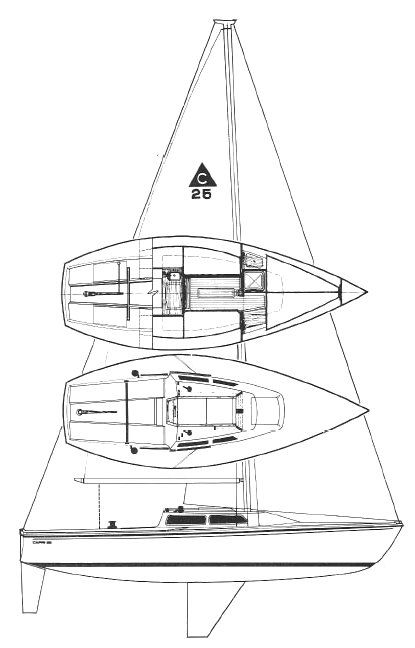
The Catalina Capri 25 was introduced in the early 1980s by Catalina Yachts, a California-based builder renowned for producing affordable, user-friendly sailboats for recreational sailors. Designed primarily as a performance cruiser, the Capri 25 occupies a hybrid space between club-level racing and weekend cruising. Targeted at sailors seeking a trailerable keelboat with spirited performance and modest accommodations, the model gained popularity quickly due to its versatility and value.
Although production ceased in the late 1980s, the Capri 25 has remained a favorite in the used market. It’s particularly attractive to individual owners and sailing clubs looking for a responsive boat that doesn’t require deep pockets to maintain or operate. Interest remains steady among coastal cruisers, entry-level racers, and sailing schools that appreciate its forgiving handling and straightforward systems.
Design and Construction
The hull of the Capri 25 features a fin keel and spade rudder configuration, a common choice in performance-oriented cruisers. Its clean underwater lines and relatively light displacement promote planing tendencies in strong winds and quick acceleration. A shoal draft wing keel version also exists, broadening its appeal to sailors in shallow bays or lakes.
The fractional sloop rig, combined with a deck-stepped mast, simplifies sail handling and allows efficient upwind performance with reduced sail area aloft—an asset in gusty conditions. Construction relies on hand-laid fiberglass with plywood core reinforcement in deck areas. While not overbuilt, the hull is sturdy enough for coastal use and trailer sailing.
Design choices favor low-cost maintenance. The deck layout is clean, and systems are minimalistic, which reduces potential failure points. These boats were built during an era where simplicity met durability—a factor that contributes to the Capri 25’s long-standing presence in U.S. marinas and backyards.
Performance
Under sail, the Capri 25 is nimble and responsive. With a sail area-to-displacement ratio around 19 and a ballast ratio near 36%, it strikes a balance between stiffness and light-footedness. In moderate breezes, it tracks well upwind and offers satisfying performance for club racing. Downwind, it can be lively but manageable, especially with a well-trimmed spinnaker.
Compared to similar boats like the J/24 or the Hunter 25.5, the Capri 25 offers a slightly more forgiving helm and a better compromise between cruising comfort and speed. It won’t dominate a competitive PHRF fleet but holds its own as a fun, fair performer in mixed club fleets.
In rougher conditions, the boat remains stable as long as reefing is done in time. The helm is light, and the balanced rudder offers good control without excessive weather helm. However, being relatively light, the ride can be choppy in short-period waves, especially off the wind.
Comfort and Accommodations
The Capri 25’s interior is simple but usable. It typically features a V-berth forward, two quarter berths aft, and basic galley and head provisions amidships. While standing headroom is limited (around 5’4″), the space works for weekenders or short-term cruising for a couple or small family.
Storage is adequate for the boat’s size, and ventilation is acceptable thanks to opening ports and companionway. The cabin materials are modest—formica, plywood trim, and molded liners—but functional. Many owners have performed minor upgrades, such as adding cushions, LED lighting, or a portable toilet.
Overall, it’s not designed for extended liveaboard use, but as a minimalist cruiser with sleeping space and shelter, it gets the job done efficiently. The interior tends to age gracefully, although some boats on the market may show signs of mildew or UV damage if not properly maintained.
Safety and Practicality
On deck, the Capri 25 is straightforward. Side decks are narrow but passable, and the cockpit is deep enough for safety without feeling cramped. Non-skid surfaces are molded in and generally remain grippy unless worn.
Because of its modest size and rig, the boat is easy to handle with one or two people. Mainsail controls, halyards, and sheets are accessible from the cockpit, which enhances singlehanding or short-handed sailing. A transom-mounted outboard (usually 6–10 HP) serves as auxiliary power and is generally reliable and easy to service.
The Capri 25 is well-suited for protected coastal waters, lakes, and bays. While not an offshore cruiser, it’s structurally sound for nearshore passages with prudent seamanship. Trailerability adds a huge practical advantage for owners seeking flexibility and cost control.
Known Issues with the Catalina Capri 25
Over time, some common issues have surfaced, especially on older, heavily used boats. These include:
- Deck core soft spots, particularly around stanchions and chainplates due to water intrusion.
- Aging rigging, as many boats still carry original wire standing rigging and need replacement for safety.
- Gelcoat crazing on deck and topsides, mostly cosmetic but sometimes extensive.
- Rudder integrity, especially with early models using foam-core rudders that can absorb water.
- Electrical system simplicity, often requiring rewiring or panel upgrades for reliability.
Many owners upgrade the rudder or reinforce the transom to handle modern, heavier outboards. Others retrofit LED lights, add shore power, or install solar panels for light cruising. These improvements can significantly boost usability and resale value.
Market Availability and Pricing in the U.S.
The Catalina Capri 25 is no longer in production, so it’s only available on the secondhand market. It’s commonly found in California, the Great Lakes region, the Chesapeake, and inland lakes across the Midwest. Boats in California and Florida tend to show more UV damage, while northern examples often benefit from winter storage and shorter sailing seasons.
Prices in 2025 range from $4,000 to $10,000, depending on condition, upgrades, and trailer inclusion. Well-kept models with updated sails and rigging are closer to the top end of that range. It represents good value for money in its category—more comfortable than a pure racer like the J/24 but more spirited than a Catalina 25 with a tall rig and fin keel.
Below is a comparison with similar sailboats from the same era:
| Model | LOA | Year | Used Price Range (USD) | Main Differences |
|---|---|---|---|---|
| Hunter 25.5 | 25.5 ft | 1984–1987 | $5,000–$9,000 | More interior volume, slightly slower under sail |
| J/24 | 24.0 ft | 1977–present | $4,000–$11,000 | Better racing performance, spartan cabin |
| O’Day 25 | 25.0 ft | 1975–1984 | $3,500–$8,500 | Swing keel version available, more cruiser-oriented |
Conclusion
The Catalina Capri 25 stands out as a capable and enjoyable pocket cruiser-racer. Its strong points include a responsive sailing experience, manageable systems, and a surprisingly comfortable interior for its size. Weaknesses lie mainly in age-related wear and cosmetic upkeep.
This boat is best suited for sailors seeking a balance between performance and comfort, particularly those who want to club race on weekends and cruise with family on occasion. It’s not a long-distance cruiser, but for coastal adventures and inland lake sailing, it remains a smart, budget-friendly option.
In today’s market, the Capri 25 represents an underrated yet reliable value, with steady resale potential and wide parts availability. For many, it’s a satisfying entry into keelboat ownership—one that rewards with sailing joy rather than maintenance headaches.
Specifications
| Hull Type | Fin w/ spade rudder |
| Rigging Type | Masthead Sloop |
| LOA (Length Overall) | 24.58 ft / 7.49 m |
| LWL (Length at Waterline) | 19.16 ft / 5.84 m |
| Beam | 9.16 ft / 2.79 m |
| Draft (Max) | 4.20 ft / 1.28 m |
| Displacement | 2,950 lb / 1,338 kg |
| Ballast | 900 lb / 408 kg (Lead) |
| Construction | Fiberglass (FG) |
| First Built | 1980 |
| Last Built | 1986 |
| Builder | Catalina Yachts (USA) |
| Sail Area (Reported) | 276.00 ft² / 25.64 m² |
| Sail Area (Calculated) | 277.02 ft² / 25.74 m² |
| SA/D (Sail Area to Displacement) | 21.60 |
| Ballast/Displacement Ratio | 30.51% |
| Displacement/Length Ratio | 187.24 |
| Comfort Ratio | 11.48 |
| Capsize Screening Formula | 2.56 |
| Hull Speed | 5.87 knots |
| Pounds/Inch Immersion | 627.10 lb/inch |
| S# (Sailing Performance Index) | 3.39 |
| Rig Dimensions (I / J / P / E) | 30.75 ft / 9.83 ft / 26.50 ft / 9.50 ft |
| Sail Area – Foretriangle | 151.14 ft² / 14.04 m² |
| Sail Area – Mainsail | 125.88 ft² / 11.69 m² |
| Estimated Forestay Length | 32.28 ft / 9.84 m |
Disclaimer
The considerations and analyses presented regarding the Catalina Capri 25 sailboat are of a general nature and are based on the available information and technical data on this model, interpreted to the best of our knowledge and understanding. It is important to note that the specific characteristics of any particular sailboat may vary due to custom modifications, maintenance performed, and conditions of use over time, among other factors. Therefore, the details and performance of the boat you are considering may not exactly match the information provided here.
We strongly recommend that, before making any purchasing or usage decisions, you conduct a detailed inspection of the boat in question, consult with nautical professionals and other sailors, and consider your personal needs, expectations, and capabilities. Each sailboat may have unique particularities that affect its performance and suitability for different types of sailing and sailors.
The information contained in this analysis should be used as a general guide and not as a definitive reference. Professional evaluation and personal inspection are essential to ensure that the boat meets your specific requirements and expectations.