


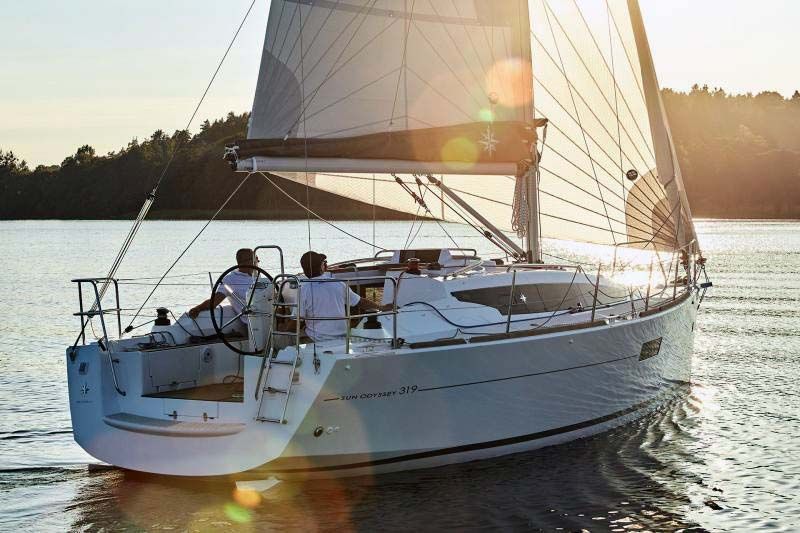
The Jeanneau Sun Odyssey 319 arrived as a compact, family-oriented cruiser built to squeeze modern comfort and easy handling into a just-over-30-foot hull. Launched by Jeanneau’s Polish facility in the late 2010s as a re-work of the Delphia/Polish 31 lineage, the 319 was updated by the Jeanneau design team (credit often given to Jeanneau’s in-house office and finishing touches associated with Andrzej Skrzat’s earlier Delphia work) and positioned explicitly as a coastal/family cruiser with both fixed-keel and lifting-keel options. From the yard’s point of view it was conceived as an entry-level Sun Odyssey: safe, roomy for its size, and straightforward to sail — answers to owners who wanted weekend comfort without the complication or price of a larger cruiser. Reviews and boat-show attention since its 2017–2018 introduction helped it earn strong used-boat demand from couples, small families and charter companies looking for an efficient two-cabin layout; it’s found a steady second-hand market in dealer listings and charter fleets rather than as a niche racer or blue-water specialist
Design and Construction
The 319’s hull is a modern, hard-chined cruiser hull with a relatively beamy profile carried well aft, twin spade rudders and the option of a deep fin with bulb or a stub keel plus centerboard to give shoal-water access. That hull form raises form stability at modest heel angles and creates usable interior volume (saloon and aft cabin) while the chines help the boat track and resist excessive hobby-horsing when pressed; the dual rudders preserve control when heeled. Deck and deckhouse treatments follow Jeanneau’s Sun-Odyssey lineage: secure cockpit ergonomics, a fold-down transom/swim platform and a cockpit planned for short-handed sailing. Construction is conventional production-boat GRP: solid hand-laid laminate for the hull and a cored deck — a combination that balances stiffness and weight while keeping repairability straightforward for owners. The design choices (sailplan, moderate sail area, options for self-tacking jib or furling solent, and modest rig dimensions) prioritize simplicity and easy handling over outright performance, and they keep long-term maintenance tasks (sail-handling systems, through-deck fittings, keel-mechanism for lifting keels) predictable for surveyors and yards. For a buyer that matters: these materials and detailing are familiar to yards across the U.S., so surveys and repairs are usually routine — but the lifting-keel variant does bring extra service items (mechanics, winches, keel boxes) that should be checked carefully on a pre-purchase survey.
Performance
On the water the 319 behaves like a modern coastal cruiser: comfortable, forgiving and capable of respectable speeds in an easy sail plan. Professional sea trials reported a lively feel in 15–20 knot conditions with reefed main and a smaller headsail, with speeds around the mid-5s to low-6 knots upwind and hull-speed potential near 7+ knots in favorable conditions — good numbers for a 31–33-foot cruising monohull. The hard chine and beam-aft hull help form stability and reduce pitching in short, confused seas, and twin rudders keep control when heeled; the trade-off is the boat isn’t tuned for close tactical racing but rather for steady, predictable handling. Some reviewers and owners noted that the factory sail plan (especially with in-mast or small furling mains) can feel a little conservative in light air, so buyers focused on day-sailing performance sometimes add a larger cruising genoa or light-air asymmetric for passage-making. Overall, the reputation is of a peppy, reliable coastal cruiser rather than a club racer — a practical choice for weekenders and family cruisers who value sea-kindliness and ease of handling.
Comfort and Accommodations
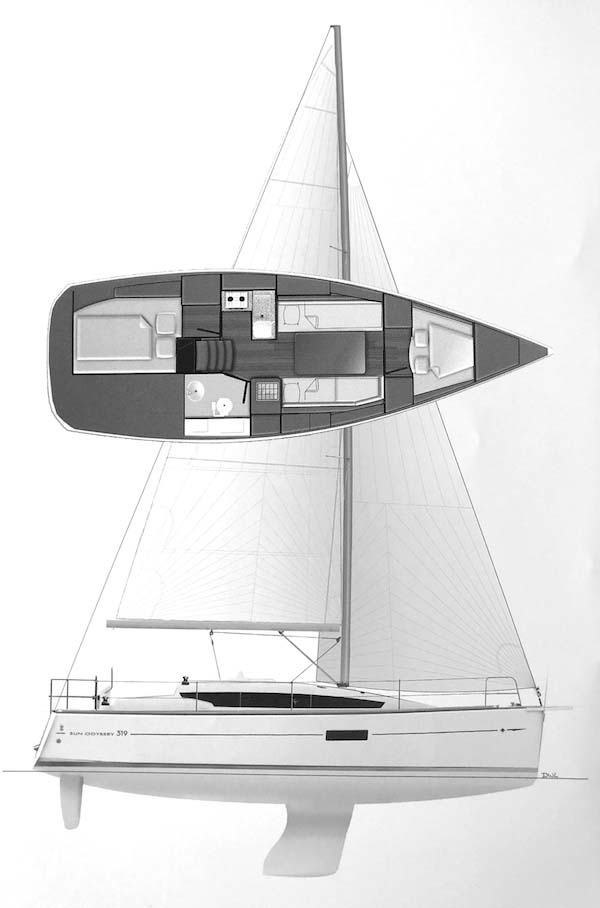
Belowdecks the 319 punches above its size: bright coachroof windows, a sensible L-shaped galley adjacent to the companionway, a forward V-berth and a full-size aft cabin make it genuinely comfortable for two and workable for a family of four for extended weekends. Jeanneau’s layout choices favor liveability — generous locker space, decent headroom for this class and a single head with shower — so the boat can be used for longer coastal cruises without feeling cramped. The aft cabin and saloon convert the hull volume into practical sleeping and storing areas, and many used examples show modest refits (upgraded refrigeration, new cushions or laminate replacements) rather than structural changes, which is a sign the original finish ages reasonably well. For prospective owners who intend to live aboard long-term, the 319 is compact but capable — most owners find it ideal for couple-cruising with occasional guests, and comfortable for a family on week-long trips if the crew adapts to tighter provisioning and storage discipline.
Safety and Practicality
Deck ergonomics are conservative and practical: secure coamings, a well-protected cockpit and a transom that converts to a safe swim/boarding platform make daily use easy. The availability of a shallow-draft lift-keel model increases anchorages and trailer-ish access but adds mechanical complexity — a buyer should ensure the keel-lifting mechanism and box are dry and mechanically sound during a survey. Systems are generally laid out for owner-serviceability: engine access under the companionway, tank access on dedicated panels and electrical runs that follow production-boat standards. With standard gear the 319 is best described as a coastal and near-offshore boat: CE-rated for a wide range of conditions and able to handle head-seas and weather if properly prepared, but buyers who plan true offshore passagemaking should budget for heavy-weather sails, upgraded ground tackle and a thorough systems check. For short-handed crews the sailplan options (self-tacking jib, furling mains) and cockpit layout make single- or two-handed sailing practical.
Known Issues with the Jeanneau Sun Odyssey 319
Owners’ forums and owner-network notes identify a handful of recurring attention items rather than single fatal flaws. Lift-keel/centerboard versions of Jeanneau boats can show wear in keel boxes, stiff or worn bearings, and occasional water ingress around the trunk area — problems that are common to any lifting-keel design and are easy to spot in a survey if you look under the saloon table and check the inspection panels. Several Sun Odyssey owners’ resources and yard threads also flag the older, unrelated Jeanneau-family issue of compression-post support pads and chainplate area leaks on some models — again not universal to the 319 but worth checking in survey photos and during a haul-out inspection. Finally, a number of reviewers commented that the standard small sailplan can be conservative in light winds, so “soft-wind” owners often upgrade headsails or add a bowsprit/code-0 to broaden light-air performance. In short: there are no systemic structural alarms documented specifically for the 319, but the lifting-keel variants and routine Jeanneau checklist items (check mast step, chainplates, keel box and sealings) should be part of a buyer’s pre-purchase scope. Recommended, commonly performed upgrades are sail inventory refresh (larger light-air sail or code-0), routine keel-mechanism service on centerboard boats, and sensible electronics/propeller updates if the boat will be used for extended cruising.
Market Availability and Pricing in the U.S.
The Sun Odyssey 319 is no longer a current production model in many markets (production runs are generally recorded as roughly 2017–2020), so new examples are rare and the market is driven by resale inventory. In the U.S. the 319 appears most often as used dealer stock or as ex-charter / brokerage listings in coastal hubs: Florida (Tampa/St. Petersburg/Miami), the mid-Atlantic (Annapolis/Chesapeake) and California show up regularly in listing portals. Typical asking prices on recent U.S. and international listings cluster in the mid-five to low-six-figure range; a practical, market-aware range for U.S. buyers is roughly $85,000–$190,000 depending on year, equipment, keel option and location, with occasional dealer or near-new listings asking higher. Compared with direct competitors in the compact coastal-cruiser segment, the 319 tends to offer a competitive value/provisioning ratio: it undercuts some Beneteau/Dufour equivalents on entry price while offering a modern layout and known dealer support. If you want resale liquidity, the 319 fares best where used Jeanneau stock is already established (Florida and the mid-Atlantic), while boats moved inland or to less-active regions can take longer to sell.
Below is a comparison with similar sailboats from the same era:
| Model | LOA | Approx. years | Typical used price (US) | Main practical differences |
|---|---|---|---|---|
| Catalina 315 | ~33.0 ft | Introduced 2012 (2012– ) | $120,000–$200,000 (used examples vary) | US-built pedigree, emphasis on inshore performance and dealer network in the U.S. |
| Hunter 33 | ~33.5 ft | Introduced ~2011–2013 | $60,000–$140,000 (wide variation by year & condition) | American design focus, comfortable cockpit and easy systems; generally strong on value. |
| Dufour 310 Grand Large | ~31.7 ft | First built ~2014 (2014– ) | $80,000–$115,000 (typical European/US brokerage listings) | Performance-leaning cruiser, slightly more “racy” hull and sail plan in the Grand Large line. |
Jeanneau Sun Odyssey 319 vs Catalina 315

The 319 and the Catalina 315 aim at the same buyer — a couple or small family wanting easy, comfortable coastal cruising — but their design priorities diverge in ways a buyer should weigh. The 319’s hard-chined hull and optional lifting keel prioritize shallow-water access and interior volume at modest heel, while the 315’s Gerry Douglas hull focuses on a slightly longer dynamic waterline and conservative performance cues tuned for U.S. marinas and owners; that makes the Catalina feel a touch more traditionally “American” in fit and finish and the Jeanneau more European in layout decisions.
Belowdecks both boats are comfortable for cruising couples, but the Catalina’s build and dealer support in the U.S. can make service and resale easier for American buyers. Performance differences are modest: the Catalina often edges upwind in light to moderate airs due to slightly higher sail area and displacement choices, while the 319 wins on cockpit ergonomics, shallow-water accessibility (lift keel) and a bit more modern interior daylighting.
► Learn more about de Catalina 315
Jeanneau Sun Odyssey 319 vs Hunter 33

Compared to the Marlow-Hunter 33, the 319 trades a bit of outright interior volume and U.S.-centric deck ergonomics for a more modern European hull shape and keel flexibility. The Hunter (Marlow) emphasizes a comfortable, often roomier cockpit and American service network, which suits owners focused on club cruising and comfortable marina life; the Jeanneau leans toward light-air efficiency and shoal-draft versatility with its lifting-keel option.
From a maintenance and ownership angle, Hunters tend to have simpler mechanical options and easier parts availability in the U.S., while the 319 gives slightly better resale value in regions where Jeanneau dealer support and brand recognition are strong; performance and comfort balance depends on whether you value shallow-water exploration (319) or traditional American cruising ergonomics (Marlow-Hunter).
► Learn more about de Hunter 33
Jeanneau Sun Odyssey 319 vs Dufour 310 Grand Large

The Dufour 310 Grand Large is pitched closer to the performance-cruiser end of the spectrum than the 319: a stiffer hull, larger sail plan and a design language that favors speed for passage-makers. The 319 accepts some loss of outright speed for easier handling, a more sheltered cockpit and practical family cruising features (fold-down transom, compact systems layout).
For a buyer focused on weekend family comfort and easy single-handing, the Jeanneau is the more forgiving, lower-stress choice; for someone prioritizing passage speed and a more “sporty” sail experience (and willing to manage a slightly tighter interior), the Dufour is the stronger candidate. Maintenance on both is comparable for their size, though the Dufour’s racing-leaning gear can mean higher sail-ward costs if performance sails are desired.
► Learn more about de Dufour 310 Grand Large
Maintenance Costs of a Jeanneau Sun Odyssey 319 in the U.S.
Below is a practical, commented list of the typical annual and periodic costs an owner should budget for; ranges are U.S.-oriented and reflect regional variation (New England/California marina fees at the high end; Florida/Gulf municipal rates at the lower end). Rule-of-thumb sources commonly advise budgeting roughly 5–10% of a boat’s value annually for upkeep, but a tighter, realistic ballpark for a well-maintained 31-foot cruiser is $3,000–$10,000 per year depending on slip/usage and whether you perform DIY work.
- Mooring / Slip / Storage: seasonal slip fees vary widely — municipal and small-marina moorings can run low ($20–$40/ft per month in some Florida municipal rates), while premium slips in Boston or Marina del Rey can be several hundred dollars per foot per season. Plan on $1,000–$12,000+ per year depending on location and whether you use winter storage. (Examples: municipal Miami/Florida rates vs Boston/Marina del Rey show large differences.)
- Insurance: typical premiums for coastal cruising 30- to 33-ft sailboats commonly fall between $300–$1,200/year, rising in hurricane zones or for commercial/charter use; higher coverage or greater liability limits push the number upward.
- Engine servicing & consumables: annual service (oil, filters, belts, impeller, coupling checks) for a small Yanmar sailboat engine typically $300–$900 if done by a local mechanic; more if injectors or saildrive work are required.
- Antifouling / haul-out / bottom paint: haul-out + pressure wash + paint can range from $300–$4,000 depending on scope and region (simple roll-on at a small yard vs full prep/blast and premium antifoul in expensive yards). Expect higher bills at high-demand northern yards.
- Standing & running rigging: routine inspection annually; a full standing-rig replacement typically ranges from $1,000–$5,000 for a 30–34-ft mast (cost differential driven by DIY vs pro install and choice of wire vs synthetic). Running rigging refresh and hardware checks are cheaper but recurring.
- Sails (periodic): expect mainsail + working headsail replacement for a 32-ft cruiser to land in the $3,000–$8,000 band depending on cloth and loft; light-air sails or performance laminates cost more. Budget for partial replacements every 8–15 years depending on use.
- Electronics / batteries: routine battery replacement every 4–8 years and periodic nav/electronics upgrades (chartplotter, AIS, VHF) — budget $500–$5,000 on episodic upgrades depending on scope.
- Small-systems and consumables (zincs, plumbing, rigging hardware, lines): $300–$1,500/year depending on use and whether you DIY.
- Significant one-time events to budget: sail inventory replacement ($3k–$8k), standing rig replacement ($1k–$5k), major electronics refit ($2k–$10k), refastening or structural refit or new bottom paint and keel servicing ($5k–$20k+ in extreme cases).
Can an owner maintain a 319 personally? Many owners can do a large share of regular maintenance (cleaning, antifouling prep with yard haul, simple engine checks, and minor rigging tasks), but items like mast stepping, professional rigging, complex sail repairs and major saildrive or keel-box work usually need yard or specialist intervention — that materially affects both time and cost. For a buyer, the bottom line is that ongoing costs are medium for a 32-ft cruiser: not negligible, but very manageable compared with larger yachts, and reasonable resale value for a well-maintained 319 often offsets sensible upkeep when compared to competitors
Conclusion
The Jeanneau Sun Odyssey 319 is a pragmatic, modern small cruiser that balances comfortable accommodations with easy, forgiving sailing. Its main strengths are usable interior volume for a 32-foot hull, a safe and well-protected cockpit, optional shoal-water capability via a lifting keel, and a manufacturer/sales support network that has made it a common and understood choice on the second-hand market. Weaknesses are the conservative factory sailplan in light airs (an easy and common fix for owners who want more performance), and the added inspection items for lifting-keel variants (keel box, bearings) that a buyer must scrutinize. For the American buyer seeking a coastal family cruiser that’s easy to single-hand or enjoy with children, the 319 is a practical and cost-effective buy; it’s not a performance racer nor a dedicated ocean-passage platform without further upgrades, but it offers good resale prospects where Jeanneau boats are already traded actively (Florida, mid-Atlantic, parts of California). If your objective is a sensible coastal cruiser with manageable maintenance and flexible anchoring options, the Sun Odyssey 319 is worth serious consideration — especially if you inspect lifting-keel examples carefully and budget for the small performance or systems upgrades that most buyers find sensible.
Specifications
| Hull Type | Fin w/bulb & dual rudders |
| Rigging Type | Fractional Sloop |
| LOA | 32.77 ft / 9.99 m |
| LWL | 29.82 ft / 9.09 m |
| S.A. (reported) | 488.68 ft² / 45.40 m² |
| Beam | 11.35 ft / 3.46 m |
| Displacement | 11,244 lb / 5,100 kg |
| Max Draft | 6.07 ft / 1.85 m |
| Construction | Fiberglass (FG) |
| Ballast Type | Iron |
| First Built | 2018 |
| Builder | Jeanneau |
| Designer | Jeanneau Design |
| Auxiliary Power | Yanmar Diesel, 21 HP |
| Fuel Capacity | 26 gal / 100 L |
| Water Capacity | 40 gal / 150 L |
| S.A./Displ. | 15.63 |
| Disp./Len. | 189.30 |
| Comfort Ratio | 22.27 |
| Capsize Screening Formula | 2.03 |
| S# | 2.44 |
| Hull Speed | 7.32 kn |
| Pounds/Inch Immersion | 1,209.34 lb/inch |
| Rig Dimensions (I / J / P / E) | I: 36.42 ft / 11.10 m J: 11.92 ft / 3.63 m P: 35.50 ft / 10.82 m E: 12.42 ft / 3.79 m |
| Sail Areas | Fore: 217.06 ft² / 20.17 m² Main: 220.46 ft² / 20.48 m² Total (100% Fore+Main): 437.52 ft² / 40.65 m² |
| S.A./Displ. (calc.) | 14.00 |
| Est. Forestay Length | 38.32 ft / 11.68 m |
| Mast Height from DWL | 44.50 ft / 13.56 m |
Disclaimer
The considerations and analyses presented regarding the Jeanneau Sun Odyssey 319 sailboat are of a general nature and are based on the available information and technical data on this model, interpreted to the best of our knowledge and understanding. It is important to note that the specific characteristics of any particular sailboat may vary due to custom modifications, maintenance performed, and conditions of use over time, among other factors. Therefore, the details and performance of the boat you are considering may not exactly match the information provided here.
We strongly recommend that, before making any purchasing or usage decisions, you conduct a detailed inspection of the boat in question, consult with nautical professionals and other sailors, and consider your personal needs, expectations, and capabilities. Each sailboat may have unique particularities that affect its performance and suitability for different types of sailing and sailors.
The information contained in this analysis should be used as a general guide and not as a definitive reference. Professional evaluation and personal inspection are essential to ensure that the boat meets your specific requirements and expectations.