


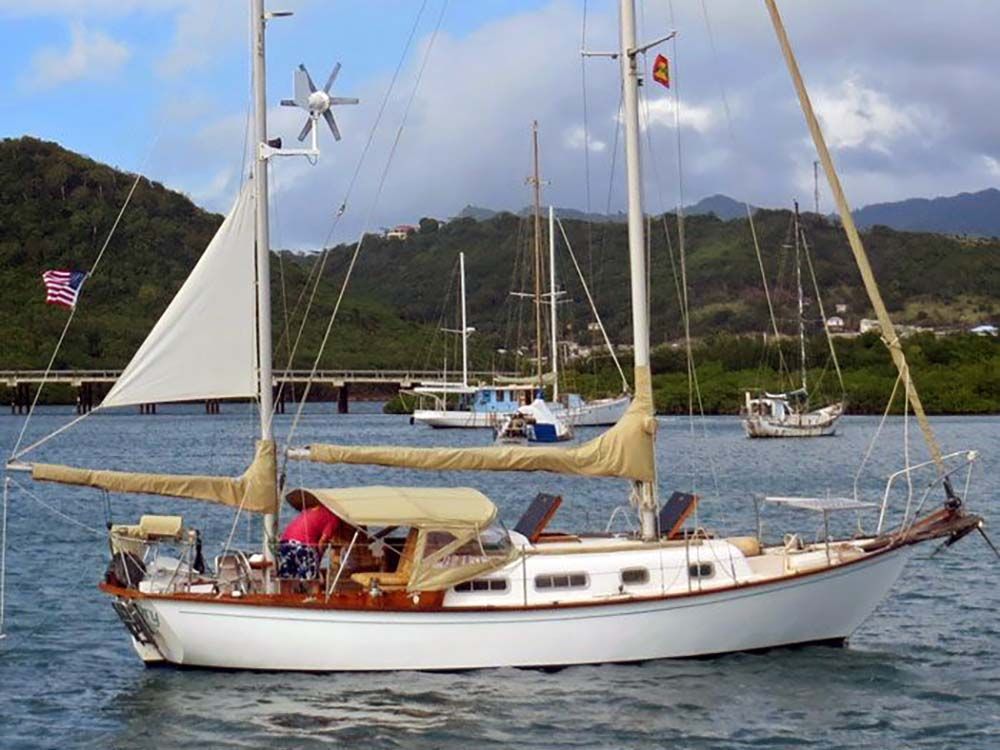
The Allied Seawind 30 is a classic American cruising sailboat launched in the mid-1960s by Allied Boat Company, a New York–based yard that built a reputation for rugged, bluewater-capable fiberglass yachts at a time when the material was still relatively new to the industry. Designed primarily for long-distance cruising rather than racing, the Seawind targeted sailors who valued seaworthiness and reliability over speed. It quickly developed a following among serious cruising couples and small families, many of whom took the boat offshore, proving its capabilities in real-world passages. Today, the model remains sought after on the secondhand market, especially among private owners who want a manageable but robust cruiser rather than a charter platform. Its reputation for durability and conservative design has helped it maintain demand even decades after production ceased.
Design and Construction
The Seawind 30 features a full-keel hull with a cutaway forefoot, a configuration that prioritizes directional stability and seaworthiness over agility. The rudder is attached directly to the keel, reducing vulnerability and maintenance needs compared to spade rudders of the same era. With its moderate beam and heavy displacement, the hull reflects a design philosophy centered on safe offshore passage rather than maximizing interior volume.
The rig is typically a masthead sloop, though some examples were configured as ketches. The sloop setup offers simplicity and efficiency, especially for shorthanded crews, while the ketch provides flexibility in heavy weather. The construction is solid fiberglass, without a balsa core, which makes the boat heavier but nearly immune to core-related structural issues—a key advantage when evaluating aging examples. Deck layouts are straightforward, with wide side decks and functional hardware placement, though buyers should expect gear to be outdated unless upgraded.
This conservative naval architecture means owners benefit from a strong resale value and ease of long-term repair, as fewer complex structures translate into fewer hidden problems.

Performance
On the water, the Seawind 30 is no sprinter, but speed was never its mission. Cruising at 5–6 knots is typical, with a hull speed of around 6.5 knots. In light air, it can feel sluggish compared to lighter modern cruisers, but in 20–25 knots with seas on the bow, it shows its true pedigree. The heavy displacement and full keel deliver excellent tracking and a reassuring motion, particularly appreciated on longer passages.
The boat points respectably to windward given its vintage design, though it cannot match the angle or responsiveness of fin-keel yachts. Under power, maneuverability is limited in tight marinas—common with full-keel boats—but experienced owners learn to anticipate its turning radius. Compared to contemporaries such as the Pearson 30 or Columbia 30, the Seawind trades some nimbleness for greater offshore credibility.
Comfort and Accommodations
Inside, the Seawind 30 has a traditional layout with a V-berth forward, saloon with settees, galley, and an enclosed head. While space is limited by modern standards, it was designed to be functional at sea rather than to impress dockside guests. Ventilation is adequate thanks to opening ports and hatches, though retrofits are common to improve airflow in warmer climates. Storage is abundant relative to its size, a direct result of the boat’s displacement and traditional cruising focus.
For a couple or small family, the interior is sufficient for extended cruising, though not luxurious. Many examples on the market today have been refitted with updated joinery, new upholstery, or modernized galley equipment, reflecting how well the structure lends itself to upgrades. As an affordable liveaboard or long-weekend cruiser, it delivers comfort in a seakindly, practical way.
Safety and Practicality
Safety is one of the Seawind’s strongest selling points. The high coamings, sturdy rig, and heavy layup give confidence offshore. Decks are secure, though the narrow beam means less working space compared to modern designs. Full-length handrails and conservative sail plans make it suitable for shorthanded crews, a major advantage for cruising couples.
From a systems perspective, access to the engine and mechanical components is straightforward, though tight by today’s standards. Its simplicity is an advantage for maintenance-minded owners, as fewer complex systems translate to lower upkeep costs. While primarily designed for coastal and offshore cruising, many have safely completed ocean crossings with minimal modifications, underlining its pedigree as a true cruiser rather than just a coastal weekender.
Known Issues with the Allied Seawind 30
Given their age, Seawind 30s on the market often present issues typical of vintage fiberglass yachts. Osmosis is rare but possible, though the solid fiberglass hulls are generally more resistant than cored boats. More common are deck leaks from aging hardware or bedding, worn standing rigging, and original engines nearing the end of their service life. Electrical systems, if not upgraded, are often outdated.
Owners frequently recommend replacing original fuel tanks, updating through-hulls to modern bronze or Marelon, and refitting with more efficient propellers to improve performance under power. These upgrades are now common, and buyers should evaluate whether they have already been completed when considering a particular boat.
Market Availability and Pricing in the U.S.
The Allied Seawind 30 is long out of production, so it is only available on the used market. Listings are most common in New England and Florida, reflecting where many were originally sailed and maintained. Condition varies widely: some examples are carefully maintained and upgraded by knowledgeable owners, while others sit neglected in boatyards.
Typical asking prices in the U.S. range from $12,000 to $25,000, depending on condition and upgrades. Compared with alternatives such as the Catalina 30 or Pearson 30, the Seawind may look more expensive for its age and performance, but buyers are paying for ruggedness and offshore pedigree. Resale remains stable, especially among cruising-oriented buyers who know its reputation.
Below is a comparison with similar sailboats:
| Model | LOA | Years Built | Typical U.S. Price | Key Differences |
|---|---|---|---|---|
| Allied Seawind 30 | 30 ft | 1960s–1970s | $12,000–$25,000 | Heavy, full keel, offshore capable, conservative design |
| Catalina 30 | 30 ft | 1975–1990s | $15,000–$35,000 | Lighter, spacious interior, strong coastal cruiser, less offshore reputation |
| Pearson 30 | 30 ft | 1971–1980 | $10,000–$20,000 | Faster, fin keel, better maneuverability, but lighter construction |
| Hunter 30 (Cherubini) | 30 ft | 1973–1983 | $12,000–$22,000 | More interior volume, cost-effective, but less rugged offshore reputation |
| Jeanneau Arcadia 30 | 30 ft | 1983–1989 | $18,000–$28,000 | European styling, fin keel, faster but less traditional build quality |
Maintenance Costs of a Allied Seawind 30 in the USA
Annual maintenance costs vary depending on location, but typical expenses include:
- Mooring or slip fees: $3,000–$6,000 annually in most U.S. coastal regions, higher in metropolitan marinas.
- Insurance: $500–$1,200 per year, depending on cruising range and survey.
- Engine servicing: $500–$1,000 annually, more if the engine is nearing replacement.
- Bottom paint/antifouling: $1,000–$2,500 depending on region and haul-out fees.
- Rigging and sails: Standing rigging replacement every 10–12 years (~$4,000–$6,000); new sails $3,000–$5,000 depending on quality.
- General upkeep and systems: $1,000–$2,000 per year for pumps, electronics, and minor refits.
Many owners perform their own maintenance, especially given the Seawind’s straightforward systems, which can significantly reduce costs. However, professional refits—such as replacing tanks, wiring, or the engine—can quickly add $10,000–$20,000 in lump-sum expenses. Overall, ownership costs are moderate for a 30-foot cruiser. When balanced against its resale stability and offshore credibility, the investment is often justified.
Conclusion
The Allied Seawind 30 remains a compelling choice for sailors seeking a small but proven bluewater cruiser. Its strengths lie in its rugged construction, seaworthy full-keel design, and reputation for safety at sea. Weaknesses include modest speed, dated interior volume compared to contemporaries, and the reality that most examples require upgrades due to age.
For buyers who value traditional cruising over modern amenities, the Seawind offers excellent value and enduring confidence. It is best suited for couples or solo sailors preparing for extended coastal cruising or even offshore passages, rather than those seeking weekend entertaining space. While not flashy, it is one of the more underrated options in its category—quietly reliable, relatively affordable, and with a stable resale market among serious sailors.
Specifications
| Design & Construction | |
|---|---|
| Hull Type | Long keel w/ transom-hung rudder |
| Rigging Type | Masthead Ketch |
| Construction | FG |
| Builder | Allied Boat Co. (USA) |
| Designer | Thomas Gillmer |
| First Built | 1962 |
| Last Built | 1982 |
| # Built | 161 |
Principal Dimensions | |
| LOA | 30.50 ft / 9.30 m |
| LWL | 24.00 ft / 7.32 m |
| Beam | 9.25 ft / 2.82 m |
| Max Draft | 4.20 ft / 1.28 m |
| Displacement | 12,000 lb / 5,443 kg |
| Ballast | 4,200 lb / 1,905 kg |
| S.A. (reported) | 502.00 ft² / 46.64 m² |
Auxiliary Power / Tanks (Original) | |
| Make | Palmer / Gray Marine |
| Model | M-60 |
| Type | Gas |
| Fuel | 12 gals / 45 L |
Accommodations / Tankage | |
| Water | 30 gals / 114 L |
Sailboat Calculations | |
| S.A. / Displ. | 15.38 |
| Bal. / Displ. | 35.00 |
| Disp. / Len. | 387.52 |
| Comfort Ratio | 36.91 |
| Capsize Screening Formula | 1.62 |
| S# | 0.96 |
| Hull Speed | 6.56 kn |
| Pounds/Inch Immersion | 793.23 lb/in |
Rig & Sail Particulars | |
| I | 35.58 ft / 10.84 m |
| J | 12.25 ft / 3.73 m |
| P | 31.83 ft / 9.70 m |
| E | 13.00 ft / 3.96 m |
| PY | 18.16 ft / 5.54 m |
| EY | 8.50 ft / 2.59 m |
| S.A. Fore | 217.93 ft² / 20.25 m² |
| S.A. Main | 206.90 ft² / 19.22 m² |
| S.A. Total (100% Fore + Main) | 424.83 ft² / 39.47 m² |
| S.A. / Displ. (calc.) | 13.01 |
| Estimated Forestay Length | 37.63 ft / 11.47 m |
Disclaimer
The considerations and analyses presented regarding the Allied Seawind 30 sailboat are of a general nature and are based on the available information and technical data on this model, interpreted to the best of our knowledge and understanding. It is important to note that the specific characteristics of any particular sailboat may vary due to custom modifications, maintenance performed, and conditions of use over time, among other factors. Therefore, the details and performance of the boat you are considering may not exactly match the information provided here.
We strongly recommend that, before making any purchasing or usage decisions, you conduct a detailed inspection of the boat in question, consult with nautical professionals and other sailors, and consider your personal needs, expectations, and capabilities. Each sailboat may have unique particularities that affect its performance and suitability for different types of sailing and sailors.
The information contained in this analysis should be used as a general guide and not as a definitive reference. Professional evaluation and personal inspection are essential to ensure that the boat meets your specific requirements and expectations.