


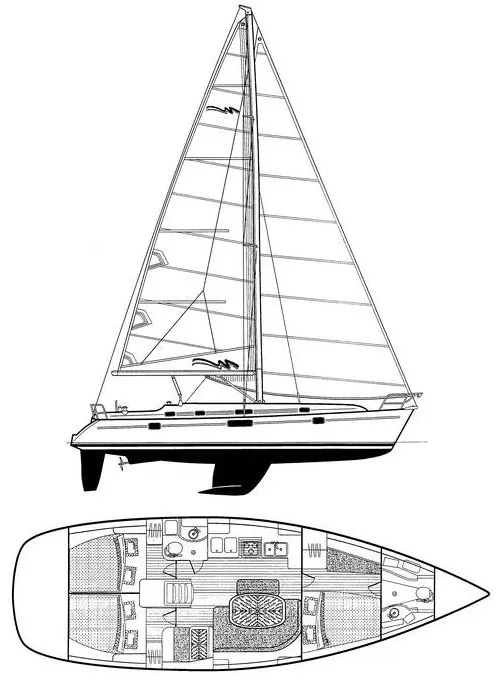
The Beneteau 411, officially known in many markets as the Oceanis 411 Clipper, is a well-regarded cruising sailboat introduced by the French builder Beneteau in 1997. Designed by the Groupe Finot design office, it was aimed squarely at the bluewater cruising segment, offering a balance between performance, liveability, and ease of handling. Built until around 2004, the 411 quickly became a popular choice among private owners and charter fleets alike, thanks to its spacious interior, modern hull form, and reputation for being both forgiving and rewarding under sail. Whether coastal cruising, liveaboard sailing, or undertaking longer offshore passages, the Beneteau 411 appeals to sailors seeking comfort without sacrificing reasonable sailing performance.
Design and Construction
The Beneteau 411 features a moderate-displacement fiberglass monohull with a fin keel and a balanced spade rudder, which combine to offer both stability and agility. The hull lines reflect late-1990s thinking: generous beam carried aft, a moderately fine entry, and good underbody volume for tankage and storage. Most models were equipped with a standard keel (1.70 m / 5.6 ft draft), but shoal-draft versions (approx. 1.5 m / 4.9 ft) were also available for shallow cruising grounds.
The construction consists of solid fiberglass below the waterline and balsa-cored sandwich above. This keeps weight down while preserving rigidity and thermal/acoustic insulation. The deck is a molded liner bonded to the hull and includes molded nonskid, molded toerails, and strategically placed handholds—well thought-out from a safety and ergonomic perspective.
Rigging is a masthead sloop, with aluminum spars, a deck-stepped mast, and in-mast furling or classic mainsail options, depending on the variant. While not optimized for high-performance sailing, the rig is robust, simple, and easy to manage with minimal crew. Chainplates are well-supported internally, and standing rigging is robust for offshore-capable cruisers of this size.
Performance
Under sail, the Beneteau 411 performs better than many cruisers in her class, especially considering her size and accommodation level. With a sail area of approximately 697 sq. ft., and a SA/D ratio in the 16–17 range, the 411 offers respectable light-air performance when properly trimmed, particularly with classic main and genoa configurations.
She points decently upwind—thanks to her fin keel and balanced helm—and tracks steadily on all points of sail. Her hull speed is around 8.1 knots, and she can approach that in moderate breeze on a reach. While not a racer, she is lively and enjoyable to sail, especially for cruising couples or small families who want engaging performance without being overpowered.
The helm is balanced and responsive, especially with a clean bottom and well-trimmed sails. The spade rudder delivers good feedback and remains effective even when heeled. Downwind, the wide beam aft aids in stability, though large following seas may require more active steering. In general, her motion is smooth and predictable—ideal for longer passages or casual coastal cruising.
Comfort and Accommodations
A standout feature of the Beneteau 411 is its exceptional interior volume for a 41-foot hull. Available in two- and three-cabin layouts, the boat offers versatility for both private ownership and charter use. The two-cabin version offers a larger aft owner’s cabin and more storage, while the three-cabin layout accommodates more crew but sacrifices some stowage and elbow room.
The salon is bright and welcoming, thanks to multiple fixed and opening ports and overhead hatches. A U-shaped dinette and settee to port provide seating for six, with a large, functional galley to starboard featuring double sinks, a gimbaled stove with oven, top-loading fridge/freezer, and ample locker space.
The forward cabin typically includes a generous V-berth with hanging locker and cabinetry, while aft cabins offer full-sized double berths and good ventilation. Headroom exceeds 6’4” in most spaces, contributing to a genuinely spacious feel. Heads include a separate shower stall—rare for this size—which enhances comfort on longer cruises.
Storage throughout is adequate, though in the three-cabin versions it may feel a bit limited for long-term liveaboard use. Fit and finish are good, with laminated wood veneers, molded liners, and thoughtful lighting. While not luxurious by high-end standards, the Beneteau 411’s interior feels solid, well-crafted, and purpose-built for cruising comfort.
Safety and Practicality
The 411 is designed with ease of handling and safety in mind. The cockpit is well-protected and ergonomically arranged, with lines led aft, a central helm station, and wide side decks with molded nonskid. The companionway is secure, with solid steps and good handholds below.
A deep anchor locker, dual bow rollers, and accessible windlass setup make anchoring efficient and safe. Handrails, lifelines, and sturdy pulpits enhance deck security. The visibility from the helm is good, and instrumentation is well placed for both seated and standing positions.
With a Yanmar diesel engine (typically 50 or 56 HP), the boat cruises easily at 6–7 knots under power. The engine room is accessible from the companionway and side panels, simplifying maintenance.
Though not designed as a full bluewater vessel, the 411 has successfully completed transatlantic passages and extended offshore voyages with the right preparation. Its safety gear capacity, tankage (approx. 500 L water, 150 L fuel), and steady hull form make it a viable cruiser for many ambitious sailors.
Known Issues with the Beneteau 411
Like many production cruisers of the late 1990s and early 2000s, the Beneteau 411 has some documented issues:
- Deck-core moisture intrusion: The balsa-cored deck can develop soft spots if fittings (especially stanchions, chainplates, and deck hardware) aren’t properly bedded and maintained.
- Rudder bearing wear: Some owners report slop or play in the rudder over time. This is usually due to bearing wear and is correctable, but may require haul-out.
- Electrical corrosion: In boats exposed to humid environments or poor maintenance, wiring terminals and panels may suffer from oxidation or corrosion.
- Gelcoat crazing: Cosmetic cracking in high-stress areas (like around chainplates or hatches) is relatively common but usually not structural.
Importantly, these issues are not necessarily design flaws but more often the result of age, neglect, or hard charter use. Well-maintained, privately owned examples tend to hold up well.
Conclusion
The Beneteau 411 remains one of the most respected production cruisers of its generation. Its combination of performance, comfort, and user-friendly design makes it a compelling choice for couples, families, or liveaboards seeking a spacious and capable sailboat without the complexities or costs of larger yachts.
Strengths include:
- Versatile, proven hull design
- Spacious and bright interior
- Easy handling and maintenance access
- Solid performance under sail and power
Weaknesses:
- Not a true bluewater yacht without modifications
- Some maintenance concerns typical of aging production boats
- Interior wood veneers may wear over time
Ideal for sailors who want a capable, comfortable cruiser for coastal and moderate offshore work, the Beneteau 411 continues to deliver a rewarding sailing experience—whether you’re headed to the next bay or another continent.
👉 Save the full technical sheet of the Beneteau 411 by downloading the PDF version
Specifications
| Hull Type | Fin w/bulb & spade rudder |
| Rigging Type | Masthead Sloop |
| LOA | 41.00 ft / 12.50 m |
| LWL | 36.92 ft / 11.25 m |
| S.A. (reported) | 697.00 ft² / 64.75 m² |
| Beam | 13.00 ft / 3.96 m |
| Displacement | 17,196.00 lb / 7,800 kg |
| Ballast | 5,500.00 lb / 2,495 kg |
| Max Draft | 4.75 ft / 1.45 m |
| Construction | FG |
| First Built | 1997 |
| Builder | Beneteau |
| Designer | Group Finot |
Auxiliary Power/Tanks (orig. equip.) | |
|---|---|
| Make | Yanmar |
| Type | Diesel |
Sailboat Calculations | |
| S.A. / Displ. | 16.80 |
| Bal. / Displ. | 31.98 |
| Disp: / Len | 152.54 |
| Comfort Ratio | 22.88 |
| Capsize Screening Formula | 2.02 |
| S# | 3.30 |
| Hull Speed | 8.14 kn |
| Pounds/Inch Immersion | 1,714.95 pounds/inch |
Rig and Sail Particulars | |
| I | 47.74 ft / 14.55 m |
| J | 16.31 ft / 4.97 m |
| P | 41.54 ft / 12.66 m |
| E | 14.83 ft / 4.52 m |
| S.A. Fore | 389.32 ft² / 36.17 m² |
| S.A. Main | 308.02 ft² / 28.62 m² |
| S.A. Total (100% Fore + Main Triangles) | 697.34 ft² / 64.79 m² |
| S.A./Displ. (calc.) | 16.81 |
| Est. Forestay Length | 50.45 ft / 15.38 m |
Sailboat Links | |
| Related Sailboats | OCEANIS 411 (BENETEAU) |
Disclaimer
The considerations and analyses presented regarding the Beneteau 411 sailboat are of a general nature and are based on the available information and technical data on this model, interpreted to the best of our knowledge and understanding. It is important to note that the specific characteristics of any particular sailboat may vary due to custom modifications, maintenance performed, and conditions of use over time, among other factors. Therefore, the details and performance of the boat you are considering may not exactly match the information provided here.
We strongly recommend that, before making any purchasing or usage decisions, you conduct a detailed inspection of the boat in question, consult with nautical professionals and other sailors, and consider your personal needs, expectations, and capabilities. Each sailboat may have unique particularities that affect its performance and suitability for different types of sailing and sailors.
The information contained in this analysis should be used as a general guide and not as a definitive reference. Professional evaluation and personal inspection are essential to ensure that the boat meets your specific requirements and expectations.