


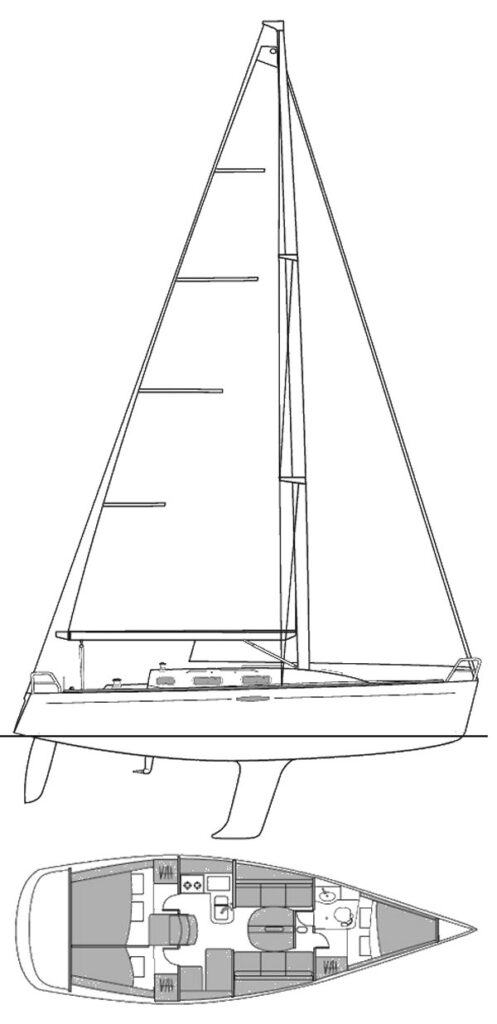
The Beneteau First 375 was introduced in the mid-1980s as part of Beneteau’s well-regarded “First” series, which blended the performance of a racer with the comfort and practicality of a cruiser. Designed by Jean Berret and built by the renowned French shipyard Beneteau, the First 375 was positioned as a fast cruising sailboat for private owners who wanted spirited sailing without compromising on cruising capacity.
The model gained attention for its well-balanced compromise between racing lines and liveaboard utility. As a result, it attracted a wide range of owners—from coastal cruisers and club racers to families looking for a reliable boat for summer cruising. In the secondhand market, it remains a sought-after model, particularly in the U.S. and Europe, where sailors value its combination of speed, quality, and classic Beneteau styling. Today, it appeals mainly to private individuals rather than charter companies or sailing schools, due to its performance-oriented character and non-modular interior.
Design and Construction
The Beneteau First 375 features a moderate displacement hull with a fine bow and broad stern, typical of performance cruisers of the 1980s. Its hull is constructed from solid fiberglass below the waterline and balsa-cored above it, with a molded deck and sandwich construction that offers both strength and weight savings. The keel options include a deep fin keel or a shallower winged variant, while the rudder is spade-mounted, enhancing responsiveness and maneuverability under sail.
Rigged as a masthead sloop, the First 375 carries a large headsail and a powerful mainsail, with a sail area around 635–660 ft² depending on rig configuration. The aluminum spars and stainless-steel rigging are standard for its class and era. Overall, the design emphasizes lightness and agility while maintaining structural durability.
For long-term owners, the materials and construction choices offer both resilience and ease of repair. While the cored deck requires vigilance against moisture intrusion, the overall design holds its value well in the secondhand market and retains excellent sailing characteristics decades after launch.
Performance
Sailing performance is where the First 375 truly shines. With a sail area-to-displacement ratio around 20.5 and a fine underbody, the boat offers spirited and responsive sailing. It performs particularly well upwind, with a tight pointing angle and a steady heel under moderate breeze. Off the wind, it accelerates quickly and tracks smoothly, making it a joy for passage-making or club-level racing.
In rougher conditions, the hull shape and balanced sail plan provide a confident and predictable ride. Though not as stiff as some heavier cruisers, the First 375 remains well-mannered, with good feedback on the helm and solid directional stability. Comparatively, it outperforms cruisers like the Catalina 36 in light winds and equals boats like the Jeanneau Sun Fast 37 in moderate breeze.
Among owners, it enjoys a reputation for being fast, seaworthy, and engaging—traits that contribute to its enduring popularity among sailors who value performance without needing a full racing rig.
Comfort and Accommodations
Below deck, the First 375 offers a surprisingly warm and comfortable interior for a boat with performance DNA. Most layouts include two large cabins (one forward, one aft), a generous head with separate shower space, and a well-equipped galley positioned to port. The main saloon features a U-shaped dinette and ample storage, providing comfort for extended stays aboard.
Ventilation is effective thanks to numerous hatches and opening ports, and finish quality—typically teak veneer over marine ply—has aged well in most examples. The interior strikes a practical balance between comfort and weight savings, and while not luxurious by today’s standards, it feels honest and functional.
For couples or small families, the layout is suitable for week-long trips or even seasonal living aboard. Most systems are easy to access, and the boat offers enough tankage and stowage for light cruising. Some owners have modernized the interiors, adding refrigeration, upgraded lighting, or new upholstery, while others keep the original design intact. Either way, the boat’s structure and layout adapt well to personalization.
Safety and Practicality
From a safety standpoint, the First 375 offers robust construction and seakeeping qualities that inspire confidence in coastal or offshore use. Wide side decks, high lifelines, and a deep cockpit make for a secure environment under sail. Grab rails are well-placed, and the companionway has strong weather protection with a removable washboard system.
The boat can be handled by a small crew or even single-handed with modest upgrades such as self-tailing winches and autopilot. The rig is manageable, and reefing can be done quickly. Systems like fuel, water, and electrical components are accessible through removable panels, helping contain maintenance costs.
While not designed as a bluewater cruiser in the strictest sense, many First 375s have crossed oceans with proper outfitting. For coastal and offshore passagemaking, it offers a solid, dependable platform with only minor modifications required.
Known Issues with the Beneteau First 375
Like many boats of its era, the Beneteau First 375 has a few age-related issues that prospective buyers should be aware of. Deck delamination around hardware fittings can occur if water intrusion has been neglected. It’s not a design flaw per se, but rather a maintenance-related risk due to cored deck construction.
Some early models are prone to rudder bearing wear, which can cause play at the helm. Chainplates should also be inspected regularly for signs of corrosion or leaks. The original engines, often Volvo Penta or Yanmar diesels in the 27–30 HP range, are generally reliable but may be nearing the end of service life depending on usage.
Osmosis is occasionally reported, especially in hulls that remained in warmer waters. Common upgrades include:
- New electronics and navigation suites
- Flexible solar panel installations
- LED lighting
- Feathering or folding props for sailing performance
- Upgraded through-hulls and seacocks
Overall, issues tend to be consistent with the boat’s age and not inherently due to design flaws.
Market Availability and Pricing in the U.S.
The First 375 is no longer in production and is available only on the secondhand market. In the U.S., listings appear most frequently in New England, the Pacific Northwest, and parts of the Great Lakes region, where cruising enthusiasts appreciate its sailing pedigree. Boats are typically found in fair to good condition, with many having seen recent upgrades.
As of 2025, typical asking prices range from $40,000 to $65,000 depending on condition, location, and upgrades. Boats that have been repowered or refitted for cruising tend to command higher prices. Compared to similarly sized cruisers like the Hunter Legend 37 or Catalina 36, the First 375 offers a stronger sailing experience, but sometimes requires more upkeep due to its age and design complexity.
Below is a comparison with similar sailboats from the same era:
| Model | LOA | Year | Used Price (USD) | Key Differences |
|---|---|---|---|---|
| Beneteau First 375 | 37.5′ | 1985–1990 | $40,000–$65,000 | Performance cruiser, responsive helm, aging systems |
| Catalina 36 | 36.3′ | 1982–1995 | $35,000–$60,000 | Roomier interior, less agile, better for families |
| Hunter Legend 37 | 37.5′ | 1986–1993 | $35,000–$55,000 | Spacious and comfortable, moderate sailing ability |
| Jeanneau Sun Fast 37 | 37′ | 2000–2006 | $55,000–$75,000 | Newer, better equipped, faster off the wind |
Conclusion
The Beneteau First 375 strikes a commendable balance between competitive sailing and cruising comfort, making it ideal for sailors who want a capable, all-around sailboat. Its strengths lie in its responsive sailing performance, well-thought-out accommodations, and practical deck layout. While it’s not a pure racer, its nimbleness and ease of handling appeal to both performance enthusiasts and cruising sailors. Some maintenance vigilance is required, particularly regarding deck integrity and rigging, but these are manageable with proper care. In sum, the First 375 suits sailors looking for a versatile boat that can deliver spirited sailing as well as comfortable extended cruising.
Specifications
| Hull Type | Fin w/spade rudder |
|---|---|
| Rigging Type | Masthead Sloop |
| LOA | 37.08 ft / 11.30 m |
| LWL | 33.16 ft / 10.11 m |
| S.A. (reported) | 648.00 ft² / 60.20 m² |
| Beam | 12.33 ft / 3.76 m |
| Displacement | 15,432.00 lb / 7,000 kg |
| Ballast | 5,291.00 lb / 2,400 kg |
| Max Draft | 6.50 ft / 1.98 m |
| Construction | FG |
| First Built | 1985 |
| Last Built | 1989 |
| Builder | Beneteau (FRA) |
| Designer | Berret |
Auxiliary Power/Tanks (orig. equip.) | |
| Make | Volvo Penta |
| Type | Diesel |
| Fuel | 25 gals / 95 L |
Accommodations | |
| Water | 36 gals / 136 L |
Sailboat Calculations | |
| S.A. / Displ. | 16.79 |
| Bal. / Displ. | 34.29 |
| Disp: / Len | 188.94 |
| Comfort Ratio | 24.48 |
| Capsize Screening Formula | 1.98 |
| S# | 2.81 |
| Hull Speed | 7.72 kn |
| Pounds/Inch Immersion | 1,460.91 pounds/inch |
Rig and Sail Particulars | |
| I | 49.00 ft / 14.94 m |
| J | 13.70 ft / 4.18 m |
| P | 43.10 ft / 13.14 m |
| E | 14.50 ft / 4.42 m |
| S.A. Fore | 335.65 ft² / 31.18 m² |
| S.A. Main | 312.48 ft² / 29.03 m² |
| S.A. Total (100% Fore + Main Triangles) | 648.13 ft² / 60.21 m² |
| S.A./Displ. (calc.) | 16.79 |
| Est. Forestay Length | 50.88 ft / 15.51 m |
Disclaimer
The considerations and analyses presented regarding the Beneteau First 375 sailboat are of a general nature and are based on the available information and technical data on this model, interpreted to the best of our knowledge and understanding. It is important to note that the specific characteristics of any particular sailboat may vary due to custom modifications, maintenance performed, and conditions of use over time, among other factors. Therefore, the details and performance of the boat you are considering may not exactly match the information provided here.
We strongly recommend that, before making any purchasing or usage decisions, you conduct a detailed inspection of the boat in question, consult with nautical professionals and other sailors, and consider your personal needs, expectations, and capabilities. Each sailboat may have unique particularities that affect its performance and suitability for different types of sailing and sailors.
The information contained in this analysis should be used as a general guide and not as a definitive reference. Professional evaluation and personal inspection are essential to ensure that the boat meets your specific requirements and expectations.