


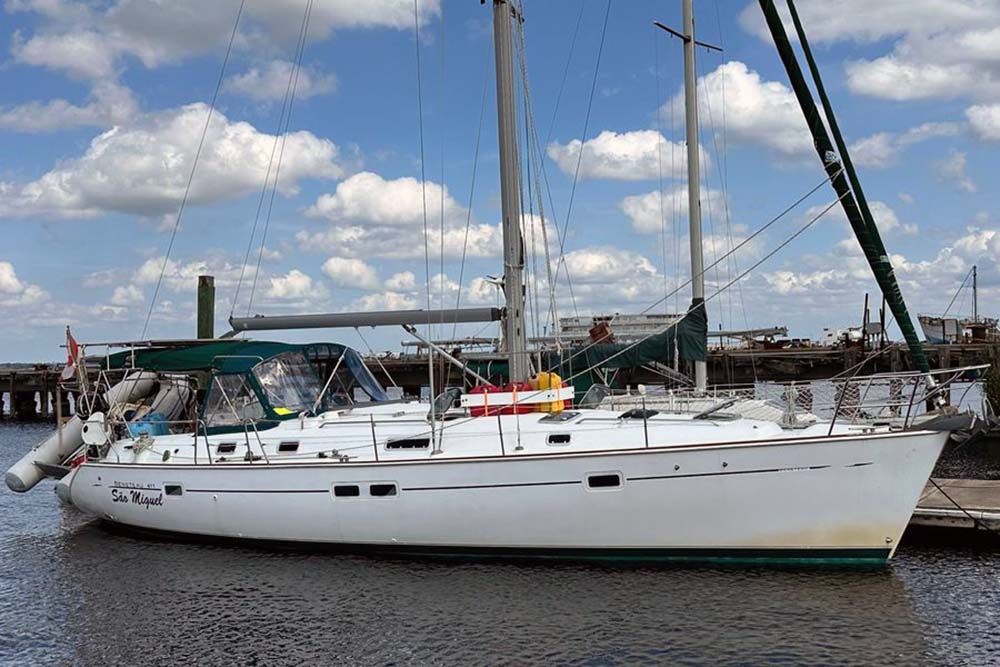
The Beneteau Oceanis 40 is a modern cruising sailboat designed with comfort, performance, and practicality in mind. Launched in 2007 by the renowned French shipyard Beneteau and designed by the Berret-Racoupeau team with interior styling by Nauta Design, the Oceanis 40 was intended as a capable coastal and offshore cruiser for couples, families, and private owners looking for bluewater potential in a manageable package.
This model quickly gained popularity for its combination of modern styling, spacious layout, and predictable handling. On the used market, it remains in strong demand, particularly among long-distance cruisers, charter fleets, and sailing schools thanks to its balance between livability and manageable size. Its availability in both two- and three-cabin versions further broadens its appeal.
Design and Construction
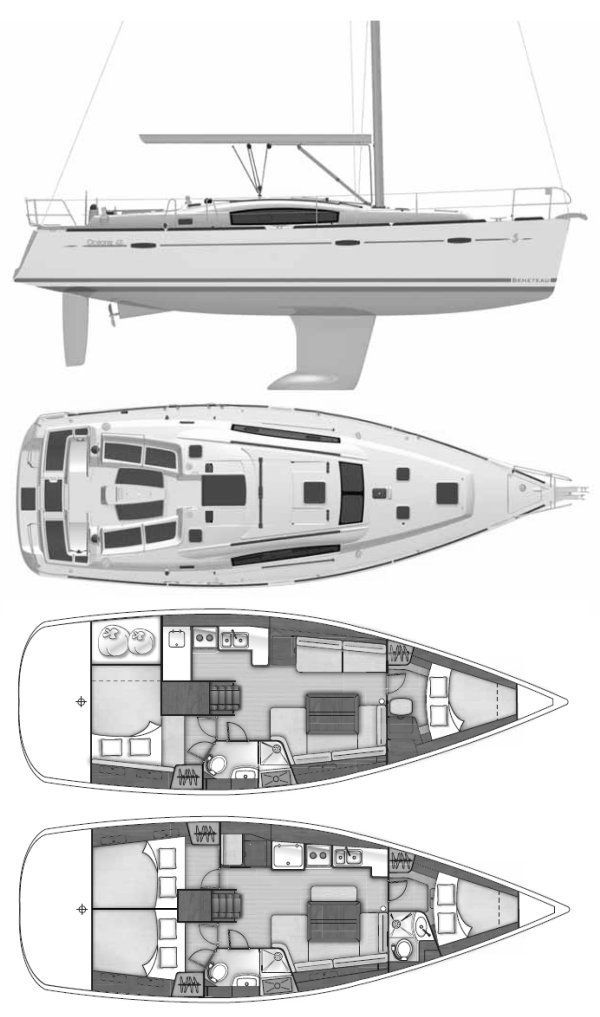
The Oceanis 40 features a modern hull shape with a plumb bow, moderate beam carried aft, and a fin keel with bulb and spade rudder configuration—offering both stability and responsiveness under sail. The hull is solid fiberglass below the waterline, with cored construction above for weight savings, while the deck is typically balsa-cored.
The rig is a fractional sloop with a deck-stepped mast, swept-back spreaders, and a standard furling genoa—designed for ease of handling, especially with small crews. This configuration provides good sail area without excessive complication, although performance purists might prefer a full battened mainsail upgrade.
Overall construction quality is consistent with Beneteau’s standards for series production boats: robust enough for coastal and moderate offshore work, with cost-effective engineering to simplify maintenance. Access to key systems (like the engine, electrical wiring, and steering components) is generally straightforward, which translates into lower long-term service costs.
Performance
Under sail, the Oceanis 40 delivers solid, if not sporty, performance. It excels in moderate wind conditions (10–20 knots), achieving hull speed efficiently thanks to its long waterline (about 33.9 ft). The hull form provides good directional stability, while the spade rudder ensures responsive helm control.
In heavier seas, the boat tracks well and offers a comfortable motion, though its broad stern can slap when reaching or running in short-period waves. Close-hauled performance is respectable for a cruiser, though not razor-sharp—typical of a boat prioritizing comfort over racing pedigree.
Compared to similar models like the Jeanneau Sun Odyssey 39i or the Catalina 400, the Oceanis 40 tends to strike a middle ground—more agile and modern than the Catalina, but not quite as nimble as some Jeanneau offerings. It’s widely considered a trustworthy and comfortable passage-maker, particularly when fitted with upgraded sails and well-trimmed rigging.
Comfort and Accommodations
The interior is where the Oceanis 40 truly stands out. Designed by Nauta, it reflects a clean, contemporary European aesthetic with plenty of natural light, high-quality joinery, and intelligent use of space. Layout options include a two-cabin (with a larger galley and owner’s aft suite) and a three-cabin version favored in charter.
The saloon is generous, with seating for 6–8, good headroom, and excellent ventilation from multiple opening hatches and ports. Galley space is practical for extended cruising, with decent refrigeration and countertop area. Storage is ample throughout, though in the three-cabin version, some deep storage lockers are sacrificed.
Cabins are comfortable and well-ventilated, with adequate separation for privacy. Many owners report the interior aging well, though upholstery and wood veneers may show wear in chartered boats. The ergonomics under sail are solid: handholds are well-placed, and spaces feel safe when heeled, although the open layout can be less secure in rougher offshore conditions.
Safety and Practicality
On deck, the Oceanis 40 features wide side decks, well-placed handrails, and a clean layout that enhances crew safety. The cockpit is large and comfortable for lounging but remains secure in rougher seas with good drainage and high coamings. The twin helm configuration allows easy access to the transom swim platform and improves visibility.
With in-mast furling (common on many models) and all lines led aft, it’s manageable by a couple or even a solo sailor in fair weather. Autopilot and electric windlass are common additions that further ease operation.
Systems are generally accessible and clearly laid out, though water pumps and wiring looms can be tight in the three-cabin layout. Fuel and water tankage are adequate for medium-range cruising, and many owners upgrade with solar, lithium batteries, or watermakers for extended autonomy.
Known Issues with the Beneteau Oceanis 40
Like many production cruisers, the Oceanis 40 has a few recurring issues reported in owner forums:
- Rudder bearings can develop play over time, particularly on heavily used charter models.
- Deck leaks may appear around stanchions or chainplates if bedding isn’t maintained.
- Electrical corrosion in the panel or wiring looms is sometimes seen in high-humidity areas or in ex-charter boats.
- The original propeller is often swapped for a feathering or folding version to improve under-power performance.
There are few structural concerns if the boat has been maintained properly. Osmosis is uncommon, and the hull/deck joint has proven to be reliable. Most owners recommend regular rig checks and upgrading the original electronics suite for modern navigationdes include improved ventilation, modern electronics, a feathering prop, and LED lighting throughout.
Market Availability and Pricing in the U.S.
The Oceanis 40 is no longer in production, replaced by the Oceanis 41 in Beneteau’s updated line. However, it remains widely available on the U.S. used market, especially in Florida, the Chesapeake, and the Pacific Northwest. Many boats are ex-charter and may show heavier cosmetic wear, but well-kept private-owner boats are also common.
As of mid-2025, typical asking prices in the U.S. range between $110,000 and $145,000, depending on year, layout, and equipment. This places it in competition with similarly sized and aged cruisers, where it holds strong value thanks to its livability and wide support network. Here’s how it stacks up against contemporaries:
| Model | LOA | Year Built | Typical Price (USD) | Main Differences |
|---|---|---|---|---|
| Beneteau Oceanis 40 | 39.3 ft | 2007–2011 | $110,000–$145,000 | Modern design, spacious interior, twin helms |
| Jeanneau Sun Odyssey 39i | 38.9 ft | 2006–2010 | $95,000–$130,000 | More performance-oriented, lighter feel under sail |
| Catalina 400 MkII | 41.6 ft | 2001–2009 | $90,000–$125,000 | Robust build, centerline aft berth, U.S. made |
| Hunter 41 | 40.3 ft | 2004–2010 | $95,000–$120,000 | More volume, but less agile under sail |
Maintenance Costs for a Beneteau Oceanis 40 in the USA
Typical Annual Costs:
- Slip or Mooring Fees – For a 40-ft boat, expect $3,500–$7,000/year. East Coast (Chesapeake, New England) is mid-range, Florida and Southern California are at the higher end, while Great Lakes and inland marinas are usually cheaper.
- Winter Storage / Haul-Out – In colder regions, haul-out, winterization, and storage add $2,500–$3,500/year. Warm-climate areas may avoid this cost.
- Insurance – Generally 1–3% of boat value. With an Oceanis 40 valued at $90k–$130k, premiums range $900–$3,900/year, higher in hurricane-prone states.
- Engine Service – Routine maintenance (oil, filters, impeller, belts): $700–$1,200/year.
- Antifouling / Bottom Paint – $1,000–$2,000 annually, depending on DIY vs. professional service.
- Sails and Rigging Maintenance – Annual checks and minor repairs cost $600–$1,200; standing rigging replacement every 10–12 years may cost $7,000–$12,000.
- General Cleaning & Upkeep – $700–$1,200/year for detailing, bottom cleaning, and consumables.
👉 Total Annual Range: $10,000–$20,000/year, depending on region and whether work is DIY or professional.
Periodic / One-Time Major Costs:
- New Sails: A mainsail and genoa set typically costs $5,000–$8,000.
- Electronics Upgrade: Modern instruments, plotters, and autopilot can reach $5,000–$10,000+.
- Rigging Replacement: $7,000–$12,000 every 10–12 years.
- Refits/Repairs: Structural work (hull, deck, rudder, systems) may run $5,000–$15,000+, depending on scope and age.
DIY vs. Professional Maintenance:
- DIY owners can handle antifouling, cleaning, and engine basics, potentially cutting yearly costs by 30–40%.
- Professional services add convenience and expertise but push the budget toward the higher end.
- Most owners choose a mixed strategy: DIY for simple jobs, professionals for rigging, electronics, or haul-out.
For a 40-ft cruising yacht, the Oceanis 40 has medium-to-high ownership costs. While manageable for hands-on owners in lower-cost regions, expenses rise significantly with professional labor and premium slips.
That said, the Oceanis 40 retains good resale value ($90k–$130k in the U.S.), which helps balance long-term investment and makes it an attractive option for sailors seeking comfort and performance in this size range.
Conclusion
The Beneteau Oceanis 40 offers a compelling mix of comfort, performance, and ease of handling that continues to resonate with modern cruisers. Its spacious interior, contemporary design, and twin-helm cockpit make it ideal for couples or families planning coastal cruising or even offshore passages with some upgrades.
While not the fastest boat in its class, its practicality, ease of maintenance, and strong support network make it a smart option for buyers seeking value. For those evaluating a purchase, it’s well worth considering—especially if you find a well-kept, privately owned example. The Oceanis 40 represents one of the better-balanced choices in the 38–41 ft range: practical, versatile, and with enduring appeal on the secondhand market.
Specifications
| Hull Type | Fin w/bulb & spade rudder |
| Rigging Type | Fractional Sloop |
| LOA | 39.86 ft / 12.15 m |
| LOD | 38.78 ft / 11.82 m |
| LWL | 33.96 ft / 10.35 m |
| Beam | 12.83 ft / 3.91 m |
| Displacement | 18,210 lb / 8,260 kg |
| Max Draft | 6.23 ft / 1.90 m |
| Ballast Type | Cast iron |
| Construction | Fiberglass (FG) |
| First Built | 2007 |
| Builder | Beneteau |
| Designer | Berret Racoupeau / Nauta Design |
Auxiliary Power / Tanks | |
| Engine Make | Yanmar |
| Type | Diesel |
| HP | 40 |
| Fuel Capacity | 53 gals / 201 L |
| Water Capacity | 95 gals / 360 L |
Sail Area and Rig Dimensions | |
| I | 49.21 ft / 15.00 m |
| J | 12.96 ft / 3.95 m |
| P | 46.00 ft / 14.02 m |
| E | 15.75 ft / 4.80 m |
| S.A. Fore | 318.88 ft² / 29.62 m² |
| S.A. Main | 362.25 ft² / 33.65 m² |
| S.A. Total (100%) | 681.13 ft² / 63.28 m² |
| S.A. Reported | 843.89 ft² / 78.40 m² |
| Est. Forestay Length | 50.89 ft / 15.51 m |
| Mast Height from DWL | 58.10 ft / 17.71 m |
Sailboat Performance Calculations | |
| S.A./Displ. (calc) | 15.80 |
| Disp./Len. Ratio | 207.57 |
| Comfort Ratio | 26.33 |
| Capsize Screening Formula | 1.95 |
| Hull Speed | 7.81 kn |
| Pounds/Inch Immersion | 1,556.83 lb/in |
| S# | 2.48 |
Disclaimer
The considerations and analyses presented regarding the Beneteau Oceanis 40 sailboat are of a general nature and are based on the available information and technical data on this model, interpreted to the best of our knowledge and understanding. It is important to note that the specific characteristics of any particular sailboat may vary due to custom modifications, maintenance performed, and conditions of use over time, among other factors. Therefore, the details and performance of the boat you are considering may not exactly match the information provided here.
We strongly recommend that, before making any purchasing or usage decisions, you conduct a detailed inspection of the boat in question, consult with nautical professionals and other sailors, and consider your personal needs, expectations, and capabilities. Each sailboat may have unique particularities that affect its performance and suitability for different types of sailing and sailors.
The information contained in this analysis should be used as a general guide and not as a definitive reference. Professional evaluation and personal inspection are essential to ensure that the boat meets your specific requirements and expectations.