


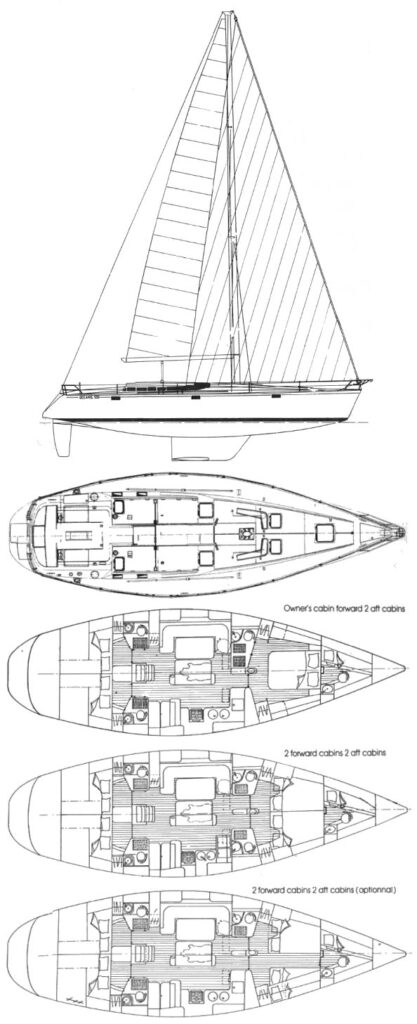
The Beneteau Oceanis 500 is a classic bluewater cruiser designed in the late 1980s, during a period when cruising yachts were evolving to offer more comfort without sacrificing offshore capabilities. Built by Beneteau, one of the world’s largest and most reputable boatbuilders, and penned by naval architect Philippe Briand, the Oceanis 500 was conceived for serious cruising with a strong emphasis on liveaboard comfort and passagemaking potential. With its spacious layout, reliable build quality, and user-friendly systems, the Oceanis 500 quickly gained popularity among private owners, charter fleets, and sailing schools. Today, it remains a highly regarded model in the secondhand market, particularly among long-term cruisers and budget-conscious buyers looking for a large, capable vessel at a reasonable price.
Design and Construction
The Oceanis 500 features a beamy, moderately heavy displacement hull with a fin keel and spade rudder, combining directional stability with responsive handling. Its fiberglass (GRP) construction, with a solid glass hull and balsa-cored deck, offers a good balance between strength and weight. The rig is a masthead sloop—simple, robust, and well-suited to cruising—making sail handling manageable even with a small crew.
Interior layouts typically include 4 or 5 cabins, designed with charter use in mind but also adaptable for private ownership, especially with conversions. The design choices reflect late-80s thinking: conservative yet practical, prioritizing robustness and straightforward maintenance. Access to systems is generally good, and the boat’s conventional lines mean that repairs and upgrades can be done by most marine technicians worldwide. These attributes contribute to a strong residual value, particularly when well-maintained.
Performance
Under sail, the Oceanis 500 delivers solid cruising performance rather than racing excitement. With a sail area/displacement ratio around 16–17 (depending on configuration), it is adequately powered for passagemaking but not overly demanding. It tracks well in moderate to heavy seas and has a reputation for comfort rather than speed. Close-winded performance is acceptable, though the wide hull and generous topsides make it more comfortable on a reach or downwind run.
In comparison with similar boats of the era—like the Jeanneau Sun Odyssey 51 or the Hunter Legend 49—the Oceanis 500 often stands out for its motion comfort and dryness under sail, even if it may not point as high or accelerate as quickly. It is a boat built for people who value reliable, long-distance sailing over sprightly performance.
Comfort and Accommodations
The Oceanis 500 was ahead of its time in interior volume. Its generous beam and nearly plumb bow create an expansive interior with excellent headroom throughout. The main saloon features a large dining area and a fully equipped galley, often located along the port side—a configuration that works well under way. Cabin layouts vary, but many models offer 4 heads and 4 double cabins, ideal for charter or families.
Storage is abundant, although access to deep bilges and lockers can be limited in some layouts. Ventilation is decent thanks to opening hatches and ports, though in tropical climates additional fans or air conditioning may be needed. The interior fit-out, often in light or mid-tone wood veneers, has aged well overall, but soft furnishings and systems (like plumbing or refrigeration) often require updating on older models.
Safety and Practicality
With wide side decks, a solid lifeline system, and a deep cockpit, the Oceanis 500 offers a secure environment on deck. The center cockpit versions are particularly appreciated for offshore use, offering better protection and visibility. Deck hardware is generally oversized and robust, a nod to its ocean-going intent.
The swim platform and transom are less integrated than in newer models, but access to the water is functional. The large cockpit can be singlehanded with electric winches and autopilot, though many owners opt to cruise with at least two people for docking and sail changes. System access for engine, plumbing, and electrics is decent and straightforward, making the boat relatively affordable to maintain despite its size.
Known Issues with the Beneteau Oceanis 500
Over the years, some consistent issues have been reported. Osmosis is a possibility on early hulls if maintenance has been deferred, though Beneteau’s hull layup from this era is generally well-respected. Deck fittings and ports may develop leaks, especially around chainplates and hatches, and electrical systems can be outdated or poorly modified on ex-charter boats.
Upgrades commonly recommended by owners include:
- Reinforcing rudder stocks or steering linkages, which can wear on high-use boats.forced mainsheet traveler setups. These not only enhance usability but also improve resale value.
- Replacing the original Perkins or Yanmar engine with a newer, more efficient model.
- Upgrading refrigeration and adding solar or lithium batteries for energy independence.
Modernizing navigation and autopilot systems.
Market Availability and Pricing in the U.S.
The Oceanis 500 is no longer in production and is available only on the secondhand market. Listings are most common in Florida, the Chesapeake Bay area, and along the West Coast, especially San Diego. Many available boats are ex-charter or have circumnavigation histories, meaning condition varies significantly. Pricing typically ranges from $100,000 to $160,000, depending on engine hours, refits, and ownership history.
Compared to similar boats like the Jeanneau Sun Odyssey 51, Hunter 49, or Catalina Morgan 50, the Oceanis 500 tends to offer more living space and long-term comfort, at the cost of slightly more conservative sailing performance. Its resale value remains strong due to its reputation and simplicity, though the market is narrower due to its size.
Here’s a comparison table:
| Model | LOA | Year | Used Price (USD) | Main Differences |
|---|---|---|---|---|
| Beneteau Oceanis 500 | 50 ft | 1987–1994 | $100,000–$160,000 | Spacious, strong cruiser; ex-charter history common |
| Jeanneau Sun Odyssey 51 | 51 ft | 1989–1995 | $110,000–$170,000 | Sleeker design, better upwind performance |
| Hunter 49 | 49 ft | 2007–2013 | $140,000–$190,000 | More modern systems, easier access layout |
| Catalina Morgan 50 | 50 ft | 1990–1997 | $130,000–$180,000 | Heavy-duty build, better offshore reputation |
Conclusion
The Beneteau Oceanis 500 remains a compelling choice for cruisers seeking a large, ocean-capable sailboat without breaking the bank. Its strengths lie in its spacious interior, solid construction, and proven offshore credentials. For families, liveaboards, or those planning extended passages, it offers significant value. While it may lack some of the flash or speed of newer models, it delivers reliability and comfort in spades.
For buyers willing to invest time in refits or selective upgrades, the Oceanis 500 can be an excellent long-term platform for coastal or bluewater cruising. Its resale value is steady, and its reputation ensures it continues to attract attention in the used market. As an overlooked gem in the 50-foot range, it’s a model well worth considering for practical, comfort-oriented sailors.
Specifications
| Hull Type | Wing Keel |
| Rigging Type | Masthead Sloop |
| LOA | 50.25 ft / 15.32 m |
| LWL | 44.50 ft / 13.56 m |
| Beam | 15.58 ft / 4.75 m |
| Draft (Max) | 6.00 ft / 1.83 m |
| Displacement | 30,700 lb / 13,925 kg |
| Ballast | 10,800 lb / 4,899 kg |
| Construction | Fiberglass (FG) |
| First Built | 1988 |
| Builder | Beneteau (FRA) |
| Designer | Philippe Briand |
| Engine | Perkins 4-236 Diesel, 85 HP |
| Fuel Capacity | 148 gal / 560 L |
| Water Capacity | 265 gal / 1,003 L |
| Sail Area (reported) | 1,115 ft² / 103.59 m² |
| S.A. / Displ. | 18.27 |
| Bal. / Displ. | 35.18 |
| Displ. / Len. | 155.53 |
| Comfort Ratio | 26.50 |
| Capsize Screening Formula | 1.99 |
| Hull Speed | 8.94 kn |
| Pounds/Inch Immersion | 2,477.27 lb/in |
| I / J / P / E | I: 59.55 ft – J: 18.70 ft – P: 51.60 ft – E: 18.04 ft |
| S.A. Fore | 556.79 ft² / 51.73 m² |
| S.A. Main | 465.43 ft² / 43.24 m² |
| Total Sail Area (100%) | 1,022.22 ft² / 94.97 m² |
| Calculated S.A. / Displ. | 16.75 |
| Est. Forestay Length | 62.42 ft / 19.03 m |
| Mast Height from DWL | 63.25 ft / 19.28 m |
Disclaimer
The considerations and analyses presented regarding the Beneteau Oceanis 500 sailboat are of a general nature and are based on the available information and technical data on this model, interpreted to the best of our knowledge and understanding. It is important to note that the specific characteristics of any particular sailboat may vary due to custom modifications, maintenance performed, and conditions of use over time, among other factors. Therefore, the details and performance of the boat you are considering may not exactly match the information provided here.
We strongly recommend that, before making any purchasing or usage decisions, you conduct a detailed inspection of the boat in question, consult with nautical professionals and other sailors, and consider your personal needs, expectations, and capabilities. Each sailboat may have unique particularities that affect its performance and suitability for different types of sailing and sailors.
The information contained in this analysis should be used as a general guide and not as a definitive reference. Professional evaluation and personal inspection are essential to ensure that the boat meets your specific requirements and expectations.