


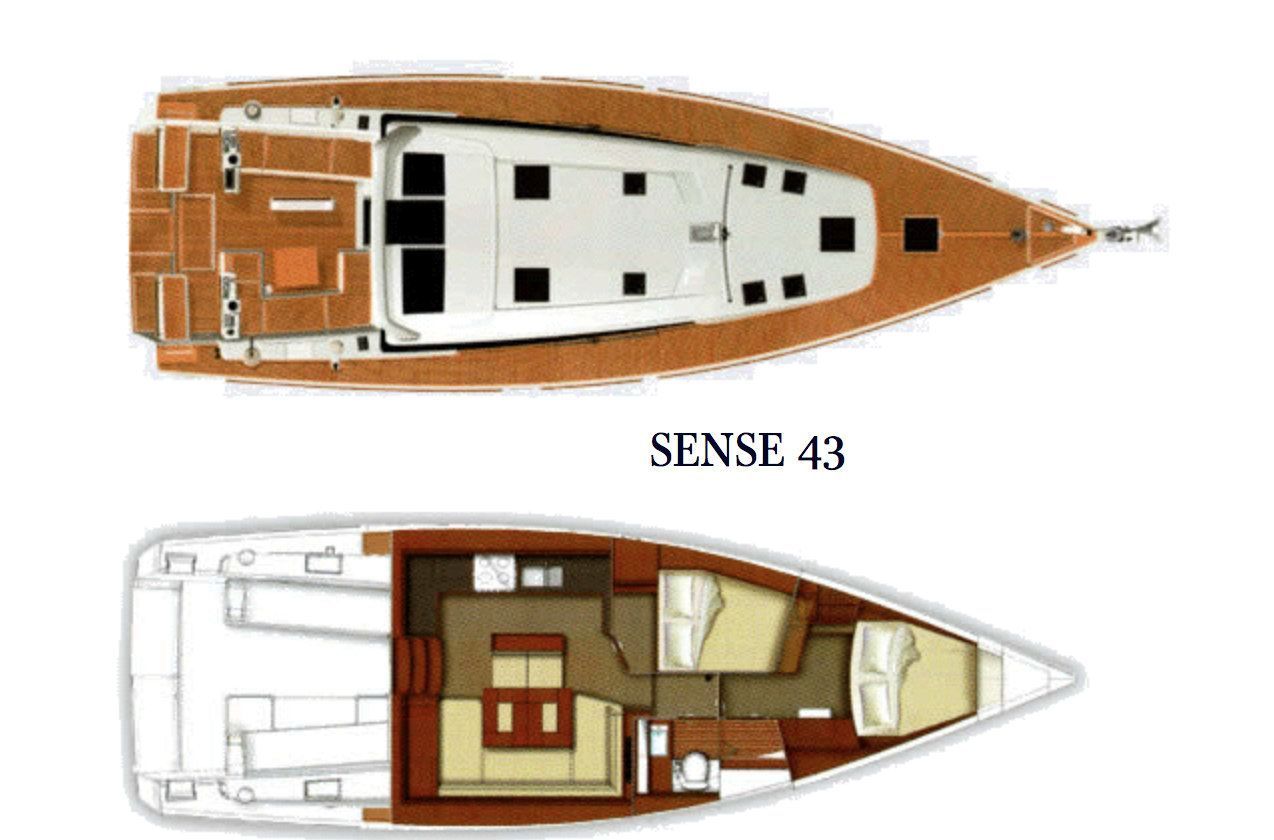
The Beneteau Sense 43 is a modern cruising sailboat launched in the early 2010s by the renowned French shipyard Beneteau, designed in collaboration with naval architects Berret-Racoupeau and interior stylists Nauta Design. Intended primarily as a comfortable cruiser rather than a performance racer, the Sense 43 introduced a fresh take on liveaboard and bluewater sailing with a strong focus on open spaces, ease of handling, and lifestyle comfort.
Positioned as part of the innovative “Sense” line, which debuted in 2010, the 43-foot model quickly earned attention for its unique layout and forward-thinking design. It appeals primarily to cruising couples, small families, and retirees seeking extended coastal or moderate offshore adventures. In the secondhand market, the Sense 43 remains in steady demand among private owners and, to a lesser extent, charter companies focused on premium offerings. Buyers are often drawn by its contemporary lines, single-level living concept, and reputation for comfort at anchor.
Design and Construction
The Sense 43 departs from conventional cruiser design in several notable ways. Its hull features a modern, beamy shape with pronounced chines and a wide transom, providing exceptional form stability and interior volume. It carries a deep fin keel with bulb (6’7”) or optional shoal draft (5’9”) for versatility in coastal cruising, and twin rudders—an increasingly common solution for wide-stern yachts, offering better control under heel and redundancy offshore.
Rigged as a sloop with a deck-stepped mast and swept-back spreaders, the sail plan emphasizes balance and ease of handling over performance tuning. The materials used are primarily fiberglass with a balsa-cored sandwich above the waterline, optimizing weight and insulation. These materials are industry standard for production yachts and ensure reasonable longevity if well-maintained, although they can be vulnerable to water intrusion over time if fittings are poorly bedded.
The boat’s hallmark is its unusual interior-exterior integration: the cockpit and salon are nearly on the same level, connected by just three shallow steps—a design choice that enhances mobility and makes life onboard more accessible, particularly for older sailors or those living aboard. Structurally, Beneteau employed modular interior elements and injection-molded liners to speed up production, which aids consistency but can complicate major retrofits or custom repairs.
Performance
Under sail, the Sense 43 delivers a composed and comfortable ride rather than spirited speed. Its wide beam provides initial stability and reduces rolling at anchor, while the dual rudders maintain good grip even when heeled. In light winds, performance is adequate, though she benefits from early reefing when winds build due to her large sail area and relatively high topsides.
The yacht points reasonably well to windward for a cruiser but won’t outpace more performance-oriented hulls like those from X-Yachts or Elan. Her real strength lies in reaching and downwind courses, where she tracks steadily and remains manageable with a small crew. With the right sail trim and attentive helming, the Sense 43 can cover respectable distances in comfort, though her primary virtue is not speed but relaxed, predictable cruising.
Compared to similarly sized cruisers from the same era, such as the Jeanneau Sun Odyssey 439 or Catalina 445, the Sense 43 is noted for superior helm feel under load and a quieter, more composed motion in moderate seas, thanks in part to its lower center of gravity and robust hull form.
Comfort and Accommodations
One of the defining attributes of the Sense 43 is its livability. Designed with cruising comfort in mind, the interior features an airy salon, generous galley, and two or three-cabin layouts. The salon’s panoramic windows and light oak finishes create a bright and open atmosphere, enhanced by the minimal steps between cockpit and interior.
For a couple or small family, the accommodations are excellent. The forward owner’s cabin includes an island berth and en suite head with separate shower—a rare luxury in a 43-foot monohull. Aft, the cabins are spacious thanks to the wide beam carried well aft, though headroom is slightly compromised under the cockpit sole.
Storage is abundant for coastal cruising, though bluewater sailors may find the tankage modest unless upgraded. Ventilation is well handled through opening ports and overhead hatches, while ergonomics throughout are notably well-conceived. The overall layout is ideal for extended living aboard or seasonal cruising, and many examples show minimal interior wear thanks to durable materials and finishes that have aged gracefully.
Safety and Practicality
From a safety standpoint, the Sense 43 is thoughtfully designed. The wide cockpit with twin wheels and open transom allows easy access to the water or dock, while the hard chine hull offers excellent directional stability. Handholds are well-placed inside and out, and side decks are wide and unobstructed, aiding safe movement while underway.
However, the open cockpit does make it somewhat exposed in heavy seas, though optional sprayhoods and biminis help mitigate this. With all lines led aft to the helm and optional electric winches, the boat is easily sailed short-handed. The integration of systems is clean and logical, and engine access under the companionway steps is sufficient for most routine maintenance. Accessibility to plumbing and electrical components is typical of Beneteau production standards—not exceptional, but functional.
Known Issues with the Beneteau Sense 43
Owners and surveyors have identified a few recurring concerns with the Sense 43. Some early hulls reported minor gelcoat cracking around chainplates or deck fittings, usually cosmetic but worth monitoring. As with many Beneteaus, water intrusion through deck hardware due to inadequate bedding over time can lead to core saturation.
Engine access is fair, but the factory-installed Yanmar 54HP has occasionally been criticized for tight working room in the alternator and impeller area. Electrical systems are generally reliable, though some owners have upgraded original electronics (Simrad or Raymarine, depending on year) due to obsolescence or performance limitations.
Improved ground tackle and upgraded autopilot systems are common modifications, especially among long-distance cruisers. Some owners also choose to reinforce cabinetry or add extra tankage. Osmosis is not widely reported, but pre-purchase surveys are essential to check for localized blistering or moisture intrusion.
Market Availability and Pricing in the U.S.
The Beneteau Sense 43 is no longer in production and is found exclusively on the secondhand market. In the U.S., listings are most common in sailing hubs such as Florida, the Chesapeake, Southern California, and the Pacific Northwest. Boats are typically in decent condition, though ex-charter models (mostly from the Caribbean) may show more cosmetic wear and require rigging or electronics updates.
As of mid-2025, prices range from $175,000 to $230,000, depending on condition, equipment, and location. This positions the Sense 43 competitively against comparable 40–45 foot cruisers, especially when considering the interior design and comfort levels.
Here’s a comparison with similar cruisers on the U.S. market:
| Model | LOA | Year Built | Used Price (USD) | Key Differences |
|---|---|---|---|---|
| Beneteau Sense 43 | 43’5” | 2011–2015 | $175,000–$230,000 | Modern layout, twin rudders, deck/salon integration |
| Catalina 445 | 44’7” | 2010–present | $210,000–$260,000 | Traditional interior, robust construction, single rudder |
| Jeanneau Sun Odyssey 439 | 43’9” | 2012–2016 | $190,000–$240,000 | Similar cockpit comfort, faster under sail, slightly more complex systems |
| Hunter 45DS | 45’0” | 2006–2014 | $160,000–$210,000 | Raised deck salon, spacious interior, less agile under sail |
Conclusion
The Beneteau Sense 43 stands out as a bold reinterpretation of the modern cruising yacht. Its strengths lie in innovative design, exceptional comfort, and easy handling, making it particularly well-suited for cruising couples, liveaboards, or families prioritizing lifestyle over high-performance sailing.
Weaknesses are relatively minor and generally revolve around production-level build limitations and some system aging typical of a 10+ year-old vessel. For those seeking a stylish, user-friendly platform with strong resale potential and excellent onboard comfort, the Sense 43 remains an appealing, often underrated choice in the 40–45 ft cruiser market. As long as the buyer conducts a thorough survey and is prepared for modest updates, this yacht represents a smart and enjoyable investment for real-world coastal cruising.
Specifications
| Hull Type | Fin w/bulb & dual rudders |
| Rigging Type | Fractional Sloop |
| LOA | 43.16 ft / 13.16 m |
| LWL | 39.16 ft / 11.94 m |
| Sail Area (reported) | 912.00 ft² / 84.73 m² |
| Beam | 14.00 ft / 4.27 m |
| Displacement | 22,200 lb / 10,070 kg |
| Ballast | 5,842 lb / 2,650 kg |
| Max Draft | 6.58 ft / 2.01 m |
| Construction | Fiberglass (FG) |
| First Built | 2011 |
| Builder | Beneteau |
| Designer | Berret-Racoupeau |
Auxiliary Power / Tanks (original equipment) | |
| Engine Make | Yanmar |
| Engine Type | Diesel |
| Engine HP | 56 HP |
| Fuel Capacity | 116 gal / 439 L |
| Water Capacity | 178 gal / 674 L |
Sailboat Calculations | |
| S.A. / Displacement | 18.55 |
| Ballast / Displacement | 26.32 |
| Displacement / Length | 165.04 |
| Comfort Ratio | 25.30 |
| Capsize Screening Formula | 2.00 |
| Hull Speed | 8.39 kn |
| Pounds/Inch Immersion | 1,958.92 lb/in |
Disclaimer
The considerations and analyses presented regarding the Beneteau Sense 43 sailboat are of a general nature and are based on the available information and technical data on this model, interpreted to the best of our knowledge and understanding. It is important to note that the specific characteristics of any particular sailboat may vary due to custom modifications, maintenance performed, and conditions of use over time, among other factors. Therefore, the details and performance of the boat you are considering may not exactly match the information provided here.
We strongly recommend that, before making any purchasing or usage decisions, you conduct a detailed inspection of the boat in question, consult with nautical professionals and other sailors, and consider your personal needs, expectations, and capabilities. Each sailboat may have unique particularities that affect its performance and suitability for different types of sailing and sailors.
The information contained in this analysis should be used as a general guide and not as a definitive reference. Professional evaluation and personal inspection are essential to ensure that the boat meets your specific requirements and expectations.