



The Sabre 34 was conceived in the late 1970s by Sabre Yachts of Maine, a yard recognized for its blend of traditional craftsmanship and practical design for American cruising conditions. Intended as a performance-oriented cruiser rather than a pure racer, the boat embodies the era’s trend of blending seaworthy hulls with comfortable interiors. Designed for coastal cruising families and couples, it also appealed to sailors who valued quality over mass-production. On the second-hand market, it has remained a popular choice, particularly among private owners looking for a reliable coastal or limited offshore cruiser, rather than charter fleets or sailing schools.
Design and Construction
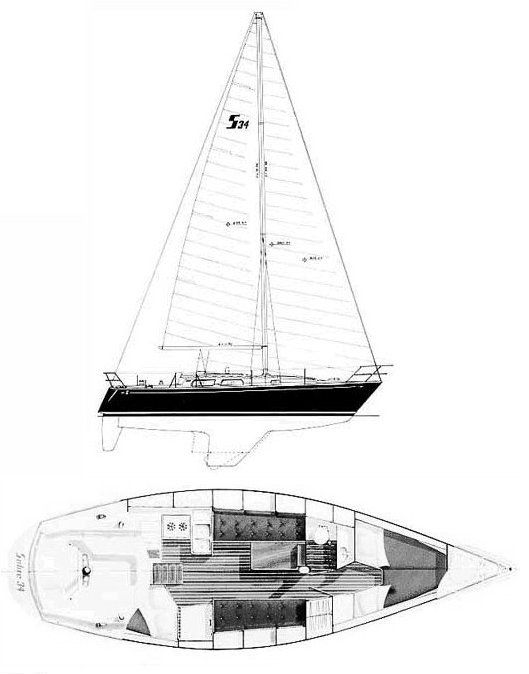
The hull of the Sabre 34 is a moderate-displacement fin keel design paired with a skeg-hung rudder, striking a balance between performance and directional stability. With a masthead sloop rig, the sail plan is efficient yet manageable, suitable for shorthanded sailing without losing power in lighter airs. Construction relies on hand-laid fiberglass with balsa-cored decks, a common method of the time that provided stiffness without excessive weight. Sabre’s reputation for robust structural integrity has meant that many boats still hold their shape decades later. The combination of solid fiberglass hulls and quality joinery inside makes these yachts comparatively easier to maintain and retain resale value, provided core issues in the deck are kept under control.
.
Performance
Under sail, the Sabre 34 is recognized for its lively yet predictable handling. It heels moderately, tracks well, and maintains decent speed for its class, with a hull speed just under seven knots. Upwind, the relatively fine entry and balanced rig give it good pointing ability, especially compared to heavier coastal cruisers like the Catalina 34. In heavier seas, the skeg-hung rudder provides confidence and less fatigue on the helm, while in lighter airs it is still responsive enough to satisfy sailors who appreciate performance. Among its contemporaries, it sits comfortably between the nimble feel of a Tartan 34 and the more relaxed motion of a Hunter 34, making it versatile for both day sailing and extended passages.
Comfort and Accommodations
The interior layout reflects Sabre’s traditional Maine boatbuilding ethos: teak joinery, quality cabinetry, and practical arrangements. The layout typically includes a V-berth forward, a convertible salon, and an aft quarter berth, accommodating a small family or two couples. Storage is generous for a boat under 35 feet, with thought given to long weekends or moderate cruising. Ventilation through opening ports and hatches is adequate, though not as abundant as in modern French designs. The finish tends to age gracefully; many Sabre 34s on the market still retain their original woodwork, sometimes enhanced by owner upgrades. For longer liveaboard use, space is modest, but for week-long cruises or coastal passages, comfort is entirely sufficient.
Safety and Practicality
On deck, the Sabre 34 offers wide side decks and solid handholds, giving security under sail. The cockpit is deep enough to feel safe offshore, though not oversized. Hardware and winches were originally well-sized and remain practical, though many boats benefit from updated self-tailing winches. With a conservative sail plan and sturdy rig, the boat can be managed by a couple or even singlehanded with minor upgrades such as autopilot or roller furling. For safety, the robust keel-to-hull joint and substantial rudder design make it capable of more than just coastal cruising; properly equipped, it has been sailed offshore. Systems access is straightforward, another reflection of Sabre’s thoughtful engineering, keeping maintenance costs more predictable.
Known Issues with the Sabre 34
As with many boats of its age, potential buyers should look for signs of deck core moisture or delamination, particularly around hardware fittings. Engine installations, often Universal diesels, may now be approaching end-of-life unless already repowered. Original wiring and electronics may also need replacement. Some owners report leaks at portlights and hatches, though these are generally solvable with refits. Improvements commonly seen include new standing rigging, updated sail inventories, modern electronics, and occasionally conversion to feathering or folding propellers to improve motoring efficiency. None of these issues are unique to the Sabre 34, but they are typical concerns for yachts of its vintageigging, a feathering prop in high-current venues, LED nav/house lighting, and contemporary instrumentss.
Market Availability and Pricing in the U.S.
The Sabre 34 is no longer in production and is found only on the used market. In the U.S., they are most frequently seen in New England and along the East Coast, reflecting their Maine heritage. Listings in Florida and the Great Lakes also appear regularly. Condition varies, but many examples have been kept in private hands with a culture of careful ownership. Asking prices typically range from $25,000 to $45,000, depending on year, upgrades, and condition. Compared to similar boats like the Catalina 34, Hunter 34, or Jeanneau Attalia, the Sabre tends to command a slight premium due to build quality and brand reputation. Resale is generally strong in regions where Sabre yachts are known and appreciated.
Comparable models:
| Model | LOA | Year (approx.) | Used Price Range (U.S.) | Key Differences |
|---|---|---|---|---|
| Sabre 34 | 34 ft | 1978–1985 | $25,000–$45,000 | Higher-quality build, balanced performance, traditional finish |
| Catalina 34 | 34 ft | 1986–2000s | $20,000–$40,000 | Roomier interior, mass production, lighter construction |
| Hunter 34 | 34 ft | 1983–1987 | $18,000–$35,000 | More interior volume, less robust offshore capability |
| Tartan 34C | 34 ft | 1968–1978 | $22,000–$40,000 | Classic design, good offshore reputation, narrower interior |
| Jeanneau Attalia 32 | 32 ft | 1980s | $18,000–$30,000 | European styling, lighter build, more agile but less traditional |
Maintenance Costs of a Sabre 34 in the USA
Annual ownership costs for a Sabre 34 depend heavily on location. In New England or the Great Lakes, annual dockage or mooring fees may run $3,000–$6,000, while in Florida or California, marina slips can easily reach $7,000–$10,000. Insurance typically falls between $800 and $1,500 annually. Routine engine service averages $500–$1,000 per year, antifouling paint about $1,500 every 18–24 months, and standing rigging inspection or replacement cycles can cost $4,000–$6,000 every 10–15 years. Sail replacement runs $6,000–$9,000 for a full set, while electronics refits vary widely but often exceed $5,000. For hands-on owners who can perform basic maintenance themselves, costs can be reduced substantially; however, the Sabre 34 is also friendly to professional service due to its accessible systems. Overall, annual running costs can be considered medium for a boat of this size—significantly lower than larger cruisers but proportionally higher than lighter production models. Its strong resale values help offset these investmentsork (or catching up on deferred maintenance) moves costs to the high end. Netting it out, the Cal 34’s cost of ownership is medium for a 34-footer: modest systems, good parts availability, and a simple glass hull keep surprises in check, and resale values in active Cal regions help recover upgrades, especially on diesel-repowered, dry-deck examples.
Conclusion
The Sabre 34 represents a well-balanced choice for sailors seeking a capable coastal cruiser with a touch of offshore pedigree. Its strengths lie in its build quality, predictable sailing performance, and enduring reputation among knowledgeable sailors. Weaknesses are primarily those of age—engine hours, dated systems, and the need for occasional refits—but these are not deal-breakers for a boat that continues to command respect. For buyers looking for a sturdy, well-regarded 34-footer, it remains a smart investment, with good resale prospects and a practical balance of comfort, safety, and performance. While alternatives like the Catalina 34 offer more volume and the Hunter 34 lower entry costs, the Sabre holds its place as a thoughtful, enduring option for serious coastal cruising and weekend adventures alike.
Specifications
| Hull Type | Fin with rudder on skeg |
| Rigging Type | Masthead Sloop |
| LOA | 34.17 ft / 10.42 m |
| LWL | 28.25 ft / 8.61 m |
| S.A. (reported) | 541.00 ft² / 50.26 m² |
| Beam | 11.17 ft / 3.40 m |
| Displacement | 11,500 lb / 5,216 kg |
| Ballast | 4,600 lb / 2,087 kg |
| Max Draft | 6.00 ft / 1.83 m |
| Construction | Fiberglass (FG) |
| Ballast Type | Lead |
| First Built | 1986 |
| Last Built | 1991 |
| # Built | 170 |
| Builder | Sabre Yachts (USA) |
| Designer | Roger Hewson / Sabre |
| Auxiliary Power (orig.) | Westerbeke 27-4, Diesel, 27 HP |
| Fuel Capacity | 25 gals / 95 L |
| Water Capacity | 75 gals / 284 L |
| S.A. / Displ. | 17.05 |
| Bal. / Displ. | 40.00 |
| Disp. / Len. | 227.72 |
| Comfort Ratio | 23.79 |
| Capsize Screening Formula | 1.98 |
| S# | 2.40 |
| Hull Speed | 7.12 kn |
| Pounds/Inch Immersion | 1,127.50 pounds/inch |
| I | 44.70 ft / 13.62 m |
| J | 13.75 ft / 4.19 m |
| P | 39.10 ft / 11.92 m |
| E | 11.90 ft / 3.63 m |
| S.A. Fore | 307.31 ft² / 28.55 m² |
| S.A. Main | 232.65 ft² / 21.61 m² |
| S.A. Total (100% Fore + Main Triangles) | 539.96 ft² / 50.16 m² |
| S.A. / Displ. (calc.) | 17.02 |
| Est. Forestay Length | 46.77 ft / 14.26 m |
Disclaimer
The considerations and analyses presented regarding the Sabre 34 sailboat are of a general nature and are based on the available information and technical data on this model, interpreted to the best of our knowledge and understanding. It is important to note that the specific characteristics of any particular sailboat may vary due to custom modifications, maintenance performed, and conditions of use over time, among other factors. Therefore, the details and performance of the boat you are considering may not exactly match the information provided here.
We strongly recommend that, before making any purchasing or usage decisions, you conduct a detailed inspection of the boat in question, consult with nautical professionals and other sailors, and consider your personal needs, expectations, and capabilities. Each sailboat may have unique particularities that affect its performance and suitability for different types of sailing and sailors.
The information contained in this analysis should be used as a general guide and not as a definitive reference. Professional evaluation and personal inspection are essential to ensure that the boat meets your specific requirements and expectations.