


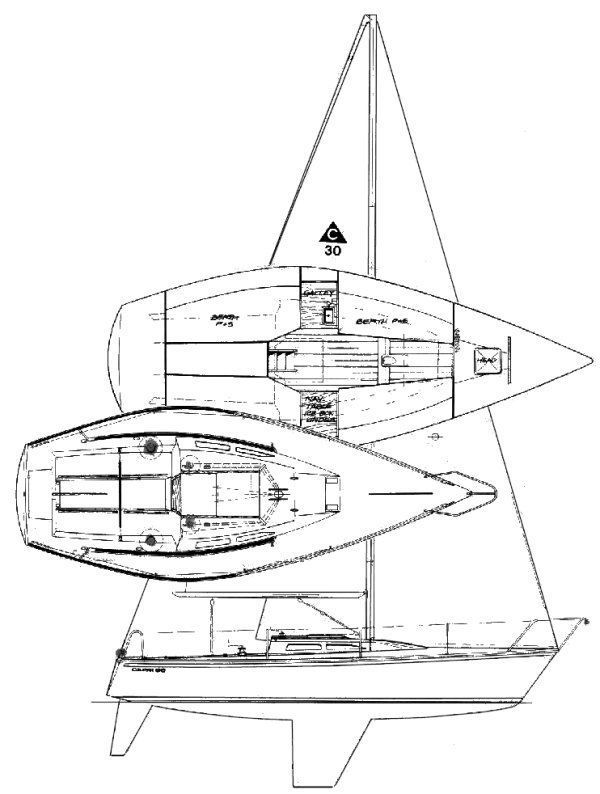
The Catalina Capri 30 was introduced in 1989 by Catalina Yachts, one of America’s most prolific and respected sailboat builders. Designed by Frank Butler and Gerry Douglas, the Capri 30 was intended as a performance-oriented racer-cruiser—more spirited and responsive than the popular Catalina 30, but still offering decent accommodations below. With its racy lines and practical layout, the Capri 30 carved a niche among sailors who wanted weekend comfort without sacrificing the thrill of a responsive hull.
Although production ended in the late 1990s, the Capri 30 maintains a modest but steady presence in the U.S. used boat market. It’s a favorite among club racers, sailing schools looking for a more dynamic trainer, and private owners seeking a budget-friendly performance cruiser with personality. The demand today is strongest among sailors who want more agility than a traditional cruiser but still need basic onboard amenities.
Design and Construction
The hull of the Capri 30 is relatively light and narrow compared to its cruising counterparts, designed with performance in mind. It features a fin keel with a spade rudder—hallmarks of responsive handling and upwind ability. Most versions have a deep draft (around 5.25 feet), though some shoal-draft versions exist. This keel/rudder combo delivers excellent pointing ability and maneuverability but limits access in very shallow waters.
The boat is rigged as a masthead sloop, with a tall rig and generous sail area that favor light-air performance. The construction is traditional Catalina: solid fiberglass hull with a balsa-cored deck. This approach balances strength and weight while keeping costs down, though it does require attention to moisture intrusion at deck fittings over time.
The deck layout is simple and race-ready. All lines lead aft, and the open cockpit is deep and functional. The tiller steering enhances feel and allows for easy crew movement, especially when racing. The combination of practical design choices and durable construction gives the Capri 30 a reputation for being easy to maintain and relatively forgiving to own.
Performance
The Capri 30 shines under sail. With a displacement-to-length ratio under 200 and a sail area-to-displacement ratio around 17, the boat is clearly built for speed. It accelerates quickly, points well, and feels lively on the helm. In flat water and moderate breeze, it can easily cruise at 6–7 knots. In a breeze, it rewards good sail trim and crew coordination, making it popular among club racers.
Compared to boats like the Catalina 30 or Hunter 30, the Capri 30 is noticeably more responsive and exciting to sail. It tacks quickly, balances well under both main and headsail, and has enough stiffness to carry sail comfortably in gusty conditions. While not a bluewater cruiser, it handles coastal chop and moderate seas with confidence, making it a solid performer for weekend passage-making.
Comfort and Accommodations
Below deck, the Capri 30 offers a spartan but usable cruising interior. The layout typically includes a V-berth forward, a convertible dinette in the saloon, a compact galley, and an enclosed head. The aft quarter berth provides additional sleeping space, allowing the boat to sleep four to five adults in close quarters.
Headroom is limited (around 5’10”), and the interior finishes are functional rather than luxurious. However, the use of teak trim and Catalina’s efficient space planning keep it from feeling too utilitarian. Storage is modest, but adequate for short cruising. Ventilation is decent thanks to opening ports and hatches.
This is not a boat for extended living aboard, but for weekend escapes or overnight racing events, it offers just enough comfort. Many examples on the market have been lightly modified or upgraded, with new upholstery, LED lighting, or modern galley gear.
Safety and Practicality
On deck, the Capri 30 offers good footing and secure handholds, with wide-enough side decks to move forward safely. The cockpit is deep and offers protection from waves, though in heavy seas, the open transom may let in some spray. The tiller setup and well-organized controls make it manageable with a small or inexperienced crew, which is part of its appeal for schools and casual racers.
While the boat is primarily suited for coastal and inshore cruising, it can handle overnight passages and longer coastal hops with competent crew and planning. The systems—engine, plumbing, and electrical—are generally straightforward and accessible, minimizing service headaches. Many boats came with inboard diesels (commonly Universal or Yanmar), though some have been repowered or converted to outboards.
Known Issues with the Catalina Capri 30
Like many boats of its age and type, the Capri 30 can suffer from a few recurring issues. Moisture intrusion in the deck core is a known problem, especially around stanchions and chainplates. Soft spots on the deck should be carefully checked in any pre-purchase survey.
The original engine installations can be tight, making maintenance challenging. Leaking stuffing boxes and aging fuel systems are common in older models. Some boats may exhibit signs of gelcoat crazing or minor hull blistering, though this is typically cosmetic.
On the sailing side, original deck hardware may be undersized for serious racing loads. Many owners have upgraded winches, lines, and blocks for improved handling. Some have also added stronger rudder posts or keel bolt reinforcements, especially in boats that have seen competitive use original electronics, and reinforcing the rudder post bracket if signs of play or flex appear.
Market Availability and Pricing in the U.S.
The Catalina Capri 30 is only available on the used market, with examples most commonly found in coastal racing hubs such as Southern California, Chesapeake Bay, and the Great Lakes. Prices generally range from $12,000 to $25,000, depending on engine condition, sail inventory, electronics, and cosmetic upkeep.
Many of the boats available today were owned by club racers or experienced sailors, so upgrades are common. However, neglected models with tired systems can be found at the lower end of the price range and may require significant investment. Well-maintained examples with newer sails and electronics tend to move quickly, especially in active sailing communities.
Below is a comparison with similar sailboats from the same era:
| Model | LOA | Year | Typical Price (USD) | Main Differences |
|---|---|---|---|---|
| Catalina Capri 30 | 29.5 ft | 1989–1995 | $12,000–$25,000 | Racer-cruiser, responsive handling, limited interior space |
| Hunter 30T | 30.5 ft | 1991–1994 | $18,000–$30,000 | Roomier interior, less performance-oriented, in-mast furling common |
| Jeanneau Sun Fast 31 | 30.5 ft | 1991–1997 | $20,000–$35,000 | Better offshore capability, European styling, more complex systems |
| J/30 | 29.9 ft | 1979–1986 | $16,000–$32,000 | Faster, more race-focused, aging fleet but strong support network |
Conclusion
The Catalina Capri 30 is an ideal boat for sailors seeking a true racer-cruiser in an affordable and manageable package. Its standout sailing performance, simple systems, and Catalina build quality make it a reliable and fun platform for both casual cruising and spirited club racing.
While it lacks the luxurious interior of heavier cruisers, it delivers more than enough comfort for short trips and makes up for it in responsiveness and speed. For sailors looking for a boat that’s more lively than a traditional Catalina 30 but still practical to own and maintain, the Capri 30 is an underrated gem. With solid resale value, an active user base, and a manageable ownership experience, it remains a smart choice in the 30-foot class.
Specifications
| Hull Type | Fin with spade rudder |
| Rigging Type | Masthead Sloop |
| LOA (Length Overall) | 29.50 ft / 8.99 m |
| LWL (Length Waterline) | 24.17 ft / 7.37 m |
| Beam | 11.17 ft / 3.40 m |
| Draft (Max) | 5.33 ft / 1.62 m |
| Displacement | 4,985 lb / 2,261 kg |
| Ballast | 2,300 lb / 1,043 kg |
| Construction | Fiberglass (FG) |
| First Built | 1982 |
| Builder | Catalina Yachts (USA) |
| Designer | Frank Butler |
Performance Ratios & Calculations | |
|---|---|
| Sail Area / Displacement | 25.24 |
| Ballast / Displacement | 46.14% |
| Displacement / Length | 157.61 |
| Comfort Ratio | 12.02 |
| Capsize Screening Formula | 2.62 |
| Hull Speed | 6.59 knots |
| Pounds/Inch Immersion | 964.66 lb/in |
| Stability Index (S#) | 4.29 |
Rig and Sail Particulars | |
| I (foretriangle height) | 40.33 ft / 12.29 m |
| J (foretriangle base) | 12.00 ft / 3.66 m |
| P (mainsail luff) | 36.83 ft / 11.23 m |
| E (mainsail foot) | 11.75 ft / 3.58 m |
| Sail Area – Foretriangle | 241.98 ft² / 22.48 m² |
| Sail Area – Mainsail | 216.38 ft² / 20.10 m² |
| Total Sail Area | 458.36 ft² / 42.58 m² |
| SA/Displacement (calc.) | 25.20 |
| Estimated Forestay Length | 42.08 ft / 12.83 m |
| Mast Height from DWL | 44.00 ft / 13.41 m |
Disclaimer
The considerations and analyses presented regarding the Catalina Capri 30 sailboat are of a general nature and are based on the available information and technical data on this model, interpreted to the best of our knowledge and understanding. It is important to note that the specific characteristics of any particular sailboat may vary due to custom modifications, maintenance performed, and conditions of use over time, among other factors. Therefore, the details and performance of the boat you are considering may not exactly match the information provided here.
We strongly recommend that, before making any purchasing or usage decisions, you conduct a detailed inspection of the boat in question, consult with nautical professionals and other sailors, and consider your personal needs, expectations, and capabilities. Each sailboat may have unique particularities that affect its performance and suitability for different types of sailing and sailors.
The information contained in this analysis should be used as a general guide and not as a definitive reference. Professional evaluation and personal inspection are essential to ensure that the boat meets your specific requirements and expectations.