



The Endeavour 37 was introduced in the mid-1970s by Endeavour Yachts, a Florida-based builder known for producing solid, practical cruising sailboats aimed at the American coastal and Caribbean market. Designed primarily as a cruising vessel rather than a racer, the Endeavour 37 quickly appealed to sailors seeking comfort, durability, and ease of handling rather than cutting-edge performance. It was produced in both sloop and ketch configurations, which widened its appeal to private owners, liveaboards, and charter operators. Today, it remains relatively common on the used market, especially in the southeastern United States, where it still draws interest from coastal cruisers, sailing schools, and budget-minded buyers who want a sturdy bluewater-capable boat without the premium pricing of European imports.
Design and Construction
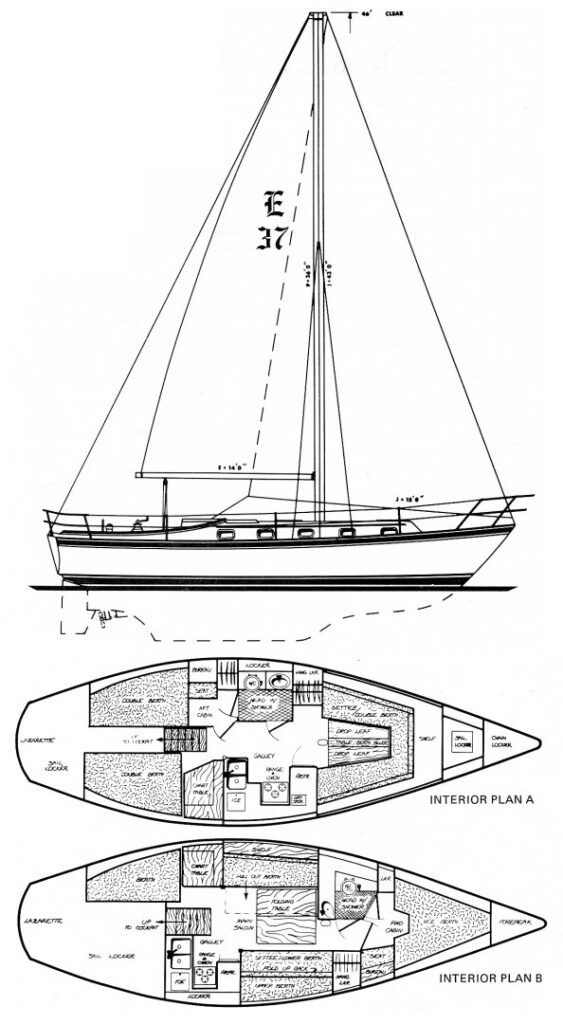
The Endeavour 37 features a moderately heavy displacement hull with a long fin keel and a skeg-hung rudder. This configuration provides directional stability and some protection to the steering gear, a compromise between the maneuverability of a fin and the ruggedness of a full keel. The rig was offered as both masthead sloop and ketch, with the latter popular among cruisers for its more versatile sail plan and easier handling in heavy air. Built from hand-laid fiberglass with substantial thickness in the hull, the construction favors strength and longevity, though it adds weight that influences performance. Deck layouts tend to be straightforward, reflecting a philosophy of function over flash. From a naval architecture standpoint, its design prioritizes seaworthiness and ease of repair over speed, which contributes to its relatively stable resale value in the used market.
Performance
Under sail, the Endeavour 37 is known for solid if unspectacular performance. It is not a fast boat, especially compared with lighter contemporaries, but it is steady and predictable. With its ballast-to-displacement ratio and relatively wide beam, the boat maintains good stability, though it can feel sluggish in light air. In moderate to heavy wind, it becomes more comfortable, with the ketch rig in particular giving owners the flexibility to shorten sail early and keep balance. It tracks well offshore and is forgiving to hand-steering or autopilot. Compared to rivals like the Catalina 36 or Hunter 37, the Endeavour is less lively but often considered more forgiving and reassuring, particularly for cruisers who value safety and comfort over speed.
Comfort and Accommodations
The interior of the Endeavour 37 was designed with long-term living in mind. It typically offers a spacious salon with opposing settees, a functional galley, a nav station, and either a V-berth forward or an aft cabin, depending on the configuration. Headroom is generous for its era, and there is ample storage for extended cruising. Ventilation is decent, thanks to hatches and opening ports, though older examples often benefit from upgraded hardware. Many boats have seen interior refits, replacing original wood finishes and upholstery. For couples or small families, the layout works well for extended coastal or Caribbean cruising, though it may feel tight for larger crews on long passages.
Safety and Practicality
On deck, the Endeavour 37 offers wide side decks and sturdy handholds, making movement reasonably safe even in rough weather. The cockpit is secure and designed more for protection than racing ergonomics. With a moderate draft (around 4.5 to 5 feet), it is suitable for coastal cruising in areas like Florida and the Bahamas while retaining offshore capability. Systems access is generally straightforward, though some owners report cramped engine spaces. Overall, the boat is manageable by a short-handed crew, and with proper upgrades, it can be prepared for offshore passages.
Known Issues with the Endeavour 37
Like many boats of its age, common concerns include deck core moisture around fittings, potential osmosis in the hull, and worn-out fuel or water tanks. The original Perkins or Westerbeke engines, if still installed, may be near the end of their service life, though many have been repowered with newer diesels. Chainplates, mast steps, and older electrical systems are also points of inspection. Owners often recommend upgrades such as modern electronics, new standing rigging, and improved ventilation. These refits can significantly enhance reliability and comfort but should be factored into purchase negotiations.
Market Availability and Pricing in the U.S.
The Endeavour 37 is no longer in production and is available only on the used market. Most listings are found in Florida, the Gulf Coast, and the Chesapeake Bay area. Condition varies widely: some are well-kept by liveaboards, while others are project boats requiring major investment. On the U.S. market, prices typically range from $25,000 to $45,000, depending on upgrades, condition, and equipment. This places the Endeavour 37 below the pricing of comparable Jeanneau or Beneteau models of the same size but in line with older American-built cruisers like Morgan or Allied. It is often praised for offering a lot of boat for the money, with stable resale potential as long as maintenance is kept up.
Below is a comparison with similar sailboats from the same era:
| Model | LOA | Year (approx.) | Typical Price (U.S.) | Key Differences |
|---|---|---|---|---|
| Endeavour 37 | 37 ft | 1977–1983 | $25,000–$45,000 | Heavier build, ketch option, designed for comfort over speed |
| Catalina 36 | 36 ft | 1982–2000s | $40,000–$70,000 | Lighter, faster, huge U.S. fleet, strong parts support |
| Hunter 37 Cutter | 37 ft | 1978–1984 | $25,000–$45,000 | Good performance for size, cutter rig standard, smaller interior |
| Jeanneau Sun Fizz 40 | 40 ft | 1980s | $50,000–$80,000 | European design, more performance-oriented, lighter displacement |
Maintenance Costs of a Endeavour 37 in the USA
Annual ownership costs vary by region. Dockage or mooring fees can range from $3,000–$7,000 per year in Florida and the Gulf, and $5,000–$10,000 in the Northeast or California. Insurance generally falls between $1,200–$2,000 annually, depending on coverage. Routine engine servicing, antifouling, and system checks average $2,000–$4,000. A full bottom job runs about $3,000, while new sails can cost $6,000–$10,000 depending on the inventory. Rigging replacement is often required every 15–20 years at $5,000–$8,000. Electronics refits add another $5,000–$15,000 depending on scope. Many Endeavour owners perform basic maintenance themselves, which can substantially reduce costs, but professional services are often needed for rigging and major mechanical work. Overall, maintenance costs for an Endeavour 37 are in the medium range for its size class. Considering its purchase price and relatively stable resale, ownership costs are generally justified for coastal or Caribbean cruising.
Conclusion
The Endeavour 37 stands out as a sturdy, comfortable cruiser designed for sailors who prioritize reliability and livability over racing performance. Its strengths lie in its solid construction, generous accommodations, and reputation as a dependable coastal and Caribbean cruiser. On the downside, it is not a fast boat, and many examples require upgrades to bring them up to modern cruising standards. For sailors seeking an affordable, proven platform for extended cruising or liveaboard life, it represents good value. As a long-term investment, it holds resale value reasonably well within its niche, making it a practical choice for buyers who want a classic American-built cruiser with a reputation for safety and comfort rather than speed.
Specifications
| Hull Type | Fin with rudder on skeg |
| Rigging Type | Masthead Sloop |
| LOA | 37.00 ft / 11.28 m |
| LWL | 30.00 ft / 9.14 m |
| Sail Area (reported) | 574.00 ft² / 53.33 m² |
| Beam | 11.58 ft / 3.53 m |
| Displacement | 20,000 lb / 9,072 kg |
| Ballast | 8,000 lb / 3,629 kg |
| Max Draft | 4.50 ft / 1.37 m |
| Construction | Fiberglass (solid laminate) |
| Ballast Type | Lead |
| First Built | 1977 |
| Last Built | 1983 |
| Number Built | 476 |
| Builder | Endeavour Yacht Corp. (USA) |
| Designer | Dennis Robbins / Creekmore |
| Auxiliary Power | Perkins 4-108 Diesel, 50 HP |
| Fuel Capacity | 55 gals / 208 L |
| Water Capacity | 101 gals / 382 L |
| S.A. / Displ. | 12.51 |
| Ballast / Displ. | 40.00 |
| Disp. / Len. | 330.69 |
| Comfort Ratio | 36.89 |
| Capsize Screening | 1.71 |
| S# | 1.20 |
| Hull Speed | 7.34 kn |
| Pounds/Inch Immersion | 1,241.30 lb/in |
| Rig Dimensions (I, J, P, E) | I: 43.00 ft / 13.11 m J: 15.00 ft / 4.57 m P: 36.00 ft / 10.97 m E: 14.00 ft / 4.27 m |
| Sail Areas | Fore: 322.50 ft² / 29.96 m² Main: 252.00 ft² / 23.41 m² Total: 574.50 ft² / 53.37 m² |
| S.A. / Displ. (calc.) | 12.52 |
| Estimated Forestay Length | 45.54 ft / 13.88 m |
| Mast Height from DWL | 46.00 ft / 14.02 m |
Disclaimer
The considerations and analyses presented regarding the Endeavour 37 sailboat are of a general nature and are based on the available information and technical data on this model, interpreted to the best of our knowledge and understanding. It is important to note that the specific characteristics of any particular sailboat may vary due to custom modifications, maintenance performed, and conditions of use over time, among other factors. Therefore, the details and performance of the boat you are considering may not exactly match the information provided here.
We strongly recommend that, before making any purchasing or usage decisions, you conduct a detailed inspection of the boat in question, consult with nautical professionals and other sailors, and consider your personal needs, expectations, and capabilities. Each sailboat may have unique particularities that affect its performance and suitability for different types of sailing and sailors.
The information contained in this analysis should be used as a general guide and not as a definitive reference. Professional evaluation and personal inspection are essential to ensure that the boat meets your specific requirements and expectations.