


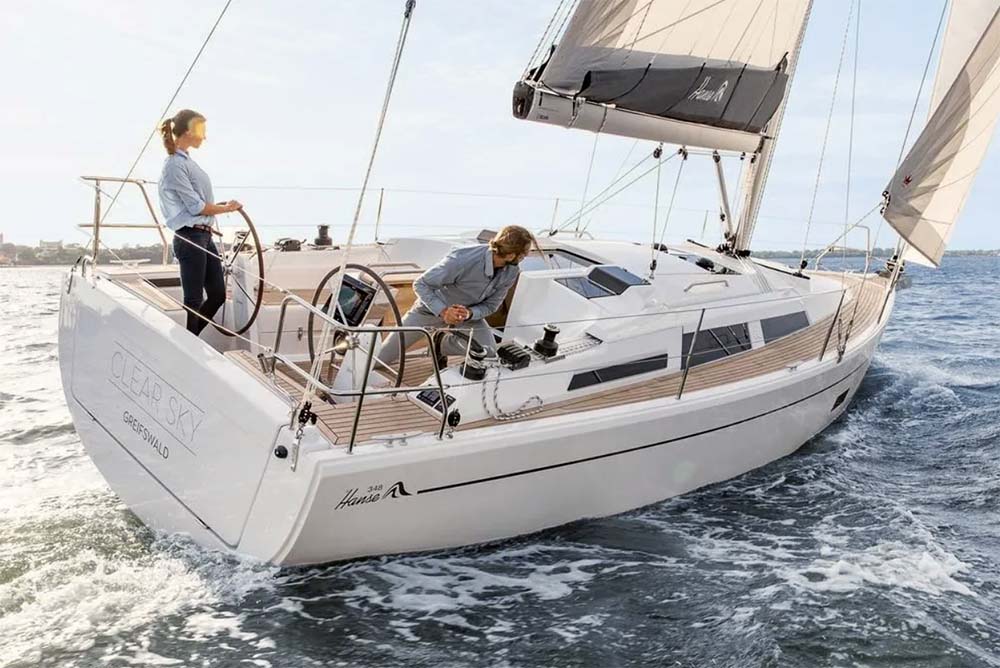
The Hanse 348 is a modern, compact performance cruiser that sits squarely in the “fast, easy-to-sail family cruiser” slot. Introduced as an evolution of Hanse’s 345 line, the 348 carries a taller rig and a sporty sail plan created to give a lively sailing experience without demanding a large crew; Judel/Vrolijk contributed to the hull geometry while Hanse (Germany) handled production and fit-out. The boat was launched in the late 2010s and has since been positioned as a boat for couples and small families who want more speed and interior volume than older 34-foot designs, yet still want easy single- or short-handed handling thanks to features such as the self-tacking jib and lines led aft. The model quickly found a place in the used market—new examples and dealer stock appear regularly in European and U.S. broker listings—and it has attracted interest from private cruisers and owner-operators more than from large charter fleets.
Design and Construction
Hanse designed the 348 around a lightweight, beamy hull with a modern underbody (options include a shallower draft and an L-keel around 1.95 m) to favor form stability and interior volume while keeping a relatively modest displacement for the size. The deck layout emphasizes uncluttered decks and cockpit ergonomics: twin wheels (with lines led to the cockpit) that operate a single rudder allow easy access and clear sightlines for helmsmanship, while the self-tacking jib reduces sailhandling complexity. Construction uses polyester/isophthalic gelcoats over GRP laminates with vinylester layers in stressed zones and cast-iron keels—standard modern production practice that balances cost, repairability and longevity. That combination (lightish displacement, broad stern, and a relatively tall rig) gives the boat a good sail-area-to-displacement ratio, which translates into lively performance in light to moderate airs but means owners should pay attention to reefing and sail trim as wind builds. From a maintenance and resale viewpoint, the GRP construction and common, well-supported systems make long-term repairs straightforward for yards familiar with European production boats, though cast-iron keels and through-hull fittings are items buyers should inspect closely at sea trials and surveys.

Performance
The 348 is generally praised for being faster and more responsive than many older mid-30s cruisers: tests and owner feedback report good speeds in light air and the ability to point reasonably close to the wind for a modern cruiser of this beam and section. In light to moderate breeze the combination of the high rig and slender entry typically produces cruising speeds in the mid-5-knot range and surges into 6–7 knots with a fresh breeze and clean trim; reviewers highlight that the boat feels “alive” on the helm and that it retrieves speed readily out of tacks. In a confused sea the broad stern and form stability help it maintain drive, while the twin-wheel cockpit keeps steering comfortable and provides good leverage for trimming. Compared with conservative, heavy displacement cruisers the 348 trades a little motion comfort in very heavy seas for noticeably better passage times and more agile harbor handling, which is why it appeals to owners prioritizing coastal passages and spirited weekend cruises.
Comfort and Accommodations
Below decks the 348 aims to feel larger than its length suggests: a wide beam carried well aft, generous portlights and coachroof windows, and intelligent joinery produce a bright, airy saloon and practical galley arrangements. Layouts are generally two-cabin or optional three-cabin arrangements; storage is decent for a 34-footer, and the galley, nav station and head are arranged with cruising ergonomics in mind. For a couple or small family the boat can be comfortable for extended weekends and short-term liveaboard periods—there’s enough tankage and stowage for weeks away if systems are managed carefully—but those planning full-time liveaboard or long ocean passages will find space and tankage more limiting than on mid-40-foot passagemakers. Overall the interior ages reasonably well if maintained; many used 348s you’ll see have modest owner refits (electronics updates, upholstery refresh) rather than wholesale remakes, which preserves resale appeal.
Safety and Practicality
Deck ergonomics emphasize safe movement: wide inboard decks, sturdy guardrails and an easily managed cockpit are design features that help when moving forward or single-handling. The self-tacking jib plus all lines led back to the cockpit minimize the need to go forward in rough conditions, and the transom platform / bathing ladder offers straightforward access to the water and dinghy handling. For coastal cruisers the boat is well-equipped out of the factory; with careful outfitting (liferaft, redundant instruments, appropriate ground tackle) it is also capable of offshore passages within its CE rating. Access to through-decks, tanks and key systems is reasonably good for a production boat of this size, which lowers routine maintenance costs and survey complications; still, owners should insist on a thorough systems survey (seacocks, rudder bearings, keel bolting) because those items are the principal long-term safety and upkeep concerns on a production GRP yacht.
Known Issues with the Hanse 348
Owners’ forums and owner-group threads highlight a few recurring themes buyers should watch for: early-series teething issues with deck hardware routing and some electronic component choices, routine discussion about the Jefa steering assembly and related corrosion in fast-change environments, and typical production-boat blemishes such as locker-seal leaks or water ingress around deck fittings if not correctly bedded. These are most often maintenance/installation issues rather than fundamental design failures, and many are resolved through routine preventive maintenance or small upgrades (e.g., improved bedding compounds, greaseable fittings, attention to anodes and rudder bearings). Common recommended buyer-side improvements are sensible: check and, if necessary, replace or service the windlass and its chain bin drainage, consider a propeller upgrade (folding or better-matched three-blade for improved sailing performance), and verify the state of standing rigging and seacocks during survey. For a buyer, a clear service history and a recent comprehensive survey will separate a smooth purchase from a project.
Market Availability and Pricing in the U.S.
The 348 is still produced and sold by Hanse dealers (dealer stock and new-build options appear in U.S. dealer listings) but most used inventory is cross-listed from European brokers—so while you will find U.S.-based examples, the model remains more common in Europe than in any single U.S. region. U.S. listings have appeared in Florida, New England and on the West Coast (San Diego/Marina del Rey), and the condition of available boats ranges from well-kept owner examples to lightly used dealer stock. Recent advertised prices and dealer listings put typical asking prices in the broad band of $160,000–$260,000 depending on year, options and location; European new-build dealer pricing and North American used listings show exact asking points within that range. That puts the 348 competitively against newer used Jeanneau, Dufour and Catalina 34–36 foot cruisers—attractive for buyers who want contemporary styling, a performance tilt and modern deck ergonomics.
Below is a comparison with similar sailboats from the same era:
| Model | LOA | Year (approx.) | Typical used price in U.S. | Main differences / buyer notes |
|---|---|---|---|---|
| Hanse 348 | 34′ (10.4 m) | 2018–present | $160,000–$260,000 | Sportier rig, self-tacking jib, bright interior, modern deck layout; more performance-oriented than many traditional 34s. |
| Jeanneau Sun Odyssey 349 | 33.9′ (10.34 m) | 2015–2020 | $90,000–$220,000 | Proven family cruiser, emphasis on comfortable cruising, often cheaper in older years but with broad dealer support in U.S. |
| Dufour 360 Grand Large | 36′ (≈10.8 m) | 2014–2020 | $120,000–$180,000 | Roomy interior and robust construction; tuned more for cruising comfort than tight club racing; often found in charter fleets in Europe. |
| Catalina 355 | 35.5′ (≈10.8 m) | 2013–present | $120,000–$285,000 | American-market mainstream cruiser with broad resale/parts support; generally conservative underwater sections and robust owner community. |
Hanse 348 vs Jeanneau Sun Odyssey 349

The 348’s hull and rig are pushed toward livelier sailing: a taller rig and a slightly lighter displacement give it a quicker feel and better light-air performance, whereas the Sun Odyssey 349 is tuned toward conservative, easy cruising with slightly fuller sections that favor motion comfort and interior volume for family use. In practical ownership terms that means the Hanse will reward owners who value passage speed and responsive helm feel, but the Jeanneau often undercuts it on purchase price, dealer availability and the depth of U.S. dealer/service support.
The Jeanneau’s interior and systems layout are typically designed around straightforward ownership and lower perceived maintenance complexity; the Hanse’s modern hardware (self-tacking systems, neat line routing) reduces crew work but sometimes adds model-specific servicing points. For a buyer who sails mostly coastal passages with a priority on comfort and service access, the Jeanneau is the conservative choice; for those who prioritize performance and contemporary deck ergonomics in a compact package, the 348 offers a stronger ride and livelier ownership experience.
► Learn more about de Jeanneau Sun Odyssey 349
Hanse 348 vs Dufour 360 Grand Large

Compared with the Dufour 360 Grand Large, the 348 is more focused on maximizing sail-area-to-displacement and cockpit ergonomics for short-handed sailing, while the Dufour emphasizes interior volume and cruising comfort for families or longer stays aboard. In practice, the Dufour’s slightly fuller hull and interior plan make it a better platform for liveaboard comfort and charter use, whereas the Hanse will usually be appreciably faster and more nimble in coastal conditions.
From a maintenance and ownership perspective the Dufour’s conventional systems and mainstream European dealer network make sourcing parts straightforward, but the Hanse’s tidy systems and modern deck layout reduce day-to-day crew work and can lower crew costs (fewer hands required). Buyers focused on family cruising or charter income should weigh the Dufour’s interior advantages; buyers who want quicker passages and easier single-handing will find the 348’s tradeoffs more attractive.
► Learn more about de Dufour 360 Grand Large
Hanse 348 vs Catalina 355

The Catalina 355 presents a conservative American design philosophy—robust construction, simpler systems and a wide parts/support network in the U.S.—while the 348 skews younger in styling, with a performance edge and more modern deck ergonomics. That means the Catalina often wins on ease of long-term ownership in U.S. marinas (spare parts, local experience), whereas the Hanse compensates with crisper sailing performance and a lighter, brighter interior.
For a buyer who values rock-solid, proven simplicity and strong U.S. resale/liquid market, the Catalina is a practical choice; for someone who wants a contemporary, quicker cruising experience and is comfortable sourcing some parts through European channels or dealers, the 348 is a compelling alternative that often represents better performance-per-foot.
► Learn more about de Catalina 355
Maintenance Costs of a Hanse 348 in the U.S.
Below are typical annual and one-time maintenance items with realistic U.S. ranges. Figures are indicative—actual costs depend on region, condition, and how much work the owner does personally.
- Mooring / slip fees — $3,000 to $20,000+ per year depending on region (New England and California high end; inland/southern marinas lower).
Comment: Location is the single largest recurring cost and can eclipse maintenance in expensive areas. - Insurance (liability + hull) — $800 to $3,000 per year depending on coverage, value, and cruising area.
Comment: Higher if you cruise offshore or have low deductibles; shop around for bundled policies. - Engine servicing (annual) — $300 to $1,000.
Comment: Routine oil/filter, impeller, fuel filters; expect higher if injectors or gearbox work is needed. - Antifouling / haul-out / bottom work — $800 to $7,000 (hauling, power-wash, primer and two coats of antifoul; wide regional variance).
Comment: East and West Coast yards tend to be pricier; contractor quotes vary with prep required. - Standing & running rigging (inspection and periodic replacement) — inspection ~$200–$600/year; replacement of standing rigging ~$3,000–$7,000 every 10–15 years.
Comment: A major periodic cost—confirm age in surveys. - Sails (repair/replace) — annual small repairs $100–$600; replacement of main and genoa $5,000–$15,000 depending on cloth and cut.
Comment: Cruising sails last longer if well-trimmed and stored correctly; racing cuts cost more. - Electronic & systems servicing (nav/autohelm/batteries) — $300–$3,000 annual range, replacement/upgrades are higher.
Comment: Modern owners often refresh displays and instruments, which are significant one-time expenses. - Miscellaneous (canvas, upholstery, anodes, zincs, small gear) — $500–$3,000/year.
Comment: Small items add up—careful budgeting avoids deferred maintenance.
Significant one-time costs to budget for: major sail replacement, standing rigging replacement, a full electronics refit, or an extensive topside/hull refit. A useful industry rule of thumb is to expect maintenance and operating costs that scale with boat value and region—many owners use a ballpark of several percent to 10% of boat value annually for conservative budgeting, though many keep costs lower with DIY work and careful management.
Owner-maintainable items on a 348 include basic engine servicing, antifoul prep if you have the skills and access to a yard, and many interior and deck repairs; however, items like standing rigging replacement, major electronics installs, or complex fiberglass/structural repairs are best handled by professionals. Overall, for a well-specified 34-foot modern cruiser the annual maintenance profile is medium—not as cheap as a small trailerable sailboat, but also not at the specialist cost level of large offshore yachts; resale values for the 348 tend to be fair if the boat has been maintained to schedule.
Conclusion
The 348’s core strengths are its blend of modern deck ergonomics, a taller sportier rig and a surprisingly roomy, light interior for a 34-footer. Those attributes make it especially well suited to couples or small families who want quick passages, straightforward short-handed sailing and a yacht that punches above its length in terms of usable space and speed. Weaknesses are mostly the usual tradeoffs for a production performance cruiser: some systems and fittings are manufacturer-specific and require careful inspection, and long-term liveaboard comfort and tankage are limited compared with larger passagemakers.
For buyers focused on coastal cruising, club-level performance and minimized crew needs, the 348 is a strong candidate and typically represents good value within the modern 34–36 foot market. It is less compelling for someone whose primary need is a blue-water, long-term liveaboard platform without upgrades. If you are weighing purchase, treat survey items such as rig condition, seacocks, keel bolting and evidence of proper bedding of deck gear as deal-makers — a well-documented service history transforms the 348 from a promising prospect into a practical, satisfying ownership proposition with reasonable resale prospects.
Specifications
| Hull Type | Fin w/spade rudder |
| Rigging Type | Fractional Sloop |
| LOA | 34.12 ft / 10.40 m |
| LWL | 31.33 ft / 9.55 m |
| S.A. (reported) | 630.00 ft² / 58.53 m² |
| Beam | 11.48 ft / 3.50 m |
| Displacement | 13,889.00 lb / 6,300 kg |
| Ballast | 5,071.00 lb / 2,300 kg |
| Max Draft | 6.40 ft / 1.95 m |
| Construction | Balsa core sandwich set in polyester resin, exterior layer of vinylester |
| Ballast Type | Cast iron |
| First Built | 2018 |
| Builder | Hanse Yachts |
| Designer | Judel/Vrolijk |
Auxiliary Power / Tanks | |
|---|---|
| Make | Yanmar |
| Type | Diesel |
| HP | 21 |
| Fuel | 42 gals / 160 L |
| Water | 61 gals / 230 L |
Sailboat Calculations | |
| S.A./Displ. | 17.51 |
| Bal./Displ. | 36.51 |
| Disp./Len. | 201.62 |
| Comfort Ratio | 25.86 |
| Capsize Screening Formula | 1.91 |
| S# | 2.63 |
| Hull Speed | 7.50 kn |
| Pounds/Inch Immersion | 1,285.13 pounds/inch |
Rig and Sail Particulars | |
| I | 44.62 ft / 13.60 m |
| J | 12.73 ft / 3.88 m |
| P | 42.98 ft / 13.10 m |
| E | 14.44 ft / 4.40 m |
| ISP | 48.56 ft / 14.80 m |
| S.A. Fore | 284.01 ft² / 26.39 m² |
| S.A. Main | 310.32 ft² / 28.83 m² |
| S.A. Total (100% Fore + Main Triangles) | 594.33 ft² / 55.22 m² |
| S.A./Displ. (calc.) | 16.52 |
| Est. Forestay Length | 46.40 ft / 14.14 m |
| Mast Height from DWL | 53.33 ft / 16.25 m |
Disclaimer
The considerations and analyses presented regarding the Hanse 348 sailboat are of a general nature and are based on the available information and technical data on this model, interpreted to the best of our knowledge and understanding. It is important to note that the specific characteristics of any particular sailboat may vary due to custom modifications, maintenance performed, and conditions of use over time, among other factors. Therefore, the details and performance of the boat you are considering may not exactly match the information provided here.
We strongly recommend that, before making any purchasing or usage decisions, you conduct a detailed inspection of the boat in question, consult with nautical professionals and other sailors, and consider your personal needs, expectations, and capabilities. Each sailboat may have unique particularities that affect its performance and suitability for different types of sailing and sailors.
The information contained in this analysis should be used as a general guide and not as a definitive reference. Professional evaluation and personal inspection are essential to ensure that the boat meets your specific requirements and expectations.