



The MacGregor 26M occupies a quirky niche: conceived and marketed as a trailerable powersailer that could be handled like a daysailer yet driven like a sportboat, it blends compromises from two traditions into one platform. The 26M is the late-stage evolution of the long-running MacGregor 26 family designed by Roger MacGregor and built by MacGregor Yacht Corporation; the M variant (introduced in the early 2000s) pushed the brand’s emphasis on light displacement, water ballast and the ability to mount a large outboard in a transom well so the boat could cruise at hull-speed under sail and sprint at planing speeds under power.
That design brief—easy trailering, shallow-water access, and a genuine ability to motor quickly—made the model popular with a certain buyer profile: weekenders who value versatility, owners who want a single boat for commuting, daysailing and occasional overnighting, and budget-minded cruisers who prize low marina costs or the option to trailer. On the used market the 26M and its 26-family cousins show steady demand from recreational owners and trailer-sailor communities; you’ll also see examples in private-owner fleets rather than heavy charter use.
Design and Construction
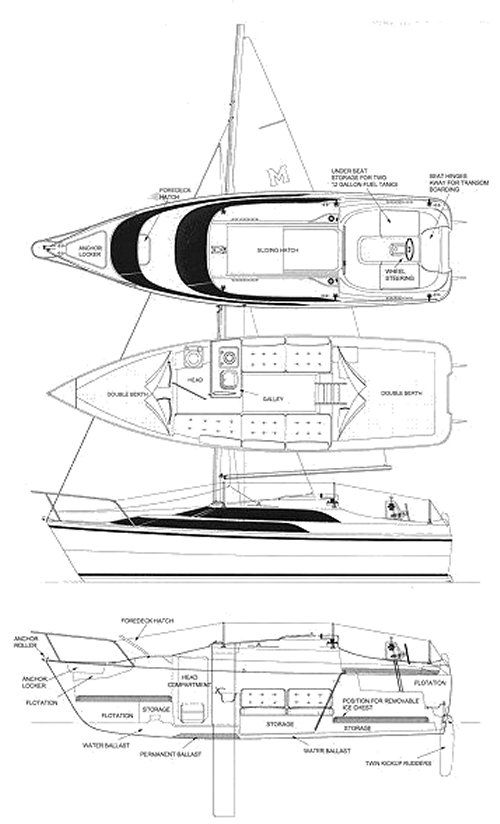
The 26M retains the monohull, fiberglass laminate construction common to MacGregor’s trailerable models but blends several distinctive choices: relatively light dry displacement, water ballast that is filled for sailing and drained for trailering, and dual transom rudders paired with a dagger/centerboard arrangement (depending on the specific year and variant). The M introduced features intended to aid both sailing and high-speed motoring—most notably a recessed transom well that accepts a large outboard and a rotating spar in some boats—so the center of effort and propulsion packaging were treated together in the design. These are intentional compromises: light structure and water ballast keep trailering and trailer launching practical, but they also mean the boat relies on its water ballast and hull form rather than heavy fixed ballast for righting moment.
From a maintenance standpoint the hull and deck are straightforward fiberglass; however, the light layup that benefits trailering increases the importance of routine inspection, particularly around hull-to-deck joints, transom fittings and ballast-tank penetrations. Naval-architecturally speaking, the tradeoffs are clear: a low displacement/length ratio gives lively light-air performance and easy towing, while the water-ballast approach lowers trailering weight at the cost of added plumbing and potential leak paths—factors that directly affect long-term upkeep and resale. Well-executed repairs are usually simple fiberglass work, but because many MacGregors were lightly equipped from the factory, buyers often budget for modest refits (hardware upgrades, improved thru-hull fittings, better cockpit drainage) to bring an older boat up to durable, comfortable cruising standards.
Performance
Under sail the 26M behaves like a light, flat-hulled pocket cruiser: it accelerates in light airs and can be surprisingly quick off the wind, but it is not a high-pointing bluewater hull. The theoretical hull-speed figure is modest (mid-6-knot range when driven conventionally), and owners commonly report that the boat benefits from careful sail trim and moderate reefing in stronger conditions; the water ballast helps stability under sail but does not substitute for deep keel performance when beating to windward.
Where the 26M really differentiates itself is under power. With a properly sized outboard in the transom well it can push into high-teens and even low-twenties in favorable conditions—far beyond what you expect from a conventional 26-footer—so for buyers who value fast hops between anchorages the boat delivers. That combined performance profile makes the 26M a hybrid: not the best upwind racer, nor a heavy-weather passagemaker, but an excellent choice for owners who want brisk, economical coastal cruising and the option to trailer and explore shallow waters. Practical-use comparisons put it in a different class from the more conventional fixed-keel cruisers of the same length: quicker under power, livelier in light breeze, and more forgiving for shallow-water exploration.
Comfort and Accommodations
Inside, the 26M reflects its multi-role intent: compact but cleverly arranged. The layout typically offers V-berth forward, a small head, a modest galley and settees that convert to additional berths; headroom and storage are limited compared with larger coastal cruisers, but the low-weight philosophy means the space is comfortable for weekend couples or small families rather than extended full-time liveaboard crews. Ventilation and natural light depend on the specific fittings a given owner has added—many used boats show owner upgrades such as extra hatches, fans and custom lockers, because factory fit-out was often minimal.
For prospective buyers this means the 26M is best judged by intended use: it’s excellent for weekend cruising, daysailing, and coastal trips where you value agility and trailering; it is less optimal as a primary liveaboard platform unless you plan a focused refit to expand storage, insulation and systems. In short, it offers good short-term comfort with clear upgrade paths if you need more cruising capability.
Safety and Practicality
Deck layout and cockpit ergonomics are functional rather than luxurious: lines are short and within reach of the cockpit when owners set the boat up for single-handing, and the shallow draft plus trailerability are practical safety features in tidal, shoal-lined areas. However, the safety profile depends on maintenance and outfitting: water-ballast plumbing, transom well seals around a large outboard, and effective bilge pumping are all practical areas to check and, if necessary, improve. The twin rudders and transom configuration work well while the boat is moving, but low-speed maneuvering relies heavily on the outboard, an operational reality different from most fixed-keel sailboats. For coastal cruising and protected-water passagemaking the 26M is suitable with routine upgrades; for sustained offshore passages a buyer should plan structural and systems upgrades before committing.
Known Issues with the MacGregor 26M
Owners and surveyors commonly flag a handful of recurring topics:
- Water-ballast plumbing and tank seals can leak or corrode fittings if not inspected and maintained; slow leaks can create hidden dampness in bilges or cavities and encourage secondary problems.
- Gelcoat blistering / osmosis is a recurring forum topic for many older, polyester-laminate trailerable boats; evidence of blistering should be factored into purchase negotiations and surveys.
- The factory gear and stock electronics were often basic—many owners upgrade sails, winches, standing and running rigging and instruments soon after purchase.
- The hull and rudder arrangements can be more sensitive to low-speed control; owners adapt by practicing coordinated use of outboard and rudder and by occasionally fitting steering-assist or skeg solutions.
Common recommended improvements include upgrading through-hull fittings and seacocks, replacing or refurbishing ballast-tank plumbing, installing better cockpit drainage and replacing worn standing rigging and sails. These improvements are well-documented in owner forums and typically bring older boats back to reliable, comfortable service.
Market Availability and Pricing in the U.S.
The MacGregor 26M is no longer produced under the original MacGregor Yacht Corp brand (production ended with the 26 variants and a closely related design was later produced as the Tattoo 26), so the model is strictly a used-boat purchase in the U.S. You’ll find the model most often in inland and coastal states with active trailer-sailer communities—Pacific Northwest and West Coast listings are common, but the 26 family is also widely listed in the Southeast and around the Great Lakes. Inventory on major listing sites shows asking prices that commonly sit in the low-to-mid five-figure range depending on year, equipment and condition.
Typical asking prices on U.S. broker platforms (examples from recent listings) cluster roughly between $12,000 and $28,000 for well-equipped, later-model 26M examples; lower-priced boats are often older, need systems work, or are sold by owners who have not refitted the plumbing/sails. Expect regional variation—boats in Florida or California with recent engine and systems work command higher prices, while inland or Great Lakes listings sometimes reflect boats needing cosmetic or mechanical attention.
Below is a comparison with similar sailboats from the same era:
| Model | LOA | Typical Years | Typical US Used Price | Principal Differences |
|---|---|---|---|---|
| Catalina 250 | ~25 ft | 1999–2008 | $10,000–$22,000 | Conventional keel/keel-centerboard options; heavier; better upwind and interior volume but less trailer-friendly. :contentReference[oaicite:13]{index=13} |
| Hunter 27 | ~27 ft | 1978–2006 (various models) | $8,000–$25,000 | Roomier layouts and conventional ballast; more proven cruising pedigree but slower under power and less shallow-water capability. :contentReference[oaicite:14]{index=14} |
| Jeanneau Sun 2500 | ~25 ft | Late 1990s–2006 | $15,000–$30,000 | European pocket-cruiser with inboard options and a more performance-oriented hull; typically better-appointed but less trailerable in practice. :contentReference[oaicite:15]{index=15} |
MacGregor 26M vs Catalina 250

The 26M leans into versatility: trailering, a large outboard in a transom well and water ballast for easy launching and shallow-water exploration. That combination produces brisk motoring speeds and excellent access to shoal areas, which a Catalina 250—with its heavier ballast and deeper keel options—does not match.
Interior comfort and finish typically favor the Catalina, which generally offers more built-in storage and a quieter ride under sail, while the 26M rewards owners who prioritize multi-role flexibility and lower mooring/transport costs. Maintenance needs differ in kind: the Catalina’s systems are conventional and durable, whereas the 26M can require extra attention to ballast plumbing, outboard wells and transom seals—tradeoffs that matter when comparing long-term ownership costs.
► Learn more about de Catalina 250
MacGregor 26M vs Hunter 27

Compared with a Hunter 27, the 26M is lighter, more trailerable and tuned for quick hops under power; the Hunter tends to have a more substantial fixed ballast and a roomier interior that suits families focused on cruising comfort. In practical ownership terms, the 26M suits owners who want one boat for both daysailing and fast coastal runs and who accept modest interior volume, while the Hunter suits crews prioritizing stability, storage and upwind performance. Maintenance is typically simpler on the Hunter’s conventional systems, but the 26M usually costs less to berth and can be taken home on a trailer—features that alter the total cost equation for many buyers.
► Learn more about de Hunter 27
MacGregor 26M vs Jeanneau Sun 2500

The Jeanneau Sun 2500 is a more traditionally-styled pocket cruiser, often sold with inboard diesels or better sail inventory and a hull shape optimized for upwind performance; by contrast the 26M emphasizes lightness and multi-modal performance (sail + planing under power). For a buyer who wants sharper sailing and a more finished interior, the Jeanneau typically has the edge; for someone who wants access to shallow creeks, trailerability, and the fun of high-speed runs under power, the 26M is more compelling. Ownership choices therefore hinge on priorities: the Sun 2500 is a conventional small cruiser with better seafaring manners under sail, while the 26M is a practical, cost-effective hybrid that rewards owners who accept the upkeep of its water-ballast and propulsion arrangements.
► Learn more about de Jeanneau Sun 2500
Maintenance Costs of an MacGregor 26M in the U.S.
Typical annual maintenance items and approximate ranges (U.S.) — each main item bolded and followed by a short explanation:
- Mooring/Marina or Trailer Costs: $1,200–$6,000+ per year (region dependent). Marina slip costs in high-demand areas (California, Florida, New England) push costs to the top end; trailering and rack storage inland can be far cheaper.
- Insurance: $300–$900/year. Depends on use, value and region (higher on the coast or for weekend charter use).
- Engine / Outboard servicing: $150–$600/year (routine), $800–$3,500 for major work or replacement. Large outboards used for planing wear faster and may need more frequent overhaul.
- Antifouling & haulout: $300–$1,200/year depending on frequency and whether you do it yourself; haulout, pressure-wash and paint in many boatyards add considerably in coastal states.
- Standing & running rigging checks / replacements: $100–$600/year for inspections and smaller parts; full standing-rigging replacement $1,200–$3,500 every 10–20 years depending on use.
- Sails (repair/replacement): $100–$500/year in repairs; new sails $800–$2,500+ depending on size and quality. Many buyers refresh the main or add a furling jib when prepping for cruising.
- Bilge, plumbing, ballast tank maintenance & leaks: $100–$1,000+/year variable; significant ballast-tank work or seal replacement can be several hundred to a few thousand dollars.
- Survey / Misc. upkeep (safety gear, electronics, winterization): $300–$2,000+ as needed.
Regional variation is important: Florida and Gulf coasts often have higher haulout and antifouling costs and faster corrosion in saltwater; northern yards add winterization and shrink-wrap costs. Significant one-time investments to budget for include sail replacement, a modern chartplotter/AIS install ($1,000–$4,000), transom/outboard mounting improvements, and any ballast-tank refurbishment (these can run from a few hundred dollars for patch jobs to several thousand for full repairs).
Owner-mechanic potential: the 26M is friendly to owner maintenance in many respects—plumbing, basic electrical, sail repair and small fiberglass jobs are within reach for competent DIY owners. However, because the model integrates systems (ballast, large outboard well, and thru-hulls) buyers should plan for at least occasional professional services; this raises costs compared with a small daysailer but remains moderate relative to larger keelboats. Overall cost-of-ownership for a 26-foot trailerable powersailer of this vintage is medium: not as cheap as a bare-bones dayboat, but usually lower than a similarly outfitted fixed-keel cruiser when you factor in trailer storage and the option to avoid a slip.
Conclusion
The MacGregor 26M is a pragmatic, personality-driven boat: it rewards buyers who prize versatility, shallow-water access, trailering and the rare combination of genuine planing ability under a large outboard with practical sailing capability. Its strengths are clear—affordable entry price on the used market, low weight for trailering, lively light-air manners and the freedom to operate in shallow or seasonal locations where deeper-keel cruisers can’t go. The tradeoffs are equally clear: lighter construction and water-ballast plumbing require disciplined inspection and occasional refits (particularly ballast seals, through-hulls and transom fittings), and the boat is not a first choice for heavy-weather offshore passages without significant upgrades.
For a buyer focused on coastal cruising, weekend adventures, trailer-exploration and economical ownership, the 26M is worth strong consideration; it offers a unique value proposition that many conventional pocket cruisers don’t. If your priorities are interior volume, long offshore passages or high upwind performance, a more conventionally ballasted Catalina, Hunter or Jeanneau model may be a better fit. In market terms the 26M typically represents a fair value: moderate purchase price, reasonable upkeep for a motivated owner and a niche but stable resale market among trailer-sailor communities—so yes, for the right buyer it’s a pragmatic, fun and economical boat to pursue.
Specifications
| Hull Type | Daggerboard |
| Rigging Type | Fractional Sloop (Rotating Spar) |
| LOA | 25.83 ft / 7.87 m |
| LWL | 23.17 ft / 7.06 m |
| S.A. (reported) | 300.00 ft² / 27.87 m² |
| Beam | 7.75 ft / 2.36 m |
| Displacement | 4,000 lb / 1,814 kg |
| Ballast | 1,450 lb / 658 kg |
| Max Draft | 5.75 ft / 1.75 m |
| Min Draft | 1.00 ft / 0.30 m |
| Construction | Fiberglass (FG) |
| Ballast Type | Water |
| First Built | 2003 |
| Last Built | 2014 |
| # Built | 5,000 |
| Builder | MacGregor Yacht Corp. (USA) |
| Designer | Roger MacGregor |
| Fuel Capacity | 24 gals / 91 L |
| Water Capacity | 5 gals / 19 L |
| Headroom | 6.00 ft / 1.83 m |
| S.A. / Displ. | 19.10 |
| Bal. / Displ. | 36.25 |
| Disp. / Len. | 143.56 |
| Comfort Ratio | 16.86 |
| Capsize Screening Formula | 1.96 |
| Hull Speed | 6.45 kn |
| Pounds/Inch Immersion | 641.61 lb/inch |
| Mast Height from DWL | 35.00 ft / 10.67 m |
Disclaimer
The considerations and analyses presented regarding the MacGregor 26M sailboat are of a general nature and are based on the available information and technical data on this model, interpreted to the best of our knowledge and understanding. It is important to note that the specific characteristics of any particular sailboat may vary due to custom modifications, maintenance performed, and conditions of use over time, among other factors. Therefore, the details and performance of the boat you are considering may not exactly match the information provided here.
We strongly recommend that, before making any purchasing or usage decisions, you conduct a detailed inspection of the boat in question, consult with nautical professionals and other sailors, and consider your personal needs, expectations, and capabilities. Each sailboat may have unique particularities that affect its performance and suitability for different types of sailing and sailors.
The information contained in this analysis should be used as a general guide and not as a definitive reference. Professional evaluation and personal inspection are essential to ensure that the boat meets your specific requirements and expectations.