



The Morgan 38 emerged in the late 1970s, a period when American builders were producing robust cruising yachts aimed at sailors seeking both comfort and reliability. Designed by Charley Morgan and later refined under Ted Brewer, the 38-foot model was intended primarily as a coastal and bluewater cruiser, not as a racing yacht. Its target audience included couples and families wanting a boat capable of extended cruising without excessive complexity. Over time, the Morgan 38 gained a loyal following on the secondhand market, where it remains popular among private owners, liveaboards, and small-scale charter operators. Today, it continues to attract demand from sailors looking for a proven, affordable cruising platform with classic lines and straightforward systems.
Design and Construction
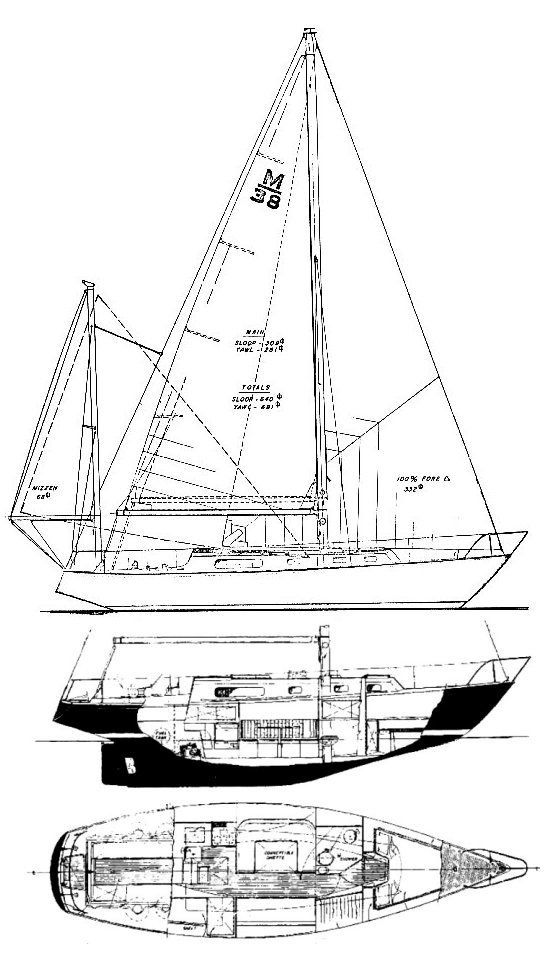
The Morgan 38 is built with a solid fiberglass hull and a fin keel combined with a skeg-hung rudder, a configuration that balances performance and protection. This design choice offers better tracking and more resilience against damage compared to spade rudders, while still being more agile than a full keel. The masthead sloop rig keeps sail handling simple and parts readily available, an important consideration for maintenance and refits. Construction quality reflects the robust philosophy of Morgan Yachts: solid laminates, straightforward systems, and interior layouts built to last decades. From a naval architecture perspective, the hull form emphasizes stability and seakindliness over pure speed, a compromise that appeals to cruisers prioritizing safety and comfort.
Performance
Under sail, the Morgan 38 is known for steady tracking and predictable handling. With a hull speed in the mid-7 knot range, it is not the fastest boat in its class, but it compensates with good balance and comfort in heavy seas. Upwind, the boat performs adequately, though modern designs with fin-and-spade configurations may point higher. In a beam reach or downwind, the Morgan 38 maintains solid speed and stability, making long passages less tiring for the crew. Compared with similar cruisers of its generation, it leans toward conservative handling rather than sporty performance, which makes it a favorite among long-distance sailors who value reliability over excitement.
Comfort and Accommodations
Inside, the Morgan 38 offers a practical and livable arrangement. The layout typically includes a V-berth forward, a spacious saloon with settees, a functional galley, and a generous navigation station. Headroom approaches six feet, making it suitable for liveaboard use. Storage is ample, with deep lockers and cabinetry well integrated into the hull. Ventilation is adequate for its era, though many boats benefit from retrofitted hatches and fans. For a couple or small family, the accommodations work well for both weekend trips and extended cruising. Interiors age gracefully when maintained, though it is common to find examples with updated upholstery, new galleys, or modern electronics.
Safety and Practicality
On deck, the wide side decks and raised coamings provide security underway. The skeg-hung rudder and sturdy construction make the boat well-suited for offshore passages, although some owners add storm sails or reinforced gear for bluewater preparation. The cockpit is deep and protective, though somewhat narrow compared to modern beamy cruisers. Systems are generally accessible, which simplifies maintenance. With its conservative sail plan and forgiving balance, the Morgan 38 can be comfortably handled by a short-handed crew, even in deteriorating conditions. This practicality enhances its appeal for couples planning long passages without large crews.
Known Issues with the Morgan 38
As with most boats of its vintage, certain issues are recurrent. Osmosis can appear in hulls that have not been barrier-coated, though repairs are straightforward. Original engines—often Perkins or Yanmar diesels—may require replacement or major overhauls after decades of service. Deck leaks around chainplates and hatches are common if not properly rebedded. Electrical systems may be outdated, with owners frequently upgrading panels and wiring. Some owners report weather helm in heavy conditions, which can be mitigated with proper sail trim or updated sail inventories. Recommended upgrades include new standing rigging, modern electronics, and in some cases a feathering or three-blade prop for better motoring performance.
Market Availability and Pricing in the U.S.
The Morgan 38 is no longer in production and is found exclusively on the used-boat market. In the U.S., they are most frequently seen in Florida, the Chesapeake, and the Gulf Coast, though well-kept examples appear in New England and California as well. Most listings show boats that have been actively cruised and maintained, though neglected examples can also be found at lower prices. Recent sales data place the Morgan 38 in the $35,000–$60,000 range, depending on condition and upgrades. Compared to alternatives like the Catalina 38 or Hunter 37, the Morgan tends to offer sturdier offshore potential at a similar price point, though it may lack some of the interior volume and modern amenities of newer boats. Jeanneau and Beneteau models from the same era often appear lighter and faster but may not match the Morgan’s rugged construction.
Below is a comparison with similar sailboats from the same era:
| Model | LOA | Year | Typical Price (U.S.) | Key Differences |
|---|---|---|---|---|
| Morgan 38 | 38 ft | 1977–1986 | $35,000–$60,000 | Solid construction, offshore capable, conservative performance |
| Catalina 38 | 38 ft | 1980s | $30,000–$55,000 | Racing heritage, better upwind performance, less robust offshore |
| Hunter 37 Cutter | 37 ft | Late 1970s–1980s | $25,000–$45,000 | Cutter rig flexibility, good for coastal cruising, lighter build |
| Jeanneau Sun Fizz 40 | 39 ft | 1980s | $40,000–$70,000 | Faster hull, European styling, less rugged construction |
Maintenance Costs of a Morgan 38 in the USA
Annual maintenance for a Morgan 38 varies by region. Dockage or mooring fees typically range from $4,000–$8,000 per year in most marinas, with higher rates in New England and California. Insurance averages $1,500–$2,500 annually depending on cruising grounds. Routine engine service adds $800–$1,200, while bottom paint and antifouling can cost $2,000–$3,000 per season. Standing rigging replacement every 15–20 years can run $6,000–$8,000, and a new suit of sails typically costs $7,000–$10,000. Major refits, such as electronics upgrades or repowering, can exceed $20,000. While many owners handle basic upkeep themselves, complex tasks often require professionals, especially in larger coastal cities. Overall, the Morgan 38 falls into a medium maintenance category for its size, but its solid resale value and offshore credibility tend to offset the investment.
Conclusion
The Morgan 38 remains a respected cruising yacht with a strong reputation for durability, safety, and comfort at sea. Its strengths lie in solid construction, conservative but capable sailing performance, and practical accommodations suitable for extended cruising. Weaknesses include the inevitable age-related issues of a vintage yacht and a performance profile that prioritizes stability over speed. For sailors seeking a dependable cruiser with offshore potential at a reasonable price, the Morgan 38 is an attractive option. It holds its resale value well and continues to occupy a niche as a practical, underappreciated classic within the used-boat market.
Specifications
| Hull Type | Keel/Cbrd. |
| Rigging Type | Masthead Sloop |
| LOA | 37.67 ft / 11.48 m |
| LWL | 28.00 ft / 8.53 m |
| S.A. (reported) | 639.00 ft² / 59.37 m² |
| Beam | 11.00 ft / 3.35 m |
| Displacement | 16,000 lb / 7,257 kg |
| Ballast | 7,500 lb / 3,402 kg |
| Max Draft | 8.33 ft / 2.54 m |
| Min Draft | 3.75 ft / 1.14 m |
| Construction | Fiberglass (FG) |
| Ballast Type | Lead |
| First Built | 1969 |
| Last Built | 1971 |
| # Built | 75 |
| Builder | Morgan Yachts (USA) |
| Designer | Charles Morgan |
| Auxiliary Power | Universal Diesel |
| Fuel Capacity | 30 gals / 114 L |
| Water Capacity | 40 gals / 151 L |
| S.A./Displ. | 16.16 |
| Bal./Displ. | 46.88 |
| Disp./Len. | 325.39 |
| Comfort Ratio | 32.82 |
| Capsize Screening Formula | 1.75 |
| S# | 1.50 |
| Hull Speed | 7.09 kn |
| Pounds/Inch Immersion | 1,100.52 lb/in |
| I | 45.00 ft / 13.72 m |
| J | 14.70 ft / 4.48 m |
| P | 38.50 ft / 11.73 m |
| E | 16.00 ft / 4.88 m |
| S.A. Fore | 330.75 ft² / 30.73 m² |
| S.A. Main | 308.00 ft² / 28.61 m² |
| S.A. Total (100% Triangles) | 638.75 ft² / 59.34 m² |
| S.A./Displ. (calc.) | 16.15 |
| Estimated Forestay Length | 47.34 ft / 14.43 m |
Disclaimer
The considerations and analyses presented regarding the Morgan 38 sailboat are of a general nature and are based on the available information and technical data on this model, interpreted to the best of our knowledge and understanding. It is important to note that the specific characteristics of any particular sailboat may vary due to custom modifications, maintenance performed, and conditions of use over time, among other factors. Therefore, the details and performance of the boat you are considering may not exactly match the information provided here.
We strongly recommend that, before making any purchasing or usage decisions, you conduct a detailed inspection of the boat in question, consult with nautical professionals and other sailors, and consider your personal needs, expectations, and capabilities. Each sailboat may have unique particularities that affect its performance and suitability for different types of sailing and sailors.
The information contained in this analysis should be used as a general guide and not as a definitive reference. Professional evaluation and personal inspection are essential to ensure that the boat meets your specific requirements and expectations.