



The O’Day 28 is a late-1970s American 28-footer conceived as an approachable family coastal cruiser with a touch of club-racing spirit. Drawn by C. Raymond Hunt Associates and built by O’Day (then part of Bangor Punta, later Lear Siegler) from 1978 to 1986, it slots into the “good old boat” sweet spot: simple systems, honest construction, and enough performance to keep the helm fun. On the used market it’s popular with private owners and club programs that value roomy interiors and forgiving handling more than cutting-edge speed. Production ended in the mid-1980s, but supply remains healthy across the U.S., and demand is steady among budget-minded coastal cruisers and first-time keelboat buyers.
Design and Construction
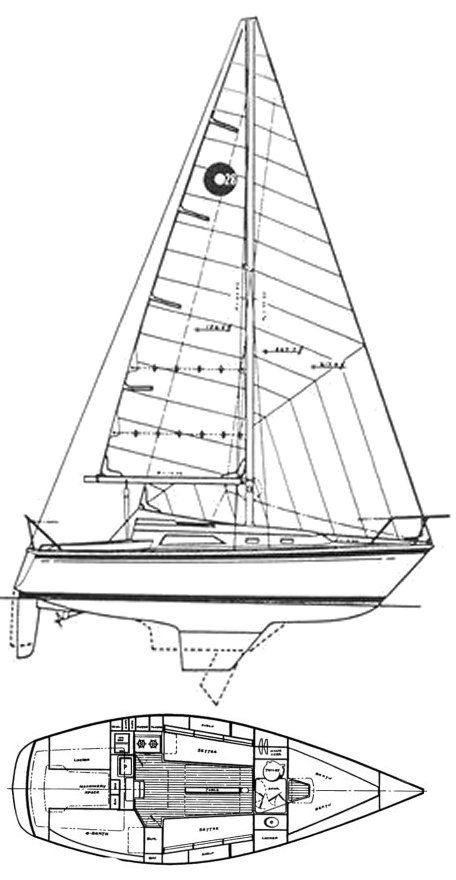
Below the waterline the boat is a moderate-displacement fin-keel design with an internally mounted spade rudder; early boats were offered with a centerboard, later replaced by a shoal-draft fixed keel option, and a deep keel/tall-rig combo also existed. The masthead-sloop rig keeps loads predictable and sailhandling straightforward, while the hull and deck are fiberglass with cored areas typical of the era. Power was usually a small Universal diesel (around 11–12 hp), though some boats left the factory with an OMC gasoline saildrive—relevant to buyers because repower history and driveline type strongly influence maintenance and resale. From a naval-architecture standpoint, the D/L near 270 and SA/D around the mid-teens put the boat squarely in the cruiser/cruiser-racer band: enough sail to move in light air without becoming twitchy in a breeze. The combination of a simple structural grid and common-sense hardware makes repairs approachable for competent owners, preserves residual value, and keeps yard bills in check.
Performance
In practice the boat tracks well, points respectably, and settles into a comfortable groove around a 6.4-knot hull speed when pressed, reefing early to keep the helm light. Typical PHRF bases cluster around ~198–204 depending on keel/rig—competitive for low-stress club starts and a fair proxy for “capable but not racy.” Compared with peers, it’s generally a tick quicker than a Catalina 27 in mixed conditions and a shade slower than a later-generation Pearson 28-2, which rates ~186 in many regions. Owners regularly describe the 28 as forgiving, stiff enough for coastal slop, and happiest on weekend passages where predictability matters more than raw pace.
Comfort and Accommodations
The interior is the 28’s calling card: a beamy saloon for the size, an enclosed head, a practical galley, a generous V-berth, and a proper quarter berth—layouts often pitched at the time as “the world’s shortest 30-footer.” Headroom is respectably near six feet on many examples, which, paired with wide settees and ample locker volume, makes the boat livable for a couple or a small family on weekend cruises. Ventilation and natural light are adequate with opening ports and forehatch; many boats have had LED lighting and fan upgrades that transform life at anchor. The cockpit is deep and secure without feeling cramped, and ergonomics under sail favor short-handed crews: primary winches fall to hand and the traveler and mainsheet systems are straightforward. Most interiors age well if kept dry; where they haven’t, refits often focus on headliners, portlights, and soft furnishings, all of which are inexpensive compared with structural work.
Safety and Practicality
Wide side decks, sensible handholds, and a compact rig make moving around underway predictable. With properly serviced standing rigging and rebedded deck hardware, the boat is well-suited for coastal cruising; offshore ambitions are possible but would demand the usual upgrades (storm sails, jacklines, additional tankage, redundant power, and thorough deck-core remediation where needed). Systems access—engine, steering, bilge, and electrical—is better than average for the vintage, keeping owner-maintenance feasible. The boat’s manners under power are docile, and with a two- or three-blade prop and a healthy diesel it’s easy to dock short-handed.
Known Issues with the O’Day 28
Common age-related themes show up across owner forums and surveys. Chainplate and stanchion leaks can wet bulkheads and local deck core if hardware hasn’t been rebedded on schedule; forward chainplates, in particular, deserve a careful look. Original OMC saildrives (gas) are widely regarded as noisy, thirsty, and expensive to support; many buyers prefer examples repowered with a small Yanmar or Universal inboard. As with many cored-deck 1980s boats, through-bolt penetrations, portlights, and mast partners can leak, eventually demanding core repairs if neglected. Electronics on older boats tend to be a time capsule; budgeting for modern instruments and wiring clean-up is realistic. Rudder moisture and play in bearings or the stock are not endemic but are worth inspecting. Fortunately, most fixes are straightforward and well-documented in owner communities, and completed upgrades materially improve value.
Market Availability and Pricing in the U.S.
The model is long out of production and exists solely on the used market, with the densest concentrations in New England, the Mid-Atlantic/Great Lakes, and pockets of the Pacific Northwest. As of recent listings, serviceable examples commonly ask in the $4,000–$15,000 range, with outliers below/above that depending on engine condition and refit level; boats with fresh diesels and cosmetics can list higher, while “project” hulls trade at the low end. Compared with similar 27–29 footers, the O’Day 28 is a strong value play: abundant supply, low entry price, and easy resale if kept dry and upgraded thoughtfully.
Below is a reasoned snapshot against three close peers:
| Model | LOA | Era (approx.) | Typical U.S. used price | Notable differences |
|---|---|---|---|---|
| O’Day 28 | 28.25 ft | 1978–1986 | $4k–$15k | Roomy interior, forgiving handling; early centerboard/shoal options; some with OMC saildrive. |
| Catalina 27 | 26.8 ft | 1971–1991 | $4k–$12k (wide spread; occasional outliers) | Huge production run; simpler interior; slightly slower PHRF on average. |
| Pearson 28-2 | 28.5 ft | 1985–1989 | $12k–$25k | Newer design; faster PHRF; more contemporary layout (aft cabin feel). |
| Ericson 28+ | ~28–29 ft | Late 1970s–1980s | $10k–$20k | Racer/cruiser bias; quality glasswork; livelier under sail. |
O’Day 28 vs Catalina 27

The O’Day carries more beam and volume, which translates into a bigger saloon, a more usable quarter berth, and a head that feels less “afterthought.” Under sail, both are predictable, but the O’Day’s slightly stiffer feel and deeper rudder bite make it easier for new skippers in puffy afternoon sea breezes. In light air the Catalina keeps up fine; as wind builds the O’Day tends to reef early and settle, while the Catalina’s older foils and shallower sections can wander if overcanvassed.
From an ownership lens, Catalina parts availability is superb thanks to the massive fleet, and that helps resale. The O’Day answers with better “bones” for interior comfort and a cockpit that keeps crew sheltered on longer bay hops. PHRF deltas are small (both around 200), so results hinge more on sails and bottom than on badges; buy on condition, not tenths of a knot.
► Learn more about de Catalina 27
O’Day 28 vs Pearson 28-2

The Pearson 28-2 is a later-generation design and it shows: quicker on paper (PHRF ~186) and crisper to weather, with a more contemporary interior flow. The O’Day counters with a warmer, simpler cabin and often a lower price of entry that frees budget for new sails, rigging, and instruments. In a seaway the Pearson feels a touch more eager; the O’Day tracks a bit heavier but keeps crew fatigue down.
For owners, Pearson’s later-80s build quality and systems routing can shave hours off refits, and the boat draws attention from club racers. The O’Day’s advantage is value and volume—great for young families or buyers moving up from trailerables. Resale on both is healthy when dry and upgraded, but the Pearson’s speed premium can widen at sell time in racing-centric markets.
► Learn more about de Pearson 28-2
O’Day 28 vs Ericson 28+

The Ericson 28+ tilts racer/cruiser with a lively helm and quality glasswork; it accelerates faster and rewards trimming. The O’Day is steadier and more docile, prioritizing predictability over edge-of-the-groove feel. Cabin layouts are comparable, but the O’Day’s beam delivers a more spacious saloon at anchor.
Maintenance-wise, both are owner-serviceable; Ericson parts support leans on a very active owners’ network, while O’Day spares are generic and easy to source. If your calendar mixes beer-can starts with weekend cruising, the Ericson is tempting; if comfort, simplicity, and price drive the brief, the O’Day wins by value. Resale depends on local taste—racing ports favor the Ericson, family harbors often favor the O’Day.
► Learn more about de Ericson 28+
Maintenance Costs of a O’Day 28 in the U.S.
- Mooring/berth: $1,200–$3,000/yr on many lakes and low-cost marinas; $3,000–$6,500/yr in New England and the Mid-Atlantic; $4,000–$8,000+/yr in high-demand Pacific coast metros.
- Insurance: $250–$700/yr for liability/basic hull on older 28-footers; more with named-storm or offshore riders.
- Engine servicing: $300–$600/yr for fluids, filters, impeller, and zincs on a small diesel; add $1,200–$2,500 every 5–7 years for injector/pump attention or cooling-system work.
- Antifouling & haul/launch: $900–$2,000/yr for a single-season hard or ablative bottom with basic yard labor; DIY can halve that in permissive yards.
- Standing rigging: $2,500–$4,500 one-time every ~10–15 years depending on scope and hardware; inspections annually.
- Running rigging: $400–$1,200 over a couple of years for sheets/halyards, more with specialty lines.
- Sails: $2,200–$3,200 for a new cruising main; $2,000–$3,000 for a 135% genoa; smart buyers budget replacements on a 10-year cadence for active use.
- Electronics refit (one-time): $2,000–$6,000 for depth/speed/wind, GPS/plotter, VHF/AIS, wiring cleanup; add autopilot ($1,200–$2,500).
- Miscellaneous: canvas, safety gear, and ground tackle tweaks often total $500–$1,500/yr.
An O’Day 28 is eminently owner-maintainable, with DIY access to most systems; choosing marinas that allow owner work meaningfully reduces total cost of ownership. In its class, annual costs land low-to-medium, and resale is resilient if structural moisture is addressed and key upgrades (diesel health, rigging age, sails) are documented.
Conclusion
For buyers who want a roomy, forgiving 28-footer with honest manners and approachable systems, the O’Day 28 remains a smart coastal-cruiser choice. Strengths include volume-per-foot, predictable handling, and simple maintenance; weaknesses are age-typical: deck-core and chainplate leaks if neglected, and the occasional legacy saildrive to avoid unless freshly overhauled or repowered. It’s best suited to couples or young families doing weekends, short vacations, and the occasional club start. In today’s used market it delivers a favorable value equation, and well-kept boats resell without drama. If your brief is “maximum liveability, minimum cost, and easy ownership,” it’s absolutely worth seeking out—and, provided surveys confirm a dry structure, it’s a sound investment for coastal cruising.
Specifications
| Hull Type | Fin w/spade rudder |
| Rigging Type | Masthead Sloop |
| LOA | 28.25 ft / 8.61 m |
| LWL | 22.92 ft / 6.99 m |
| S.A. (reported) | 370.00 ft² / 34.37 m² |
| Beam | 10.25 ft / 3.12 m |
| Displacement | 7,300 lb / 3,311 kg |
| Ballast | 2,350 lb / 1,066 kg |
| Max Draft | 4.50 ft / 1.37 m |
| Construction | Fiberglass (FG) |
| Ballast Type | Lead |
| First Built | 1978 |
| Last Built | 1986 |
| # Built | 544 |
| Builder | Bangor Punta Marine (USA) |
| Designer | C. Raymond Hunt Assoc. |
Auxiliary Power/Tanks (orig. equip.) | |
|---|---|
| Make | Universal |
| Model | 12 |
| Type | Diesel |
| HP | 11 |
| Fuel | 18 gals / 68 L |
Accommodations | |
| Water | 25 gals / 95 L |
Sailboat Calculations | |
| S.A. / Displ. | 15.78 |
| Bal. / Displ. | 32.19 |
| Disp. / Len. | 270.66 |
| Comfort Ratio | 20.73 |
| Capsize Screening Formula | 2.12 |
| S# | 1.88 |
| Hull Speed | 6.42 kn |
| Pounds/Inch Immersion | 839.43 pounds/inch |
Rig and Sail Particulars | |
| I | 36.00 ft / 10.97 m |
| J | 12.08 ft / 3.68 m |
| P | 30.50 ft / 9.30 m |
| E | 10.00 ft / 3.05 m |
| S.A. Fore | 217.44 ft² / 20.20 m² |
| S.A. Main | 152.50 ft² / 14.17 m² |
| S.A. Total (100% Fore + Main) | 369.94 ft² / 34.37 m² |
| S.A./Displ. (calc.) | 15.78 |
| Est. Forestay Length | 37.97 ft / 11.57 m |
| Mast Height from DWL | 40.08 ft / 12.22 m |
Disclaimer
The considerations and analyses presented regarding the O’Day 28 sailboat are of a general nature and are based on the available information and technical data on this model, interpreted to the best of our knowledge and understanding. It is important to note that the specific characteristics of any particular sailboat may vary due to custom modifications, maintenance performed, and conditions of use over time, among other factors. Therefore, the details and performance of the boat you are considering may not exactly match the information provided here.
We strongly recommend that, before making any purchasing or usage decisions, you conduct a detailed inspection of the boat in question, consult with nautical professionals and other sailors, and consider your personal needs, expectations, and capabilities. Each sailboat may have unique particularities that affect its performance and suitability for different types of sailing and sailors.
The information contained in this analysis should be used as a general guide and not as a definitive reference. Professional evaluation and personal inspection are essential to ensure that the boat meets your specific requirements and expectations.