



The Dufour 360 Grand Large is a compact coastal cruiser that was conceived to fold big-yacht comforts into a manageable 35-footer. Launched in the late 2010s as part of Dufour’s Grand Large range and penned by Felci Yacht Design (Umberto Felci), the 360 was advertised as a family-friendly cruising yacht that brings modern deck ergonomics, a roomy feel below and a boat-for-couples performance bias to the mid-30-foot segment. Its intent is clear: give couples and small families a forgiving, short-handed platform that still sails with a lively edge, and do so with the production efficiency of a European yard. Since introduction the model has become a visible name on the used market—appearing with greater frequency in Mediterranean and West-Coast U.S. listings—and it tends to attract private owner-cruisers and boutique charter owners more than large charter fleets.
Design and Construction
The 360’s naval architecture follows contemporary production-cruiser thinking: a relatively beamy hull with a pronounced stern and chines, a fin keel with a bulb and a spade rudder that together trade a little motion comfort for form stability and interior volume. Dufour and Felci pushed innovations normally seen on larger yachts into this size—reworked coachroof lines for increased natural light, an optimized helm station and raised winch positions to keep the cockpit uncluttered and easy to handle short-handed. Construction is typical modern GRP (vacuum-infused or hand-laminated fiberglass) with localized cored or foam-cored deck structures to save weight and stiffen the topsides; systems and fittings follow mainstream European production patterns. Those choices make the boat relatively light for its length (helpful for light-air performance), straightforward to repair in yards familiar with European production boats, and generally good for residual value—provided the usual pressure points (keel joint, through-hull bedding, deck core around fittings) are inspected and maintained.

Performance
On the water the Dufour 360 Grand Large tends to sit in the “comfortable cruiser with a sporty touch” lane. Test sails and reviews report crisp acceleration in light airs and the ability to sustain respectable passage speeds in moderate conditions, helped by a modern sail plan and a hull form that keeps drive off the stern; reviewers quoted cruising speeds in the high 5s to mid-6s knots under sail or with an optional larger engine in light to moderate conditions. The steering and helm feel benefit from the hull-and-rudder pairing and the optimized cockpit ergonomics, which makes short-handed tacking and trimming straightforward; the tradeoff is the expected reduction in motion dampening compared with heavier-displacement passagemakers of similar length. In short, the 360 outperforms many older 34–36-foot cruisers in coastal passages and club-level events while remaining far more cruiser-friendly than pure racers.
Comfort and Accommodations
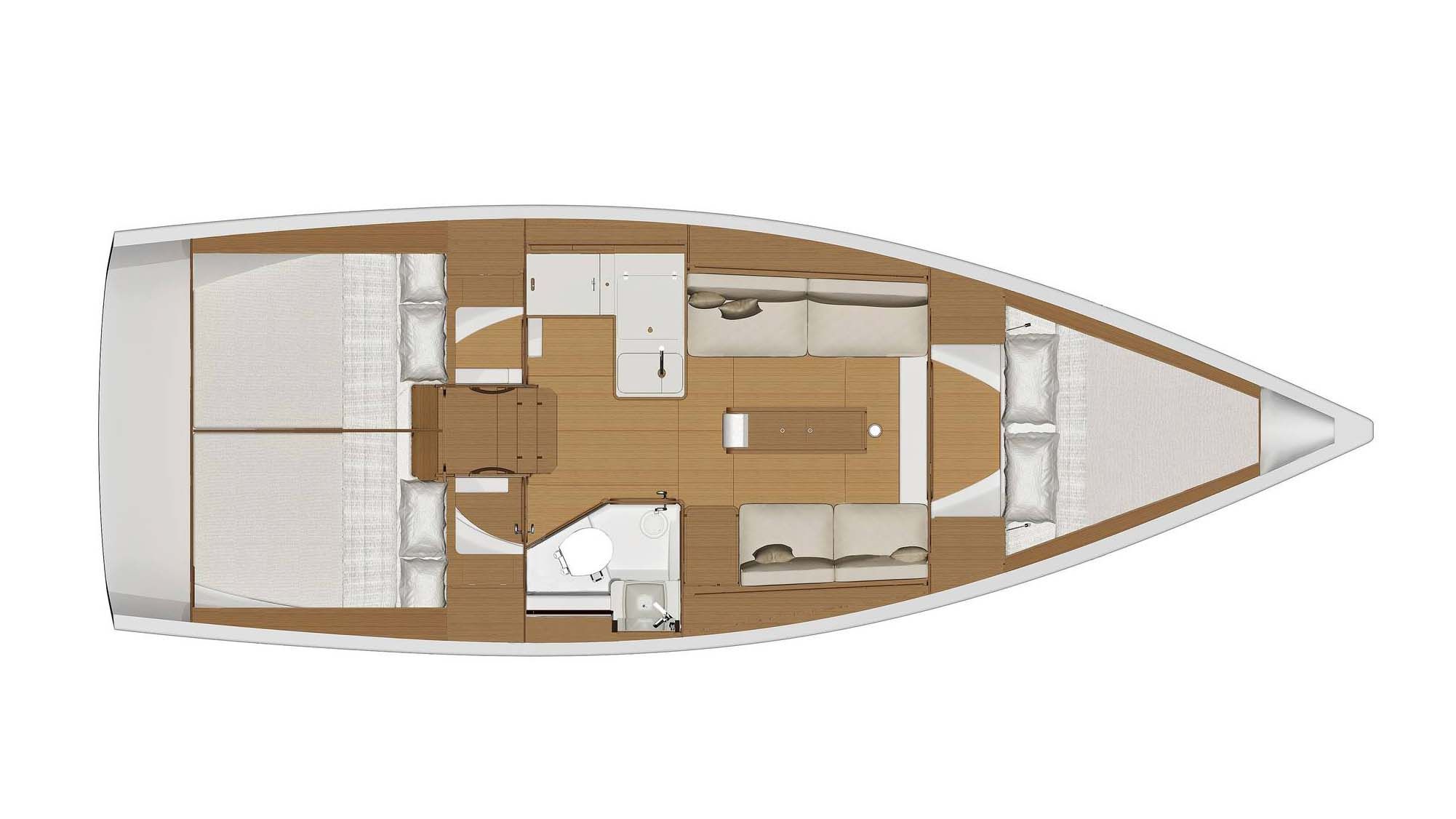
Dufour’s interior on the 360 is deliberately bright and roomy for the length: wide settees, large portlights, and a coachroof design that brings light into the forward cabin create the impression of a larger boat. Layouts commonly come in two-cabin or three-cabin arrangements with a practical L-galley, a full head with separate shower, and generous lockers—enough for comfortable cruising or extended weekends for a couple or small family. Storage and ergonomics are sensible rather than sumptuous; owners who have kept boats for multi-month cruising typically add modest tankage or refrigeration upgrades for extended living aboard rather than wholesale refits. In short, the 360 is well-suited for coastal cruising and live-aboard stints of weeks at a time if systems and tankage are managed, but it is not a replacement for a dedicated long-range passagemaker.
Safety and Practicality
Deck ergonomics are designed for confident movement: broad side decks, an open cockpit with comfortable coamings, and well-placed winches and cleats reduce the need to leave the cockpit while sailing. The layout favors short-handed handling—halyards, reefing and sheet leads are routed to the helm area—so a couple can safely manage routine reefing and sail changes without frequent forward movement. For coastal and offshore work the boat can be outfitted responsibly (appropriate ground tackle, liferaft, redundant instruments); however, buyers should confirm the state of essential safety systems at survey (seacocks, bilge pumps, steering bearings) because access and condition of those components are decisive for passage reliability. Overall the 360’s practical ergonomics and accessible systems lean toward low day-to-day maintenance if properly monitored.
Known Issues with the Dufour 360 Grand Large
Owners’ discussion groups and service threads underline a few recurring themes—none are unique to the 360, but all are worth an investigator’s attention. Forum threads flag typical production-boat items: potential water ingress where deck fittings aren’t well bedded (a risk on cored structures if caulking fails), the need to inspect keel-to-hull joints and fastenings, and attention to rig-base and spreader fittings on modern rigs that use swept spreaders or minimal backstays. There’s also the usual aftermarket update list—owners frequently specify stronger chainplates, periodic standing-rigging checks, and upgrades to propeller and windlass arrangements for improved sailing and anchoring performance. For a buyer the practical takeaway is explicit: insist on a recent professional survey and a clear maintenance history; the most common surprises are repairable maintenance items rather than systemic design defects.
Market Availability and Pricing in the U.S.
The 360 was introduced in the 2017–2019 window and shows up regularly on the international used market; though Dufour offered new 360s through the early 2020s, many hulls traded into brokerage inventories as owners adjusted to local markets. U.S. listings exist—California and Florida have appeared as common U.S. locations for available examples, and broker postings show a mix of well-maintained owner boats and dealer stock imported from Europe. Based on recent U.S. and international broker listings, a realistic used-market band for well-optioned Dufour 360 Grand Large examples in the U.S. today is roughly $120,000–$200,000, depending on year, engine option and fit-out; lower-end listings reflect older boats with basic gear or European listings that include freight, while the higher end reflects U.S.-located boats with upgraded power, electronics and canvases. In resale terms the 360 competes well on interior feel and deck ergonomics with Jeanneau and Hanse offerings of the same era, while American-market brands such as Catalina often offer deeper U.S. dealer/support networks—an important liquidity consideration for some buyers.
Below is a comparison with similar sailboats from the same era:
| Model | LOA | Year (approx.) | Typical used price in U.S. | Main differences / buyer notes |
|---|---|---|---|---|
| Dufour 360 Grand Large | 35.2′ / 10.73 m | 2017–2022 | $120,000–$200,000 | Modern coachroof, Felci hull lines and cockpit ergonomics; balances coastal performance and interior volume. |
| Jeanneau Sun Odyssey 349 | 33.9′ / 10.34 m | 2014–2022 | $90,000–$210,000 | Family-oriented, conservative sections, broad dealer support; often priced lower in older model years. |
| Hanse 348 | 34.1′ / 10.40 m | 2018–present | $160,000–$260,000 | Sporty sail plan, modern styling and self-tacking jib options; stronger light-air performance. |
| Catalina 355 | 35.5′ / 10.8 m | 2013–present | $120,000–$285,000 | Robust American-market support, conservative underwater profile, solid resale in U.S. waters. |
Dufour 360 Grand Large vs Jeanneau Sun Odyssey 349

The Dufour 360 leans toward a modern, slightly sportier feel—Felci’s hull and coachroof treatment create room and a more performance-tilted sail plan—while the Sun Odyssey 349 is designed with conservative seakeeping and ease-of-use as priorities. That translates in practice to the 360 feeling brisker in light to moderate airs and offering cockpit ergonomics suited to short-handed sailing, whereas the Jeanneau trades a little performance for a softer motion and typically broader dealership/support options in many markets.
For a buyer that means if weekend club races and lively passages are a priority, the Dufour’s sharper behavior will be rewarding; if predictable comfort, dealer serviceability and maximum interior hardiness in a variety of U.S. ports matter more, the Jeanneau presents a lower-risk, user-friendly choice.
► Learn more about de Jeanneau Sun Odyssey 349
Dufour 360 Grand Large vs Hanse 348
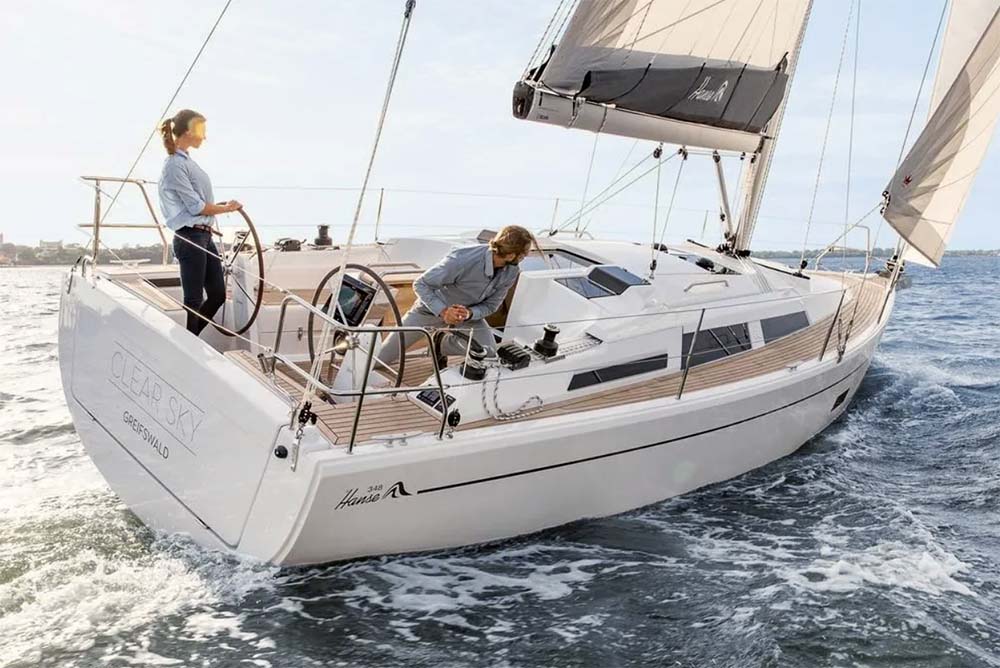
Both boats push modern styling and deck ergonomics, but the Hanse 348 often emphasizes easier single-handling (self-tacking jib options, very clean cockpit lines) and a taller, livelier rig that rewards light-air performance. The Dufour, while fast for its class, places slightly more emphasis on interior space and a comfortable, well-appointed saloon—so owners get a nicer below-decks experience without completely sacrificing on-deck performance.
Practically, the Hanse will appeal to a buyer whose top priorities are spirited short-handed sailing and minimal crew chores; the Dufour will suit someone wanting a balance where a more comfortable interior and slightly different helm ergonomics are worth a modest trade in pure speed.
► Learn more about de Hanse 348
Dufour 360 Grand Large vs Catalina 355

The Catalina is built to American expectations of durability, simple systems and strong resale support in U.S. marinas; the Dufour brings European styling, a more contemporary hull shape and slightly more aggressive sailing characteristics. In day-to-day ownership the Catalina’s parts network and dealership footprint in the U.S. can make sourcing service and spares easier, while the Dufour often offers a brighter interior and a hull that accelerates more readily in coastal conditions.
Therefore, buyers focused on easy long-term ownership in U.S. waters—who prioritize local support and a conservative, tried-and-true design—will find Catalina attractive; buyers aiming for a modern aesthetic, better light-air performance and a slightly loftier interior feel will prefer the Dufour’s tradeoffs.
► Learn more about de Catalina 355
Maintenance Costs of a Dufour 360 Grand Large in the U.S.
Below are typical annual and periodic costs for a mid-30-foot production cruiser, with regional notes and one-time expenses to plan for. Figures are indicative; actual costs vary with condition, state, and owner DIY ability.
- Mooring / slip fees — $3,000 to $20,000+ per year depending on marina and region (Florida and New England/California at the high end).
Comment: Location dominates recurring cost and can exceed maintenance in expensive harbors. - Insurance (liability + hull) — $800 to $3,000 per year depending on boat value, cruising area and coverages.
Comment: Offshore cruising or low deductibles push premiums higher; insurers price by region and experience. - Engine servicing (annual) — $300 to $1,200 (oil/filter, impeller, belts, fuel filters; more for saildrive or larger engines).
Comment: Opting for the larger factory engine option raises service parts/costs but improves motoring performance. - Antifouling / haul-out / bottom work — $800 to $7,000 depending on hull prep, number of coats, and yard rates.
Comment: Coastal regions with harsh fouling or high labor rates push costs to the upper range. - Standing & running rigging (inspection & replacement) — inspections $200–$600/year; standing rigging replacement ~$3,000–$8,000 every 10–15 years.
Comment: Modern rigs with swept spreaders or minimal backstays benefit from careful periodic checks. - Sails (repairs/replacement) — small repairs $100–$600/year; full set replacement $5,000–$15,000 depending on cloth and cut.
Comment: Cruising cuts last longer than high-performance laminates; storing and trimming sails properly extends life. - Electronics & battery servicing/upgrades — $300–$5,000+ annually depending on replacement cycle and whether you upgrade chartplotters, autopilot or install AIS.
Comment: Modern owners commonly invest in one-off upgrades to displays and navigation for safety and resale.
Significant one-time costs to budget: major sail set replacement, standing-rigging overhaul, a full electronics refit (multi-thousand dollars), or structural work if a survey reveals compromised bedding or core issues. A conservative planning rule often used in brokerage circles is to budget roughly 5–10% of boat value annually for operating and maintenance costs, though individual owner behavior (DIY vs. pro yard) substantially alters that number. Given its size and systems, the Dufour 360 generally sits in the medium maintenance cost bracket for 34–36-foot cruisers—more than a small pocket cruiser but less than larger offshore yachts—and a sound maintenance record materially helps preserve resale value.
Conclusion
The Dufour 360 Grand Large offers a compelling package for buyers who want a modern, light-feeling interior, thoughtful deck ergonomics and a hull that prefers lively coastal passages to languid motoring. Its strengths are the up-to-date coachroof and cockpit design, reasonable sailing performance for the size, and an interior that maximizes perceived volume. Weaknesses are largely the class-typical tradeoffs—shorter tankage and lower motion comfort than heavier passagemakers, and the need for disciplined bedding and core inspection to avoid water-intrusion issues. For a couple or small family seeking a coastal cruiser that feels larger than its LOA and will be easy to single-hand, the 360 is worth serious consideration; for buyers whose primary objective is long offshore voyaging or maximal U.S. parts/support simplicity, other models merit comparison. On balance the 360 typically represents a good value in its segment when a demonstrable service history accompanies the sale—well-maintained examples tend to hold market appeal and resell reasonably within the modern mid-30-foot market.
Specifications
| Hull Type: | Fin w/bulb & spade rudder |
| Rigging Type: | Fractional Sloop |
| LOA: | 35.20 ft / 10.73 m |
| LWL: | 29.69 ft / 9.05 m |
| S.A. (reported): | 592.00 ft² / 55.00 m² |
| Beam: | 11.61 ft / 3.54 m |
| Displacement: | 12,732.00 lb / 5,775 kg |
| Ballast: | 3,417.00 lb / 1,550 kg |
| Max Draft: | 6.23 ft / 1.90 m |
| Construction: | FG |
| Ballast Type: | Cast Iron |
| First Built: | 2018 |
| Builder: | Dufour Yachts |
| Designer: | Umberto Felci |
Auxiliary Power/Tanks (orig. equip.) | |
|---|---|
| Make: | Volvo |
| Type: | Diesel |
| HP: | 19 |
| Fuel: | 42 gals / 160 L |
Accommodations | |
| Water: | 58 gals / 220 L |
Sailboat Calculations | |
| S.A. / Displ.: | 17.43 |
| Bal. / Displ.: | 26.84 |
| Disp. / Len.: | 217.18 |
| Comfort Ratio: | 23.97 |
| Capsize Screening Formula: | 1.99 |
| S#: | 2.30 |
| Hull Speed: | 7.30 kn |
| Pounds/Inch Immersion: | 1,231.65 pounds/inch |
Rig and Sail Particulars | |
| I: | 41.67 ft / 12.70 m |
| J: | 12.14 ft / 3.70 m |
| P: | 35.60 ft / 10.85 m |
| E: | 14.76 ft / 4.50 m |
| S.A. Fore: | 252.94 ft² / 23.50 m² |
| S.A. Main: | 262.73 ft² / 24.41 m² |
| S.A. Total (100% Fore + Main Triangles): | 515.67 ft² / 47.91 m² |
| S.A./Displ. (calc.): | 15.19 |
| Est. Forestay Length: | 43.40 ft / 13.23 m |
Disclaimer
The considerations and analyses presented regarding the Dufour 360 Grand Large sailboat are of a general nature and are based on the available information and technical data on this model, interpreted to the best of our knowledge and understanding. It is important to note that the specific characteristics of any particular sailboat may vary due to custom modifications, maintenance performed, and conditions of use over time, among other factors. Therefore, the details and performance of the boat you are considering may not exactly match the information provided here.
We strongly recommend that, before making any purchasing or usage decisions, you conduct a detailed inspection of the boat in question, consult with nautical professionals and other sailors, and consider your personal needs, expectations, and capabilities. Each sailboat may have unique particularities that affect its performance and suitability for different types of sailing and sailors.
The information contained in this analysis should be used as a general guide and not as a definitive reference. Professional evaluation and personal inspection are essential to ensure that the boat meets your specific requirements and expectations.