


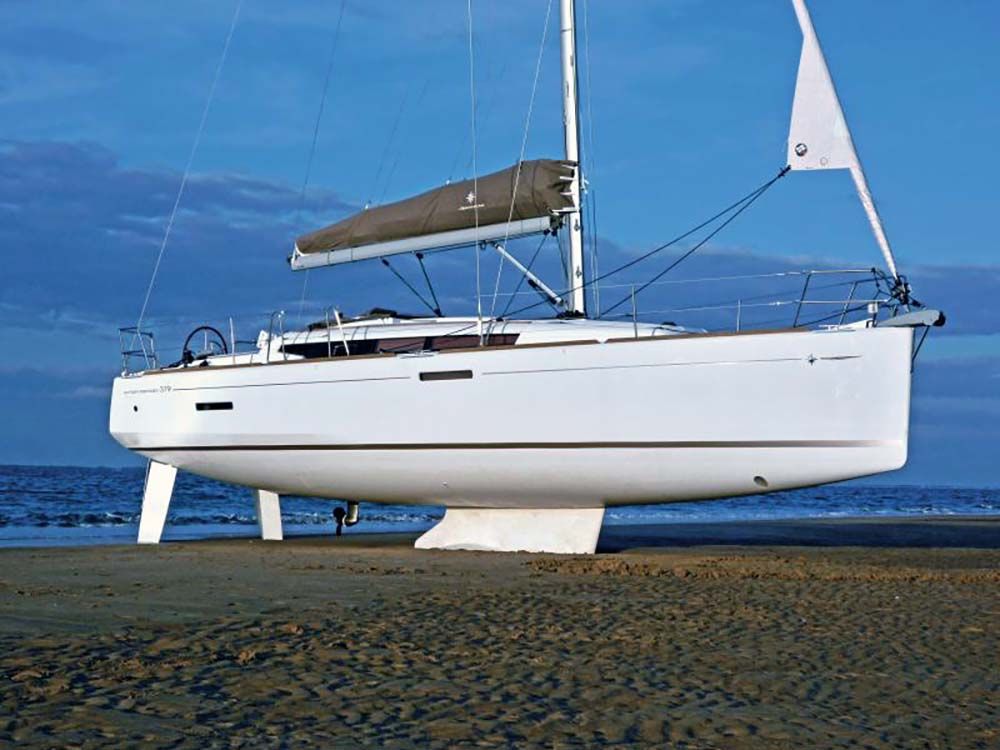
The Jeanneau Sun Odyssey 379 is a modern, performance-minded cruiser designed to give couples and small families a comfortable liveaboard-capable platform that still sails well. Launched by Jeanneau in the early 2010s and penned by Marc Lombard, the 379 was marketed as a mid-size cruiser that blended easy handling (single- or short-handing friendly systems) with contemporary hull lines and interior volume; it earned immediate attention—Cruising World named it Domestic Boat of the Year and Best Midsize Cruiser soon after launch—so it arrived as a pragmatic, club-capable cruiser rather than a pure racer. The boat found traction in owner and charter markets alike: dealers and brokers report steady used-market activity because the 379 slots neatly between looser “daysailer” offerings and larger, more complex passagemakers, attracting coastal cruisers, couples planning extended weekends, and charter operators who prize the roomy cockpit and flexible 2–3 cabin layouts
Design and Construction
The 379 follows contemporary French production practice: a plumb bow, hard chine carried aft and a relatively broad beam—paired with a fin keel and, in many versions, twin rudders or alternative shoal/centerboard options—so the hull translates form stability into usable interior volume and predictable control when heeled. Jeanneau employed solid fiberglass hulls and cored decks with modern manufacturing controls; choices such as a 9/10 fractional rig (factory options included a self-tacking jib or performance packages), twin helm stations and a relatively low cockpit sole make the boat both easy to work and straightforward to service in familiar dealer networks. Those construction and naval-architecture choices aim to balance stiffness (for sail carrying), simple repairability (standardized deck hardware and serviceable thru-hulls) and residual value—buyers trade some pure racing efficiency for a boat that’s more forgiving in mixed conditions and cheaper to keep on the hook. The factory documentation and spec sheets also show careful attention to deck ergonomics (anchoring locker, flush hatches) and modular interior arrangements that reduce the need for bespoke refits.
Performance
On the water the 379 is widely regarded as a lively coastal cruiser: the chined hull and well-balanced fractional rig let it accelerate cleanly off the wind and maintain good speed upwind for its class. Owners and professional testers report comfortable handling in chop and a responsive helm that rewards trim—while the boat is not a race-boat, its sail-area-to-displacement ratios and hull form give it a clear advantage over older, heavier production cruisers in light to moderate airs; a taller or “performance” rig option improves light-air pointing without significantly complicating handling. Because the design aims for a middle ground—good pointing, competent off-wind speed and forgiving motion in a short sea—the 379 sits above basic coastal cruisers in pace but beneath dedicated club racers, making it a strong candidate for owners who want to cruise quickly between waypoints without accepting the maintenance and fragility of a full race program.
Comfort and Accommodations
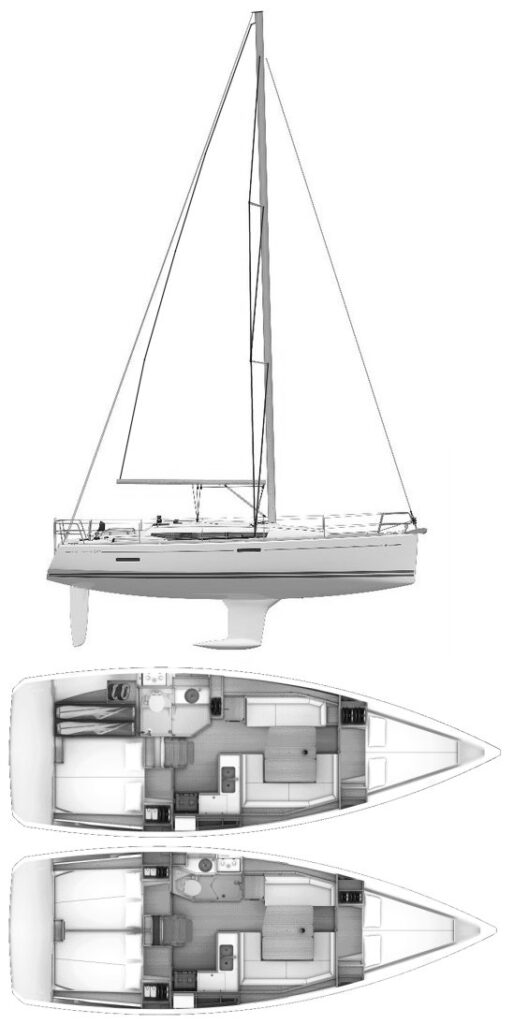
Interior planning is one of the 379’s real selling points: the beam carried well aft and smart use of chines create more usable cabin volume than older 36–37 foot boats while keeping passageways and the galley ergonomically sensible. Layouts commonly offer two- or three-cabin versions with a large saloon, practical L-galley and a well-shaped shower compartment—choices that work well for couples who cruise and for families doing weekend hops or longer seasonal trips. Ventilation and natural light are strong compared with older production boats, and the joinery finishes are competitive with peer models in the same price band; that said, full-time liveaboard comfort on a 37-foot hull still requires careful organization and occasional system upgrades (additional refrigeration, more battery/inverter capacity, or improved insulation) to be truly comfortable in colder climates. Many used examples show tasteful owner upgrades rather than wholesale refits—good if you want an immediately usable boat without a large refit budget.
Safety and Practicality
Deck ergonomics and the dual-helms layout make cockpit movement and visibility straightforward: the walk-around decks, flush hatches and well-placed clutches let a short crew manage sail changes in moderate conditions without risky re-routing of lines. The 379 was designed with user-friendly sail options (self-tacking jibs, electric winch options) so singlehanding is realistic; systems and engineering are conventional (Yanmar diesels are typical), which keeps spare-parts channels and professional service costs predictable in the U.S. For true blue-water passagemaking an owner would sensibly add redundancy (backup steering checks, beefed-up sea-cocks, storm sails and life-raft options), but for coastal cruising and limited offshore legs the boat is fundamentally capable and practical as delivered. The overall result is a boat that reduces day-to-day friction for a cruising couple while leaving reasonable upgrade paths for owners who want to expand its blue-water capability.
Known Issues with the Jeanneau Sun Odyssey 379
The Sun Odyssey 379 is a modern production boat and most documented problems are maintenance- and installation-related rather than inherent design failures. Owners and survey reports commonly flag routine items: deck-fitting seals and companionway/scupper seals that need resealing over time, the usual attention to any cored-deck penetrations, and expected wear on furling gear and running rigging depending on usage. The 379’s production variants—performance vs. cruising packages, keel and rudder options—mean surveys must check variant-specific hardware such as centerboard cases, twin rudder bearings (on shoal/twin-rudder versions) and chainplate installations; attention to these areas during purchase negotiation typically avoids nasty surprises. Practical, frequently recommended improvements include updating navigation electronics (modern chartplotter/AIS), replacing old sails or refitting sail-handling systems, and confirming the condition of the engine-mount and shaft seals—upgrades that improve reliability and often pay back in resale desirability.
Market Availability and Pricing in the U.S.
Jeanneau built the 379 in the 2011–2015 era; it is no longer a current production model, so buyers find it only on the used market where it remains reasonably common and actively traded. U.S. listings in recent years show availability concentrated where demand and brokerage activity intersect—Pacific Northwest and California coasts, the Mid-Atlantic (Annapolis/Jacksonville) and Florida—often appearing both in private listings and dealer stock. Recent U.S. asking prices cluster roughly between $115,000 and $180,000 depending on year, equipment and condition; brokers and marketplace snapshots show ads from low-$100k (older or European-located listings) to near-$180k for well-equipped, low-hour U.S. boats, with typical U.S. broker listings centering in the mid-$150k range. Given its award-backed design, roomy interior and recognized brand, the 379 generally offers good value and liquidity compared with both older domestic designs and newer small-yacht European models—well-maintained examples sell briskly when priced realistically.
Below is a comparison with similar sailboats from the same era:
| Model | LOA | Approx. first year | Typical used price (US) | Main differences |
|---|---|---|---|---|
| Jeanneau Sun Odyssey 379 | ~37.2 ft | 2011–2015 | **$115,000–$180,000** | Modern hull with chine, twin-rudder/keel options, contemporary interior and good systems support. |
| Beneteau Oceanis 35.1 | ~34.3 ft (LOA) | 2017 | $140,000–$215,000 (varies by year/spec) | More recent interior styling options, twin rudders, Nauta interior packages; often marketed with modern conveniences at higher asking prices. |
| Dufour 360 Grand Large | ~35–36 ft (varies by spec) | 2017–2018 | $150,000–$220,000 | Italian-designed hulls with vacuum construction, performance-leaning options and refined fit-out at a premium. |
| Catalina 36 | ~36.3 ft | 1982 (MkII mid-1990s) | $25,000–$100,000 | Older domestic classic: heavier, simpler systems, widely supported parts market and lower entry prices. |
Jeanneau Sun Odyssey 379 vs Beneteau Oceanis 35.1

The 379 presents a modern, chined hull with a beam carried aft and multiple keel/steering options that translate into higher interior volume and livelier light-air performance compared with the older, more conservative Catalina 36. In practical terms that means the Jeanneau will feel quicker off the wind and offer more contemporary ergonomics in the cockpit and below, while the Catalina’s simpler systems and heavier displacement produce a more sedate motion in a chop and an easier, lower-cost maintenance profile.
For a buyer focused on immediate comfort, modern systems and resale appeal in a market that favors newer European design cues, the 379 is compelling; for someone needing the lowest possible acquisition cost, the broad parts availability and simplicity of the Catalina 36 make it an appealing, lower-risk buy—especially if the owner plans significant DIY maintenance rather than paying yard rates.
► Learn more about de Beneteau Oceanis 35.1
Jeanneau Sun Odyssey 379 vs Dufour 360 Grand Large

Both are modern European designs aimed at comfortable coastal cruising, but the Oceanis 35.1 leans into very recent interior styling and modular layout choices (Nauta Design influence), often marketed with the latest convenience features and optional folding transoms—choices that can raise initial price and perceived value. The 379 typically offers a slightly fuller hull form and a proven balance between performance and ease of handling; owners who prize a compact, highly optimized interior and the newest dealer options may prefer the Beneteau, while those who want the balance of sailing performance, established systems and lower-friction service networks will find the Jeanneau’s platform more predictable.
Practically, this means the Oceanis 35.1 can feel more “finished” off the dock and may fetch higher asking prices, but the 379’s combination of sailing manners and serviceability often results in lower long-term ownership friction—important when factoring survey findings, parts lead times and refit budgets.
► Learn more about de Dufour 360 Grand Large
Jeanneau Sun Odyssey 379 vs Catalina 36

The Dufour 360 Grand Large emphasizes performance-lean construction techniques (vacuum lamination, Felci hull shapes) and a slightly sportier intent that can translate into higher initial cost but sharper light-air performance and a stiffer feel under sail. The 379, by contrast, is tuned for a middle ground: responsive and enjoyable to sail, but with an emphasis on approachable deck systems, simpler package options and a focus on comfort for couples and families rather than squeezing every knot.
For buyers who want a sportier platform and are willing to accept a higher acquisition and potential refit bill for higher-spec construction, the Dufour rewards you with a crisper helm and race-adjacent options; owners who want strong coastal cruising performance with better dealer support in many U.S. locations and easier maintenance paths will find the Jeanneau a more pragmatic and cost-efficient choice.
► Learn more about de Catalina 36
Maintenance Costs of a Jeanneau Sun Odyssey 379 in the U.S.
Below are typical annual and one-time expenses you should budget for; numbers are ranges and depend heavily on region, condition and how much you DIY.
- Mooring / Slip or Storage — $3,000–$18,000/year (big regional variance; high-demand marinas and premium slips in places like San Francisco or Miami are at the high end).
- Insurance — $800–$4,000+/year depending on coverage, cruising area and value; coastal and charter use drive this up.
- Engine servicing (routine) — $300–$1,200/year for annual service; expect larger invoices for injectors, gearbox or transmission work.
- Antifouling & haul-out — $800–$4,000 per haul (bottom paint, power-wash, small repairs); premium yards cost more.
- Standing rigging (inspection / replacement) — inspection modest yearly; full replacement every ~10–15 years $6,000–$12,000+ depending on hardware.
- Running rigging, sails & canvas — annual small repairs $200–$1,500; new mainsail or headsail $3,000–$8,000+ depending on cloth and cut.
- Electronics & safety upgrades — modern chartplotter/AIS/autopilot packages $2,000–$12,000 if you modernize; EPIRB/liferaft add extra.
- Survey / reserve for surprises — set aside $1,000–$5,000/year to smooth out irregular repairs and surveys.
Region matters: slips and haul costs are the single biggest driver of variance (New England and California top the list; many Gulf Coast and inland locations are lower cost). Owners who can perform mechanical and systems work themselves can substantially reduce the recurring line items—professional labor is the largest component of running costs when you don’t DIY. As a rule of thumb, expect medium annual running costs in this size class: higher than older simple domestic boats but lower than high-spec blue-water yachts; overall ownership tends to be cost-effective if you buy a boat with a clean maintenance history and plan conservative upgrades.
Conclusion
The Sun Odyssey 379 balances modern hull design, comfortable interiors and accessible systems in a way that suits a broad swath of buyers: cruising couples who want speed without complexity, small families seeking a practical weekend and summer boat, and brokers who value a design with recognized credentials. Its strengths are contemporary volume, easy sail handling, and a production-boat service network that keeps parts and expertise available; its weaknesses are the normal caveats for production boats of this era—variant-specific hardware to inspect carefully, the need for periodic rig and sail investment, and regional price pressure that can make better-equipped boats relatively costly. For a buyer focused on coastal cruising with the option to step up to limited offshore work with sensible upgrades, the 379 is worth serious consideration: it typically represents a strong value for a modern 37-footer and holds resale appeal because of its award pedigree and practical design.
Specifications
| Hull Type | Fin w/bulb & spade rudder |
| Rigging Type | Fractional Sloop |
| LOA | 37.20 ft / 11.34 m |
| LWL | 34.12 ft / 10.40 m |
| S.A. (reported) | 753.00 ft² / 69.96 m² |
| Beam | 12.34 ft / 3.76 m |
| Displacement | 14,771.00 lb / 6,700 kg |
| Ballast | 3,900.00 lb / 1,769 kg |
| Max Draft | 6.36 ft / 1.94 m |
| Min Draft | 4.92 ft / 1.50 m |
| Construction | FG |
| First Built | 2011 |
| Builder | Jeanneau |
| Designer | Marc Lombard |
| Auxiliary Power | Yanmar Diesel, 29 HP |
| Fuel | 34 gals / 129 L |
| Water | 53 gals / 201 L |
| S.A. / Displ. | 20.09 |
| Bal. / Displ. | 26.40 |
| Disp. / Len. | 166.01 |
| Comfort Ratio | 22.93 |
| Capsize Screening Formula | 2.02 |
| S# | 3.10 |
| Hull Speed | 7.83 kn |
| Pounds/Inch Immersion | 1,504.43 pounds/inch |
| I | 46.70 ft / 14.23 m |
| J | 13.60 ft / 4.15 m |
| P | 44.60 ft / 13.59 m |
| E | 13.90 ft / 4.24 m |
| S.A. Fore | 317.56 ft² / 29.50 m² |
| S.A. Main | 309.97 ft² / 28.80 m² |
| S.A. Total (100% Fore + Main) | 627.53 ft² / 58.30 m² |
| S.A./Displ. (calc.) | 16.74 |
| Est. Forestay Length | 48.64 ft / 14.83 m |
Disclaimer
The considerations and analyses presented regarding the Jeanneau Sun Odyssey 379 sailboat are of a general nature and are based on the available information and technical data on this model, interpreted to the best of our knowledge and understanding. It is important to note that the specific characteristics of any particular sailboat may vary due to custom modifications, maintenance performed, and conditions of use over time, among other factors. Therefore, the details and performance of the boat you are considering may not exactly match the information provided here.
We strongly recommend that, before making any purchasing or usage decisions, you conduct a detailed inspection of the boat in question, consult with nautical professionals and other sailors, and consider your personal needs, expectations, and capabilities. Each sailboat may have unique particularities that affect its performance and suitability for different types of sailing and sailors.
The information contained in this analysis should be used as a general guide and not as a definitive reference. Professional evaluation and personal inspection are essential to ensure that the boat meets your specific requirements and expectations.