



The Pacific Seacraft 37 (often known in its earlier form as the Crealock 37) is a classic, bluewater-oriented cruising yacht conceived in the late 1970s and built to be a safe, seakindly passagemaker rather than a daysailer or club racer. Designed by W. I. B. “Bill” Crealock and taken into production first as the Crealock 37 and then by Pacific Seacraft beginning around 1980, the 37 was aimed at serious cruising couples and small crews who wanted a boat that inspired confidence offshore: solid structure, modest sailplan options (sloop, cutter, yawl), and seakindly hull lines. Over decades the design has earned a strong reputation among voyagers and small-boat circumnavigators for seaworthiness and is a sought-after type on the used market by buyers who value bluewater capability, though demand is niche—mostly private cruisers and long-distance sailers rather than charter operators.
Design and Construction
The Pacific Seacraft 37 reflects conservative, time-tested design choices: a relatively narrow beam for its length, moderate underbody sections, a pronounced sheer and overhangs that give reserve buoyancy, and a skeg-supported rudder paired with a substantial fin keel—an arrangement that balances directional stability with reasonable maneuverability. Construction has been traditionally robust: hulls are hand-laid solid fiberglass and decks were originally sandwich-cored (marine plywood through much of the production run, later switching to end-grain balsa or updated core systems). The builder maintained ABS-inspired laminating standards for many years and adopted vinylester first laminates later in production runs to reduce osmotic blistering—details that matter to buyers inspecting older boats. Those conservative construction choices favor longevity and relative ease of repair: a solid laminate hull is straightforward to patch, and Pacific Seacraft’s conservative engineering concentrates loads where yards expect to see them, simplifying structural surveys and repairs.
From a naval-architecture perspective the 37’s moderate displacement/length and a relatively high ballast ratio give predictable righting behavior and a comfortable motion in a seaway—qualities prioritized in a bluewater design. The trade-offs are evident: she will not accelerate like a modern light-displacement cruiser in light airs, but in wind and sea states that unsettle lighter boats she preserves course-keeping and the kind of motion that reduces crew fatigue on long passages. For a buyer this equals fewer unplanned refits to strengthen structural systems, but it also means that expectations on passage times and light-air performance should be realistic.
Performance
Under sail the Pacific Seacraft 37 behaves as a traditional passagemaker: steady, tracking well to windward, and comfortable off the wind. In moderate to strong breeze she is capable of sustained passage-making speeds that, while not high by modern rating standards, are consistent and predictable—qualities that many offshore sailors prize more than sprint performance. The skeg-hung rudder and balanced underwater profile give good directional control in confused seas and make handling under autopilot or short-handed conditions more straightforward than many full-keel alternatives. Conversely, in light airs the heavier displacement and narrower waterline length mean she will lag contemporaries designed for performance; careful sail selection and prudent hull cleanliness are common owner strategies to optimize light-air behavior.
Compared with racers or modern performance cruisers the 37 trades speed for seaworthiness: think steady arrival rather than beating the fleet. Compared with older full-keel heavy cruisers she is often a touch more maneuverable and responsive because of the fin keel/skeg rudder combination—an attribute that appeals to sailors who want long-range capability without the single-minded handling compromises of very full-keel designs.
Comfort and Accommodations
The interior of the Pacific Seacraft 37 is purpose-built for living aboard and long passages: robust joinery, practical berth arrangements (usually a private forward cabin, roomy settees that double as sea berths, and a well-engineered quarter-berth/owner cabin depending on layout), and thoughtful systems placement. Storage and tankage are typically sized for extended cruising rather than weekend hops, and light, ventilation and simple galley layouts emphasize function over flashy finishes. As a result, couples or small families can cruise for extended periods with fewer on-deck compromises; compared to more modern boats that maximize open-plan saloons the 37’s interior feels solid and utilitarian, which ages well when corrosion and moisture are managed. Many owners refresh upholstery, update galley refrigeration and modernize electronics, but the basic layout rarely requires major rework to suit extended cruising.
For long-term liveaboard use the 37 is comfortable if systems (heating, refrigeration, watermaker or larger tanks) are upgraded to match intended use. The durable joinery and access to systems under berths and behind panels make in-place servicing achievable, a big plus for owners who plan to keep the boat at sea for months at a time.
Safety and Practicality
On deck the 37 is designed with safety in mind: secure toerails, handholds, and a deck layout that prioritizes clear movement. The cutter-sloop options and moderate sail area options make reefing strategies straightforward and manageable with a small crew—an advantage for shorthanded long-distance sailors. Access to the engine and through-hulls is generally good for a boat of this era, and the conservative systems layout makes troubleshooting and repairs less exotic than on more modern, tightly packaged boats. All told, the boat is ready-built for coastal and ocean passages as delivered, although owners planning serious offshore work commonly fit upgraded ground tackle, modern communications (satcom/long-range HF or SSB), and enhanced safety kit (jacklines, storm sails, backup steering arrangements) to match their risk tolerance.
Known Issues with the Pacific Seacraft 37
Because the 37 has been built and maintained across several decades, the issues buyers encounter are often age-related and linked to changes in construction practice over time rather than a single fatal flaw. Historically noted items include:
- Deck core concerns where plywood cores were used in older decks (inspect for soft spots and water intrusion around fittings).
- Osmosis/blistering on early laminates prior to wider adoption of vinylester first laminates (later production models and refits used vinylester to mitigate this). Buyers should look for evidence of earlier blister repairs and ask for osmosis histories.
- Rigging and engine age: as with any older cruiser, standing rigging replacement and engine repowers or major services are common capital items on used examples.
Practical, commonly recommended improvements are straightforward for a prospective buyer: re-bed deck fittings and chainplates as needed, replace standing rigging on age criteria, refresh sails with modern cuts or materials for better light-air performance, and modernize navigation/electrical systems for reliability and safety. These are typical refit items for bluewater boats and, when done correctly, improve both safety and resale value.
Market Availability and Pricing in the U.S.
The Pacific Seacraft 37 is no longer a new-production model in the general market (the design was built from the late 1970s through later decades under Pacific Seacraft and related production runs), so the market is entirely used-boat–driven. Recent U.S. listings show a broad price spread reflecting year, equipment, refit history and condition—examples listed in broker marketplaces often range roughly $65,000–$170,000, with nicer late-1990s and 2000s examples at the higher end and older or project boats at the lower end. Regionally, the 37 turns up most frequently where bluewater and coastal cruising communities concentrate: New England, the Mid-Atlantic, the Southeast (Florida and the Carolinas) and the Pacific Northwest. Boats in broker hands or owned by experienced cruisers tend to command higher prices; project boats or those with dated systems appear as bargains but usually require measurable investment to bring to passage-ready condition.
Below is a comparison with similar sailboats from the same era:
| Model | LOA | Approx. Years Built | Typical U.S. Used Price | Main Differences / Notes |
|---|---|---|---|---|
| Pacific Seacraft 37 (Crealock 37) | ~36.9 ft | 1978–2000s (various runs) | $65,000–$170,000 | Solid hand-laid laminate, bluewater-proven Crealock hull, cutter/sloop options, built for offshore safety. |
| Tayana 37 | ~37 ft | 1970s–1980s | $30,000–$90,000 | Robert Perry designs; roomy, often cutter-rigged, solid Taiwanese construction; generally more interior volume per foot. |
| Contessa 32 | ~32 ft | 1970s–1980s (various builders) | $25,000–$60,000 | Classic British bluewater design: light, fast for size, seaworthy but more motion and less interior volume than a 37-footer. |
| Westsail 32 | ~32 ft | 1970s–1980s | $20,000–$80,000 | Heavy, full-keel traditional cruisers with extensive tankage and ruggedness; slower but extremely stout and simple to maintain. |
Pacific Seacraft 37 vs Tayana 37

The Pacific Seacraft 37 and the Tayana 37 are both comfortable offshore cruisers, but they arrive from different design priorities. The 37’s Crealock pedigree emphasizes conservative underwater lines, a skeg-supported rudder and structural conservatism that reward long passages and heavy weather; the Tayana, often a Robert Perry design or derivative, typically offers more interior volume and sometimes a slightly more performance-lean hull for similar length.
In practical ownership terms the Pacific Seacraft often appeals to buyers who prize a resolute, calm motion and a hull built to tight laminating standards, while Tayana buyers trade some of that reserve buoyancy for more living space and a generally livelier feel in moderate conditions. Maintenance regimes are similar—both are solidly built—but the Tayana’s typically larger interior systems (bigger tanks, more amenities) can mean slightly higher refit costs in some cases.
► Learn more about de Tayana 37
Pacific Seacraft 37 vs Contessa 32
Viewed side-by-side, the Pacific Seacraft 37 is a larger, more comfortable passagemaker with a heavier displacement and more tankage, whereas the Contessa 32 is a smaller, sharper boat that earned a reputation for exceptional sea-kindliness for its size and surprisingly brisk performance. The Contessa’s narrower, more performance-oriented hull rewards sailors who accept a firmer motion and less living space in exchange for better light-air speed and a rewarding helm feel.
For a buyer, the Contessa is attractive if offshore capability on a tight budget and relatively light displacement are priorities; the Pacific Seacraft is better if interior volume, tankage and conservative, heavy-weather friendliness are the purchase drivers. Maintenance on the Contessa can be simpler in some respects (less volume, smaller systems), but wiring, rigs and age-related refits are common to both types and should be budgeted.
► Learn more about de Contessa 32
Pacific Seacraft 37 vs Westsail 32

The Westsail 32 and Pacific Seacraft 37 both inhabit the heavy-displacement cruising world, but the Westsail leans toward very conservative, full-keel robustness with a slower hull speed and enormous tankage for its size; the Pacific Seacraft 37 offers a mid-ground with better maneuverability (fin keel + skeg) and usually a livelier passage speed. The Westsail’s simplicity and voluminous storage attract circumnavigators who prioritize autonomy and tankage, while the Pacific Seacraft appeals to sailors who want similar offshore safety with slightly more performance and a more modern deck/rig ergonomics.
Buyers valuing minimal electronics and maximum tankage might choose a Westsail for low-tech long-term voyaging; buyers who want a more balanced cruising yacht that is easier to single-hand and dock, with good resale prospects among bluewater sailors, will likely prefer the Pacific Seacraft. Both require careful inspection for age-related issues, but the Pacific Seacraft’s construction changes over time (e.g., vinylester first coats) can be a selling point for buyers concerned about osmosis history.
► Learn more about de Westsail 32
Maintenance Costs of a Pacific Seacraft 37 in the U.S.
Below is a practical, commented list of typical annual and one-time ownership costs to budget for. Numbers are ranges informed by marketplace guidance for similar-sized bluewater cruisers and regional service pricing.
- Mooring / Slip fees: $3,000–$24,000 per year — varies widely by region; premium slips in New England or California top the range.
- Insurance: $600–$3,000 per year — typically ~1%–2% of insured value; age, cruising area and claims history drive premiums.
- Engine servicing and routine mechanicals: $600–$2,500 per year — includes oil, filters, belts, impellers; major overhauls or repowers are additional one-time costs ($8,000–$25,000+).
- Antifouling / haul-out and bottom paint: $1,000–$5,000 every 1–3 years — haul, power-wash, fairing and antifouling costs vary by haul-out yard and region.
- Standing and running rigging inspections / replacements: $300–$1,200 per year for inspections and minor works; full standing rig replacement typically $3,000–$8,000 depending on mast complexity.
- Sails (maintenance / replacement): $500–$2,000 per year for repairs and maintenance; a new set of cruising sails (main + working jib) generally runs $6,000–$15,000 depending on cloth and cut.
- Electronics and navigation upgrades: $0–$10,000+ (one-time) — modern chartplotter, AIS, autopilot upgrades and satellite communications are common refit items.
- Annual miscellaneous (anodes, zincs, small plumbing/electrical): $300–$1,500.
Region matters: owners in New England or the Pacific Coast should expect higher slip and yard rates; Gulf and Southeast costs tend to be midrange, and inland or small-town yards are often cheapest. Significant one-time costs that commonly arise for the 37 are standing rig replacement, major deck-core or structural repairs (rare but expensive), repowering, and a comprehensive electronics/energy refit (solar, battery bank, inverter) to support extended cruising. Many routine tasks (zincs, small engine maintenance, sail repairs) can be owner-performed, but rigging jobs, composite structural repairs and major electrical refits usually require professionals. Considering the boat’s size and offshore intent, expect medium-to-high running costs relative to smaller coastal cruisers; however, when the boat is well-maintained and refitted thoughtfully, strong resale interest among bluewater buyers often offsets investments at resale.
Conclusion
The Pacific Seacraft 37 is a classic bluewater cruising yacht that rewards buyers who prioritize seaworthiness, structural conservatism and long-term reliability over modern light-air speed or minimalist race-boat styling. Its strengths are clear: a proven hull form by a respected designer, conservative construction practices that favor repairability, and a seakindly motion that reduces crew fatigue on long passages. Weaknesses are equally predictable: heavier displacement means slower light-air performance, and older examples require attentive inspection for deck-core, rigging and systems age—typical items for any mature bluewater yacht.
For the coastal or passagemaking sailor who plans serious cruising, couple-centric voyaging or extended liveaboard passages, the Pacific Seacraft 37 is worth seeking out: it is a pragmatic investment for those who value safety and capability and it generally holds resale appeal within the bluewater community when refits are documented. For buyers whose priorities are weekend racing, minimal maintenance or sheer interior volume per foot, other designs may be a better match; but for a robust, trustworthy 37-foot cruiser that encourages confident offshore sailing, it remains a strong and well-regarded choice.
Specifications
| Hull Type | Fin with rudder on skeg |
| Rigging Type | Cutter |
| LOA | 36.92 ft / 11.25 m |
| LWL | 27.75 ft / 8.46 m |
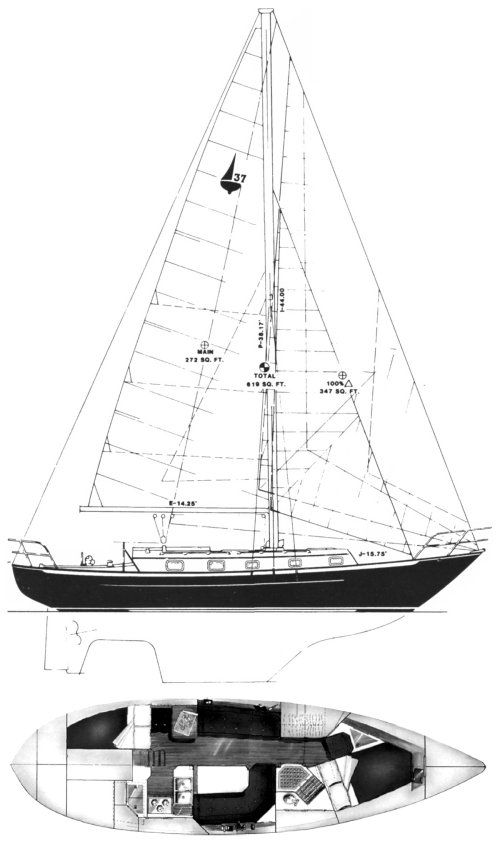
| Sail Area (reported) | 618.00 ft² / 57.41 m² |
| Beam | 10.83 ft / 3.30 m |
| Displacement | 16,000 lb / 7,257 kg |
| Ballast | 6,200 lb / 2,812 kg |
| Max Draft | 5.50 ft / 1.68 m |
| Construction | Fiberglass (FG) |
| Ballast Type | Lead |
| First Built | 1980 |
| Builder | Cruising Consultants Inc. / Pacific Seacraft (USA) |
| Designer | W.I.B. Crealock |
| Auxiliary Power | Yanmar 4JH2E, Diesel, 51 HP |
| Fuel Capacity | 40 gals / 151 L |
| Water Capacity | 95 gals / 360 L |
| S.A. / Displ. | 15.63 |
| Bal. / Displ. | 38.75 |
| Disp. / Len. | 334.26 |
| Comfort Ratio | 33.95 |
| Capsize Screening Formula | 1.72 |
| S# | 1.41 |
| Hull Speed | 7.06 kn |
| Pounds/Inch Immersion | 1,073.84 pounds/inch |
| Rig Dimensions (I, J, P, E) | I: 44.00 ft / 13.41 m J: 15.75 ft / 4.80 m P: 38.17 ft / 11.63 m E: 14.25 ft / 4.34 m |
| Sail Areas | Fore: 346.50 ft² / 32.19 m² Main: 271.96 ft² / 25.27 m² Total: 618.46 ft² / 57.46 m² |
| Est. Forestay Length | 46.73 ft / 14.24 m |
Disclaimer
The considerations and analyses presented regarding the Pacific Seacraft 37 sailboat are of a general nature and are based on the available information and technical data on this model, interpreted to the best of our knowledge and understanding. It is important to note that the specific characteristics of any particular sailboat may vary due to custom modifications, maintenance performed, and conditions of use over time, among other factors. Therefore, the details and performance of the boat you are considering may not exactly match the information provided here.
We strongly recommend that, before making any purchasing or usage decisions, you conduct a detailed inspection of the boat in question, consult with nautical professionals and other sailors, and consider your personal needs, expectations, and capabilities. Each sailboat may have unique particularities that affect its performance and suitability for different types of sailing and sailors.
The information contained in this analysis should be used as a general guide and not as a definitive reference. Professional evaluation and personal inspection are essential to ensure that the boat meets your specific requirements and expectations.