


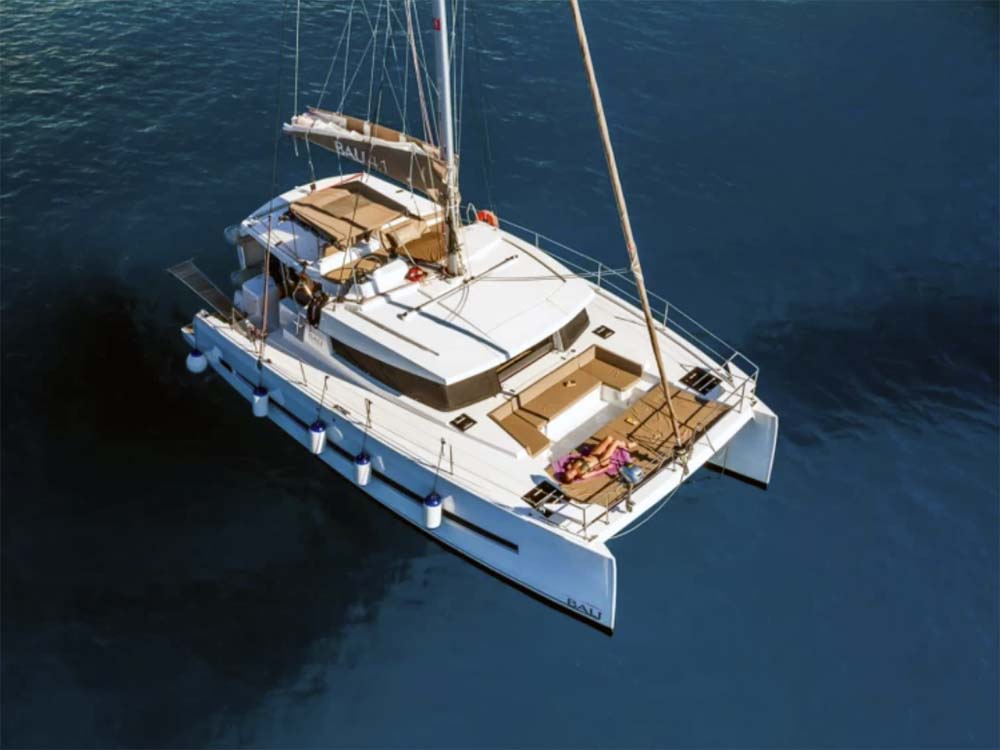
The Bali 4.1 is a family- and charter-oriented cruising catamaran that deliberately prioritizes social deck space and live-aboard volume while keeping sensible passage-making capability. Launched in the late 2010s by the Catana Group under the Bali brand (with naval architecture by Xavier Faÿ and concept work by Olivier Poncin / Yann Chabaud), the 4.1 builds on Bali’s “open-plan” philosophy — a removable forward cockpit door, a generous cockpit-salon connection and a focus on effortless short-handed sailing. It was conceived primarily for owners and charter companies who value a convivial deck layout and low-stress handling more than race boat performance; as a result the model has been prominent on the used market and is popular with charter operators, couples and families seeking a comfortable coastal cruiser.
Design and Construction
The Bali 4.1 uses twin-hulled, moderate-displacement geometry with relatively full sections for generous interior volume and a bridgedeck shaped to reduce slamming — a typical choice for production cruising cats that are aimed at comfort rather than outright speed. Construction is foam-cored, vacuum-infused fiberglass in many areas; Catana’s production practices emphasize structural lamination and modular interiors that speed construction and simplify replacements. The rig is a fractional sloop with a moderate sail area and options for a self-tacking jib, which limits sail handling complexity and makes short-handing easier; twin rudders and twin keels/saildrives are standard for the class. Those design decisions mean easier, repeatable repairs (fiberglass laminate work is straightforward at many yards) and good resale support from a recognizable builder, but they also mean a buyer should pay attention to core-area sealing (deck penetrations, windows and forward doors) — common wear areas on production cats that see heavy liveaboard or charter use.

Performance
On the water the Bali 4.1 sails as a comfortable, steady cruiser rather than an enthusiastic performer. Independent reviews and owner reports show realistic cruising speeds in the mid-6 to low-8 knot range in typical coastal conditions, with the boat feeling most at home reaching and off the wind; when pressed upwind she will make progress but won’t point as close or accelerate as quickly as lighter, performance-oriented 40-foot cats. The balance between hull fullness and bridgedeck clearance reduces hobby-horsing and slamming in choppy seas, so motion aboard tends to be forgiving for family cruising. Compared with contemporaries that stress performance (some Nautitech or high-spec Lucia variants), the Bali trades a small amount of speed and pointing ability for lower handling complexity, more usable social space, and straightforward short-handed systems — a trade many buyers prefer for chartering or day-to-day cruising.
Comfort and Accommodations
The Bali 4.1’s strongest selling point is its interior and deck ergonomics: the brand’s open-plan philosophy gives a salon and cockpit that function as one large living room, and large hatches and windows supply light and ventilation. Layouts range from owner-versions to full charter fits with four cabins and en-suite heads, so the model adapts well to couples, families and small-crew cruising. Storage, tankage (large water tanks) and galley capacity are competitive for the size, making extended cruising practical with modest upgrades; that said, many ex-charter boats will show heavier wear on soft furnishings, plumbing and galley appliances, so buyers planning long-term liveaboard use should budget for interior refreshes and system upgrades. Overall the interior ages acceptably if systems are maintained, but owners who value a more traditional separation between galley, cockpit and forward lounging may prefer other layouts.
Safety and Practicality
Deck safety is good for a production cruising cat: wide side decks, solid pulpit/handrail arrangements and a helm that typically places the skipper in good sightlines. The Bali’s distinctive forward cockpit/door arrangement increases social space but requires careful attention to sealing and sturdy closing mechanisms if you plan offshore work; for coastal cruising and charter use the layout is very practical, but ocean passages call for reinforced doors, upgraded closing systems and diligence in securing forward openings. Systems are generally accessible for routine maintenance (engines in separate compartments, standard saildrive or IPS options depending on fit), though some service access can be tight — typical for a 40-foot multihull — which makes regular professional services advisable for major mechanical tasks.
Known Issues with the Bali 4.1
Buyers and long-term owners commonly report the following areas to inspect closely:
- Seals and glazing around large windows and the forward door: leaks and degraded sealant show up on older or high-use boats.
- Wear from charter service on soft goods, plumbing and electrics — ex-charter units often need a systems refresh.
- Forward-door structural loads: owners who cruise offshore sometimes add reinforcements or upgraded locking hardware.
- Typical production-cat maintenance items — rigging inspection, sail wear and occasional composite repairs to deck penetrations.
Recommended buyer action: insist on a thorough survey that checks window seals, core integrity near penetrations, door frame reinforcement and service records for engines and saildrive units. Common upgrades that reduce ownership headaches include resealing/glazing refreshes, stronger forward-door fittings, a modern electronics suite (for safety and efficiency) and a propeller optimized for cruising economy.
Market Availability and Pricing in the U.S.
The Bali 4.1 was produced through the late 2010s into the early 2020s and appears primarily on the brokerage market rather than as a new model in the U.S.; listings show examples offered both by U.S. dealers and by international brokers importing inventory. Current used asking prices in U.S.-accessible listings and broker pages typically fall roughly in the band $375,000–$600,000, with variability driven by year, equipment level and whether a boat is an ex-charter unit or an owner-maintained example. Boats are most commonly found in Florida and the Caribbean, with occasional listings in the Northeast and on the West Coast when brokers relocate units or owners move boats between charter regions. Overall the model has a strong presence in the used charter/owner market and trades reasonably well — its social layout and established brand support make resale easier compared with smaller independent builders, though heavy charters will reduce asking price unless a thorough refit was done..
Here is a comparison with three similar catamarans of comparable size and era:
| Model | LOA | Approx. Years | Typical US Used Price | Main Differences |
|---|---|---|---|---|
| Bali 4.1 | ~39.8–41 ft | 2017–2022 | $375,000–$600,000 | Open-plan cockpit/salon integration, emphasis on social spaces, charter-friendly layouts. |
| Lagoon 400 / 400 S2 | ~39 ft | 2009–2018 (S2 updates later) | $300,000–$380,000 | Very common on used market, roomy, charter-proven; generally comfort over performance. |
| Fountaine Pajot Lucia 40 | ~40 ft | 2016–present (used market) | $280,000–$430,000 | Lighter laminate options, modern lines, slightly more performance bias and finish options. |
| Leopard 40 | ~39–40 ft | 2015–2021 | $210,000–$420,000 | Proven production build, balanced performance/comfort; broad used inventory and charter pedigree. |
Bali 4.1 vs Lagoon 400

The Bali 4.1 emphasizes an uninterrupted living space and forward-door social area, whereas the Lagoon 400 family gives marginally more conventional separation between cockpit and salon and has long been a ubiquitous choice for charter operators. In practice this means the Bali feels more open and party-friendly at anchor, while the Lagoon’s greater prevalence and service network often translates into easier sourcing of parts and slightly lower used prices.
When it comes to sailing, the Lagoon 400 is typically tuned toward comfortable, predictable cruising with plenty of interior volume; the Bali trades a small amount of pointing ability for the social design and easier day-to-day movement, making the Bali preferable for owners who prioritize onboard living and charter revenue, while the Lagoon suits buyers seeking a proven resale ecosystem.
► Learn more about de Lagoon 400
Bali 4.1 vs Fountaine Pajot Lucia 40

Compared with the Lucia 40, the Bali 4.1 places more emphasis on open social areas and simple, robust systems targeted at high-use scenarios; Lucia’s design leans a touch toward lighter laminates and slightly crisper sailing behavior. That means buyers who want a fresher finish and a cat that may accelerate and point a little better should look closely at Lucia options, while those who want fewer compromises in layout and straightforward charter-friendly practicality often prefer the Bali.
Maintenance expectations differ accordingly: the Lucia’s lighter construction can reward attentive owners with better performance, but may demand closer inspection of laminate condition and rig tune; the Bali’s heavier-feel, production orientation generally simplifies repairs and can be easier to reconfigure for charter or owner-use.
► Learn more about de Fountaine Pajot Lucia 40
Bali 4.1 vs Leopard 40

Against the Leopard 40, the Bali 4.1 trades some traditional separation and conservative deck ergonomics for a more radical social plan that opens the boat up for guests and charter use. The Leopard typically presents more conservative hull lines and a slightly more performance-minded balance, which can give it an edge upwind and in marginal conditions, while the Bali wins on usable living space and a more modern social layout.
For buyers this distinction matters: choose the Leopard if you prize marginally better passage performance and a time-proven owner-cruiser platform; choose the Bali if entertaining, charter income or maximizing accommodation per foot are higher priorities. Maintenance and parts follow similar patterns for production cats, though Leopard’s long presence in certain markets can make specialized spares and broker support marginally easier in some regions.
► Learn more about de Leopard 40
Maintenance Costs of a Bali 4.1 in the U.S.
A realistic annual cost picture for a 40-foot production catamaran in the U.S. looks like the following (ranges are approximate and depend heavily on region, boat condition and how much owner labor is used):
- Mooring / slip / storage: $3,000–$20,000 per year (Florida/Caribbean mid-range; premium Northeast and California marinas at the high end).
- Insurance: $2,000–$8,000+ per year (depends on valuation, cruising area and whether the boat is used commercially).
- Engine servicing (both engines): $1,000–$4,000 per year (routine oil/filter jobs; higher if injectors, gearboxes or saildrives need attention).
- Antifouling & haul/yard work: $1,500–$10,000 per year (multihull haul/paint jobs are more expensive than monohulls; locations with high labor costs push this number up).
- Standing & running rigging: $300–$1,000 per year for inspections/maintenance; full replacement every 10–15 years can cost $5,000–$15,000+.
- Sails (amortized): $500–$3,000 per year; full replacement $8,000–$30,000 depending on inventory.
- Electronics / batteries / systems (amortized): $500–$5,000 per year; major upgrades (radar, plotters, lithium bank) are one-time costs of $5,000–$30,000+.
- General consumables and safety gear: $1,000–$4,000 per year.
Significant one-time refit costs to plan for include new sails, a major electronics refit, any composite repairs or door/frame reinforcements, and possible replacement of engines or saildrives as they age. The Bali 4.1 can be partially owner-maintained (routine tasks, cleaning, basic servicing), but the density of systems and the size of multihull haulouts often necessitate professional services for haulouts, fiberglass or structural work, and major mechanical servicing. Overall, cost of ownership for a Bali 4.1 sits in the medium range for 40-ft production catamarans: not the cheapest to run because of twin systems and multihull haul complexity, but not unusually expensive compared to sister models in the segment — and strong resale demand for clean examples helps offset cumulative expenses.
Conclusion
The Bali 4.1 is a deliberate statement: it chooses social space, straightforward short-handed systems and owner/charter flexibility over marginal racing performance. Its strengths are an expansive, bright living area, flexible cabin plans and an inherent appeal to owners who want an easy, convivial boat for island hopping, family cruising and charter income. Weaknesses to weigh are the forward-door design that needs careful sealing and reinforcement for offshore work, and the usual production-cat caveats (ex-charter wear on some boats and the need to verify core areas). For buyers focused on coastal cruising, family comfort and maximizing usable deck and salon space, the Bali 4.1 is worth serious consideration and generally represents a sound value in its class — provided you buy with a careful survey, verify service history, and budget for the routine upgrades that keep used production cats competitive in the resale market.
Specifications
| Hull Type | Catamaran Twin Keel |
| Rigging Type | Fractional Sloop |
| LOA | 39.76 ft / 12.12 m |
| LWL | 38.98 ft / 11.88 m |
| S.A. (reported) | 1,134.52 ft² / 105.40 m² |
| Beam | 22.05 ft / 6.72 m |
| Displacement | 19,621 lb / 8,900 kg |
| Max Draft | 3.67 ft / 1.12 m |
| Construction | Foam-cored, vacuum-infused FG |
| First Built | 2019 |
| Builder | Catana (FRA) |
| Designer | Xavier Faÿ |
| Auxiliary Power | Yanmar, Diesel; Saildrive, 2 x 19 HP |
| Fuel | 106 gals / 400 L |
| Water | 211 gals / 800 L |
| S.A. / Displ. | 25.05 |
| Disp. / Len. | 147.89 |
| KSP | 0.75 |
| Mast Height from DWL | 58.58 ft / 17.86 m |
Disclaimer
The considerations and analyses presented regarding the Bali 4.1 catamaran are of a general nature and are based on the available information and technical data on this model, interpreted to the best of our knowledge and understanding. It is important to note that the specific characteristics of any particular sailboat may vary due to custom modifications, maintenance performed, and conditions of use over time, among other factors. Therefore, the details and performance of the boat you are considering may not exactly match the information provided here.
We strongly recommend that, before making any purchasing or usage decisions, you conduct a detailed inspection of the boat in question, consult with nautical professionals and other sailors, and consider your personal needs, expectations, and capabilities. Each sailboat may have unique particularities that affect its performance and suitability for different types of sailing and sailors.
The information contained in this analysis should be used as a general guide and not as a definitive reference. Professional evaluation and personal inspection are essential to ensure that the boat meets your specific requirements and expectations.