


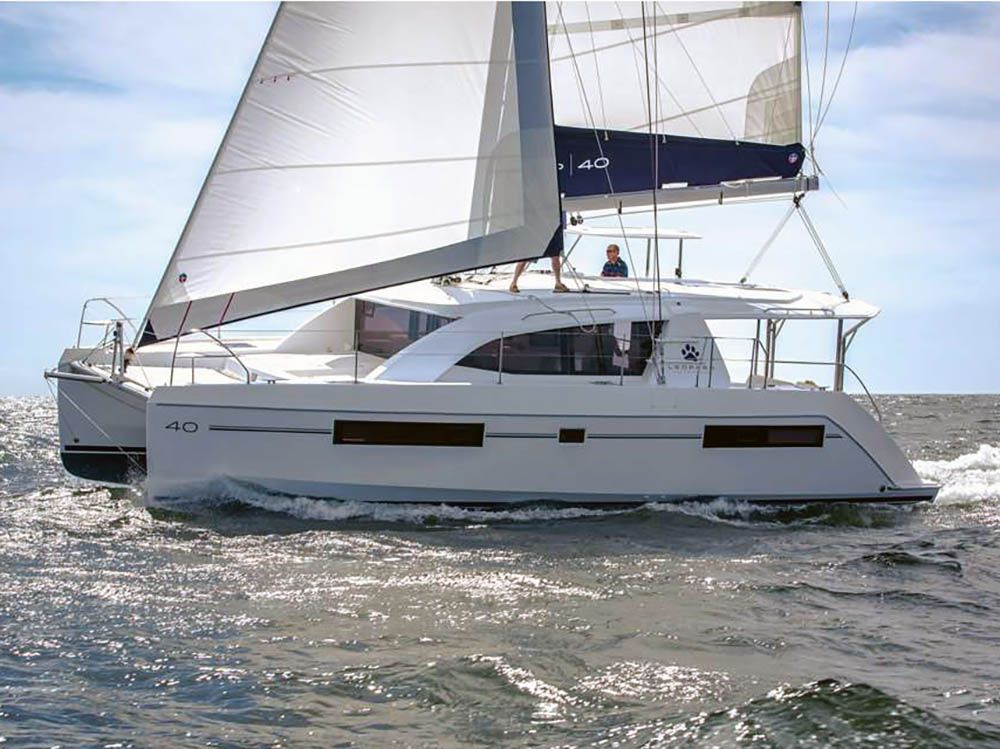
The Léopard 40 is a compact cruising catamaran aimed primarily at owner-operators, couples and small families who want a roomy, easy-handling platform for coastal cruising and island hopping — a boat that doubles comfortably between private ownership and a charter role. The name “Leopard 40” has been applied to a few different iterations: an early 2000s Moorings 4000/Leopard 40 lineage, a later sailing-cat redesign first shown at the 2015 Miami shows and built by Robertson & Caine, and (separately) a Leopard 40 power-cat variant. The most recent sailing-cat incarnation (built by Robertson & Caine and associated with Morrelli & Melvin design work in the 2015–2020 run) deliberately balanced interior volume and bridgedeck clearance with hull finesse to keep performance respectable for its size. This model has become familiar on the second-hand market — both as privately owned boats and as ex-charter units — and today it attracts buyers looking for practical family cruising cats, entry-level bluewater aspirations and charter operators alike.
Design and Construction
The sailing Leopard 40 is a modern, moderate-displacement cat with twin hulls, twin keels (production variants), twin rudders and a fractional sloop rig — a clean, owner-friendly sail plan with lines led to the cockpit/helm. Construction is GRP/fiberglass sandwich in key areas (Robertson & Caine’s factory methods have used vacuum processes and balsa/foam cores in parts of the structure), which helps keep weight down while providing interior stiffness; the builder’s approach is very much production-yard oriented, aimed at repeatability for owner and charter customers. The hulls are relatively fine forward with a raised bridgedeck clearance (one of the design priorities), which reduces slamming and improves comfort in chop at moderate speeds but also means that through-deck systems and panel joins need careful inspection when buying used. Those choices — a roomy salon, galley-up arrangement, molded modules and a series-production lamination process — make the boat economical to build and straightforward to repair in fiberglass terms, yet they also demand careful attention to core-area sealing and routine inspection (especially on boats that spent time in charter fleets).
Performance
On the water the Leopard 40 tends to favor steady, predictable behavior over blistering performance. Independent sea trials and owner reports place typical cruising speeds in the high-6 to mid-8 knot band in moderate conditions; during sail trials the boat showed comfortable speeds around 8 knots on a beam reach in 15–18 knots of wind, with engine cruise in the high-6s to low-8s depending on load. The combination of relatively fine hull sections and increased bridgedeck clearance keeps motion drier and reduces slamming in confused seas, while the fractional rig gives an easy reefing and headsail-change regime that benefits short-handed crews. Compared with true performance-models of similar length the Leopard 40 is not a club racer, but its helm feel, moderate wetted surface and conservative displacement make it an economical, reliable cruiser that will happily cover miles with predictable manners.
Comfort and Accommodations
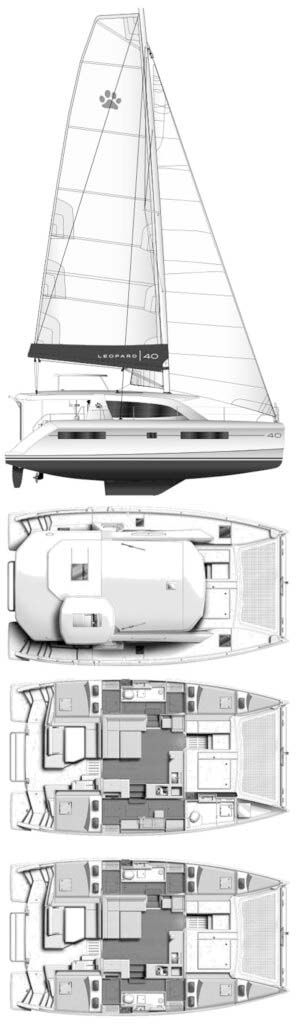
Interior layouts are one of the Leopard 40’s selling points: owner’s versions and multi-cabin charter layouts exist, with 3-cabin (owner) and 4-cabin (charter) arrangements common. The salon is bright and open (galley-up on most builds), the forward windows and hatches give good ventilation and the cabins generally have sensible storage for a 40-footer. For a couple or small family the boat provides real liveaboard potential — decent tankage and refrigeration capacity, comfortable sleeping cabins and a cockpit/salon flow designed for social cruising. That said, long-term liveaboard comfort depends on the fit-out: many ex-charter boats show heavier wear, and owners often rework bunks, increase insulation/ventilation and upgrade electrical systems for extended cruising. In short: the layout is generous for the size and converts well to owner-use, but expect to budget for personalizing and modernizing if you are buying an ex-charter example.
Safety and Practicality
Deck ergonomics are thoughtfully arranged for cruising: control lines are generally led to the helm, the helm position gives good visibility and the bridgedeck clearance reduces the chance of stern-to-bridge deck slamming in moderate seas. The more recent revisions that added forward lounging areas improved social space but have been debated by offshore riders because forward cockpit/door arrangements can present vulnerability in very heavy seas — a buyer planning offshore passages should verify sealing, scupper arrangements and forward-door structure in survey. Systems placement (engines in individual engine rooms, electrical panels near galley/companionway) is tidy, but engine access can be snug on some units and tight engine bays increase the value of routine mechanical upkeep. For coastal and island cruising the Leopard 40 is well suited straight off the broker’s dock; for serious offshore work the boat is capable but benefits from a series of pro-level upgrades (offshore safety package, heavy-duty seacocks, upgraded ground tackle and stronger hatches/doors).
Known Issues with the Léopard 40
Owners’ forums and long-term surveys surface a handful of recurring service items to watch for when shopping for a Leopard 40:
- core and moisture concerns in deck/hull laminates (early and ex-charter boats can show condensation, soft patches or delamination where penetrations and drains weren’t serviced).
- window and hatch leaks or sealant failures around large glazing — these are repairable but cost time and money in a purchase refit.
- compressed bulkhead modules or stress cracks around high-load areas (some owners have reinforced bulkheads or laminated additional support where loads were concentrated).
- cramped engine compartments and service access that make routine tasks (filter changes, fuel system work) slower and sometimes more expensive.
- refrigeration, plumbing and electrical issues on ex-charter boats from heavy use and deferred maintenance.
Practical buyer guidance: insist on a detailed survey that checks core areas around deck penetrations and windows, review service logs for saildrives/gearboxes, and budget for routine upgrades (prop changes, electronic navigation refresh, water-maker or A/C service if present). Common aftermarket improvements include fitting a more efficient propeller, replacing older sail inventory, upgrading chart electronics and reinforcing/reaming deck penetrations before resealing. These steps fix recurring weak points and materially reduce long-term headaches.
Market Availability and Pricing in the U.S.
The sailing Leopard 40 (most recent sailing series) was produced in the mid-2010s and shows production dates in online registries roughly spanning the 2015–2020 period; it is not a current, ongoing new-build line in most U.S. dealer networks, so examples are found on the brokerage market or as ex-charter handovers. In the U.S. and Caribbean used listings commonly place asking prices in a band from approximately $210,000–$420,000 depending on year, equipment, and whether the boat was an ex-charter unit or owner-maintained example. Boats listed for sale are frequently located in Florida and the Caribbean, with additional availability in New England and on the West Coast (California) when owners relocate or brokers import/export stock. Expect to see a mix of well-kept owner versions, lightly used ex-charter boats with full maintenance histories, and some older units that need refit work.
Here is a comparison with three similar catamarans of comparable size and era:
| Model | LOA | Approx. Years | Typical US Used Price | Main Differences |
|---|---|---|---|---|
| Léopard 40 | ~39–40 ft | 2015–2020 (latest sailing series) | **$210,000–$420,000** | Production-yard build, bridgedeck clearance, owner/charter configurations; balanced cruising performance and living space. |
| Lagoon 400 | ~39 ft | 2009–2016 | $225,000–$395,000 | Very successful production model with wide resale pool; roomier beam and strong charter presence; tends toward comfort over performance. |
| Fountaine Pajot Lucia 40 | ~38–40 ft | 2016–present (used market) | $270,000–$480,000 | Contemporary lines, lightweight laminate construction, often marketed to owner-cruisers aiming for higher finish levels and better sailing performance than older production cats. |
| Bali 4.0 | ~39–40 ft | 2016–2020 | $260,000–$370,000 | Innovative open-plan cockpit/salon integration, heavy emphasis on social deck space; good for charter/family cruising but a different trade-off for offshore robustness. |
Léopard 40 vs Lagoon 400

The Léopard 40 tends to be a slightly more performance-oriented production platform than the Lagoon 400, thanks to hull fine sections and attention to bridgedeck clearance that keep motion drier and handling a bit crisper in chop. In practical ownership terms this translates to a Leopard that will feel a touch livelier on passage and easier to single-hand upwind, while the Lagoon 400 trades that edge for a marginally larger living volume and the security of a very large resale/parts network.
For a buyer, the Lagoon’s biggest strength is its ubiquity — many units, parts and refit specialists — which lowers running costs and shortens lead times for upgrades. The Leopard’s strengths are predictable handling and a layout that often feels more “owner-friendly” for couples who want to cruise quickly between islands; maintenance considerations are comparable, though buyers should pay special attention to the service history on either platform.
► Learn more about de Lagoon 400
Léopard 40 vs Fountaine Pajot Lucia 40

Compared with the Lucia 40, the Leopard 40 tends to be positioned more toward a balanced owner/charter market with heavier production yard influence, while the Lucia emphasizes lighter vacuum-laminate construction and a slightly more modern cruising performance envelope. That means the Lucia can feel a bit loftier in acceleration and may offer a fresher interior finish at similar ages, but the Leopard often wins on simplicity of systems layout and on decks that were designed with mixed owner/charter use in mind.
For potential buyers this comes down to priorities: choose Lucia if you want the sharpest modern cruising lines and a “newer” spec; choose Leopard if you prefer a proven production platform with lots of used inventory and straightforward, proven systems that are easy to source and repair.
► Learn more about de Fountaine Pajot Lucia 40
Léopard 40 vs Bali 4.0
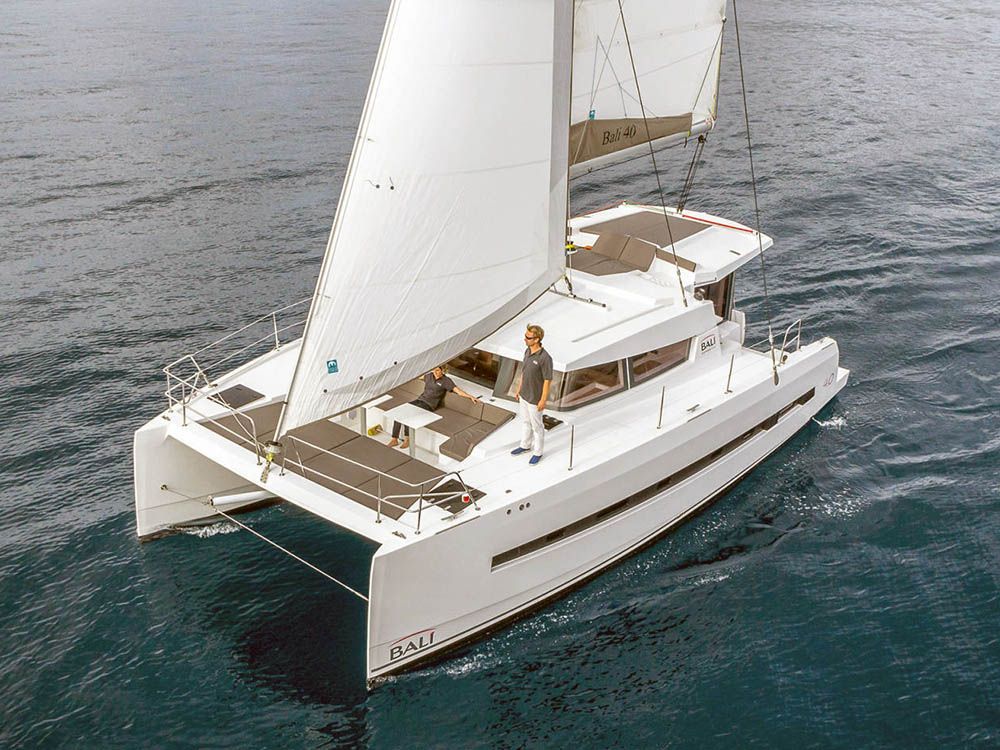
The Bali 4.0 is a doctrinally different boat: it sacrifices traditional separation between cockpit and salon to create a very social, open plan that is ideal for charter and day-use entertaining; the Léopard 40 retains more conventional separation and a more conservative deck layout that favors offshore confidence. In handling terms the Bali’s broad, voluminous hulls and open deckscape favor comfort at anchor and roomy social spaces, while the Leopard’s hull shaping and bridgedeck attention favor a steadier ride and slightly better upwind manners.
Buyers who plan high-use entertaining, charter income or short family cruises will appreciate the Bali’s social design and ease of movement; buyers focused on passagemaking, privacy and a more conventional cruising feel will likely prefer the Leopard’s balance between sailing manners and accommodation.
► Learn more about de Bali 4.0
Maintenance Costs of a Léopard 40 in the U.S.
Below is a practical, commented list of recurring expenses and what to expect annually (ranges are approximate and depend strongly on region, condition and how much DIY work you do):
- Mooring / Slip / Storage: $3,000–$18,000 per year. Coastal Florida and the Caribbean tend to be mid-range for slip cost; California and popular New England marinas run higher. (If you haul annually for bottom work, factor haul/launch fees into this line.)
- Insurance: $2,500–$8,000+ per year (roughly 1%–2% of insured value is a starting rule; higher for commercial/charter use or hurricane exposure). Location, cruising area and value drive this.
- Engine servicing (both engines): $1,000–$4,000 per year. Routine oil, filter changes, gearbox check and intermittent injectors/impellers; costs rise if injectors or transmissions need work.
- Antifouling & haul/yard work: $1,500–$9,000 depending on scope and region (40-ft multihull jobs are more expensive than monohulls; boatyards in high-cost regions and complex prep increase totals). Expect higher haul/paint fees on the U.S. West Coast.
- Standing & running rigging (inspection, minor repairs): $300–$1,000 per year for inspections/maintenance; full rigging replacement every 10–15 years can be $5,000–$12,000+.
- Sails (maintenance / amortized replacement): $500–$3,000 per year amortized; a full new main and genoa can be $8,000–$30,000 depending on cloth and builders. Budget for sail replacement on a 7–15 year cycle depending on use.
- Electronics / batteries / systems: $500–$4,000 per year amortized; larger one-time upgrades (radar, chartplotter, inverter, lithium bank) can run $5,000–$30,000 depending on scope.
- General consumables, plumbing, sails, lines, safety equipment: $1,000–$4,000 per year.
Significant one-time costs to plan for: new sails ($8k–$30k), major electronics refit ($5k–$20k), composite repairs or osmosis/core repairs ($5k–$50k depending on severity), and any rigging or engine overhauls. Owner-maintained routines (cleaning, basic service, changing filters, polish) can reduce bills, but the scale and density of systems on a 40-ft cat often means pro services are needed for haulouts, composite work and major engine or rigging jobs. As a rule of thumb, plan on roughly 6–10% of purchase price per year for conservative budgeting on a 40-foot production catamaran if you include slip and insurance; lower if you DIY aggressively or if the boat is moored in low-cost locations. Overall the Léopard 40 sits in the medium-to-high maintenance bracket for its size and capability, but its robust used market and production-yard support tend to keep unexpected long-term costs manageable if a thorough pre-purchase survey is done.
Conclusion
The Léopard 40 is a pragmatic, well-balanced 40-foot cruising catamaran that appeals to owners who want an easy-to-live-with boat that still sails respectably. Its strengths are a sensible owner/carbon footprint (production cost efficiencies), comfortable accommodation choices, good bridgedeck clearance for a dryer ride and a healthy used inventory that keeps the resale market active. Drawbacks to weigh are the usual production-yard trade-offs — ex-charter wear on many examples, a handful of recurrent seal/core issues to check at survey, and the need to budget for routine upgrades if you want modern electronics or offshore proofing. For coastal and Caribbean cruising, family weekending and owner-operator passagemaking with sensible weather windows, the Leopard 40 is absolutely worth considering; it offers a good trade-off between purchase price, space and sailing manners. If your priorities are racing performance or the absolute lightest, exotic laminate construction, other models may better fit — but for real-world cruising value, the Leopard 40 is a sound, market-proven choice provided you buy with a careful survey and a realistic refit budget.
Specifications
| Hull Type | Catamaran Twin Keel |
| Rigging Type | Fractional Sloop |
| LOA | 39.34 ft / 11.99 m |
| LWL | 38.12 ft / 11.62 m |
| S.A. (reported) | 1,032.26 ft² / 95.90 m² |
| Beam | 22.05 ft / 6.72 m |
| Displacement | 20,591 lb / 9,340 kg |
| Max Draft | 4.10 ft / 1.25 m |
| Construction | Fiberglass (FG) |
| First Built | 2015 |
| Last Built | 2020 |
| Builder | Robertson and Caine |
| Designer | Morrelli & Melvin |
Auxiliary Power / Tanks (original equipment) | |
|---|---|
| Make | Volvo |
| Type | Diesel |
| HP | 29 x 2 |
| Fuel Capacity | 95 gals / 360 L |
Accommodations | |
| Water Capacity | 206 gals / 780 L |
Sailboat Calculations | |
| S.A. / Displ. | 22.07 |
| Disp. / Len. | 165.95 |
| KSP | 0.69 |
Rig and Sail Particulars | |
| Mast Height from DWL | 63.81 ft / 19.45 m |
Disclaimer
The considerations and analyses presented regarding the Léopard 40 catamaran are of a general nature and are based on the available information and technical data on this model, interpreted to the best of our knowledge and understanding. It is important to note that the specific characteristics of any particular sailboat may vary due to custom modifications, maintenance performed, and conditions of use over time, among other factors. Therefore, the details and performance of the boat you are considering may not exactly match the information provided here.
We strongly recommend that, before making any purchasing or usage decisions, you conduct a detailed inspection of the boat in question, consult with nautical professionals and other sailors, and consider your personal needs, expectations, and capabilities. Each sailboat may have unique particularities that affect its performance and suitability for different types of sailing and sailors.
The information contained in this analysis should be used as a general guide and not as a definitive reference. Professional evaluation and personal inspection are essential to ensure that the boat meets your specific requirements and expectations.