


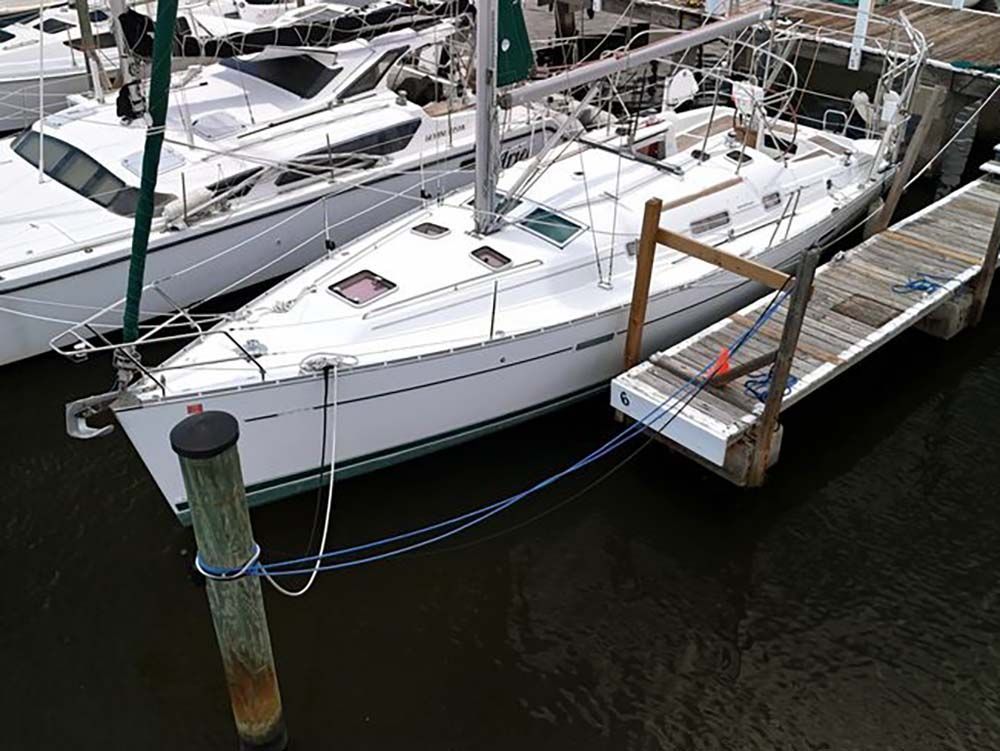
The Beneteau 343, introduced in 2005, is a versatile cruising sailboat that blends ease of handling with generous interior comfort. Designed by the acclaimed naval architecture firm Berret-Racoupeau and built by Beneteau, it occupies a sweet spot in the mid-size cruiser category—ideal for coastal sailing and capable of offshore passages. It was marketed as part of the Oceanis line in some regions and quickly became popular among sailors seeking a well-balanced, modern cruising yacht.
Design and Construction
The Beneteau 343 features a modern hull with a fin keel and bulb, paired with a spade rudder, offering responsive steering and good stability under sail. With an LOA of 10.82 meters (35.5 feet) and a beam of 3.48 meters (11.42 feet), the boat delivers a roomy interior and cockpit while remaining manageable for short-handed crews.
The hull is constructed from fiberglass-reinforced plastic (GRP) using Beneteau’s injection-molding process for the deck, which improves structural integrity and reduces weight. The cast iron keel carries 1,543 kg (3,402 lbs) of ballast, contributing to a ballast-to-displacement ratio of 25.3%—providing a good compromise between stiffness and sailing performance.
The rig is a 9/10 fractional sloop with swept-back spreaders and an in-mast furling mainsail (on many units), which allows for easier reefing and sail handling. The moderate rig size, combined with a large cockpit and clear side decks, makes the boat suitable for cruising couples or small crews.
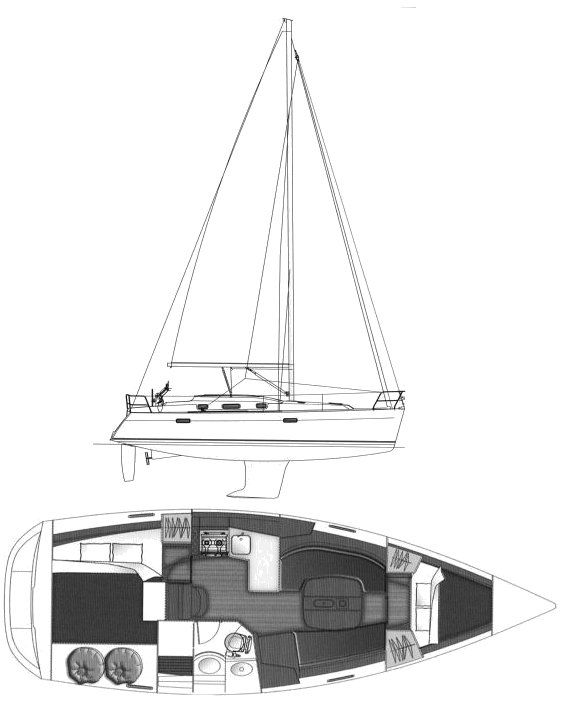
Performance
With a total sail area of 60.29 m² (649 ft²) and a displacement of 6,100 kg (13,448 lbs), the Beneteau 343 offers solid light-air performance and stability in stronger breezes. Its Sail Area to Displacement ratio (SA/Displ) of 18.43 places it in the category of performance cruisers—offering better-than-average agility for a boat in its class.
The 1.90-meter (6.23-foot) draft provides a good compromise between upwind ability and access to shallow anchorages. The hull speed is calculated at 7.44 knots, a typical cruising speed under sail, and the boat performs well in a range of conditions, with a forgiving helm and minimal weather helm when properly trimmed.
Many owners appreciate the yacht’s ease of handling and responsiveness, especially when sailing short-handed, making it an ideal platform for relaxed family cruising or occasional club racing.
Comfort and Accommodations
The interior of the Beneteau 343 is spacious for a 35-footer, benefiting from its broad beam and clever layout. Two and three-cabin configurations were offered, both featuring a large central saloon, L-shaped galley, and generous headroom of 2.01 meters (6.6 feet).
The forward cabin includes a traditional V-berth, while the aft cabins (especially in the two-cabin layout) provide full-width sleeping areas with good ventilation. The saloon features a U-shaped dinette convertible to an additional berth, and the galley includes a two-burner stove, oven, deep sink, and refrigerator. Multiple opening hatches and ports ensure airflow, crucial for extended time aboard in warm climates.
Storage is abundant, and the tankage—particularly the 255-liter (67-gallon) water tank—supports multi-day passages without resupply. The head compartment is roomy and includes a separate shower stall in many configurations.
Safety and Practicality
Safety features on the Beneteau 343 are well-integrated into the deck and cockpit design. Wide side decks, solid stainless grab rails, and non-skid surfaces allow for safe movement around the boat. Lifelines are robust, and the cockpit includes a deep locker for storage and easy access to systems.
The boat is powered by a dependable 29 HP Yanmar diesel engine, offering ample thrust for docking and motoring in calms. The 75-liter (20-gallon) fuel tank is adequate for most cruising needs, and access to the engine via the companionway steps is straightforward for maintenance.
With a capsize screening formula of 1.92, the 343 falls well below the offshore threshold of 2.0, indicating good resistance to knockdown and suitability for moderate offshore work in the hands of experienced sailors.
Known Issues with the Beneteau 343
While the Beneteau 343 is generally regarded as a well-built and user-friendly cruising sailboat, several issues have been consistently reported by owners. It is important to differentiate between problems that stem from poor maintenance or aging components and those that appear to originate from the boat’s original design or factory construction. This section focuses solely on the latter: issues attributable to the design and manufacturing of the vessel.
1. Leaking Saloon Skylight
One of the most frequently cited design-related problems is water intrusion through the saloon skylight. The plexiglass panel and its mounting system have been known to develop leaks, often due to inadequate sealing from the factory. Even well-maintained boats may experience this issue, and replacing the panel is not always straightforward, as custom fitting may be required.
2. Weather Helm in Strong Winds
Another inherent characteristic of the Beneteau 343 is a tendency toward noticeable weather helm in higher wind conditions. This is related to the sail plan and the position of the center of effort relative to the hull and rudder. Although this can be mitigated through proper sail trimming and reefing, the tendency itself is a product of the boat’s design.
3. Limited Light-Air Performance
While not a “defect” in the traditional sense, the 343’s hull shape, shallow keel option, and roller-furling mainsail contribute to underwhelming performance in light wind. This tradeoff was likely intentional, favoring ease of handling and comfort over racing capabilities. However, it remains a limitation that prospective owners should be aware of.
These known issues are generally not severe and do not detract from the boat’s overall reliability or popularity among coastal cruisers. Still, they reflect aspects of the Beneteau 343’s design that may require consideration, especially for buyers with specific performance expectations.
Market Availability and Pricing in the U.S.
The Beneteau 343 is no longer in production, so all examples on the U.S. market are pre-owned. It is most commonly found along the East Coast, particularly in Florida and the mid-Atlantic, with a smaller presence in California and the Great Lakes region. Boats are generally well-maintained private ownership models, though some were used as charter vessels, which can reflect in both price and condition. Well-documented, lightly used examples tend to command higher resale value, while older or ex-charter models may require updating to modern systems.
Recent listings indicate a typical U.S. market price range of $65,000–$95,000, depending on year, condition, and included equipment. Compared with alternatives in the same 34–36 ft coastal cruiser category, the Beneteau 343 offers a strong balance of build quality, interior volume, and sailing performance. Its resale value tends to be stable, partly due to the brand’s reputation and the boat’s versatility as a family cruiser.
Below is a comparison with similar sailboats:
| Model | LOA | Approx. Year | Typical U.S. Price | Key Differences |
|---|---|---|---|---|
| Beneteau 343 | 34.5 ft | 2004–2008 | $65,000–$95,000 | Modern European design, spacious interior, solid coastal cruiser |
| Catalina 34 | 34.8 ft | 2000–2008 | $50,000–$80,000 | American design, reliable systems, slightly less interior volume |
| Hunter 34 | 34.5 ft | 2001–2007 | $45,000–$75,000 | Known for ease of handling, cockpit comfort, lighter displacement |
| Jeanneau Sun Odyssey 35 | 35.0 ft | 2003–2009 | $60,000–$90,000 | Similar French design philosophy, good sailing performance, comparable volume |
Beneteau 343 vs Catalina 34

The Beneteau 343 and the Catalina 34 occupy similar market space as comfortable coastal cruisers, but they approach design trade-offs differently: the 343’s modern, slightly fuller hull and higher coachroof prioritize interior volume, light and headroom, which translates to a brighter, more open cabin that appeals to families and liveaboard buyers; the Catalina’s hull is more conservative with fuller midsections carried aft to maximize usable saloon and berth space while keeping systems and deck hardware simple for owner-operators. Rigging on the Beneteau is typically a performance-oriented fractional or short-mast package with options for a full-batten main and choices of keels, which gives the 343 sharper acceleration and easier reefing control under sail, whereas the Catalina’s traditional masthead sloop rig is simpler to tune and repair—an important ownership consideration if you value low-maintenance gear and wide parts availability. Underway, the 343 generally outperforms the Catalina in light to moderate airs and on reach, producing crisper helm feel and better pointing when tuned, while the Catalina rewards conservative trimming with predictable handling and a more forgiving motion in confused chop. Below, the 343’s raised coachroof and panoramic ports make living spaces feel larger and more modern, which suits couples and families who want comfort and social living space; the Catalina 34 trades some of that modern openness for roomy, practical berths and an often more straightforward galley that is easier to maintain.
From a maintenance perspective, the Beneteau’s built-in systems and composite construction can require more attentive care to deck coring and fittings, while the Catalina’s simpler construction and massive owner network typically lower long-term service friction and parts cost. Typical use differs accordingly: the 343 is better for buyers who want brisk coastal passages, weekend comfort and occasional club performance, while the Catalina favors buyers focused on relaxed family weekends, minimal systems complexity, and ease of DIY upkeep. In resale and ownership terms, the Beneteau will attract buyers seeking a newer-style interior and slightly better performance, but the Catalina often holds appeal for cost-conscious owners seeking a boat that’s easy to live with and service.
► Learn more about the Catalina 34
Beneteau 343 vs Hunter 34

Compared with the Hunter 34, the Beneteau 343 again reflects a move toward volume-forward, performance-minded production yachts, while the Hunter emphasizes a mix of liveability and straightforward sailing gear aimed at American coastal cruisers. The Hunter’s underbody and hull sections were designed to give roomy interiors and a balanced helm, often delivering lively light-air behavior that many owners praise; the 343 tends to feel more modern in steering and responsiveness due to a spade rudder and tuned rig options, so an owner who likes crisp feedback and the option to squeeze more speed out of light breezes will lean to the Beneteau. Rig complexity is a practical ownership point: Hunters of the era favor simple, robust masthead rigs and accessible deck layouts that make singlehanding easier, whereas the 343’s fractional/more refined sailplan rewards time spent on sail trim and gives better reefing options for offshore work. Stability and handling show differences in tradeoffs—Hunters often have flatter sections aft to provide initial form stability and a roomy cockpit for social sailing, while the 343’s hull and keel choices give a steadier motion offshore and better control when sailing close-hauled. Interiorly, the Beneteau’s contemporary layout, larger windows and multiple hatch sources of light produce a feeling of space that benefits families and couples who cruise long weekends; Hunter interiors are practical and sometimes more utilitarian but often offer clever storage and ergonomics for liveaboard use.
Maintenance expectations diverge as well: Hunters can be simpler to keep in top shape due to conventional systems and a history of owner-sourced fixes, while the Beneteau’s more integrated systems may justify occasional professional attention, especially for electronics or composite repairs. For usage, the Hunter is an excellent weekend/family cruiser that can be tuned for club racing, while the Beneteau 343 straddles faster coastal cruising with a greater potential for competitive club performance if the buyer is willing to invest in sail and tuning. Buyers should weigh whether they prefer the Hunter’s straightforward, DIY-friendly approach or the Beneteau’s modern handling and interior comfort that can demand a bit more attention to systems.
► Learn more about the Hunter 34
Beneteau 343 vs Jeanneau Sun Odyssey 35

The Beneteau 343 versus the Jeanneau Sun Odyssey 35 comparison highlights two contemporary European production philosophies: both prioritize liveable interiors and deck ergonomics, but the 343 leans toward a slightly sportier helm and more modern coachroof styling while the Sun Odyssey 35 emphasizes seakindly motion, well-proportioned deck flow and a design tuned for comfortable family cruising. Hull shapes reflect that distinction—Jeanneau’s Sun Odyssey 35 carries beam aft and a hull form that delivers comfortable motion and impressive behavior under sail for its size, often translating into dependable performance on passages and an easy balanced helm in mixed conditions, while the Beneteau’s hull and keel options give sharper acceleration and responsiveness that appeal to buyers wanting livelier passage-making. Rigging and sailplan differences matter in practice: Jeanneau packages are generally engineered for uncomplicated handling and predictable reefing, with deck arrangements that favor short-handed cruising; Beneteau’s set-up often includes options that favor sailors who will fine-tune sail controls for speed. Interior layouts both aim for family comfort, but the Sun Odyssey’s design tends to be exceptionally efficient in using beam and light to create comfortable berths and storage for extended cruising, whereas the Beneteau’s panoramic ports and raised coachroof make interiors feel brighter and more open—an important quality for buyers prioritizing liveability and social space.
Maintenance needs track with construction approaches: both are modern composites and require diligent attention to deck fittings and through-hull integrity, but Jeanneau’s conservative systems and well-executed ergonomics often make routine upkeep straightforward; Beneteau’s slightly more performance-biased hardware may increase tuning and sail maintenance if the owner pushes for speed. In terms of use, the Sun Odyssey 35 is a comfortable family coastal cruiser that handles well on passage and is forgiving for less experienced crews, while the 343 is attractive to those who want a comfortable boat that can be tuned up for faster coastal runs or club racing. For buyers, the decision rests on whether they prefer Jeanneau’s tried-and-true seakindly comfort and simple systems or Beneteau’s brighter interior, sharper on-the-water manners and the option to pursue more performance through sail and rig investment.
► Learn more about de Jeanneau Sun Odyssey 35
Maintenance Costs of a Beneteau 343 in the USA
Annual maintenance for a 34–35 ft cruiser like the Beneteau 343 generally falls in the $6,000–$12,000 range, excluding major refits. Key contributors include:
- Dockage and haul-out: $2,500–$7,500 per year depending on location; East Coast and mid-Atlantic tend to be cheaper than South Florida or California.
- Insurance: $700–$1,800 annually, influenced by coverage limits, owner history, and hurricane zones.
- Engine service (typically Yanmar 27–40 hp): DIY $300–$700; professional service $800–$1,500, including belts, impellers, and filters.
- Bottom paint and antifouling: $1,200–$3,500 every 1–2 years; additional $300–$600 for polishing.
- Sails and rigging: Standing rigging replacement every 10–15 years $5,000–$10,000; main and headsail replacement $6,000–$12,000 depending on fabric and style.
- Systems and consumables: Batteries $800–$3,500; water pumps, sanitation, and minor repairs $200–$600 annually.
- Electronics (occasional upgrades): Autopilot, chartplotter, AIS, and instruments $5,000–$15,000.
Much routine maintenance can be handled by the owner, including oil changes, impeller swaps, minor rigging adjustments, and basic electronics upkeep. Higher-cost items generally involve professional yards, such as standing rigging, composite hull inspections, or sail replacement.
Overall, the Beneteau 343 has moderate to high maintenance costs for a boat of its size and type, but these are offset by the model’s stable resale value when well maintained. A properly cared-for example provides excellent long-term value for coastal cruising and occasional offshore passagesner (oil, impellers, filters, running rigging, basic electronics). The items that drive costs up are specialized yard projects (standing rigging, tanks, rudder, interior carpentry to access fittings). Overall, the cost of ownership is medium-high for a 35-footer, but the resilient resale value of the brand offsets it if you buy a well-maintained, well-documented example.
Conclusion
The Beneteau 343 stands out as a well-executed mid-size cruising yacht that delivers a strong combination of comfort, practicality, and sailing capability. Designed for ease of handling and livability, it caters especially well to couples or small crews looking for a manageable and enjoyable platform for coastal cruising—and with the right preparation, even for moderate offshore passages.
While it does present a few design-related limitations—such as occasional weather helm, modest light-wind performance, and a known vulnerability to leaks at the saloon skylight—these issues are relatively minor within the context of its overall strengths. They do not undermine the boat’s core value as a reliable, spacious, and thoughtfully appointed cruiser.
Thanks to its proven construction, comfortable accommodations, and well-balanced sailing characteristics, the Beneteau 343 continues to hold its place as a desirable option on the used boat market for sailors seeking a modern, dependable, and enjoyable cruising experience.
👉 Save the full technical sheet of the Beneteau 343 by downloading the PDF version
Specifications
| Hull Type | Fin w/bulb & spade rudder |
| Rigging Type | Fractional (9/10) Sloop |
| LOA | 35.50 ft / 10.82 m |
| LOD | 34.05 ft / 10.38 m |
| LWL | 30.83 ft / 9.40 m |
| S.A. (reported) | 649.00 ft² / 60.29 m² |
| Beam | 11.42 ft / 3.48 m |
| Displacement | 13,448.00 lb / 6,100 kg |
| Ballast | 3,402.00 lb / 1,543 kg |
| Max Draft | 6.23 ft / 1.90 m |
| Construction | GRP |
| Ballast Type | Cast iron |
| First Built | 2005 |
| Last Built | 2008 |
| Builder | Beneteau |
| Designer | Berret – Racoupeau |
| Auxiliary Power | Yanmar Diesel, 29 HP |
| Fuel Capacity | 20 gals / 75 L |
| Water Capacity | 67 gals / 255 L |
| Headroom | 6.60 ft / 2.01 m |
| S.A. / Displ. | 18.43 |
| Bal. / Displ. | 25.30 |
| Disp / Len | 204.88 |
| Comfort Ratio | 25.16 |
| Capsize Screening Formula | 1.92 |
| S# | 2.46 |
| Hull Speed | 7.44 kn |
| Pounds/Inch Immersion | 1,258.02 pounds/inch |
| Rig and Sail Particulars | |
| I | 43.44 ft / 13.24 m |
| J | 12.80 ft / 3.90 m |
| P | 39.14 ft / 11.93 m |
| E | 13.58 ft / 4.14 m |
| S.A. Fore | 278.02 ft² / 25.83 m² |
| S.A. Main | 265.76 ft² / 24.69 m² |
| S.A. Total (100% Fore + Main Triangles) | 543.78 ft² / 50.52 m² |
| S.A. / Displ. (calc.) | 15.44 |
| Est. Forestay Length | 45.29 ft / 13.80 m |
| Mast Height from DWL | 49.40 ft / 15.06 m |
Disclaimer
The considerations and analyses presented regarding the Beneteau 343 sailboat are of a general nature and are based on the available information and technical data on this model, interpreted to the best of our knowledge and understanding. It is important to note that the specific characteristics of any particular sailboat may vary due to custom modifications, maintenance performed, and conditions of use over time, among other factors. Therefore, the details and performance of the boat you are considering may not exactly match the information provided here.
We strongly recommend that, before making any purchasing or usage decisions, you conduct a detailed inspection of the boat in question, consult with nautical professionals and other sailors, and consider your personal needs, expectations, and capabilities. Each sailboat may have unique particularities that affect its performance and suitability for different types of sailing and sailors.
The information contained in this analysis should be used as a general guide and not as a definitive reference. Professional evaluation and personal inspection are essential to ensure that the boat meets your specific requirements and expectations.