


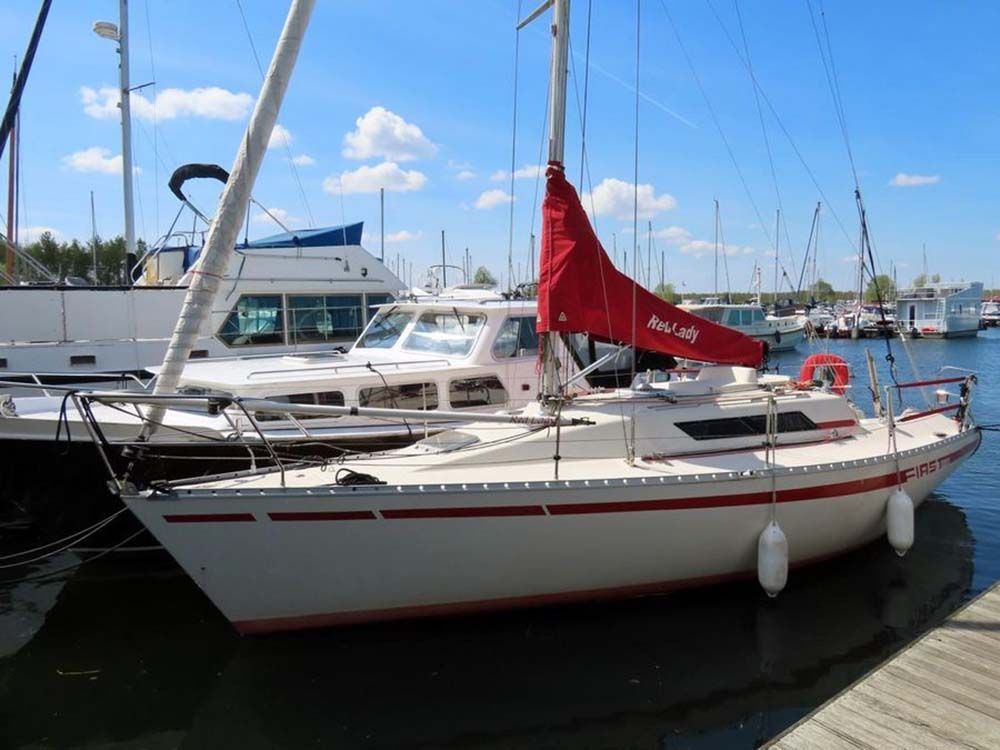
The Beneteau First 30 ES is a versatile cruiser-racer designed by Jean Berret, aimed at sailors seeking a well-balanced boat for both competitive racing and comfortable coastal cruising. Produced in the early 1980s, this model targets sailors who desire a classic yet performance-oriented vessel, suitable for weekend adventures as well as spirited regattas.
Design and Construction
The First 30 ES features a fin keel with a spade rudder, combining responsiveness with stability. The hull is constructed from fiberglass (FG), typical of the era, ensuring durability without excessive weight. Jean Berret’s naval architecture emphasizes a balance between speed and comfort, with a moderate beam of 10.66 ft and iron ballast to provide righting moment. The masthead sloop rig offers simplicity and efficiency, with well-sized sail areas for good power without overwhelming the crew.
Performance
Under sail, the First 30 ES demonstrates solid performance, particularly in moderate wind conditions. The fractional sloop rig and fin keel allow for agile handling and good pointing ability to windward. The hull speed of nearly 7 knots, combined with a relatively high sail area to displacement ratio, translates into lively acceleration and good pace on all points of sail. It handles well in choppy seas and is responsive to helm inputs, though heavier conditions may challenge less experienced sailors.
Comfort and Accommodations
The interior layout is thoughtfully designed for a 30-foot boat, providing enough space for a small crew or family. The 27 gallons of freshwater capacity and ergonomic design improve liveability on multi-day trips. With a moderate beam, the cabin space balances comfort and sailing performance, offering a cozy but practical environment. The accommodations include basic amenities for cruising, making it suitable for coastal voyages or short-term living aboard.
Safety and Practicality
Safety is addressed with a stable hull form and reliable deck layout that facilitates easy movement and sail handling. The masthead sloop rig is straightforward, and the boat is equipped with a dependable Yanmar diesel auxiliary engine for maneuvering in tight quarters. While not specifically designed for bluewater passagemaking, its robust build and moderate draft make it a competent coastal cruiser. The boat’s iron ballast and moderate displacement offer a good capsize screening formula, contributing to its safety profile.
Versions of the Beneteau First 30
The Beneteau First 30 is a sailboat with multiple versions that reflect the evolution of nautical design and technology over time, offering options for different types of sailors and sailing styles. Each version was created by a renowned designer, bringing specific features that address varied needs—from comfort for coastal cruising to performance in racing.
The First 30 (Jean Berret version), along with its variant First 30 ES (Jean Berret version), represents the classic design of the 1980s. These models stand out for their robustness, stability, and good livability, ideal for sailors seeking a balance between comfort and performance on coastal passages. The fiberglass construction and mostly masthead sloop rig reflect an era when reliability and ease of handling were paramount.
On the other hand, the First 30 (Mauric version) offers a slightly more traditional design with a rudder protected by a skeg, which provides greater safety and control, especially in challenging conditions. This model is suitable for those who value stability and safer handling in demanding waters.
The more recent and sportier versions, such as the First 30 (Juan Kouyoumdjian version) and the First 30 (Samuel Manuard version), incorporate modern designs with lighter hulls, bulb keels, and dual rudders that enhance performance and maneuverability. These models are aimed at sailors looking for higher racing performance or more agile and faster sailing, while still maintaining reasonable comfort levels for short or medium cruises.
In summary, the different versions of the Beneteau First 30 offer a wide range of choices for today’s sailor: from the tradition and comfort of classic models to the innovation and sportiness of the latest designs, adapting to various preferences and sailing styles.
| Model | Designer | Year Built | LOA | Hull Type | Rigging | Displacement | Ballast | Main Use |
|---|---|---|---|---|---|---|---|---|
| First 30 (Jean Berret) | Jean Berret | 1981–1984 | 30.5 ft / 9.3 m | Fin w/spade rudder | Fractional Sloop | 6,834 lb / 3,100 kg | Lead ballast | Coastal cruising & club racing |
| First 30 E (Jean Berret) | Jean Berret | 1981–1984 | 30.5 ft / 9.3 m | Fin w/spade rudder | Fractional Sloop | 6,834 lb / 3,100 kg | Lead ballast | Comfort-oriented coastal cruising |
| First 30 ES (Jean Berret) | Jean Berret | 1981–1984 | 30.5 ft / 9.3 m | Fin w/spade rudder | Fractional Sloop | 6,834 lb / 3,100 kg | Lead ballast | Performance and cruising balance |
| First 30 (Mauric) | A. Mauric / A. Maurie | 1977–1981 | 29.36 ft / 8.95 m | Fin with rudder on skeg | Masthead Sloop | 7,606 lb / 3,450 kg | Iron ballast | Safe coastal cruising and day sailing |
| First 30 (Juan Kouyoumdjian) | Juan Kouyoumdjian | 2011–2015 | 32.32 ft / 9.85 m | Fin w/bulb & dual rudders | Fractional Sloop | 8,267 lb / 3,750 kg | Lead ballast | High performance racing & fast cruising |
| First 30 (Samuel Manuard) | Samuel Manuard | 2025 (planned) | 33.89 ft / 10.33 m | Fin w/bulb & dual rudders | Fractional Sloop | 6,702 lb / 3,040 kg | Cast iron ballast | Modern performance cruising & racing |
Conclusion
The Beneteau First 30 ES is a well-rounded sailboat combining respectable racing capabilities with comfortable cruising features. Its strengths lie in its balanced design, responsive handling, and practical accommodations. Ideal for sailors who want a classic cruiser-racer for coastal sailing and club racing, it offers a reliable and enjoyable sailing experience. However, those looking for modern bluewater capabilities or expansive interior space might consider larger or more recent models. Overall, the First 30 ES remains a timeless choice for enthusiasts of traditional French yacht design.
Specifications
| Hull Type | Fin w/spade rudder |
|---|---|
| Rigging Type | Fractional Sloop |
| LOA | 30.50 ft / 9.30 m |
| LWL | 26.97 ft / 8.22 m |
| S.A. (reported) | 410.00 ft² / 38.09 m² |
| Beam | 10.66 ft / 3.25 m |
| Displacement | 6,834.00 lb / 3,100 kg |
| Ballast | 2,976.00 lb / 1,350 kg |
| Max Draft | 5.58 ft / 1.70 m |
| Construction | FG |
| Ballast Type | Lead |
| First Built | 1981 |
| Last Built | 1984 |
| Builder | Beneteau (FRA) |
| Designer | Jean Berret |
| Auxiliary Power/Tanks (orig. equip.) | Volvo or Yanmar Diesel, 15 HP |
| Water | 12 gals / 45 L |
Sailboat Calculations | |
| S.A. / Displ. | 18.27 |
| Bal. / Displ. | 43.55 |
| Disp: / Len | 155.52 |
| Comfort Ratio | 16.12 |
| Capsize Screening Formula | 2.25 |
| S# | 3.46 |
| Hull Speed | 6.96 kn |
| Pounds/Inch Immersion | 1,027.27 pounds/inch |
Rig and Sail Particulars | |
| I | 36.10 ft / 11.00 m |
| J | 10.90 ft / 3.32 m |
| P | 36.10 ft / 11.00 m |
| E | 11.80 ft / 3.60 m |
| S.A. Fore | 196.75 ft² / 18.28 m² |
| S.A. Main | 212.99 ft² / 19.79 m² |
| S.A. Total (100% Fore + Main Triangles) | 409.74 ft² / 38.07 m² |
| S.A./Displ. (calc.) | 18.26 |
| Est. Forestay Length | 37.71 ft / 11.49 m |
Disclaimer
The considerations and analyses presented regarding the Beneteau First 30 ES (Jean Berret desgin) sailboat are of a general nature and are based on the available information and technical data on this model, interpreted to the best of our knowledge and understanding. It is important to note that the specific characteristics of any particular sailboat may vary due to custom modifications, maintenance performed, and conditions of use over time, among other factors. Therefore, the details and performance of the boat you are considering may not exactly match the information provided here.
We strongly recommend that, before making any purchasing or usage decisions, you conduct a detailed inspection of the boat in question, consult with nautical professionals and other sailors, and consider your personal needs, expectations, and capabilities. Each sailboat may have unique particularities that affect its performance and suitability for different types of sailing and sailors.
The information contained in this analysis should be used as a general guide and not as a definitive reference. Professional evaluation and personal inspection are essential to ensure that the boat meets your specific requirements and expectations.