



The Cape Dory 28 is a compact, classic-minded cruising sloop that was conceived as a safe, sea-kindly pocket cruiser rather than a club racer. Designed by Carl Alberg and built by Cape Dory Yachts in the 1970s–80s, it blends traditional lines (long overhangs and a relatively narrow beam) with a full-keel sensibility intended for comfortable, predictable offshore motion; roughly 350–400 hulls were produced, which makes it familiar on the used market. The boat was aimed at owners who valued seaworthiness and straightforward systems over maximum interior volume or racing performance — couples or small families who liked weekend cruising with occasional longer passages. Today the model is well represented on the U.S. second-hand market and attracts buyers looking for a solidly built coastal cruiser or a restoration project; listings and broker inventory show demand from private owners and coastal cruisers more than from commercial charter fleets.
Design and Construction
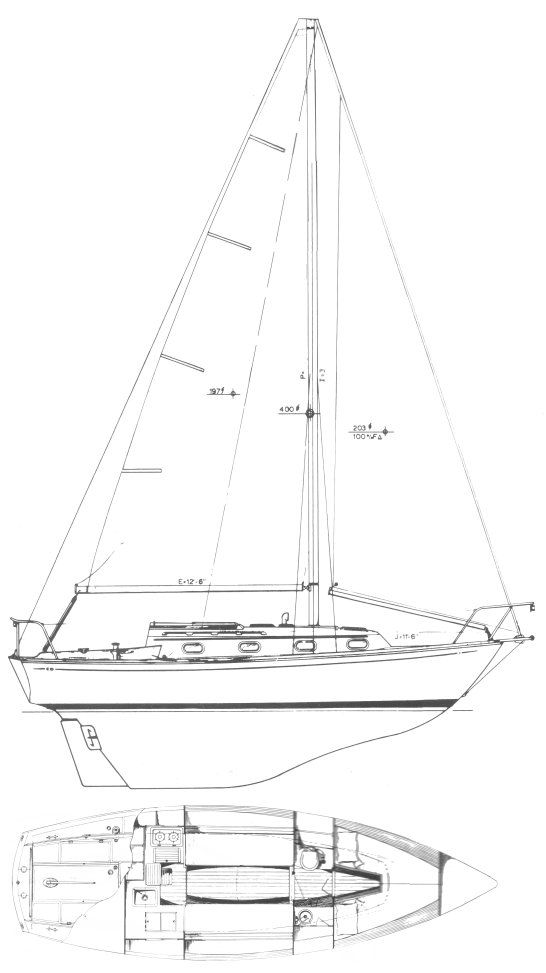
The hull is a traditional Carl Alberg shape: relatively narrow for its length with graceful overhangs and a full keel with a cutaway forefoot. That keel/hull combination promotes directional stability and a comfortable motion in a seaway at the cost of some pointing ability and outright speed compared with modern fin-keel designs. Most Cape Dory 28s were built using a solid fiberglass hull with a cored deck and teak trim; the rig is a simple masthead sloop, which keeps sail handling and rig upkeep straightforward. These choices — solid laminate below the waterline, cored deck above, and conservative structural detailing — give the boat long-term durability and make structural repairs fairly conventional (glass repair, chainplate reinforcement, deck coring repairs) rather than exotic. From a naval-architecture perspective the boat trades light-air speed and interior volume for reserve buoyancy, predictable righting behavior and easier, lower-stress autopilot/helm loads — factors that tend to preserve value for cruisers who prioritize safety and simplicity.
Performance
On the water the Cape Dory 28 is typically described as steady rather than sporty: she tracks well, feels solid in a chop, and will power through confused seas with relatively little hobby-horsing. In moderate breezes she will make reliable passage speeds for a heavy-displacement 28-footer; her longer effective waterline (a result of trimmed stern overhang) and conservative sailplan give reasonable speed potential for cruising, although she won’t outpace contemporaries with lighter hulls and fin keels. The full-keel geometry sacrifices a bit of pointing and tacking agility, so tight in-harbor maneuvers and quick course changes demand more helm input than on modern cruisers, but the payoff is forgiving behavior in a blow and good directional steadiness on long watches. Sailors who have owned them often praise the boat for being predictable and comfortable in a seaway — qualities that matter more to passagemakers and weekend cruisers than to racers.
Comfort and Accommodations
Interior volume on a Cape Dory 28 is modest by contemporary standards: the layout favors practical berths, a compact galley and an enclosed head rather than expansive social spaces. For a couple cruising weekends or a small family on short trips the ergonomics usually work well — sleeping arrangements, stowage under settees and in lockers, and a functional galley are all present — but taller or larger groups will feel constrained on extended passages. Ventilation and light are adequate for the era but often improved in refits (additional hatches, fans, LED lighting), and it’s common to find older 28s with tasteful modernizations to upholstery, galley appliances or navigation benches. Overall, the interior tends to age nicely when owners keep woodwork and joinery in good condition; many boats have been upgraded to make week-long cruising more comfortable while preserving the boat’s classic appeal.
Safety and Practicality
Decks and cockpit layouts were designed for straightforward, safe day-to-day handling: wide sidedecks are modest rather than expansive, and the cockpit is comfortable with protective coamings suited to two-person handling. The full-keel underbody provides directional stability and a forgiving motion offshore, which reduces crew fatigue on longer passages. For single-handing or short-handed cruising you’ll want reliable winches and a well-organized reefing plan (roller-furling headsail or robust hanked-on jibs and reefing points on the main); many owners retrofit a self-tailing winch or improved reefing lines to make sail reductions easier. Systems are generally accessible — the engine sits in an accessible compartment and through-hulls are straightforward — so routine maintenance and surveys are manageable for mechanically inclined owners or local yards. These practicalities combine to make the boat well suited for coastal and limited offshore work, provided the owner addresses age-related systems proactively.
Known Issues with the Cape Dory 28
Common issues reported by owners and surveyors are mostly age-related rather than unique design failures. Because the hull is solid fiberglass but the deck is cored, water intrusion at deck penetrations (chainplates, stanchion bases, older deck hardware) is the most frequently cited trouble spot; neglected bedding can lead to soft core and localized repairs. Chainplate area corrosion and leaking around fastenings appears in owner forums as an item to inspect closely during surveys, and owners often reinforce or re-engineer the chainplate beds during refits. Other recurring notes are the expected maintenance on older diesel engines and the replacement or renewal of running rigging and sails as they age. Recommended improvements that commonly show up in owner checklists include renewing standing rigging on an appropriate cycle, upgrading electrical/electronics for safety and navigation, and checking the deck/core under key fittings. These are typical for a boat of this vintage and size, and tend to be straightforward to budget for if discovered during a pre-purchase survey.
Market Availability and Pricing in the U.S.
The Cape Dory 28 is no longer in production and is sold exclusively on the used market. Listings across brokers and listing sites show boats offered from small project prices up to well-maintained examples in the mid-five figures depending on refit level and location. A reasonable contemporary U.S. price band for market valuation is $8,000–$40,000, with typical good-condition examples often trading in the $15,000–$30,000 neighborhood; bargains exist, but they usually require mechanical or cosmetic work. You’ll see the model most often in traditional sailing regions: New England and the Mid-Atlantic (Maine, Massachusetts, Chesapeake), with occasional listings on the West Coast and Florida as boats change hands or move with owners. Boats advertised tend to be privately owned cruisers or restored projects rather than ex-charter boats, which helps keep a steady buyer pool of weekend cruisers and classic-boat enthusiasts.
Below is a comparison with similar sailboats from the same era:
| Model | LOA | Years (approx.) | Typical used price (U.S.) | Main differences |
|---|---|---|---|---|
| O’Day 28 | ~28 ft | 1978–1986 | $4,000–$18,000 | More modern beam/volume in many marks; fin-keel variants; generally cheaper but varies by condition. |
| Pearson P-28 | ~28 ft | 1976–1986 | $8,000–$20,000 | Fin-keel hulls with slightly more interior volume; more performance-oriented handling; similar maintenance profile. |
| Catalina 30 | ~30 ft | 1978–1994 (various marks) | $9,000–$30,000 | Roomier interior, more aftermarket support and parts; wider appeal for family cruising; typically easier to sell. |
Cape Dory 28 vs O’Day 28

The Cape Dory 28 emphasizes a full-keel, heavy-displacement approach that rewards steadiness and seakindliness, whereas the O’Day 28 (depending on year/mark) tends to have a wider beam and fin-keel options that favor interior volume and slightly better light-air performance. For a buyer this means the Cape Dory will feel more predictable offshore and typically requires less active steering to hold a course, while an O’Day will feel roomier below and more responsive in maneuvers.
Maintenance and upgrade profiles differ: the Cape Dory’s solid hull/cored deck arrangement directs attention to deck penetration sealing and rigging age, while many O’Days demand similar routine work but may have easier aftermarket parts and lighter-weight systems. Ownership use drives the choice — choose the Cape Dory if you value classic build and a forgiving motion, choose the O’Day if interior space and a slightly peppier on-wind performance are higher priorities.
► Learn more about de O’Day 28
Cape Dory 28 vs Pearson 28

Both boats occupy a similar size bracket, but the Pearson P-28 leans more toward a modern fin-keel hull plan with a bit more beam and internal volume, which translates to better form stability and potentially more speed to windward. A purchaser who sails mostly around coastal waters and wants more living space and slightly livelier handling may prefer the Pearson, while an owner planning more offshore or heavy-weather passages will value the Cape Dory’s tracking and seakindly motion.
From a maintenance point of view the Pearson’s typical issues are conventional rig/engine/systems aging items, comparable to the Cape Dory; however the Cape Dory’s classic construction and teak trim can demand more cosmetic or carpentry work to maintain classic looks, while Pearsons sometimes trade that for easier, mass-market replacement parts and a broader local service market. In resale terms, the Pearson often appeals to family cruisers seeking space; the Cape Dory appeals to a narrower enthusiast market that prizes traditional lines.
► Learn more about de Pearson 28
Cape Dory 28 vs Catalina 30

Compared with the Catalina 30, the Cape Dory 28 trades interior volume and deck layout flexibility for a more conservative, blue-water oriented underbody and classic aesthetic. The Catalina’s wider beam, larger cockpit and more commodious accommodations make it an easier family cruiser and often simpler to modernize for comfort and electronics, but the Cape Dory offers a calmer motion and often better tracking in confused seas.
For a buyer the practical calculus comes down to intended use: if weekend family comfort, resale liquidity and parts availability are top priorities, the Catalina 30 is compelling; if a sailor prioritizes seaworthiness, traditional joinery and a boat that “feels correct” in a blow, the Cape Dory is the more honest choice — albeit with a potentially smaller resale audience and more bespoke maintenance of classic trim.
► Learn more about de Catalina 30
Maintenance Costs of an Cape Dory 28 in the U.S.
Below is a concise, annotated list of typical annual and periodic costs you should budget for; each item is bold followed by an explanation.
- Mooring/Slip or Storage — annual marina slip fees vary dramatically: expect $1,200–$6,000+ depending on location (high in New England or California, lower in many Gulf or inland regions); off-season haul/yard storage adds to this.
- Insurance — for a 28-ft classic cruiser, likely $400–$1,200/year depending on coverage, cruising area, and owner experience.
- Engine servicing — routine winter service, filters and belts typically $300–$900/year; more if injectors or major work is required.
- Bottom paint / anti-fouling — expect $300–$1,200 every 1–3 years depending on hull condition and yard rates.
- Standing rigging replacement — cycle every ~10–15 years; full replacement can be $1,500–$4,000 depending on turnbuckles and labor.
- Running rigging & sails — mains and genoa replacement is a large one-time cost: $1,500–$6,000+ depending on cloth and whether you choose new or used sails; routine line replacement is modest.
- Electrical / electronics upgrades — modern chartplotter, VHF, battery bank and wiring upgrades: $1,000–$6,000 depending on scope.
- Hull/deck repairs (chainplate/core) & cosmetic work — if core repairs are needed or chainplates are pulled and rebuilt, budget $1,000–$8,000 as a potential periodic, localized refit item.
Regional differences: boatyards and haul/launch fees are highest in New England and California, midrange in the Mid-Atlantic and Florida, and lowest around some Gulf or inland areas. Significant one-time expenditures you should plan for are standing-rigging replacement, a new suit of sails, or a substantial deck/core repair if the survey finds rot — any of which can quickly move a purchase from “affordable” to a multi-thousand-dollar refit.
Owner-maintainable items include many routine engine tasks, varnish/touch-up, and some electrical work if you’re competent; power-boatyard labor or specialist riggers are usually recommended for complex rig or hull/core repairs. Overall, for a 28-foot classic cruiser the annual outlay is medium relative to size: manageable for an owner who does much work themselves, but with occasional higher-cost refits that should be anticipated in a five-year ownership plan. The Cape Dory’s durable hull often helps preserve resale value enough that careful, documented maintenance generally pays off at resale.
Conclusion
The Cape Dory 28 is a classic, honest coastal cruiser that rewards buyers who place a premium on seaworthiness, solid construction and period charm. Its strengths are predictable seagoing manners, a robust (solid) hull and a simple, serviceable rig — all attractive to couples or small crews who prefer reliable, low-drama sailing over maximal interior volume or racing performance. The trade-offs are modest living space, slower tacking/pointing than fin-keel contemporaries, and the normal vintage-boat checklist (rigging, sails, deck penetrations) that any purchaser must budget for.
For the buyer seeking a capable, characterful 28-foot cruiser for coastal passages and comfortable weekend or occasional offshore work, the Cape Dory 28 is worth looking for — especially if you value classic aesthetics and a forgiving motion at sea. It is not the cheapest 28-footer to own if you avoid DIY, but properly maintained examples hold appeal to a specific buyer segment, so resale prospects remain reasonable within that niche. In short: a smart buy for the right sailor — someone who wants substance, not flash — and a practical platform for comfortable, conservative cruising.
Specifications
| Hull Type | Full Keel |
| Rigging Type | Masthead Sloop |
| LOA | 28.10 ft / 8.56 m |
| LWL | 22.21 ft / 6.77 m |
| S.A. (reported) | 404.00 ft² / 37.53 m² |
| Beam | 8.87 ft / 2.70 m |
| Displacement | 9,000.00 lb / 4,082 kg |
| Ballast | 3,500.00 lb / 1,588 kg |
| Max Draft | 4.00 ft / 1.22 m |
| Construction | FG solid laminate hull / cored deck |
| Ballast Type | Lead |
| First Built | 1974 |
| Last Built | 1988 |
| # Built | 388 |
| Builder | Cape Dory Yachts (USA) |
| Designer | Carl Alberg |
| Auxiliary Power Make | Volvo |
| Auxiliary Power Model | MD7A |
| Auxiliary Power Type | Diesel |
| Auxiliary HP | 13 |
| Fuel Capacity | 13 gals / 49 L |
| Water Capacity | 60 gals / 227 L |
| S.A. / Displ. | 14.99 |
| Bal. / Displ. | 38.89 |
| Disp: / Len | 366.73 |
| Comfort Ratio | 31.68 |
| Capsize Screening Formula | 1.71 |
| S# | 1.18 |
| Hull Speed | 6.32 kn |
| Pounds/Inch Immersion | 703.91 pounds/inch |
| I | 36.00 ft / 10.97 m |
| J | 11.50 ft / 3.51 m |
| P | 31.50 ft / 9.60 m |
| E | 12.50 ft / 3.81 m |
| S.A. Fore | 207.00 ft² / 19.23 m² |
| S.A. Main | 196.88 ft² / 18.29 m² |
| S.A. Total (100% Fore + Main) | 403.88 ft² / 37.52 m² |
| S.A./Displ. (calc.) | 14.98 |
| Est. Forestay Length | 37.79 ft / 11.52 m |
| Mast Height from DWL | 40.50 ft / 12.34 m |
Disclaimer
The considerations and analyses presented regarding the Cape Dory 28 sailboat are of a general nature and are based on the available information and technical data on this model, interpreted to the best of our knowledge and understanding. It is important to note that the specific characteristics of any particular sailboat may vary due to custom modifications, maintenance performed, and conditions of use over time, among other factors. Therefore, the details and performance of the boat you are considering may not exactly match the information provided here.
We strongly recommend that, before making any purchasing or usage decisions, you conduct a detailed inspection of the boat in question, consult with nautical professionals and other sailors, and consider your personal needs, expectations, and capabilities. Each sailboat may have unique particularities that affect its performance and suitability for different types of sailing and sailors.
The information contained in this analysis should be used as a general guide and not as a definitive reference. Professional evaluation and personal inspection are essential to ensure that the boat meets your specific requirements and expectations.