



The Pearson 28 sits squarely in the sweet spot of classic American 1970s–80s production cruisers: big enough to weekend with a family, small enough to own and maintain without drama. Drawn by Bill Shaw for Pearson Yachts and launched in 1975, the line evolved through several iterations (a 1980 refresh and the later 28-2 from 1985), all aimed at practical coastal cruising with club-race friendliness. Early boats often carried Atomic 4 gasoline auxiliaries; later examples and most 28-2s moved to small diesels, which many buyers prefer today for range and economy. On the used market the model has a steady following in the Northeast and Great Lakes, where Pearson’s reputation and dealer network were strongest, and demand tends to come from budget-minded cruisers, sailing schools, and first-time owners who want a stout, forgiving platform rather than a performance thoroughbred. Production ended in the late 1980s with the company’s closure, so availability is strictly second-hand; the 28 and 28-2 remain popular because parts, documentation, and owner knowledge are abundant.
Design and Construction
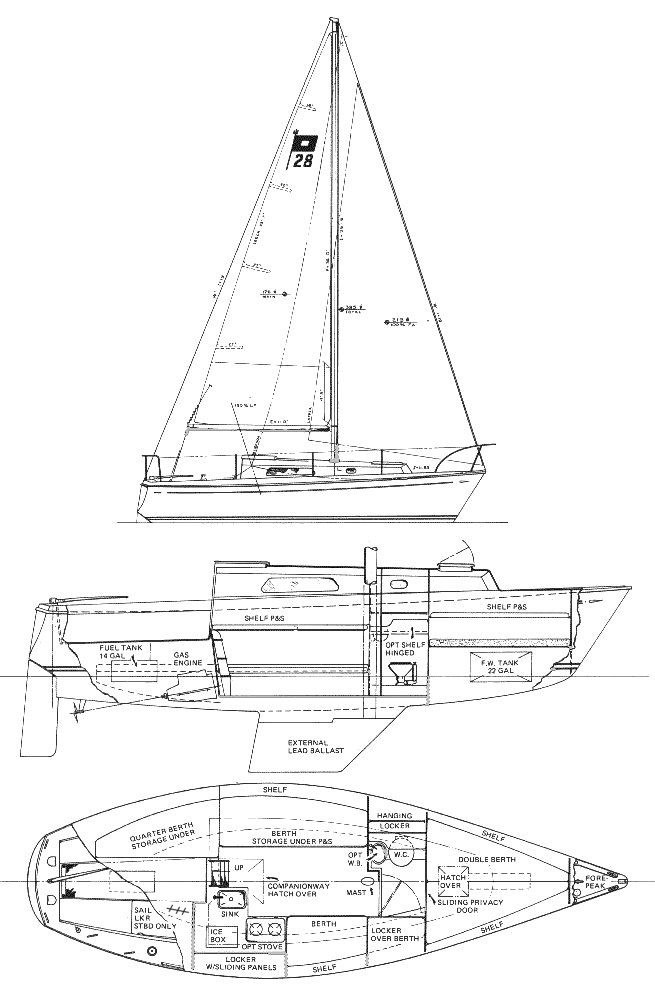
The Pearson 28 line is a moderate-displacement, fiberglass monohull with a fin keel and internally mounted spade rudder; hulls are solid FRP while decks are balsa-cored with wood trim. The rig is a straightforward masthead sloop—conservative sail plan and manageable spar loads that favor durability and easy tuning over raw power. The 28-2 modernized the package with a slightly revised underwater profile (including shoal-draft options) and weight distribution to improve balance without changing the boat’s essential character. From a naval-architecture standpoint, the moderate D/L (~200 for the 28-2; a touch higher on early boats) and SA/D in the mid-teens yield predictable behavior and low gear stress, which supports long service life and good residual value if the deck core and chainplate structure are kept dry. Solid-glass hulls simplify structural repairs; cored decks demand careful bedding of hardware to prevent moisture ingress, but are lighter and stiffer when sound. The result is a construction approach that rewards attentive owners: easy cosmetic work, accessible systems, and an interior arranged around a simple saloon/galley/nav station with either quarter-berth or aft-cabin variations depending on generation.
Performance
Under sail, the Pearson 28 is happiest in 8–18 knots where her moderate sail area keeps heel angles comfortable and rudder feel light. Expect hull speeds around 6.5–7.0 knots depending on variant and sea state; the 28-2 typically rates near 189 PHRF (≈180–198 regional), putting it in friendly club-race company against Catalina 27/28s and O’Day 28s. In a chop she has the reassuring, damped motion of a moderate-displacement coastal cruiser: not the quickest to accelerate, but steady tracking and predictable weather helm as gusts build. Upwind, the relatively shallow forefoot and conservative keel mean she will not point like modern fin-bulb designs, but she rewards smooth trimming and will tack crisply with sensible headsail sizes. Off the wind, the big foretriangle makes for easy reaching with a 135%–150% genoa or cruising chute, and the helm stays composed as speeds creep into the mid-6-knot range. Owners value the type not for fireworks but for reliability and low drama on real cruise days when comfort and crew confidence matter more than corrected times.
Comfort and Accommodations
Inside, the Pearson 28 delivers a pragmatic New England layout: opposing settees around a folding table, a compact but workable L-galley, and a large V-berth forward. Headroom is respectable for a sub-30-footer, and storage is honest—cockpit lockers for cruising gear, bins and shelves around the saloon, and tankage sized for weekends rather than weeks. Ventilation comes from opening portlights and a forward hatch; many boats have upgraded acrylics and fans over the years, which are welcome in warmer climates. Ergonomics underway are friendly: wide coamings, stout handholds, and a low companionway threshold that eases movement between cockpit and cabin. Couples will find the 28 an easy long-weekend boat; small families can cruise a week if disciplined about water and stowage. Interiors age well when leaks are controlled; many examples show tasteful refreshes—LED lighting, new soft goods, and modern electronics—without major carpentry. The 28-2’s subtly re-worked interior feels brighter and makes better use of volume, a small but noticeable upgrade if you’re comparing across generations.
Safety and Practicality
On deck you get deep cockpit coamings, stout lifelines, and straightforward gear runs—features that keep crews secure and reduce overwhelm for new sailors. Side-deck width and handrail placement make going forward in sloppy weather manageable, and many boats have wheel-steering guards that double as harness clip-in points. From a systems standpoint, access is a highlight: engine panels, stuffing box, and electrical distribution are reachable enough for owner maintenance on most layouts, keeping yard time in check. For mission profile, the Pearson 28 is a quintessential coastal cruiser with the right prep for short offshore hops: sound rigging, up-to-date nav/electronics, and renewed through-hulls. Autopilot and rope-clutch upgrades turn it into a very manageable short-handed platform. The caveat is the cored deck and chainplate landings—structurally fine when dry, but an owner’s responsibility to inspect and maintain, especially after hardware changes.
Known Issues with the Pearson 28
Decades-old Pearson 28s commonly present with (1) moisture in balsa-cored decks from poorly bedded hardware, seen as soft spots around stanchions, portlights, and mast partners; (2) chainplate staining or bulkhead deterioration from slow leaks; (3) aging plastic portlights that craze or crack; and (4) the usual vintage-FRP cosmetic blistering below the waterline. Rudder moisture and weeps at the rudder tube/seal also appear on some boats; not catastrophic, but something to survey and address with proper repair. Engines vary by era: early Atomic 4s can be completely serviceable but many buyers prefer diesel-repowers for safety, economy, and resale. Expect original 1980s electronics and wiring to be “due” unless already modernized. Popular upgrades include rebedded or replaced portlights and deck hardware, chainplate and bulkhead remediation, barrier-coat/bottom work, a small folding prop to improve light-air speed, and a modest sail plan refresh (new main and a 120–135% headsail) that livens performance noticeably.
Market Availability and Pricing in the U.S.
he Pearson 28 and 28-2 are long out of production and found only second-hand, with concentrations in New England, the Mid-Atlantic, and the Great Lakes; Gulf and Florida examples exist, often as snowbird boats. Condition ranges from honest, well-kept family cruisers with sensible upgrades to neglected yard finds; ex-charter examples are rare. As of recent U.S. listings, asking prices cluster roughly between $10,000 and $22,000 depending on year, auxiliary (diesel commands a premium), deck/hull condition, and sail/electronics age; unusually tidy 28-2s can push above that range. In this bracket the Pearson competes directly with Catalina and O’Day for “value per foot,” and it tends to resell readily in active sailing regions because of deep parts availability and owner communities.
Below is a comparison with similar sailboats from the same era:
| Model | LOA | Approx. build years | Typical used price (U.S.) | Key distinctions |
|---|---|---|---|---|
| Pearson 28 / 28-2 | 28′ (28-2 ≈28.5′) | 1975–1982 / 1985–1989 | $10k–$22k | Solid FRP hull, cored deck; conservative masthead sloop; 28-2 tweaks improve balance; wide owner network. |
| Catalina 27 | 26.8′ | 1971–1991 | $4k–$15k | Huge production run; very simple systems; more basic finish, broad parts ecosystem, lively class scene. |
| O’Day 28 | 28′ | 1978–1986 | $8k–$20k | Comparable comfort; often value-priced; check deck core/portlights; easy coastal cruiser. |
| Hunter 28.5 | 28.5′ | 1985–1988 | $12k–$22k | Newer design feel; fractional-ish dimensions with bigger mains; roomier interior for the length. |
Pearson 28 vs Catalina 27

The Pearson carries more ballast and a deeper fin, which steadies motion and improves tracking when the breeze pipes up, while the Catalina’s lighter hull pops forward sooner in single-digit winds. Helm feel on the Pearson is slightly heavier but reassuring; the Catalina’s tiller feedback is lively and immediate. Both rigs are masthead sloops with affordable inventories, though the Pearson 28-2’s deck layout better supports single-handing with clutches and self-tailers. Below, the Catalina maximizes volume; the Pearson’s joinery and tank installs are a touch sturdier and often age better if leaks were controlled. Maintenance profiles are comparable—cored decks, aging portlights—but Pearson buyers should budget for chainplate/bulkhead remediation, whereas Catalina owners frequently address keel-joint and mast-step concerns. Use-case favors the Catalina for inexpensive learning and club racing; the Pearson suits sailors seeking a calmer, more “big-boat” feel in rougher afternoon chops. Resale is healthy for both, with the Catalina moving faster on sheer market size and the Pearson holding value on condition and diesel power.
► Learn more about the Catalina 27
Pearson 28 vs O’Day 28

On hull form and displacement the two are near peers, but the Pearson’s standard deeper fin and slightly higher ballast ratio yield more composure when pressed upwind, while the O’Day can feel friskier off the breeze in light airs. Rig simplicity is identical, keeping sail and rigging costs modest on both; late-model O’Days and 28-2s often have better line-handling on deck than 1970s Pearson layouts. Interiors deliver similar berths and galleys; Pearson’s cabinetry and tank foundations often show less flex with age. Routine refit items—portlights, scuppers, and through-hulls—appear on both checklists, though O’Day’s hardware and bedding sometimes lag in longevity; budget similar dollars either way. For families, cockpit depth and handholds feel slightly better executed on the Pearson, which many novices appreciate when it gets lumpy. If you prioritize purchase price and are willing to DIY leaks, the O’Day can be the value buy; if you prefer a steadier motion and stronger resale in the Northeast, the Pearson typically wins.
► Learn more about the O’Day 28
Pearson 28 vs Hunter 28.5

Hunter’s later-generation hull and sail plan produce quicker light-air acceleration and a cabin that feels a size up, while the Pearson counters with a more planted motion and classic balance offshore. Helm ergonomics on the Hunter favor short-handed crews with larger mains and efficient controls; the Pearson’s traditional masthead setup is easy to live with and cheap to keep powered. In 12–18 knots with chop, the Pearson’s deeper fin and moderate displacement reward patient trimming with less slamming, whereas the Hunter may need earlier reefing to keep heel and helm in check. Storage and tankage are similar in absolute terms, but the Pearson’s systems access is generally better for owner-maintenance. Maintenance focus differs—Pearson deck-core/chainplates vs. Hunter deck gear and interior liners—but total effort is comparable in this age bracket. For weekenders who want space and spirited light-air sailing, the Hunter appeals; for crews who often sail breezy afternoons and value a conservative, confidence-building ride, the Pearson is the safer bet. Resale hinges on condition and upgrades for both, with regional bias giving the Pearson an edge in New England.
► Learn more about de Hunter 28.5
Maintenance Costs of a Pearson 28 in the U.S.
- Mooring/slip: $1,200–$3,000/yr on small-town lakes and rivers; $3,000–$6,500/yr in major coastal markets (NE/SoCal/FL). Dry storage $800–$2,000/season in colder regions.
- Insurance: $250–$700/yr liability only; $600–$1,200/yr for agreed-value hull coverage depending on survey and region.
- Engine servicing (gas A-4 or small diesel): $300–$800/yr for fluids, filters, impeller; add $400–$900 every 2–3 years for exhaust/elbow and fuel-system attention.
- Bottom paint & haul: $900–$2,000 for single-season ablative in temperate zones; add yard fees for haul/pressure wash ($300–$700).
- Standing rigging: $2,500–$4,500 for a full replacement every 15–20 years; annual inspections $150–$300.
- Running rigging & deck hardware: $300–$800/yr incremental; clutches/winches as-needed during refits.
- Sails: $2,200–$3,500 for a new cruising main; $2,000–$3,200 for a 120–135% genoa. Annual service/repairs $200–$500.
- Electronics/electrical (periodic): Refits range $1,500–$6,000 for plotter/AIS/autopilot updates; battery refresh $400–$1,200 depending on chemistry.
One-time projects commonly seen: Portlight replacement and deck-core repairs near chainplates/ stanchions ($500–$3,000 DIY-assisted; more if extensive), barrier coat/ blister job ($3,000–$7,500 scope-dependent), rudder repairs ($500–$2,000).
A handy owner can keep annual cash outlay toward the lower end by doing oil changes, deck rebedding, and seasonal bottom work; professional yards push toward the high end but protect resale by documenting repairs. In its class, total cost of ownership is low-to-mid thanks to simple systems, easy-to-source parts, and modest sail/rig loads; well-documented upgrades materially support resale, which is healthy in active sailing regions availability, which helps offset ongoing maintenance costs for long-term owners.
Conclusion
The Pearson 28’s strengths are its straight-ahead manners, robust glass hulls, and a layout that still works for modern coastal cruising; its weaknesses are age-related—deck-core moisture and chainplate landings that demand vigilant upkeep, plus legacy auxiliaries and electronics that may need modernization. It is best suited to new or returning sailors who want a trustworthy 28-footer for weekends and week-long coastal trips, with the option to club-race for fun. If you’re weighing value, this model is absolutely worth a look: condition-for-dollar is often excellent, upgrades are affordable, and the owner community is deep. As a coastal cruiser investment, it offers stable resale in the regions where Pearsons are common, and a well-sorted example will return your refit dollars in years of low-stress, confidence-building sailing.
Specifications
| Hull Type | Fin w/spade rudder |
|---|---|
| Rigging Type | Masthead Sloop |
| LOA | 28.00 ft / 8.53 m |
| LWL | 24.00 ft / 7.32 m |
| S.A. (reported) | 395.00 ft² / 36.70 m² |
| Beam | 9.25 ft / 2.82 m |
| Displacement | 7,850.00 lb / 3,561 kg |
| Ballast | 3,530.00 lb / 1,601 kg |
| Max Draft | 5.00 ft / 1.52 m |
| Construction | FG w/balsa cored deck |
| Ballast Type | Lead |
| First Built | 1975 |
| Last Built | 1980 |
| Builder | Pearson Yachts (USA) |
| Designer | William Shaw |
| Auxiliary Power/Tanks (orig. equip.) | Universal Atomic 4, Gas, 30 HP, Fuel: 14 gals / 53 L |
| Accommodations | Water: 22 gals / 83 L |
| S.A. / Displ. | 16.05 |
| Bal. / Displ. | 44.97 |
| Disp: / Len | 253.51 |
| Comfort Ratio | 24.86 |
| Capsize Screening Formula | 1.86 |
| S# | 2.04 |
| Hull Speed | 6.56 kn |
| Pounds/Inch Immersion | 793.23 pounds/inch |
| Rig and Sail Particulars |
I: 36.50 ft / 11.13 m J: 11.83 ft / 3.61 m P: 32.00 ft / 9.75 m E: 11.00 ft / 3.35 m S.A. Fore: 215.90 ft² / 20.06 m² S.A. Main: 176.00 ft² / 16.35 m² S.A. Total: 391.90 ft² / 36.41 m² S.A./Displ. (calc.): 15.93 Est. Forestay Length: 38.37 ft / 11.70 m Mast Height from DWL: 41.83 ft / 12.75 m |
Disclaimer
The considerations and analyses presented regarding the Pearson 28 sailboat are of a general nature and are based on the available information and technical data on this model, interpreted to the best of our knowledge and understanding. It is important to note that the specific characteristics of any particular sailboat may vary due to custom modifications, maintenance performed, and conditions of use over time, among other factors. Therefore, the details and performance of the boat you are considering may not exactly match the information provided here.
We strongly recommend that, before making any purchasing or usage decisions, you conduct a detailed inspection of the boat in question, consult with nautical professionals and other sailors, and consider your personal needs, expectations, and capabilities. Each sailboat may have unique particularities that affect its performance and suitability for different types of sailing and sailors.
The information contained in this analysis should be used as a general guide and not as a definitive reference. Professional evaluation and personal inspection are essential to ensure that the boat meets your specific requirements and expectations.