


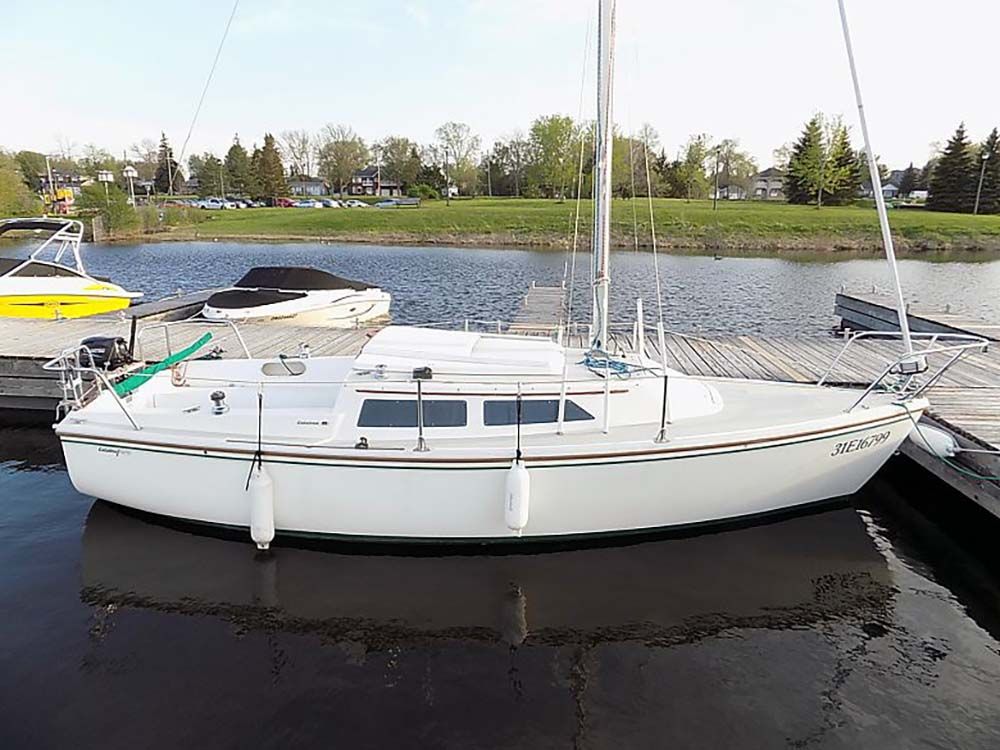
The Catalina 22 is one of the most iconic small cruising sailboats ever built. Introduced in 1969 by Catalina Yachts and designed by Frank Butler, it was conceived as a trailerable, family-friendly boat that could serve both as a coastal cruiser and a weekend racer. With over 15,000 hulls produced, it has become a cornerstone of the American sailing experience.
This compact sloop was built to provide accessible and enjoyable sailing for beginners, while offering just enough capability to satisfy more experienced sailors. It struck a rare balance between affordability, versatility, and performance—qualities that made it a staple in sailing clubs, training fleets, and among private owners. Today, the Catalina 22 remains highly popular on the used market, particularly among new sailors, couples, and families seeking an entry-level cruising boat with low ownership costs.
Design and Construction
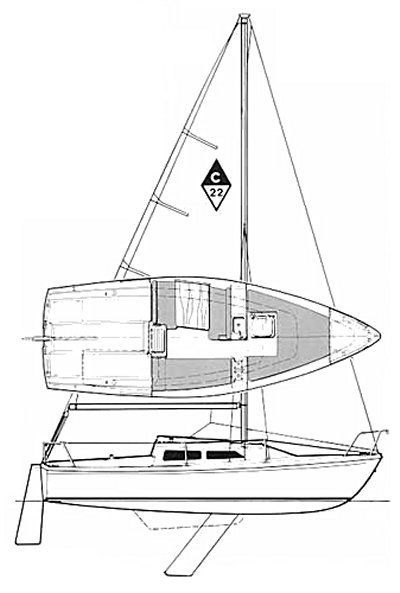
The Catalina 22 features a classic hull shape with moderate beam and a pronounced sheerline, providing a timeless silhouette on the water. It was offered in both swing keel and fixed keel versions, with the swing keel variant being the most popular due to its shallow draft and trailerability. The rudder is transom-mounted and often removable, which further simplifies trailering and storage.
The rig is a simple masthead sloop, easy to manage and well-suited for casual cruising or one-design racing. The hull and deck are constructed from hand-laid fiberglass, while interior joinery is a mix of fiberglass liners and wood veneer. While not luxurious, the design emphasizes simplicity and ease of maintenance, ideal for those who prefer sailing over fussing with systems.
The boat’s compact size and design choices make it relatively easy to repair, upgrade, and refit. Key principles of naval architecture—such as weight distribution, hull stiffness, and form stability—are modestly applied here but well-executed for the boat’s size and purpose. Its construction has proven remarkably durable, which is one reason so many Catalina 22s remain in service today.
Performance
For its size, the Catalina 22 performs admirably. It’s not a speedster, but it sails cleanly and predictably in light to moderate conditions. The swing keel version is particularly forgiving, though it suffers some leeway when beating upwind. The fixed keel improves tracking and pointing but limits trailer access and shallow water exploration.
With its relatively light displacement and easily driven hull, the Catalina 22 responds well to sail trim and balances nicely on the helm. While not ideal in heavy weather—where its light weight and small size can make handling more challenging—it can manage moderate chop and wind with confidence if properly reefed and balanced.
Compared to other small trailer-sailers like the Hunter 23 or MacGregor 22, the Catalina 22 offers a more balanced blend of ease-of-use and seaworthiness. It’s nimble enough for club racing and relaxed enough for a weekend cruise, which has helped it earn a loyal following among sailors of all skill levels.
Comfort and Accommodations
Below deck, the Catalina 22 is minimalist but functional. The cabin layout typically includes two settees and a V-berth forward, offering basic sleeping accommodations for a small family or couple. Some models feature a small galley unit with a sink and space for a portable stove, and a chemical or portable toilet under the V-berth.
Cabin headroom is limited—about 4’4″—but many later models or upgraded units include a pop-top that significantly improves ventilation and livability at anchor. Storage is adequate for weekend trips, with lockers under the berths and modest cabinetry.
The interior finish varies across production years, but in general, it holds up reasonably well. Due to the boat’s popularity and longevity, many owners have undertaken cabin remodels, ranging from basic upholstery replacements to full refinishing with modern materials. While it’s not a boat for extended liveaboard cruising, it’s a charming platform for casual outings, learning the ropes, or enjoying quiet nights on the hook.
Safety and Practicality
For its size and intended use, the Catalina 22 scores well in safety and practicality. The deck layout is simple and uncluttered, with wide enough side decks and secure lifelines on later models. The cockpit is deep and protected, with comfortable seating and tiller steering that provides direct feedback.
The swing keel design adds versatility, allowing the boat to be beached or launched from shallow ramps, although the keel mechanism requires regular inspection and maintenance. The small outboard motor—typically 4 to 8 HP—provides enough thrust for docking and motoring in calm conditions, though it’s not designed for strong current or offshore legs.
Handling under sail or power is easy with a small crew or even single-handed. Maintenance access is straightforward, and systems are minimal, keeping long-term ownership costs low. For coastal sailing, lakes, and protected bays, the Catalina 22 is more than capable with no major modifications.
Known Issues with the Catalina 22
After more than five decades in production, several issues have become well-known within the Catalina 22 community. The swing keel pivot and cable system are notorious for wear and corrosion, and many boats require periodic servicing or retrofits to the keel hardware. Leaks around chainplates, hatch covers, and deck hardware are also common in older boats, particularly those exposed to prolonged UV or rain.
The rudder assembly—especially on early models—can show signs of wear or delamination. Interior wood trim may suffer from water intrusion and cosmetic aging. Electrical systems, often owner-installed or upgraded, vary greatly in quality and should be inspected carefully.
Recommended upgrades include:
- Keel cable and pin replacement kits
- Modern sail handling hardware (e.g., jiffy reefing, better cleats)
- Solar panels for battery charging
- LED lighting upgrades
- Pop-top canvas enclosure for increased comfort
Despite these concerns, most issues are well-documented and supported by an active owner community and plentiful spare parts from Catalina Direct and other suppliers.
Market Availability and Pricing in the U.S.
The Catalina 22 is still in production under the designation Catalina 22 Sport, with updated styling and systems. However, the vast majority of boats on the market are earlier models built from the 1970s through early 2000s. These boats are found throughout the United States, particularly in inland sailing regions like the Midwest, Great Lakes, and Southeast, as well as coastal states such as Florida and California.
Used Catalina 22s are widely available, with pricing ranging from $2,500 for project boats to $10,000–$15,000 for well-maintained or recently restored examples. The newer Catalina 22 Sport models often list for $20,000–$30,000 depending on age and equipment.
Due to its reputation and affordability, the Catalina 22 is easy to resell, especially in active sailing communities and clubs. It’s a particularly good value for buyers who want a low-risk entry into sailboat ownership.
Below is a comparison with similar sailboats from the same era:
| Model | LOA | Year | Used Price (USD) | Key Differences |
|---|---|---|---|---|
| Catalina 22 | 21.5′ | 1969–present | $2,500–$15,000 | Iconic, trailerable, active owner support |
| Hunter 23 | 23.3′ | 1985–1992 | $4,000–$12,000 | Roomier interior, slightly heavier, fewer parts available |
| MacGregor 22 | 21.7′ | 1970s–1980s | $2,000–$8,000 | Lighter, faster off the wind, more basic build |
| O’Day 23 | 22.9′ | 1972–1980 | $3,500–$9,000 | Shoal draft option, heavier build, good upwind ability |
Maintenance Costs of a Catalina 22 in the U.S.
The Catalina 22 is one of the most popular trailerable sailboats in the United States, and that popularity translates into manageable upkeep costs and easy access to parts. Compared to larger fixed-keel cruisers, the Catalina 22 sits firmly at the low end of the maintenance spectrum, though costs vary depending on whether the boat is kept on a trailer, on a mooring, or in a slip year-round.
- Dockage or mooring: Trailer storage dramatically reduces costs, often to just a few hundred dollars a year for yard fees. A seasonal mooring runs $800–$2,000 depending on region, while marina slips can range from $2,000–$4,000 annually in the Great Lakes and up to $5,000–$6,000 in coastal hotspots like Florida or California.
- Insurance: Small size and low replacement value keep premiums affordable, generally $200–$500 annually. Coastal states with hurricane exposure may push costs higher.
- Engine servicing: Most Catalina 22s rely on small outboard motors rather than inboards. Annual service—oil changes, impellers, spark plugs—usually runs $150–$300. A new 5–6 hp four-stroke outboard costs $1,500–$2,500 if replacement is needed.
- Bottom paint (antifouling): If trailered and washed after use, no antifouling is needed. For boats left in the water seasonally, a coat of bottom paint runs $600–$1,200 every 1–2 years, depending on yard labor rates.
- Standing rigging: Inspections are often DIY. Replacement of shrouds and stays every 10–15 years costs around $1,500–$2,500, lower than larger boats but still a significant investment relative to boat value.
- Sails: A new mainsail or genoa costs $1,000–$2,000 each. Casual cruisers can stretch sails for 10+ years, while racing sailors might refresh more frequently. Annual sail repair budgets average $150–$300.
Periodic and one-off expenses
- Electronics: Many Catalina 22s carry only basic gear (depth sounder, handheld GPS). Adding a small chartplotter and VHF radio runs $800–$2,000.
- Refits: A full cosmetic refresh (gelcoat work, cushions, wiring) can run $3,000–$6,000, though most owners perform gradual DIY upgrades instead.
DIY vs. professional upkeep
One of the Catalina 22’s strongest points is that it can largely be maintained by the owner. The small rig, simple systems, and outboard engine make DIY work not only feasible but common. Professional yards are typically used only for bottom work, rigging replacements, or significant cosmetic repairs. This keeps ownership costs low and predictable.
Overall assessment
Annual ownership costs for a Catalina 22 typically fall between $1,000 and $3,500 for trailered or moored boats, rising to $4,000–$6,000 if kept in a slip in premium coastal areas. Within its size range, this places the Catalina 22 solidly in the low-cost bracket. Combined with a strong resale market—thanks to its reputation, active owners’ association, and abundance of buyers—it remains one of the most economical entry-level sailboats in the U.S.
Conclusion
The Catalina 22 remains one of the best entry-level sailboats ever built—affordable, reliable, and supported by an unmatched owner community. Its balance of sailing performance, trailerability, and simplicity has made it a cornerstone of American sailing for over 50 years.
While it lacks the speed and volume of larger cruisers, it delivers an authentic and accessible sailing experience with very low risk. For new sailors, weekend cruisers, or club racers, it offers an ideal blend of practicality and fun. For the budget-conscious buyer looking for a boat with proven pedigree and strong resale value, the Catalina 22 is not just a good investment—it’s a gateway into a lifelong love of sailing.
Specifications
| Hull Type | Swing Keel |
| Rigging Type | Masthead Sloop |
| LOA | 23.83 ft / 7.26 m |
| LOD | 21.50 ft / 6.55 m |
| LWL | 19.33 ft / 5.89 m |
| Beam | 7.67 ft / 2.34 m |
| Draft (max / min) | 5.00 ft / 1.52 m (max) 2.00 ft / 0.61 m (min) |
| Displacement | 2,250 lb / 1,021 kg |
| Ballast | 550 lb / 249 kg |
| Construction | Fiberglass (FG) |
| First Built | 1969 |
| Number Built | 15,000 |
| Builder | Catalina Yachts (USA) |
| Designer | Frank V. Butler |
| Auxiliary Power | Outboard (5–7 HP recommended) |
| Sail Area (reported) | 212.00 ft² / 19.70 m² |
| Sail Area (calc.) | 204.86 ft² / 19.03 m² |
| S.A. / Displ. | 19.80 (reported) 19.13 (calculated) |
| Bal. / Displ. | 24.44 |
| Disp. / Len. | 139.07 |
| Comfort Ratio | 11.14 |
| Capsize Screening Formula | 2.34 |
| S# (Sail Performance Index) | 3.85 |
| Hull Speed | 5.89 knots |
| Pounds/Inch Immersion | 529.75 lb/inch |
| Rig Dimensions (I / J / P / E) |
I: 25.83 ft / 7.87 m J: 8.00 ft / 2.44 m P: 21.00 ft / 6.40 m E: 9.67 ft / 2.95 m |
| Sail Areas (Fore / Main) |
Fore: 103.32 ft² / 9.60 m² Main: 101.54 ft² / 9.43 m² |
| Estimated Forestay Length | 27.04 ft / 8.24 m |
| Mast Height from DWL | 25.00 ft / 7.62 m |
Disclaimer
The considerations and analyses presented regarding the Catalina 22 sailboat are of a general nature and are based on the available information and technical data on this model, interpreted to the best of our knowledge and understanding. It is important to note that the specific characteristics of any particular sailboat may vary due to custom modifications, maintenance performed, and conditions of use over time, among other factors. Therefore, the details and performance of the boat you are considering may not exactly match the information provided here.
We strongly recommend that, before making any purchasing or usage decisions, you conduct a detailed inspection of the boat in question, consult with nautical professionals and other sailors, and consider your personal needs, expectations, and capabilities. Each sailboat may have unique particularities that affect its performance and suitability for different types of sailing and sailors.
The information contained in this analysis should be used as a general guide and not as a definitive reference. Professional evaluation and personal inspection are essential to ensure that the boat meets your specific requirements and expectations.