


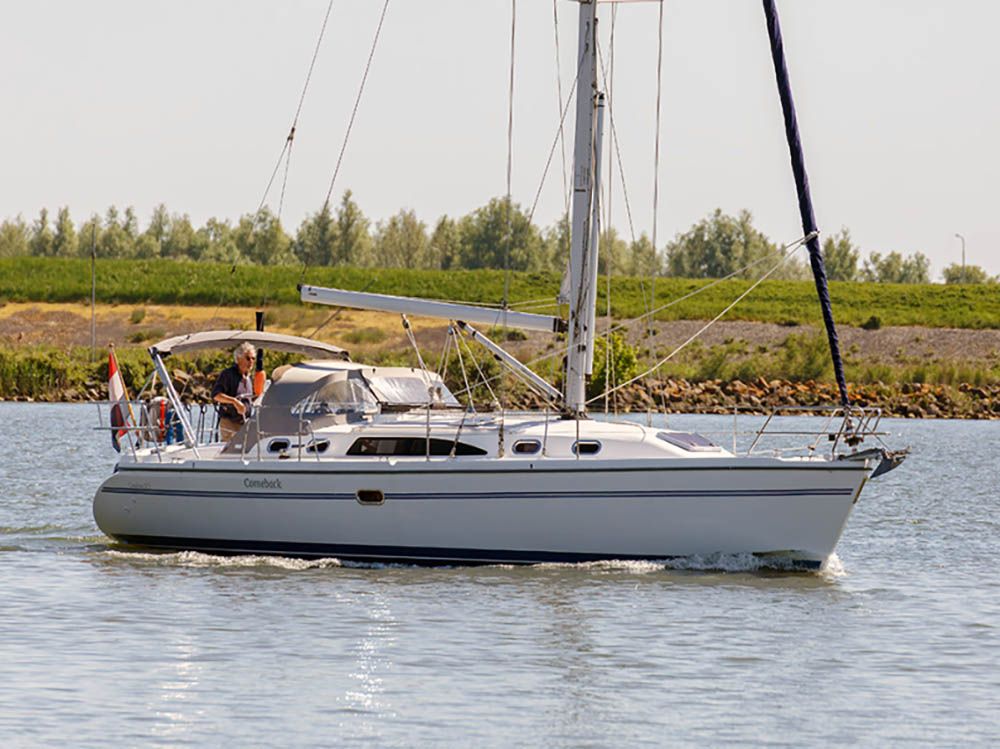
The Catalina 375 is a mid-size cruising yacht introduced by Catalina Yachts in 2008 and penned by Gerry Douglas as a direct successor to the long-running Catalina 36. It was conceived primarily as a comfortable family cruiser with sensible sailhandling—heavy emphasis on a roomy cockpit, generous lockers and systems space—rather than a stripped-out racer, so the target owner was the cruising couple or family who wanted easy short-handed sailing and the option for comfortable coastal passages. The model enjoyed positive press when new and a solid but relatively short production run; today well-equipped examples turn up on the second-hand market and typically attract private owners and couples looking for an easy-to-live-with coastal cruiser rather than charter fleets or performance racers.
Design and Construction
Catalina’s design brief for the 375 emphasized practical cruising: a moderate-to-full beam carried aft, a fin keel (with shoal and deep options), and an internally mounted spade rudder married to a fractional sloop rig with factory options such as in-mast furling. The hull is hand-laid fiberglass with vinylester and an integral structural grid; decks are balsa-cored where lightness and stiffness matter while heavy structural areas use solid laminate—choices that balance stiffness, durability and repairability for owners. Those construction choices mean routine fiberglass and deck repairs are straightforward for most yards, but buyers should be alert to typical long-term wear items—deck core around fittings, chainplate beds and seacock hoses—which are the normal focus of surveys on production boats of this era. In short, the 375’s design errs on the side of conservative, robust cruising systems rather than experimentation; that conservatism pays off in predictable maintenance and decent residual value when the boat has been well kept.
Performance
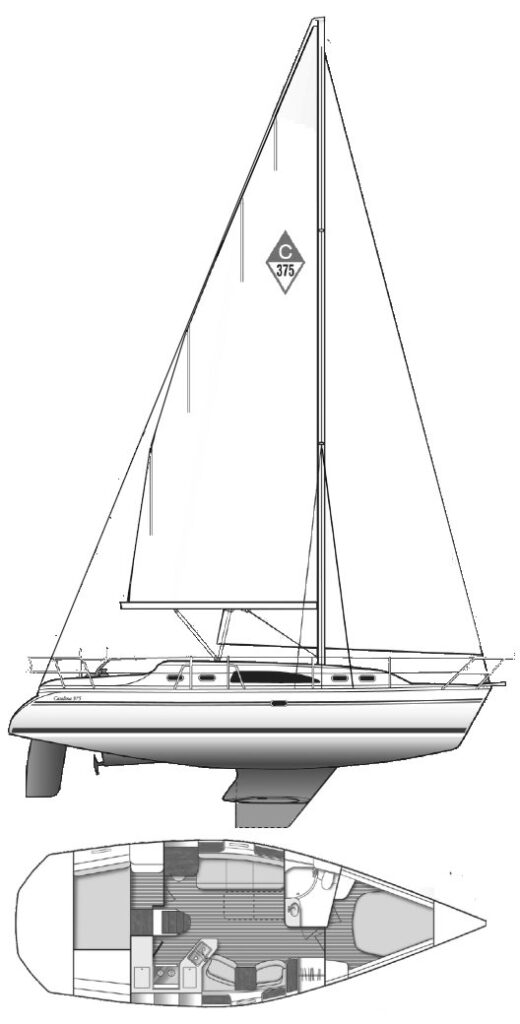
On the water the Catalina 375 sails like a solid coastal cruiser: with a reported LOA of about 38.5 feet and a 40-hp Yanmar auxiliary the boat cruises comfortably in the high-5 to low-7 knot range under typical conditions, and its lead ballast and sensible sailplan make it steady and confidence-inspiring off the wind. The conservative factory sail plan (often an in-mast-furling main and overlapping genoa) favors ease of handling and reefing over razor-sharp light-air performance, so owners trading off raw speed for manageable short-handed sailing will find the trade acceptable. In comparison with lighter European cruisers the 375 is less “sporty” to helm but more forgiving in a seaway and easier to maintain; compared with heavier older Catalina models it benefits from modern hull lines and more cockpit ergonomics, delivering predictable behavior for family cruising and comfortable passagemaking in coastal waters.
Comfort and Accommodations
The interior of the 375 is deliberately comfortable: a large cockpit with long seating, generous cockpit lockers, dedicated spaces for generator/AC, and a layout that places a roomy aft cabin and a generous forward island berth as core features. Accommodations prioritize liveability—ample galley area, good storage and thoughtful ergonomics—so the boat can easily support a cruising couple or small family for extended weekends and modest coastal cruises; full-time liveaboard is possible but the 38-foot hull size imposes expected limits on tankage and private space. Many owners have updated upholstery, electronics and galley equipment over time, so buyer impressions will vary widely with the level of refit; structurally the interior ages well when moisture is controlled, and the teak joinery and practical layout tend to make refits straightforward and locally serviceable.
Safety and Practicality
Safety-wise the 375 benefits from a low-center lead keel, robust hardware from Harken and good cockpit ergonomics—features that make short-handed reefing and sail management easier and the boat steady for family crews. Deck layout places primary winches near the helm and large lifelines and cockpit coamings are designed with practical cruising in mind; systems access (engine bay, tanks, seacocks) is generally good, which reduces yard time and costs for routine servicing. While the 375 is well suited to coastal and offshore passages in capable hands, prospective blue-water voyagers should budget for upgrades (additional seacocks, redundant electronics, heavy-duty ground tackle) before embarking longer offshore passages.
Known Issues with the Catalina 375
Catalina’s 375 has no single systemic design failure widely reported, but typical ownership patterns produce recurring checklist items a buyer should verify. Deck core and chainplate bedding must be inspected for soft spots or past leaks (common to many cored-deck production boats); the in-mast-furling mainsail option, when fitted, reduces sail area and can limit light-air performance and complicate repairs—many owners prefer a conventional slab-reef main for better sail shape and longevity. Engine and sail inventories on used boats are often original and will typically need service or replacement after a decade of use; routine items such as seacocks, hoses, and running-rigging should be included in a purchasing budget. Practical buyer improvements seen in listings include modern chart electronics, new sail inventories, and renewed bedding/seacock work—all sensible investments to convert a comfortable used 375 into a low-maintenance, reliable cruiser
Market Availability and Pricing in the U.S.
The Catalina 375 is no longer in production; the model was introduced in 2008 and had a relatively short production window (roughly 2008–2012), so all examples now sell on the used market. Well-equipped, recent model-year examples and U.S-located boats typically list in the mid-five-figure to mid-six-figure range; recent listings and dealer offerings suggest a practical market band of $140,000–$180,000 for cared-for 2008–2012 boats in the U.S., with lower prices for older, minimally outfitted or yard-stored hulls and premiums for boats with recent refits. Boats appear most often where cruising demand is strong—Florida, the Chesapeake/Mid-Atlantic and California—and many listings show boats that were owner maintained rather than charter workhorses. For buyers who value cockpit comfort and robust systems, the 375 usually presents a competitive value against peers; for those prioritizing light-air performance or minimal upkeep for budget ownership, alternatives from Beneteau, Jeanneau or Hunter in comparable sizes may be more attractive.
Here’s a comparison with similar models:
| Model | LOA | Approx. years built | Typical US used price | Main differences |
|---|---|---|---|---|
| Catalina 375 | 38.5 ft | 2008–~2012 | $140,000–$180,000 | Conservative, comfortable cruiser with roomy cockpit and robust systems; in-mast furling common option. |
| Beneteau Oceanis 37 | 37.7 ft | 2006–2014 | $90,000–$175,000 | Lighter, sleeker hull, more performance-oriented feel; often more modern lines and varied layout options. |
| Jeanneau Sun Odyssey 36 Mk I | ~35.9 ft | ~2007–2014 | $70,000–$110,000 | European hull tuning, injection-molded deck; often lighter displacement and a balance of comfort/performance. |
| Hunter 38 | 38.2 ft | 2004–2010 | $80,000–$120,000 | Beamier, very comfortable interiors, B&R rig options and features aimed at owner convenience. |
Catalina 375 vs Beneteau Oceanis 37

The Catalina 375 emphasizes conservative ease-of-use: broader cockpit ergonomics, robust hardware and systems space that favor owners who cruise with family or singlehand. The Oceanis 37, by contrast, is a touch sleeker in hull form and often feels livelier in light conditions; buyers who want a slightly sharper sailing experience and more modern lines will favor the Beneteau, while those who prioritize forgiving handling, a very comfortable cockpit and straightforward serviceability will appreciate the Catalina.
In practical ownership terms the Oceanis may demand slightly more attention to tuning, sails and electronics to extract its best performance, which raises running costs for performance-minded owners; the Catalina’s more conservative specification reduces tuning time and often translates into lower day-to-day maintenance friction for cruising couples.
► Learn more about the Beneteau Oceanis 37
Catalina 375 vs Jeanneau Sun Odyssey 36 Mk I

Compared with the Sun Odyssey 36i, the Catalina 375 leans heavier and more traditional—built to be comfortable and durable—while the Jeanneau presents a European balance of relatively lighter displacement and refined underwater sections that tend to accelerate and point well. The Sun Odyssey often offers slightly more performance potential for owners willing to tune and maintain a crisp sail inventory, whereas the Catalina emphasizes cockpit comfort, larger lockers and systems integration (generator/AC space) for liveability.
For a buyer focused on passage speed and sporty feel in coastal conditions, the Jeanneau can be the better match; for an owner who values low-stress sailing, easy short-handed reefing and a layout organized around cruising life rather than performance, the Catalina’s pragmatic choices make it easier to own and operate.
► Learn more about the Jeanneau Sun Odyssey 36 Mk I
Catalina 375 vs Hunter 38

The Hunter 38 typically offers a roomier interior and owner-convenience features (notably engineered modular interiors, in-mast or roller furling options and emphasis on living comfort), while the Catalina 375 trades some interior volume for a more substantial feel in systems and structural grid. Under sail the Hunter can feel more commodious and forgiving when heavily loaded, but the Catalina’s hull and lead keel yield a secure, steady ride that many cruising couples find reassuring on longer coastal legs.
From a maintenance and ownership perspective, Hunters of that era often include convenience features that can either reduce or shift maintenance (for example, complex furling systems) and sometimes require owner familiarity with proprietary components; the Catalina’s simpler, proven hardware lineup generally offers easier access to spares and conventional repair techniques, a practical advantage for owners who cruise far from brand-specialist yards.
► Learn more about the Hunter 38
Maintenance Costs of a Catalina 375 in the U.S.
Below are typical recurring and periodic costs for a Catalina 375; figures are ranges and vary by region, condition and owner involvement.
- Mooring / slip fees: $1,500–$10,000 per year — high in southern California and premium Florida marinas; lower at smaller regional harbors.
- Insurance: $500–$2,000 per year — coastal cruising and offshore endorsements increase premiums; location and owner experience matter.
- Engine servicing: $400–$1,200 per year — routine oil/filter, impeller and winter checks; higher if a repower or major service is required.
- Antifouling / haul-out: $600–$3,000 every 1–2 years — depends on bottom condition, need for gelcoat or fiberglass repair, and yard rates.
- Standing and running rigging: $0–$4,000 amortized — running rigging and hardware are ongoing; standing rigging replacement typically $1,500–$4,000 every 10–15 years.
- Sails: $0–$8,000 — patching and small repairs are inexpensive; mainsail or new headsail replacements range from $1,200–$4,000 each depending on cloth and style.
- Electronics and safety gear: $300–$4,000 amortized — modern chartplotters, AIS, and updated safety kit will be a significant one-time or infrequent outlay.
- Routine consumables: $300–$1,200 per year — pumps, hoses, zincs, small electrical and cosmetic items.
Significant one-time costs to budget for include standing rigging replacement, a full sail inventory, a repower or large bottom repair, and electronics refits. Many Catalina owners can perform routine maintenance and cosmetic work themselves, which reduces costs; professional services are typically needed for rig replacement, major engine work and complex electrical refits. Overall, ownership costs for a well-equipped Catalina 375 are medium for its size bracket: higher than small weekenders but reasonable for a comfortable 38-footer, and resale value is generally fair when mechanical and cosmetic maintenance is up to date
Conclusion
The Catalina 375 is a deliberately pragmatic cruiser designed to deliver comfortable, low-stress family sailing with robust systems and a cockpit that favors real-world use. Its strengths are practical ergonomics, dependable construction details and sailhandling choices that reduce the effort of short-handed coastal cruising; its compromises are less emphasis on light-air performance and the tradeoffs that come with in-mast options when chosen. For buyers seeking a comfortable, well-engineered coastal cruiser that is straightforward to maintain and live with, the 375 is a strong candidate and typically offers good value in today’s used market—particularly if you find a boat with a documented service history and sensible upgrades. It is a very sensible choice for weekend and family cruisers and coastal passagemakers; those whose priority is club racing or the light-air edge should compare closely with sleeker European designs, but for steady, practical ownership the Catalina 375 is worth serious consideration.
Specifications
| Hull Type | Fin w/spade rudder |
|---|---|
| Rigging Type | Fractional Sloop |
| LOA | 38.50 ft / 11.73 m |
| LWL | 34.42 ft / 10.49 m |
| S.A. (reported) | 646.00 ft² / 60.02 m² |
| Beam | 13.00 ft / 3.96 m |
| Displacement | 15,500.00 lb / 7,031 kg |
| Ballast | 5,200.00 lb / 2,359 kg |
| Max Draft | 6.83 ft / 2.08 m |
| Construction | FG |
| Ballast Type | Lead |
| First Built | 2008 |
| Builder | Catalina Yachts |
| Designer | Gerry Douglas |
Auxiliary Power / Tanks (orig. equip.) | |
| Make | Yanmar |
| Type | Diesel |
| HP | 40 |
| Fuel | 40 gals / 151 L |
| Accommodations | |
Water | 97 gals / 367 L |
| Sailboat Calculations & Definitions | |
| S.A. / Displ. | 16.69 |
| Bal. / Displ. | 33.55 |
| Disp. / Len | 169.69 |
| Comfort Ratio | 22.07 |
| Capsize Screening Formula | 2.09 |
| S# | 3.05 |
| Hull Speed | 7.86 kn |
| Pounds/Inch Immersion | 1,598.82 pounds/inch |
Rig and Sail Particulars | |
| I | 47.58 ft / 14.50 m |
| J | 14.75 ft / 4.50 m |
| P | 43.50 ft / 13.26 m |
| E | 13.58 ft / 4.14 m |
| S.A. Fore | 350.90 ft² / 32.60 m² |
| S.A. Main | 295.37 ft² / 27.44 m² |
| S.A. Total (100% Fore + Main) | 646.27 ft² / 60.04 m² |
| S.A./Displ. (calc.) | 16.69 |
| Est. Forestay Length | 49.81 ft / 15.18 m |
| Mast Height from DWL | 54.00 ft / 16.46 m |
Disclaimer
The considerations and analyses presented regarding the Catalina 375 sailboat are of a general nature and are based on the available information and technical data on this model, interpreted to the best of our knowledge and understanding. It is important to note that the specific characteristics of any particular sailboat may vary due to custom modifications, maintenance performed, and conditions of use over time, among other factors. Therefore, the details and performance of the boat you are considering may not exactly match the information provided here.
We strongly recommend that, before making any purchasing or usage decisions, you conduct a detailed inspection of the boat in question, consult with nautical professionals and other sailors, and consider your personal needs, expectations, and capabilities. Each sailboat may have unique particularities that affect its performance and suitability for different types of sailing and sailors.
The information contained in this analysis should be used as a general guide and not as a definitive reference. Professional evaluation and personal inspection are essential to ensure that the boat meets your specific requirements and expectations.