



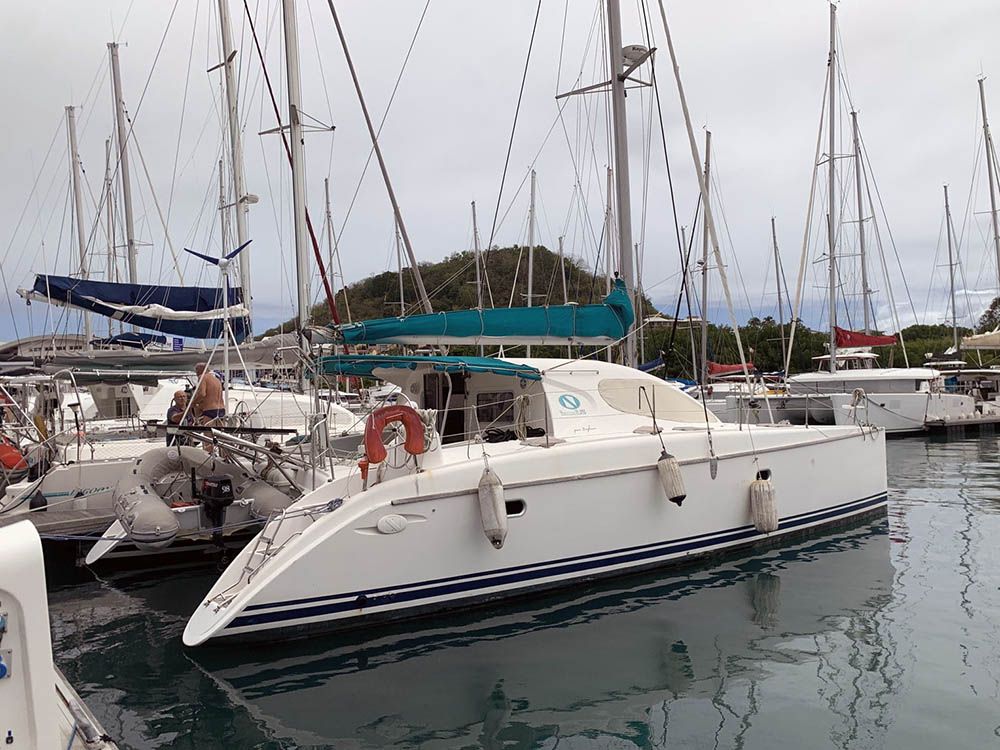
The Fountaine Pajot Lavezzi 40 is a purpose-built cruising catamaran that arrived at a moment when production cruising cats were consolidating into a mature market: compact, comfortable, and oriented toward coastal and short-offshore cruising rather than pure racing. Designed in the early 2000s by French naval architects (Joubert-Nivelt with contributions from O. Flahault in some sources) and built by Fountaine Pajot, the Lavezzi 40 was produced through the 2000s and became one of the yard’s best-selling 40-foot models.
The boat’s brief was obvious in the lines: give a small-to-mid-size cruising couple or family the space and light of a larger cat in a hull length that still fits many slips and costs less to own than 45-50′ cats. That intent has made the model popular in the second-hand market for private owners, live-aboards and, to a lesser extent, charter. You’ll find Lavezzi 40s traded by private sellers and brokers, commonly offered for coastal cruising in Florida and the Caribbean, and occasionally listed in East Coast and Mediterranean brokerages—evidence that the model attracted both private owners and ex-charter examples.. On today’s brokerage market, it remains a popular choice among private owners seeking reliability and among charter fleets looking for a proven workhorse. Demand continues to be strong, particularly in regions like the Caribbean and Florida, where short-term charters and liveaboard buyers drive interest.
Design and Construction
The Lavezzi 40 is a moderate-beam (about 21’4″) cruising catamaran with relatively straight bows, bridgedeck salon and a fractional sloop rig—an arrangement tuned for simplicity and short-handed handling. The hulls are shallow-draft (around 1.10 m / ~3.6 ft) with fixed keels/fins rather than daggerboards, which prioritizes robustness, shallow-water cruising and simpler maintenance over maximizing upwind pointing. The fractional sloop rig (sometimes reported with a rotating spar option on early descriptions) gives a large mainsail and smaller headsail, easing tacking and sail handling for a small crew.
Construction is hand-laid fiberglass with an emphasis on stiffness; later production and some reviews note the use of infusion and well-bonded bulkheads into the hull to maintain torsional rigidity—features that make the deck-salon feel solid and quiet at sea. Infusion and structural bonding were positive steps for durability and comfort, but they also change the nature of repairs: laminated structural work requires skilled composite technicians and, where factory processes or materials were less ideal, can make large repairs more expensive than on older wet-lay boats. In practice this means prospective buyers should budget for competent surveyors and accept that major laminate repairs are specialist work, even if routine gelcoat and deck hardware repairs are straightforward.
From the owner’s-value perspective, those build choices balance reasonably well: a stiff, well-engineered nacelle and hulls preserve resale value and comfort, but core and laminate issues (see Known Issues) can materially affect long-term ownership costs if not addressed proactively. The naval-architecture principles at work—wide beam for form stability, bridgedeck clearance to limit hobby-horsing and a modest center of effort for the sailplan—favor a predictable, non-dramatic motion and easier single-handing at anchor.

Performance
The Lavezzi 40 was designed as a cruising performer: not a raceboat, but livelier and quicker than earlier volume-first cats. With a large sail area and lightish displacement for a 40-foot cruising cat, it readily accelerates in moderate breeze and will sustain 7–9 knots in 12–18 knots of wind under sail with a good point of sail. Upwind pointing is respectable for a cruising cat thanks to its fractional rig and hull shape, though it will not match the windward angles of modern daggerboard cats or performance multihulls. Owners and reviews consistently describe competent, confidence-inspiring behavior in typical cruising conditions.
In confused seas or open ocean conditions the Lavezzi 40’s bridgedeck clearance and hull sections moderate slamming and hobby-horsing better than some earlier 38–40′ designs, but as with any catamaran of this era you will feel a firmer ride than on a heavier displacement monohull in very long, steep swells. Maneuverability under power is straightforward (twin diesels/saildrives are typical), and the wide cockpit and helm visibility make single-handing in port or tight marinas practical. Compared to similarly sized cats (Lagoon 380, Nautitech 395, Leopard 39/40), the Lavezzi sits in the middle: better paced than volume-first models but behind later performance-leaning cats in light-air pointing and acceleration.
Comfort and Accommodations
The Lavezzi 40’s bridgedeck salon and elevated galley create the sense of a larger boat: lots of light, good sightlines and easier movement between cockpit and saloon. Layouts were marketed in 3- and 4-cabin plans, with the 3-cabin versions favored by owners intending to live aboard or cruise as a couple (more storage, bigger owner’s cabin), while the 4-cabin plan targeted charter or family use. Headroom, cross-ventilation via hatches and large forward coachroof windows keep the interior airy—attributes that make the boat comfortable for extended cruise if owners are disciplined about storage and ventilation.
For a couple living aboard the Lavezzi 40 offers sensible ergonomics: a bridgedeck galley that keeps cooking inside the living space, simple electrical and engine access under steps or in hull lockers, and reasonable tankage (water and fuel adequate for coastal cruising). Families or groups will appreciate the multiple berth options, but storage can be tight if you intend long-term, gear-heavy passagemaking without significant customization. Many Lavezzi interiors age gracefully if maintained; it’s common to see refits that modernize fabrics, electronics and galley systems rather than structural changes.
Safety and Practicality
On deck the Lavezzi favors safe, practical ergonomics: wide sidedecks, a protected central cockpit, and clear access to the helm make working the boat in decent conditions straightforward. The shallow draft and fixed keels favor shoal anchorages and cruising ground not accessible to deeper monohulls, a practical advantage for owners cruising Florida, the Bahamas and the eastern Caribbean. For offshore passages the boat is fundamentally capable as a short-offshore cruiser, but prudent owners add storm preparation (stronger lashings, redundant steering/drift anchors) and check survey recommendations—some buyers upgrade rigging and through-hulls when they plan serious ocean work.
Systems accessibility is generally good: engines and saildrives are in hull trunks with accessible service points, and the bridgedeck area offers space for navigation and house systems. That said, the specialist nature of composite repairs and the sometimes idiosyncratic placement of wiring and plumbing in production boats mean that larger electrical or structural interventions are often best handled by professionals, which raises long-term ownership costs compared with very simple, older designs.
Known Issues with the Fountaine-Pajot Lavezzi 40
Owners’ forums and survey reports commonly point to a few recurring items on older Lavezzi 40s. Most prominent is osmosis / gelcoat blistering reported on some early hulls; this was linked by owners to resin systems and changing factory processes during the production run, and it appears in several community threads where localized repairs or full-hull barrier treatments were discussed. Prospective buyers should treat any sign of blisters seriously on survey and demand professional assessment.
Other practical items reported across examples include wear or corrosion on deck hardware where fittings penetrated the laminate, saildrive/service-history issues (as with many twin-engine cats) and the expected aging of original electronics, sails and upholstery on boats from the 2000s. Many owners recommend routine preventive work—refreshed sealant around deck gear, replacement of original flexible hosework, and careful attention to companionway and hatch sealing—to avoid water intrusion that can accelerate core and gelcoat problems. Commonly recommended upgrades by buyers (depending on condition) include fresh sail inventories, upgraded chart electronics, and in some cases replacement of propellers/shafting or saildrive units if hours and maintenance history warrant it. Forum discussions and broker listings show both inexpensive cosmetic fixes and more costly osmosis-related or engine-related jobs depending on history.
Market Availability and Pricing in the U.S.
The Lavezzi 40 is no longer in production; examples are sold exclusively on the second-hand market. Typical listings in recent years show boats available through U.S. brokers and in nearby Bahamas/Caribbean locations as well as European listings that sometimes reposition to U.S. waters. U.S. listings and brokers commonly show Lavezzi 40s in Florida and the Southeast (e.g., Fort Lauderdale/West Palm/Key West), with periodic examples on the East Coast and occasional listings farther afield—so buyers in the U.S. most often source boats through Florida brokers or brokers who will deliver from the Caribbean.
Based on recent broker and listing samples, a realistic U.S. market range for a Lavezzi 40 today is roughly $140,000–$380,000, depending on year, equipment, refits and location. Listings seen in broker databases and auction/sales sites include boats offered in the low-to-mid six-figure range for hulls needing upgrades and higher asking prices for well-maintained, refitted examples with new engines or recent barrier coat work.
Below is a short comparison to three broadly comparable multihulls that buyers commonly consider when looking at used 38–40′ cruising cats. The table is provided as raw HTML so you can copy it directly; all cells and headers are aligned left for easy reuse.
Here is a comparison with three similar catamarans of comparable size and era:
| Model | LOA | Typical build years | Typical used price in U.S. market | Main differences |
|---|---|---|---|---|
| Fountaine Pajot Lavezzi 40 | ~39’1″ | 2002–2009 | **$140,000–$380,000** | Balanced cruising performance, bridgedeck salon, stiff infusion construction; some hulls show osmosis history. |
| Lagoon 380 | ~38′ | 2000s–2010s | $170,000–$300,000 | Very common, high charter presence, roomy but more volume-first; good resale liquidity. |
| Leopard 39 / 40 | ~39′ | 2010s (Leopard 39+) / mid-2000s (40) | $230,000–$380,000 | Modern production standards, often slightly heavier but robust; good equipment packages from factory. |
| Nautitech 395 | ~39’–39.5′ | 1996–2005 | $120,000–$240,000 | Performance-oriented Dufour-designed hulls; often lighter and more sailing-centric than volume-first cats. |
Fountaine-Pajot Lavezzi 40 vs Lagoon 380
The Lagoon 380 emphasizes simplicity and comfort, with a bright interior and straightforward systems that appeal to both first-time owners and charter operators. By contrast, the Lavezzi 40 offers a more performance-oriented rig and slightly higher sailing speeds, especially on a reach, though its interior is more compact and less airy. Buyers seeking interior space and resale security tend to favor the Lagoon, while those focused on livelier sailing characteristics often lean toward the Lavezzi.
From a practical standpoint, the Lagoon is easier to maintain due to widespread parts availability and its large production base. The Lavezzi, while offering better performance, can require more attentive rigging upkeep and may have a smaller resale pool in the U.S. The decision often comes down to lifestyle priorities: stability and comfort versus speed and handling.
► Learn more about de Lagoon 380
Fountaine-Pajot Lavezzi 40 vs Leopard 39

The Nautitech 40 presents itself as a sportier, more responsive alternative, with twin helms aft and a narrower profile that allows for better upwind performance. The Lagoon 380, on the other hand, is more conservative, with its central helm and emphasis on safety and livability. For coastal cruising and family use, the Lagoon provides a friendlier layout, while the Nautitech appeals to sailors seeking a more engaging helm experience.
Interior comfort is another differentiator. The Lagoon 380 feels more spacious for its length, especially in the saloon, while the Nautitech favors cockpit living and outdoor flow. Maintenance on both is comparable, though Nautitech’s more performance-oriented fittings can lead to higher upkeep if heavily sailed. Buyers must weigh whether they value space and ease or sailing agility and responsiveness.
► Learn more about de Leopard 39
Fountaine-Pajot Lavezzi 40 vs Nautitech 395
The Leopard 39 is a newer design with a strong charter background, offering a larger cockpit and more modern fittings. It shares the Lagoon’s reputation for durability and practical systems but typically comes at a higher price point. While the Lagoon 380 is slightly smaller, it is often more affordable and equally comfortable for family cruising.
In terms of sailing, both are steady rather than fast, but the Leopard’s newer rig and systems provide incremental advantages in efficiency and handling. Maintenance costs for the Leopard can be higher due to newer equipment and features, though these may reduce refit needs in the near term. For buyers, the Leopard represents a step up in modernization, while the Lagoon offers proven value and stronger liquidity on the resale market.
► Learn more about de Nautitech 395
Maintenance Costs of a Fountaine-Pajot Lavezzi 40 in the U.S.
Region matters: Florida and the Southeast usually offer lower haulout and slip costs than New England or parts of California, but hurricane season insurance and storm prep can push costs higher in the Southeast. West Coast haulouts and storage often are expensive, and outlying Pacific islands increase logistics and freight costs for parts and specialized technicians.
Significant one-time costs for a Lavezzi buyer often include barrier-coat/osmosis repairs (if needed), sail inventory replacement, saildrive overhauls or new engines depending on hours, and modern electronics/refit packages. Whether the boat can be owner-maintained depends on the owner’s skills: routine mechanical, sail and cosmetic work is achievable by a capable owner, but composite structural repairs, inboard-engine major overhauls and complex electrical system rewiring generally require professionals. Overall, for a 40′ production cat the Lavezzi sits in the medium maintenance-cost tier: more expensive than a same-length monohull for hull servicing and engine work (two engines, twin systems), but often less expensive than significantly larger cats—provided there are no major osmosis or structural surprises. The resale value of well-maintained examples usually offsets sensible investment in preventive maintenance.
Conclusion
The Lavezzi 40 is a thoughtful compromise: it gives a compact cruising crew the volume and liveability of a larger cat in a manageable hull length, with sailing manners that are pleasant without being extreme. Its strengths are a comfortable bridgedeck salon, solid infusion-era construction, and an ergonomically sensible deck and interior layout that work well for couples, families and live-aboard cruisers who value a predictable, comfortable platform.
Its principal weaknesses are the age-related items that affect many production cats—most notably instances of osmosis reported on some older hulls and the costs that come with replacing aging saildrives, sails or electronics. For buyers, the practical advice is clear: buy the best-documented example you can find, insist on a current, thorough survey (paying close attention to gelcoat/hull condition and saildrive/shafting history), and budget for a few targeted upgrades. When those boxes are ticked, the Lavezzi 40 is worth seeking out as a value-oriented coastal cruiser with the capability to do short offshore passages and the comfort to make extended time aboard genuinely enjoyable.
Specifications
| Hull Type | Catamaran Twin Keel |
|---|---|
| Rigging Type | Frac. Sloop (Rotating Spar) |
| LOA | 39.10 ft / 11.92 m |
| LWL | 39.10 ft / 11.92 m |
| S.A. (reported) | 969.00 ft² / 90.02 m² |
| Beam | 21.40 ft / 6.52 m |
| Displacement | 13,228.00 lb / 6,000 kg |
| Max Draft | 3.60 ft / 1.10 m |
| Construction | FG |
| First Built | 2002 |
| Last Built | 2009 |
| # Built | 227 |
| Builder | Fountaine Pajot Catamarans (FRA) |
| Designer | O. Flahault Design / Joubert – Nivelt |
| Auxiliary Power | Volvo 2030, Diesel x 2, 36 HP |
| Fuel | 66 gals / 250 L |
| Water | 145 gals / 549 L |
| S.A. / Displ. | 27.82 |
| Disp. / Len. | 98.79 |
| KSP | 0.85 |
| Mast Height from DWL | 57.58 ft / 17.55 m |
Disclaimer
The considerations and analyses presented regarding the Fountaine-Pajot Lavezzi 40 catamaran are of a general nature and are based on the available information and technical data on this model, interpreted to the best of our knowledge and understanding. It is important to note that the specific characteristics of any particular sailboat may vary due to custom modifications, maintenance performed, and conditions of use over time, among other factors. Therefore, the details and performance of the boat you are considering may not exactly match the information provided here.
We strongly recommend that, before making any purchasing or usage decisions, you conduct a detailed inspection of the boat in question, consult with nautical professionals and other sailors, and consider your personal needs, expectations, and capabilities. Each sailboat may have unique particularities that affect its performance and suitability for different types of sailing and sailors.
The information contained in this analysis should be used as a general guide and not as a definitive reference. Professional evaluation and personal inspection are essential to ensure that the boat meets your specific requirements and expectations.