


The Lagoon 380 is one of the most recognizable cruising catamarans of the early 2000s, launched by Lagoon, a French shipyard owned by Groupe Beneteau, and designed by Marc Van Peteghem and Vincent Lauriot-Prévost (VPLP). Conceived as a compact yet capable multihull, it was never intended for racing but rather for family cruising, charter operations, and extended coastal or bluewater passages in comfort. Since its debut in 1999, it quickly gained traction as one of Lagoon’s best-selling models, with more than 800 hulls delivered worldwide. On today’s brokerage market, it remains a popular choice among private owners seeking reliability and among charter fleets looking for a proven workhorse. Demand continues to be strong, particularly in regions like the Caribbean and Florida, where short-term charters and liveaboard buyers drive interest.
Design and Construction
The Lagoon 380 is a twin-hull fiberglass catamaran built using sandwich construction with balsa core, offering both lightness and rigidity. Each hull carries shallow mini-keels rather than deep fins, a choice that reduces draft and allows access to shallow anchorages while also protecting the rudders. The twin spade rudders provide good maneuverability and redundancy. Rigged as a fractional sloop with a single mast and a self-tacking jib option, the sail plan is simple, reflecting Lagoon’s design philosophy of user-friendly operation.
From a naval architecture standpoint, the wide beam adds significant form stability, reducing heel and creating a safe, level sailing experience. At the same time, the high bridge deck clearance minimizes pounding in choppy seas. These elements translate into long-term durability, though the sandwich construction requires vigilant maintenance to prevent water intrusion. For buyers, this means lower immediate upkeep compared to wooden or aluminum hulls, but attention to sealing and fittings is crucial for preserving value.
Performance
In terms of sailing ability, the Lagoon 380 is steady and forgiving, though not particularly fast compared to performance-oriented catamarans. With 6–8 knots of cruising speed under sail in moderate winds, it is adequate for family cruising but will not outpace slimmer designs like a Catana or Outremer. Upwind performance is modest, with noticeable leeway in stronger breezes, but the boat excels on a reach or downwind course, where its wide beam and sail area come into balance.
Owners often highlight its predictability and ease of handling, especially with small crews or couples. Twin engines improve maneuverability in marinas, a significant advantage over monohulls of similar size. When compared with production monohulls from the same era, the Lagoon 380 trades some pointing ability for exceptional stability, space, and comfort under way, which are often more valuable for cruising families.
Comfort and Accommodations
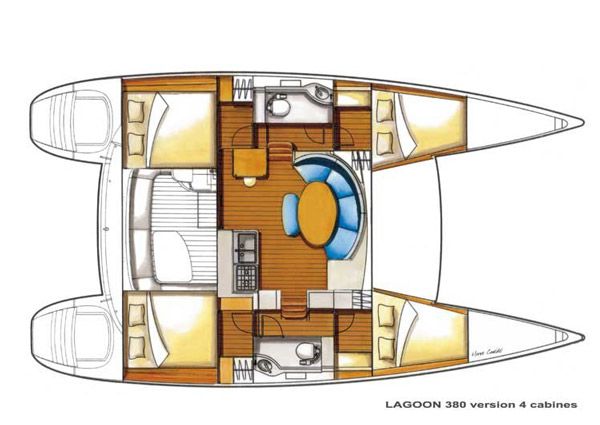
The Lagoon 380 is widely praised for its livability. With four double cabins in the charter version or three cabins in the owner’s version, the interior is bright, ventilated, and surprisingly spacious for a vessel under 40 feet. The saloon offers panoramic views and an efficient galley-up layout, allowing communication between the cook and crew. Ventilation is excellent thanks to numerous opening hatches, a practical consideration for tropical sailing.
For liveaboard use, storage is adequate but not abundant; long-term cruisers often add modular solutions. The finish is durable but simple, and many boats on the market show interior refits or upgrades to modernize upholstery and electronics. While it may not exude luxury compared to newer models, the Lagoon 380 remains practical and comfortable, suitable for a couple or small family on extended voyages.
Safety and Practicality
Safety on deck is enhanced by wide side decks, good handholds, and secure access to the cockpit. The aft transoms make water access easy, both for swimming and boarding a dinghy, though they can be wet in heavy following seas. The helm position is semi-raised, offering visibility without isolation from the crew. With all lines led aft, it is manageable by two people, making it popular among owner-operators without large crews.
In terms of capability, the Lagoon 380 is well-suited for coastal and moderate offshore passages. Many have crossed oceans, though some owners add upgrades such as reinforced rigging or additional tankage for bluewater cruising. Systems are generally accessible, reducing maintenance costs. Its simplicity of design means fewer specialized repairs, which keeps long-term ownership practical.
Known Issues with the Lagoon 380
Common issues reported by owners include leaks around deck hatches and windows, a typical challenge in aging production catamarans. Some boats have shown early signs of osmosis if poorly maintained, though the balsa-cored hulls usually resist problems if kept dry. Ex-charter models may have engines with high hours, and saildrives often require seal replacements to prevent water intrusion.
Upgrades often recommended include improved electronics, folding or feathering propellers for better performance under sail, and reinforced davits for heavier tenders. Rigging should be inspected closely, as many boats on the market still carry original standing rigging. While these are not structural flaws, prospective buyers should budget for targeted refits to align the vessel with their cruising needs.
Market Availability and Pricing in the U.S.
The Lagoon 380 is no longer in production but remains abundant on the second-hand market. In the United States, it is most commonly found in Florida, the Chesapeake Bay, and California, often arriving after service in Caribbean charter fleets. Buyers will typically encounter two categories: ex-charter boats with higher wear but attractive pricing, and well-kept private-owner versions, often upgraded and in good cosmetic shape. A few neglected hulls also appear, though these require substantial refit and are usually purchased at steep discounts.
Typical prices in the U.S. range from $180,000 to $280,000, depending on year, condition, and level of refit. Compared to similar catamarans, the Lagoon 380 remains one of the most cost-effective entry points into ownership of a proven cruising multihull. Its strong brand recognition and popularity in charter markets make it easier to resell than many competitors.
Here is a comparison with three similar catamarans of comparable size and era:
| Model | LOA | Year | Typical Price (U.S.) | Main Differences |
|---|---|---|---|---|
| Lagoon 380 | 38 ft | 1999–2019 | $180,000–$280,000 | High-volume production, excellent resale, family/charter oriented |
| Fountaine Pajot Lavezzi 40 | 40 ft | 2002–2012 | $200,000–$300,000 | More sail area, slightly faster, interiors less spacious but more modern |
| Nautitech 40 | 40 ft | 2003–2010 | $190,000–$280,000 | Sportier design, twin helm stations, better upwind, less storage |
| Leopard 39 | 39 ft | 2010–2014 | $240,000–$330,000 | Newer build, robust charter pedigree, larger cockpit, slightly higher upkeep |
Lagoon 380 vs Fountaine Pajot Lavezzi 40

The Lagoon 380 emphasizes simplicity and comfort, with a bright interior and straightforward systems that appeal to both first-time owners and charter operators. By contrast, the Lavezzi 40 offers a more performance-oriented rig and slightly higher sailing speeds, especially on a reach, though its interior is more compact and less airy. Buyers seeking interior space and resale security tend to favor the Lagoon, while those focused on livelier sailing characteristics often lean toward the Lavezzi.
From a practical standpoint, the Lagoon is easier to maintain due to widespread parts availability and its large production base. The Lavezzi, while offering better performance, can require more attentive rigging upkeep and may have a smaller resale pool in the U.S. The decision often comes down to lifestyle priorities: stability and comfort versus speed and handling.
► Learn more about de Fountaine Pajot Lavezzi 40
Lagoon 380 vs Nautitech 40

The Nautitech 40 presents itself as a sportier, more responsive alternative, with twin helms aft and a narrower profile that allows for better upwind performance. The Lagoon 380, on the other hand, is more conservative, with its central helm and emphasis on safety and livability. For coastal cruising and family use, the Lagoon provides a friendlier layout, while the Nautitech appeals to sailors seeking a more engaging helm experience.
Interior comfort is another differentiator. The Lagoon 380 feels more spacious for its length, especially in the saloon, while the Nautitech favors cockpit living and outdoor flow. Maintenance on both is comparable, though Nautitech’s more performance-oriented fittings can lead to higher upkeep if heavily sailed. Buyers must weigh whether they value space and ease or sailing agility and responsiveness.
► Learn more about de Nautitech 40
Lagoon 380 vs Leopard 39

The Leopard 39 is a newer design with a strong charter background, offering a larger cockpit and more modern fittings. It shares the Lagoon’s reputation for durability and practical systems but typically comes at a higher price point. While the Lagoon 380 is slightly smaller, it is often more affordable and equally comfortable for family cruising.
In terms of sailing, both are steady rather than fast, but the Leopard’s newer rig and systems provide incremental advantages in efficiency and handling. Maintenance costs for the Leopard can be higher due to newer equipment and features, though these may reduce refit needs in the near term. For buyers, the Leopard represents a step up in modernization, while the Lagoon offers proven value and stronger liquidity on the resale market.
► Learn more about de Leopard 39
Maintenance Costs of a Lagoon 380 in the U.S.
Typical annual maintenance for a Lagoon 380 varies with location and use:
- Mooring or marina fees: $8,000–$15,000 per year in Florida or California; lower in the Chesapeake.
- Insurance: $3,000–$5,000 annually, depending on cruising grounds and coverage.
- Engine servicing (twin diesels): $1,200–$2,000 annually.
- Antifouling paint: $3,000–$5,000 every 18–24 months, higher in warm waters.
- Standing rigging inspection/replacement: $1,500 annually for inspections; $12,000–$15,000 for full replacement every 10–12 years.
- Running rigging: $1,000–$2,000 every few years, depending on use.
- Sails: $4,000–$7,000 for replacements, typically every 8–10 years in active cruising.
One-time costs may include electronics upgrades ($10,000–$20,000), air conditioning retrofits, or solar/wind generation systems. Many Lagoon 380 owners handle light maintenance themselves, though systems like saildrives often require professional service. Overall, ownership costs are medium for its size, balanced by strong resale value and consistent demand on the used market.
Conclusion
The Lagoon 380 is not a performance machine, nor was it ever meant to be. Its strength lies in its balance of comfort, practicality, and reliability. With a strong record in the charter industry and an enduring appeal among private owners, it remains one of the most versatile small catamarans available today.
For coastal cruising, liveaboard lifestyles, or entry into the charter market, the Lagoon 380 offers excellent value and broad market acceptance. Its stable resale prices and global popularity make it a safe investment, provided buyers are realistic about its sailing limitations. For the right owner—someone seeking comfort, stability, and proven design—it is a boat worth pursuing.
Specifications
| Hull Type | Catamaran Twin Keel |
|---|---|
| Rigging Type | Fractional Sloop |
| LOA | 37.89 ft / 11.55 m |
| LWL | 36.08 ft / 11.00 m |
| S.A. (reported) | 829.00 ft² / 77.02 m² |
| Beam | 21.42 ft / 6.53 m |
| Displacement | 16,005 lb / 7,260 kg |
| Max Draft | 3.77 ft / 1.15 m |
| Construction | FG (Fiberglass) |
| First Built | 2000 |
| # Built | 760 |
| Builder | Jeanneau (FRA) |
| Designer | Van Peteghem / Lauriot-Prevost (VPLP) |
| Auxiliary Power (orig. equip.) | Yanmar or Volvo diesel ×2 |
| Fuel Capacity | 53 gals / 200 L |
| Water Capacity | 79 gals / 300 L |
| Sail Area / Displacement | 20.96 |
| Disp / Length | 152.13 |
| KSP | 0.68 |
| Mast Height from DWL | 56.83 ft / 17.32 m |
Disclaimer
The considerations and analyses presented regarding the Lagoon 380 catamaran are of a general nature and are based on the available information and technical data on this model, interpreted to the best of our knowledge and understanding. It is important to note that the specific characteristics of any particular sailboat may vary due to custom modifications, maintenance performed, and conditions of use over time, among other factors. Therefore, the details and performance of the boat you are considering may not exactly match the information provided here.
We strongly recommend that, before making any purchasing or usage decisions, you conduct a detailed inspection of the boat in question, consult with nautical professionals and other sailors, and consider your personal needs, expectations, and capabilities. Each sailboat may have unique particularities that affect its performance and suitability for different types of sailing and sailors.
The information contained in this analysis should be used as a general guide and not as a definitive reference. Professional evaluation and personal inspection are essential to ensure that the boat meets your specific requirements and expectations.