



The Fountaine Pajot Lucia 40 was conceived as a modern, family-oriented cruising catamaran: a comfortable, relatively compact platform intended for relaxed coastal cruising, bluewater passages in moderate conditions, and a healthy second life in the charter market. Designed by Berret‑Racoupeau and launched in the mid‑2010s by the French builder Fountaine Pajot, the Lucia 40 sits between the smaller daysailer cats and the larger, more luxurious long‑range catamarans that followed. Its brief was practical: give small crews good visibility, easy handling, and usable living space without the complexity and cost of a larger yacht. That balance made the model attractive to private owners who wanted family cruising plus occasional charter revenue, and it shows up reasonably often on the secondhand market—demand today is split between cruisers buying for private use, charter operators refreshing fleets, and buyers seeking a comfortable coastal cruiser with modest draft.
Design and Construction
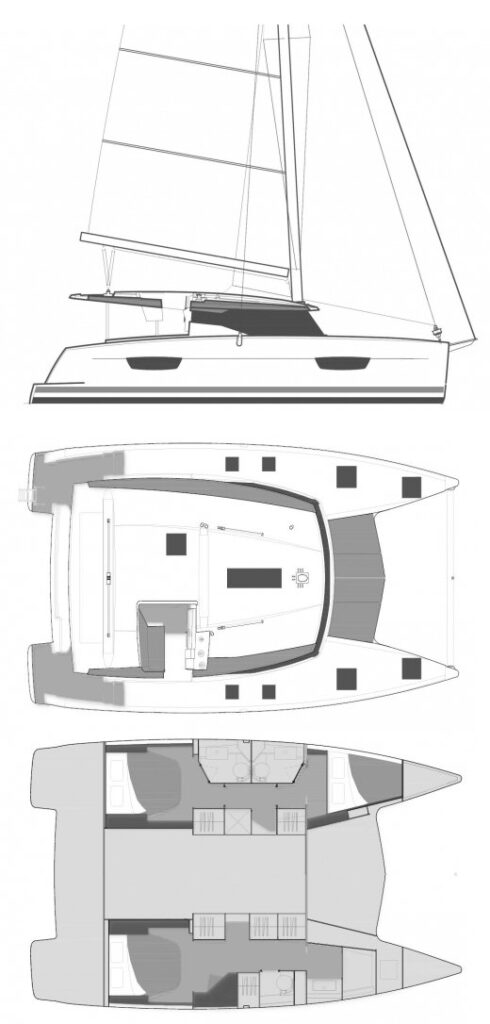
The Lucia 40 follows contemporary multihull thinking: twin slender hulls with shallow fixed keels and twin rudders for predictable handling and a draft that opens up shallow anchorages. The rig is a fractional sloop optimized for a furling headsail and reefing main, which keeps sail handling straightforward for short-handed crews. Fountaine Pajot employed vacuum‑infused fiberglass construction with cored sections in decks and some interior panels to keep weight down while preserving stiffness—choices that make the boat sprightly under sail and fuel‑efficient under power, but also create long‑term maintenance considerations around core integrity and through‑deck penetrations.
Those construction decisions affect ownership in two practical ways: first, the infusion process and engineered cores tend to produce a stiff, lightweight structure that resists fatigue, which is good for resale; second, any water ingress into cored areas—often tracing back to poorly bedded windows, chainplates, or deck hardware—will demand timely attention and sometimes localized core repairs. From a naval architecture standpoint the Lucia prioritizes form stability (beam and hull separation) rather than deep ballast, so it is inherently stiff and comfortable at anchor and on reaches, while relying on hull shape rather than ballast to resist capsize—an expected tradeoff for cruising catamarans that favors living space and shallow draft over racing performance.
Performance
On the water the Lucia 40 tends to feel like a modern cruising catamaran should: responsive, stable and reassuring rather than sporty. In moderate wind she accelerates cleanly, steers with light helm and makes comfortable passage speeds on a reach; upwind she will not point as high as a performance monohull, but the wide platform gives steady progress without excessive motion. As with most cats in this size range, light airs require trimming and weight management to keep momentum, while stronger conditions reward early reefing and sensible sail choices to preserve comfort rather than chase top knots.
Compared with contemporaries in the 38–41 foot range, the Lucia leans toward comfortable cruising rather than club racing—owners praise its predictable behavior and the dual‑engine maneuverability in tight marinas. Its twin‑engine setup gives excellent control under power (helpful in currents and close quarters) and redundancy that many monohull buyers value when switching to multihulls.
Comfort and Accommodations
The Lucia 40’s interior is one of its strongest selling points: an airy saloon with panoramic windows, a cockpit that integrates with the living area, and multiple layout options (three‑ or four‑cabin floorplans) make it adaptable for couples, families, or small charter groups. Storage is generous for a 40‑foot platform because the hulls are long and the beam is wide, and the galley‑up configuration improves social life aboard—cooking and navigation happen in the same living flow, which owners often cite as a quality‑of‑life win on cruising trips.
For long‑term liveaboard use the Lucia ticks many boxes: cross‑ventilation through hatches and windows, decent headroom in the saloon, and cabins sized for comfortable sleep. That said, families and full‑time cruisers should inspect woodwork and joinery for signs of wear; many Lucia interiors hold up well, but you will commonly find owner‑led remodels—upgraded fridges, custom shelving, or refreshed upholstery—because the base fit‑out prioritizes durability for charter usage rather than bespoke comfort.
Safety and Practicality
Deck ergonomics on the Lucia favor safe movement: broad coachroof walkways, solid grabrails in the cockpit and saloon coamings, and shallow draft that makes anchoring in coastal spots more practical than deeper‑keeled cruisers. Steering systems include conventional wheel gear with emergency tiller procedures documented in the manual, which is a sensible redundancy for offshore passages. Access to critical systems is generally reasonable—engine rooms under the companionway steps and accessible saildrive/shaft areas—so routine service is straightforward for a competent owner or a local mechanic.
That practicality extends to suitability for coastal cruising and passages without radical modification; however, serious bluewater voyaging benefits from preventive upgrades: additional structural inspection points, reinforced bedding for deck hardware, and attention to through‑hull fittings to minimize the risk of water ingress. Overall, the Lucia is a safe, practical platform for coastal and moderate offshore work when maintained to good‑yacht standards.
Known Issues with the Fountaine Pajot Lucia 40
Owners and forum reports converge on a handful of recurring maintenance topics rather than a single catastrophic fault. Window and deck‑joint leaks are commonly reported—usually stemming from aging sealant or movement at the mast/deck junction—and are often cured by careful removal, cleaning and rebedding. Some owners have reported problems with factory genset installations (salt‑water intrusion, exhaust/drain routing) that required replacement or enclosure work, and a few threads discuss crazing or scratching of acrylic windows, which affects visibility and may prompt replacement with laminated glass in higher‑end refits.
These problems are not unique to the Lucia—the symptom (water ingress through fittings or aging seals) is typical for many production multihulls—but they are material to a buyer because repairs range from inexpensive resealing jobs to more involved core repairs if leaks are neglected. Practical upgrades commonly recommended by owners include a planned reseal of all deck fittings and windows on acquisition, a review or replacement of the genset installation if it shows signs of salt‑water contact, and routine inspection of rudder pintles and bearings for play.
Market Availability and Pricing in the U.S.
The Lucia 40 is no longer in active production (the run was mid‑2010s into the late 2010s), so the model circulates on the used market with most listings in the 2015–2019 build years. In the U.S. you’re most likely to encounter Lucia 40s in Florida (including Fort Lauderdale and the Keys), the U.S. Virgin Islands and Caribbean brokerage stocks, the Chesapeake/Annapolis region, and occasional West Coast listings (California). Condition varies: many boats are well maintained by private owners or upgraded after charter service, while other examples—particularly older charter boats—can show higher systems wear and require a thorough survey.
A realistic used‑market price range for a Lucia 40 today is $270,000–$425,000, depending on year, equipment, and condition. That range places the Lucia competitively among other 38–41 foot cruising cats: it tends to be priced above older production cats with certificated heavy use, and below newer or larger semi‑luxury cats. Below is a concise comparison table showing the Lucia alongside three commonly considered alternatives; the table is raw HTML so you can copy it directly.
Below is a compact comparison table of the Lagoon 40 and three contemporaries in the 40-foot multihull class
| Model | LOA | Year (approx) | Typical used price (US) | Main differences |
|---|---|---|---|---|
| Fountaine Pajot Lucia 40 | 38.5 ft | 2015–2019 | $270,000–$425,000 | Modern infusion construction, compact beam for marina access, comfortable saloon; strong charter presence. |
| Leopard 40 | ~40 ft | 2006–2021 (varies by generation) | $300,000–$480,000 | Often slightly more performance oriented in later generations, broad dealer support, common in charter fleets. |
| Lagoon 400 (S2) | 39–40 ft | 2010s | $260,000–$390,000 | Roomy interior, large saloon windows, established service network and strong resale in some markets. |
| Nautitech 40 Open | ~39.5 ft | 2014–2020 | $285,000–$400,000 | Sportier deck plan and hull sections, performance bias while remaining comfortable for cruising. |
Fountaine Pajot Lucia 40 vs Leopard 40

The Lucia emphasizes comfortable, charter‑friendly accommodation with a compact, hard‑working sailplan that keeps handling simple for short‑handed crews; Leopard 40 variants often push a touch harder toward sailing performance and offer different layout compromises that favor speed and deck ergonomics. Practical ownership differs: Leopards are commonly found with dealer networks and strong broker visibility in charter markets, which can make sourcing parts and documented maintenance easier, while the Lucia’s strength is a well‑balanced interior and typically lower deck profile for easier marina access.
► Learn more about de Leopard 40
Fountaine Pajot Lucia 40 vs Lagoon 400 (S2)

Both boats occupy the same cruising niche—family coastal cruising and charter—with Lagoon tending to advertise a slightly more voluminous saloon and broad resale recognition. In everyday use that translates into the Lagoon feeling roomier inside and sometimes more comfortable for large groups, whereas the Lucia can be slightly nimbler in tighter anchorages and often costs less on the used market for equivalently equipped boats.
► Learn more about de Lagoon 400 S2
Fountaine Pajot Lucia 40 vs Nautitech 40 Open

Nautitech’s Open 40 has a sportier personality: deck layouts and hull forms targeting lively sailing and better pointing in some conditions, which appeals to buyers who value passage performance as highly as accommodation. By contrast the Lucia trades a bit of outright performance for easier living spaces and often simpler systems—buyers who prize weekend comfort and charter versatility typically prefer Lucia, while those wanting a more engaging sail profile will steer toward Nautitech.
► Learn more about de Nautitech 40 Open
Maintenance Costs of a Fountaine Pajot Lucia 40 in the U.S.
- Mooring/Slip: $3,000–$12,000 per year (varies widely by region; marina rates are highest in California and popular Florida/NE marinas).
- Insurance: $1,200–$6,000 per year (depends on use, value, cruising area, and insurer).
- Engine servicing (2 engines): $800–$2,500 per engine per year (routine oil/service plus intermittent gearbox/saildrive checks).
- Antifouling and haulouts: $1,200–$6,000 every 1–2 years (depends on haulout method, hull condition, and region).
- Standing & running rigging inspections/replacements: $300–$2,500 annually set aside; major rigging refresh every 8–12 years can be $8,000–$20,000 depending on work.
- Sails (maintenance/replacement): $300–$2,000 per season in repairs; full sail replacement $6,000–$20,000+ depending on cut and material.
Significant one‑time costs to budget for include a genset replacement ($10,000–$25,000 installed if needed), major electronics refits ($5,000–$20,000+), or core/deck repairs if leaks have been neglected (variable, commonly $3,000–$25,000 for localized work). Many systems are owner‑serviceable if you have mechanical aptitude—routine engine checks, simple electrical troubleshooting, and cosmetic work can be owner‑led—but structural inspections, major sail work, and complex electronics usually require professionals, which raises costs. Overall, for a 40‑foot cruising catamaran the Lucia sits in the medium cost band for annual upkeep: not cheap, but not at the top end for larger catamarans; sensible maintenance and a good survey often protect resale value.
Conclusion
The Lucia 40 is a pragmatic, well‑rounded small cruising catamaran that pairs comfortable accommodations with easy handling—qualities that make it attractive to families, couples who cruise shorthanded, and buyers who want an entry‑level cruising cat with charter pedigree. Weaknesses to factor into a purchase are largely in the maintenance category: attention to sealant, through‑deck fittings, genset installations and rudder gear will determine whether a particular example is a bargain or a money sink. For coastal cruising and seasonal liveaboard use the Lucia is a solid contender and—if you buy carefully with a professional survey and budget for the typical upgrades noted above—it offers acceptable resale prospects and good day‑to‑day comfort. Whether it is the best pick for you depends on priorities: choose Lucia for practical comfort and straightforward handling; choose a sportier or more established charter platform if you prioritize performance or dealer support.
Specifications
| Hull Type | Catamaran Twin Keel |
| Rigging Type | Fractional Sloop |
| LOA | 38.48 ft / 11.73 m |
| LWL | 38.48 ft / 11.73 m |
| S.A. (reported) | 624.00 ft² / 57.97 m² |
| Beam | 21.69 ft / 6.61 m |
| Displacement | 19,621 lb / 8,900 kg |
| Max Draft | 3.94 ft / 1.20 m |
| Construction | FG infusion w/balsa & Klegecell |
| First Built | 2015 |
| Last Built | 2019 |
| Builder | Fountaine Pajot (FRA) |
| Designer | Berret-Racoupeau Yacht Design |
| Auxiliary Power/Tanks (orig. equip.) | Diesel x 2, 40 HP each |
| Fuel | 79 gals / 299 L |
| Water | 140 gals / 530 L |
| S.A. / Displ. | 13.78 |
| Disp. / Len. | 153.73 |
| KSP | 0.55 |
Disclaimer
The considerations and analyses presented regarding the Fountaine Pajot Lucia 40 catamaran are of a general nature and are based on the available information and technical data on this model, interpreted to the best of our knowledge and understanding. It is important to note that the specific characteristics of any particular sailboat may vary due to custom modifications, maintenance performed, and conditions of use over time, among other factors. Therefore, the details and performance of the boat you are considering may not exactly match the information provided here.
We strongly recommend that, before making any purchasing or usage decisions, you conduct a detailed inspection of the boat in question, consult with nautical professionals and other sailors, and consider your personal needs, expectations, and capabilities. Each sailboat may have unique particularities that affect its performance and suitability for different types of sailing and sailors.
The information contained in this analysis should be used as a general guide and not as a definitive reference. Professional evaluation and personal inspection are essential to ensure that the boat meets your specific requirements and expectations.