



The Nautitech 40 Open was conceived as a performance-oriented cruising catamaran that blends lively sailing characteristics with practical, modern accommodation—essentially a boat for owners who want to go fast without sacrificing liveability. Designed by Marc Lombard and produced by Nautitech (France) during the 2010s, the model arrived when the market was demanding quicker, stiffer 40-foot cats with clean deck ergonomics and a more open cockpit/saloon connection; that intent shows in both the hull lines and the “Open” deck plan. The boat has found a steady second-hand market among couples and small families who value passagemaking speed and marina-friendly size, as well as owners who prefer an energetic platform for weekend cruising and occasional club racing.
Design and Construction
The 40 Open embodies modern multihull naval-architecture choices: relatively fine, wave-piercing bows, broad beam for form stability, and twin rudders that keep control crisp under heel and through waves. Construction is vacuum infusion with foam or klegecell cores in areas needing stiffness—an approach that delivers a favorable strength-to-weight ratio and a hull that accelerates with minimal pitching. The rig is a fractional sloop with a generous sailplan and an emphasis on a short forestay/large gennaker or asymmetric option for reaching performance; deck hardware layouts are set up to favour short-handed handling with electric winch options and headsail furling. Those choices make the boat responsive and relatively simple to tune, but they also mean that long-term maintenance priorities tilt toward careful inspection of core integrity around deck penetrations and diligent bedding of chainplates and windows—repairing core damage is straightforward for an experienced yard but can be costly if problems are neglected.
Performance
Under sail the Nautitech 40 Open feels noticeably sportier than many conventionally appointed cruising cats of similar length: hull form and low displacement let it accelerate quickly in a building breeze, and the broad, flat sections astern support good off-wind speeds. It tends to shine on reaches and on runs, where apparent wind creates sustained boat speeds that outpace many monohulls and older-generation cruising cats; upwind she will not point like a dedicated racer but still makes efficient VMG when well trimmed. Helm feel is light and responsive, and twin engines/saildrives make close-quarters handling—even turning on a sixpence—less stressful than single-engine alternatives. Owners and charter crews commonly note that the boat rewards sensible sail inventory (reef early, deploy asymmetric for reaching) and careful weight distribution to preserve momentum in lighter airs.
Comfort and Accommodations
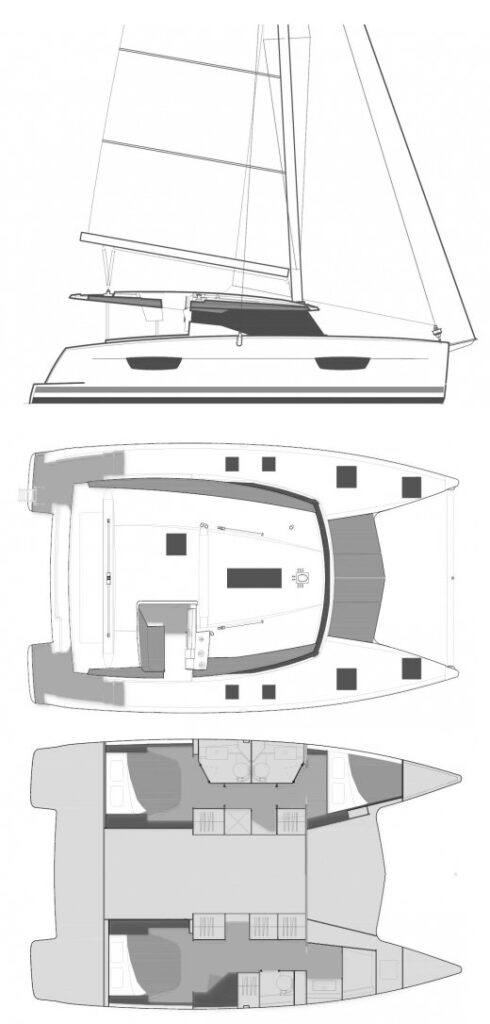
The Open’s interior layout is modern and airy: a saloon that opens to the cockpit, multiple layout options (commonly 3-cabin or 4-cabin versions), and well-integrated galley-up arrangements make social life aboard easy. Cabins are typically generous for a 40-foot multihull, with hull-long storage and sensible ventilation via hatches and saloon windows; this design works well for couples who cruise offshore as well as families on coastal passages. Because the hulls remain slender compared with larger cats, the living volume is not as cavernous as some 44–50 foot designs, but the tradeoff is better sailing performance and lighter displacement. Long-term liveaboard use is practical if systems are upgraded from basic charter spec (refrigeration, hot water, and shelving are common owner improvements); many boats on the market show tasteful owner refits rather than wholesale rework, a sign that the base interior ages reasonably well when looked after.
Safety and Practicality
Deck ergonomics favor safe movement: the Open plan keeps coachroof walkways relatively clear, and the cockpit/saloon flow reduces the number of steps between helm and living spaces—useful for short-handed crews. Twin engines and rudders provide redundancy and precise low-speed control, which improves safety in tight marinas and when approaching crowded anchorages. Access to machinery is pragmatic—engine/saildrive spaces are reached beneath companionway steps or in dedicated engine rooms—so routine servicing is manageable for professional yards and experienced owners alike. For serious offshore voyaging, owners commonly strengthen bedding compounds, monitor core areas around through-deck fittings, and install additional safety lash points and redundant bilge pump systems; with those sensible upgrades the platform is well suited for coastal passages and moderate bluewater use.
Known Issues with the Nautitech 40 Open
Nautitech’s product line has generally been well regarded, but the community has highlighted a few recurring topics buyers should check during survey. There are occasional reports of rudder and keel-related repairs on older hulls—some owners and forum threads indicate localized structural repairs were required and, in a few cases, were handled through dealer support or warranty work. Other common concerns mirror those for many infused multihulls: sealant failure around windows and deck fittings, wear in saildrive seals, and the need to inspect tiller/rudder bearings for play. Practical buyer takeaways are straightforward: insist on a thorough structural survey that includes rudder pintles and bearings, test saildrive seals and engine rooms for water staining, and verify a documented bedding and reseal history for all deck penetrations. Addressing these items at purchase (or budgeting to do them soon after) is far cheaper than deferred structural work.
Market Availability and Pricing in the U.S.
Nautitech has continued to evolve the 40 Open platform (new editions and cosmetic refinements appear in more recent years), but most boats for sale in the U.S. market are pre-owned models built in the mid-2010s. Listings show a broad price spread that reflects geography, equipment, and whether a given hull served in charter fleets; U.S. and Caribbean brokerages frequently list boats in the low- to mid-six-figure range, with newer or exceptionally equipped examples pushing higher. A realistic used-market range in the U.S. is $275,000–$450,000, depending on year, engines, electronics, and condition—boats in hurricane-impacted or heavy-charter history slots will normally sit toward the lower end of that band. If you compare value for money, the 40 Open often sits above older, more heavily chartered cats of similar size because of its performance bias, but it typically prices below brand-new equivalents and larger performance cats.
Below is a compact comparison table of the Nautitech 40 Open and three contemporaries in the 40-foot multihull class
| Model | LOA | Year (approx) | Typical used price (US) | Main differences |
|---|---|---|---|---|
| Nautitech 40 Open | ~39.3 ft | 2013–2020 | $275,000–$450,000 | Sporty hulls and deck plan, performance bias, modern infusion construction; nimble and engaging for passage making. |
| Fountaine Pajot Lucia 40 | 38.5 ft | 2015–2019 | $270,000–$425,000 | Comfort and charter suitability prioritized; slightly more conservative sailing behavior and broad appeal for liveaboard/charter markets. |
| Lagoon 400 (S2) | 39–40 ft | 2010s | $260,000–$390,000 | Very roomy saloon and proven dealer network; trades some performance for interior volume and charter familiarity. |
| Leopard 40 | ~40 ft | 2006–2021 (varies by generation) | $300,000–$480,000 | Often a bit more performance focused in later generations, with broad charter presence and strong broker support. |
Nautitech 40 Open vs Fountaine Pajot Lucia 40

The Nautitech 40 Open is tuned toward lively sailing—the hull sections, sail area and deck layout encourage speed and responsive helm, which benefits owners who prioritize passage making and brisk coastal hops. Lucia 40, by contrast, fits buyers who want a slightly more conservative sail profile and an interior optimized for charter or maximum social space; that results in a more comforting onboard environment at anchor and potentially lower tuning demands under sail.
From a maintenance and ownership perspective, the Nautitech’s performance orientation means you should be attentive to rig and appendage wear (sail inventory and rudder bearings), while the Lucia’s broader charter adoption often brings well-documented service histories and easier parts support; resale paths differ accordingly, with Lucia appealing to the charter/owner-liveaboard buyer and Nautitech to the performance-minded private owner.
► Learn more about de Fountaine Pajot Lucia 40
Nautitech 40 Open vs Lagoon 400 (S2)

Compared to the Lagoon 400 S2, the Nautitech 40 Open favors a sportier ride and a sleeker deck profile that reduces windage and improves handling in dynamic conditions. The Lagoon typically provides greater internal volume and a roomier saloon, which is an advantage for larger crews or owners who value interior living space over straight-line performance.
In ownership terms, Lagoon’s dealer and charter footprint can simplify logistics and resale in high-demand markets, while the Nautitech rewards owners who want an engaging sailing experience and are willing to invest in performance-oriented maintenance—rig tuning, asymmetric sails and attention to hull bottom condition to preserve speed.
► Learn more about de Lagoon 400 S2
Nautitech 40 Open vs Leopard 40

Both the Nautitech and Leopard lines aim to blend cruising comfort with respectable sailing ability, but the Nautitech often leans a touch more toward performance in hull shape and sail area, whereas Leopard models (especially later generations) balance those gains with robust charter-grade finishes and dealer support. Buyers who want a sharper helm and quicker passages will appreciate the Nautitech’s responsiveness; those who prefer strong after-sales networks and familiarity in the charter market may favor Leopard.
Maintenance expectations also diverge: Nautitech owners commonly budget for sail inventory and appendage checks to preserve the boat’s performance, while Leopard owners may face more typical wear-and-tear items associated with heavier charter use but benefit from more accessible parts and documented service routes.
► Learn more about de Leopard 40
Maintenance Costs of a Nautitech 40 Open in the U.S.
- Mooring/Slip: $3,000–$15,000 per year depending on region and marina class (New England and California at the high end; secondary ports and Florida’s inland slips toward the low end).
- Insurance: $1,500–$6,500 per year (value, cruising area and insurer underwriting multihulls strongly influence premiums).
- Engine servicing (twin diesels/saildrives): $800–$3,000 per engine annually for routine service and intermittent saildrive/gearbox checks; major overhauls are more expensive.
- Antifouling and haulouts: $1,200–$8,000 every 1–2 years (haulout fees, bottom prep, and paint vary widely by yard and hull condition).
- Standing & running rigging inspections/replacements: $300–$3,000 per year saved for planned maintenance; a full rigging refresh can range $8,000–$20,000 depending on spars, hardware and labor.
- Sails (maintenance/replacement): $400–$3,000 per season for repairs and servicing; full replacements ($6,000–$30,000+) depend on material, asymmetric inventory and whether performance laminates are chosen.
Significant one-time expenditures frequently include major electronics refits ($5,000–$25,000), a genset replacement or major engine work ($10,000–$35,000), or hull/structural repairs if core issues are found ($3,000–$30,000+). Many routine tasks—engine oil checks, basic electrical troubleshooting, and cosmetic upkeep—are owner-doable, but structural, rigging and complex systems work should be handled by professionals. Overall, for a 40-foot performance cruising cat the Nautitech’s annual running costs sit in the medium to upper-medium band: higher than a similarly sized monohull because of twin-engine and multihull-specific items, but reasonable for its class; sensible maintenance and documented surveys tend to protect resale value.
Conclusion
The Nautitech 40 Open is a convincing proposition for buyers who want a 40-foot catamaran that sails with energy and still offers practical accommodations for family cruising. Its strengths are a responsive hull form, contemporary construction techniques, and an onboard layout that supports both lively passages and comfortable living. Weaknesses are mostly maintenance-related: owners must be diligent with through-deck bedding, rudder and saildrive checks, and a proactive approach to rig and sail inventory if they want to preserve the boat’s performance advantage.
For coastal cruising and occasional offshore passages, the Nautitech 40 Open is generally worth seeking out if you value passage speed and an engaging helm; it represents a good compromise between performance and comfort and—when purchased with a thorough survey and sensible upgrade budget—offers fair resale prospects in markets where performance cats are appreciated.
Specifications
| Hull Type | Catamaran (no boards/asym.) |
| Rigging Type | Fractional Sloop (Rotating Spar) |
| LOA | 39.30 ft / 11.98 m |
| LWL | 39.17 ft / 11.94 m |
| S.A. (reported) | 979.00 ft² / 90.95 m² |
| Beam | 22.67 ft / 6.91 m |
| Displacement | 18,743 lb / 8,502 kg |
| Max Draft | 4.43 ft / 1.35 m |
| Construction | Fiberglass infusion with Klegecell core |
| First Built | 2015 |
| Builder | Nautitech (France) |
| Designer | Marc Lombard |
| Auxiliary Power | Twin Diesel Engines |
| Horsepower | 2 × 60 HP |
| Fuel Capacity | 114 gal / 430 L |
| Water Capacity | 114 gal / 430 L |
| S.A. / Displ. | 22.28 |
| Displ. / Len. | 139.23 |
| KSP | 0.72 |
| Mast Height from DWL | 67.26 ft / 20.50 m |
Disclaimer
The considerations and analyses presented regarding the Nautitech 40 Open catamaran are of a general nature and are based on the available information and technical data on this model, interpreted to the best of our knowledge and understanding. It is important to note that the specific characteristics of any particular sailboat may vary due to custom modifications, maintenance performed, and conditions of use over time, among other factors. Therefore, the details and performance of the boat you are considering may not exactly match the information provided here.
We strongly recommend that, before making any purchasing or usage decisions, you conduct a detailed inspection of the boat in question, consult with nautical professionals and other sailors, and consider your personal needs, expectations, and capabilities. Each sailboat may have unique particularities that affect its performance and suitability for different types of sailing and sailors.
The information contained in this analysis should be used as a general guide and not as a definitive reference. Professional evaluation and personal inspection are essential to ensure that the boat meets your specific requirements and expectations.