



The Hunter 35 occupies a clear niche as a mid-size coastal cruiser designed in the late 1980s and early 1990s under the Hunter Marine (later Marlow-Hunter) umbrella. The model family most buyers encounter in the U.S. is the Legend/35.5 lineage: a fiberglass, fin-keel, fractional-sloop that was marketed as a comfortable family cruiser with sensible performance for club racing and coastal passages. It was conceived for owners who wanted roomy accommodations and easy single- or short-handed sailing rather than an out-and-out racer — a “weekend-to-coastal” boat that could also handle longer hops when properly prepared. The design enjoyed steady production runs and today appears frequently on the used market; demand is steady among coastal cruisers and private owners looking for value, and you’ll also find examples used by schools and small charter outfits, though the strongest market is owner-operators seeking a comfortable 35-foot cruiser.
Design and Construction
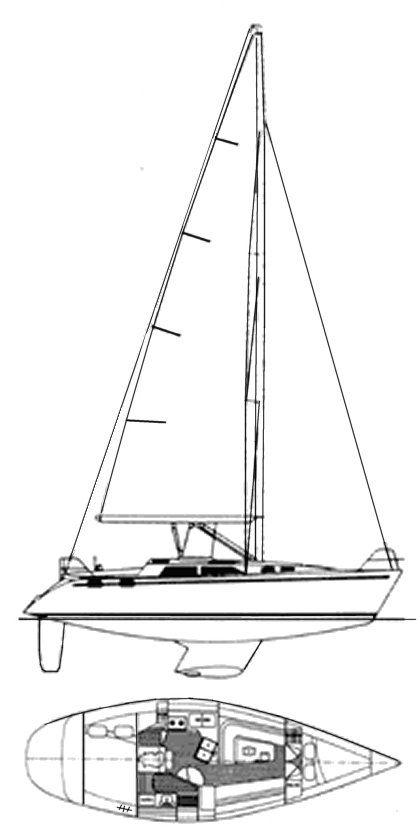
The hull of the Legend-era Hunter 35 is a moderate-displacement, fin-keel hull with a spade rudder and a relatively beamy profile for its length — a recipe that prioritizes interior volume and form stability. The original rigs are fractional sloops, which keep headsail sizes manageable and make sail handling easier for short-handed crews; many models came with inboard diesel engines and options for wing or fin keels. Construction is classic hand-laid fiberglass with a visible grid-reinforced deck structure in many Hunters of that era; Hunter used a hull-and-deck lamination process intended to keep weight down while providing a large interior. These material choices deliver good everyday durability and simple repairability: a solid fiberglass hull repairs easily in most boatyards, and replacement parts for mechanical and rigging systems are commonly available.
From an architectural point of view the beamy hull and moderate ballast ratio trade a bit of upwind pointing for interior comfort and initial stability — you feel steadier at anchor and have a roomy cockpit and salon. The grid strengthers and the deck-core arrangement make access to systems easier in some cases, but there are known failure modes around deck penetrations and chainplate beds that buyers should inspect carefully: long-term leaks into core or poorly sealed fittings are among the maintenance items that affect durability and resale value. In practice this means surveys should focus on chainplate areas, deck fittings, and the condition of the rudder and skeg interfaces.
Performance
On the water the Hunter 35 behaves like a comfortable coastal cruiser. In moderate winds she sails comfortably with a well-trimmed main and modest headsail; the fractional rig gives easy reefing options and predictable sail balance. Because of the beamy hull form she tends to accelerate quickly off the wind and offers a stable ride at anchor and on reaches, though she won’t point as high to windward as narrower, performance-oriented 35-footers. In short, expect respectable cruising speeds in the 6–7 knot range under sail in typical 12–18 knot conditions, with downwind speed and comfort being relative strengths. In heavier seas and sustained offshore conditions the boat remains controllable but may feel more “surf-and-recover” than a heavier, full-keel bluewater cruiser; prudent owners reef early and watch sea state. Owners’ and magazine reviews commonly praise the boat for being easy to handle, forgiving, and suitable for family coastal cruising rather than demanding ocean passagemaking.
Compared with contemporaries, the Hunter 35 sits nearer the comfortable/cruiser end of the spectrum: quicker and roomier than many traditional full-keel cruisers of the same era, but not as weatherly or close-hauled as racer/cruiser designs with narrower beams and deeper keels.
Comfort and Accommodations
Interior layout is one of the Hunter 35’s strongest selling points: a beamier hull delivers a spacious salon, larger berths, and usable standing headroom in most areas. Typical two-cabin layouts make the boat well suited for a couple cruising in comfort or a small family; storage is generous for a 35-foot boat, and galley and nav station ergonomics generally favor liveability over racing minimalism. Ventilation and natural light were emphasized in later editions, making summer cruising pleasant. That said, some earlier production interiors used cost-saving veneers and trim that can look dated and may require refit or cosmetic upgrades to meet modern tastes — an expected tradeoff for the lower purchase price of many used examples.
For full-time liveaboards the boat is workable but not luxurious: systems (water, heating/AC, galley appliances) will need upgrades for extended off-grid living, and owners commonly modernize cabinetry or cushions. Many Hunters on the market today show owner-led refits — new upholstery, updated heads, and electronics upgrades — which both improve comfort and help resale.
Safety and Practicality
On deck the Hunter 35 is arranged for straightforward, low-stress sailing: wide sidedecks, a roomy cockpit with good seating, and a rig that keeps big foresails manageable. For safety, pay close attention to non-structural but critical items: condition of lifelines and stanchions, integrity of deck penetrations, and the state of chainplates and backing structures. Several owner reports flag water ingress at foredeck fittings and around furling gear as a recurrent issue; left unchecked, this compromises deck core and chainplate beds and raises repair costs. When properly maintained and with attention to sealing and chainplate reinforcement, the boat is well suited for coastal and limited bluewater passages; however, someone planning serious offshore work should budget for structural checks and likely upgrades. Accessibility of systems below decks is reasonable — many items are reachable from the salon or dedicated access panels — which keeps routine maintenance and troubleshooting manageable for owner-operators.
Known Issues with the Hunter 35 Legend
Owners and surveyors commonly report a handful of recurring issues on Legend-era Hunters and related 35-foot models:
- deck-core water intrusion at foredeck fittings and furling line exits (can cause delamination around chainplates and rudder interfaces); remedial work typically involves removing soft core, replacing with marine-grade core or solid fiberglass and resealing fittings.
- chainplate / chainplate bed concerns where corrosion or inadequate bedding allows moisture to penetrate; upgrading bedding materials, using stainless reinforcement or through-bolting into solid backing is a common corrective.
- occasional reports of rudder delamination/waterlogged rudders on older examples — a survey check of rudder integrity and bearings is essential.
- interior finish and trim wear on older boats (peeling veneers, worn upholstery) — mostly cosmetic but common and often refurbished by buyers.
Practical, commonly recommended upgrades for buyers include replacing old standing rigging if over 10–15 years old, updating electronics (chartplotter/LED instruments), renewing seacocks and pumps as preventive work, and inspecting/possibly replacing propellers or shaft couplings. These are normal refit items that protect safety and value.
Market Availability and Pricing in the U.S.
The Legend/35.5 Hunters are no longer in production and are firmly in the second-hand market. You will find the most listings in Florida, the Mid-Atlantic, and the Great Lakes regions — areas with large coastal cruising communities — and a fair number on the West Coast (California). Condition varies widely: many are well maintained by private owners and show tasteful refits; others are older, ex-charter or lightly maintained boats that need work. Current U.S. listing snapshots show asking prices commonly clustering in the $28,000–$45,000 band for decent, ready-to-sail examples, with lower-end project boats below that and fully refitted boats sometimes above. This pricing tends to make the model an attractive entry into 35-foot cruising for buyers who can do moderate maintenance or refit work. boattrader.com+1
Below is a reasoned comparison with three contemporaries of similar LOA and intended use. Prices are typical used-boat ranges seen in U.S. listings and reflect older boats (1980s–2000s) found on broker sites and classifieds today.
Below is a short comparison table that places the Catalina 36 against three alternatives in the same size and era:
| Model | LOA | Approx. years | Typical used price (U.S.) | Key differences |
|---|---|---|---|---|
| Hunter 35 / Legend 35.5 | ~35–36 ft | late 1980s–1990s | **$28,000–$45,000** | Roomy interior, fractional rig, known deck/core & chainplate areas to inspect. |
| Catalina 36 | ~36 ft | 1980s–2000s | $25,000–$75,000 | Proven cruiser with heavy owner market; often deeper inventory and parts availability; slightly heavier, generally forgiving handling. |
| Beneteau Oceanis 350 | ~34–35 ft | late 1980s–1990s | $10,000–$35,000 | European design emphasis on modern interiors; can be less expensive but check for osmotic blistering and older refit needs. |
| Jeanneau Sun Odyssey 35 | ~34–36 ft | 1990s–2000s | $30,000–$80,000 | Contemporary European lines, often newer systems on later builds; generally good resale where the brand is popular. |
Hunter 35 Legend vs Catalina 36

The Hunter 35 emphasizes interior volume and easy sail handling with a fractional rig and a beamy hull, making it feel roomy and comfortable for family cruising; Catalina 36 leans toward a slightly more conservative hull form with a reputation for rugged simplicity and deep owner support, which often translates to easier resale and parts availability. From a handling perspective the Catalina may track a bit truer upwind and feel heavier in a seaway, while the Hunter trades some pointing ability for quicker acceleration and a drier cockpit on reaches.
For the buyer this means the Hunter is attractive if interior comfort and single-handed handling are priorities, whereas the Catalina 36 is a safer bet for owners who prioritize a time-tested, workmanlike platform with a large resale market and potentially lower long-term retrofit costs.
► Learn more about de Catalina 36
Hunter 35 Legend vs Beneteau Oceanis 350
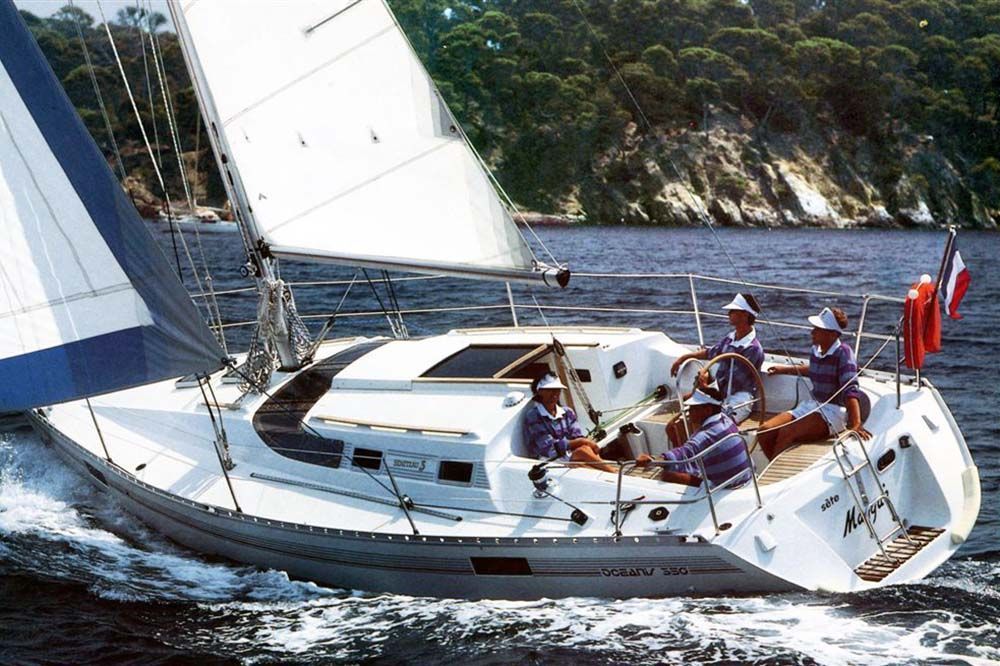
Both are marketed as family cruisers, but the Oceanis 350 often showcases more contemporary European interior styling and, on some builds, a slightly lighter displacement for the same length — which can feel more modern in motion but also puts a premium on structural checks in older hulls. The Oceanis may be found at lower acquisition prices, but older Beneteaus sometimes show osmotic or deck-core issues in certain climates; Hunters commonly show the opposite pattern: cosmetically dated interiors but robust grid construction.
Practically, a buyer who prefers a roomier American-style interior and straightforward systems will like the Hunter, while someone seeking European lines, possibly a lighter feel under sail, and interior style may prefer the Oceanis — but must budget carefully for surveys and potential blister/core repairs.
► Learn more about de Beneteau Oceanis 350
Hunter 35 Legend vs Jeanneau Sun Odyssey 35

The Sun Odyssey 35 typically represents a slightly newer European take with a focus on comfortable cruising performance and refined decks/rigging in later years; Jeanneau tends to deliver a bit better upwind performance and modernized systems on later builds. Hunter’s strengths remain its roomy cockpit/salon and easy-to-manage fractional rig, whereas the Jeanneau often feels more performance-oriented and may offer more contemporary fit-outs if you find a later model.
For ownership and maintenance: Hunters often require local-style upgrades (seacocks, chainplate beds) and cosmetic refreshes, while a Sun Odyssey may attract buyers willing to pay for slightly newer systems — the key decision for a purchaser is whether they value interior volume and simplicity (Hunter) or newer European design and potentially higher asking prices (Jeanneau).
► Learn more about de Jeanneau Sun Odyssey 35
Maintenance Costs in the U.S.
- Slip or marina fees (annual): $2,000–$12,000 (wide variation: inexpensive small-harbor slips vs premium marinas in Florida/California)
- Insurance: $400–$2,000/year (depends on value, cruising range, and owner experience)
- Engine servicing: $400–$1,200/year (annual oil/service; larger jobs more)
- Antifouling / haulout & bottom paint: $800–$2,500 every 1–3 years (haul, power-wash, paint)
- Standing rigging inspection / replacement: inspection $100–$400; replacement $2,000–$6,000 if older than 10–15 years
- Running rigging & sails: new mainsail $1,500–$6,000; headsail $800–$3,000 — staggered replacements typical
- Winterization / shrinkwrap (if applicable): $300–$1,000/year
- Routine systems (batteries, pumps, electronics upkeep): $300–$2,000/year depending on upgrades
- Major one-time refit items: full electronics refit $3,000–$12,000; deck/core repairs (if needed) $2,000–$12,000+; sail and rig replacements can push total refit bills above $15,000–$30,000 for a comprehensive refit
Regional differentiation: mooring and slip costs dominate in places like San Francisco, Newport, or Miami and push annual ownership up; routine haulouts and bottom work will cost more on the West Coast than in many Gulf or East Coast yards. Insurance and survey costs also vary by cruising area and intended offshore use.
Can an owner maintain the Hunter 35 themselves? Much routine work (zincs, simple engine servicing, varnish, routine systems checks) can be owner-performed if the owner is handy. Structural tasks — thorough chainplate bed repairs, large deck core replacements, or major electrical overhauls — generally require professional yards and add to cost. Overall, for a 35-ft coastal cruiser the annual running costs placing the boat in the medium cost range — neither the cheapest (small daysailer) nor the most expensive (classic luxury yachts or bluewater passagemakers). Given typical resale prices and a strong used market for Hunters, a well-maintained Hunter 35 often represents good value; resale will reflect both mechanical condition and whether common weak points (deck cores, rigging, sails) have been addressed.
Conclusion
The Hunter 35 is a practical, buyer-friendly mid-size cruiser that trades outright upwind performance for interior comfort, ease of handling, and value. Its strengths are a spacious salon and cockpit, a forgiving fractional rig suited to short-handed sailing, and an abundance of used examples that make the model accessible to new owners. Weaknesses to budget for are recurring maintenance items tied to deck penetrations, chainplates, and occasional rudder or core issues on older boats — all things a careful survey will expose and that competent refits will cure.
For a buyer focused on coastal cruising, weekend family trips, or a comfortable platform to learn systems and improve gear over time, the Hunter 35 is a compelling, cost-effective option. If your priority is bluewater passagemaking with minimal refit, you may prefer fuller-keel, heavier designs; if modern interior style or sharper upwind performance is the goal, some Beneteau or Jeanneau alternatives may be worth the premium. In short: for coastal cruisers who value room, easy handling, and good purchase price, it’s worth searching for a well-surveyed Hunter 35 — it can be an excellent practical buy and, when maintained, holds resale appeal in the active U.S. used market.
Specifications
| Hull Type | Fin w/spade rudder |
| Rigging Type | Fractional Sloop |
| LOA | 35.58 ft / 10.84 m |
| LWL | 29.75 ft / 9.07 m |
| S.A. (reported) | 593.00 ft² / 55.09 m² |
| Beam | 11.75 ft / 3.58 m |
| Displacement | 12,100.00 lb / 5,488 kg |
| Ballast | 4,600.00 lb / 2,087 kg |
| Max Draft | 6.50 ft / 1.98 m |
| Construction | FG |
| First Built | 1986 |
| Last Built | 1989 |
| Builder | Hunter Marine (USA) |
| Auxiliary Power | Yanmar 3GM Diesel, Fuel: 22 gals / 83 L |
| Water Capacity | 64 gals / 242 L |
| S.A. / Displ. | 18.06 |
| Bal. / Displ. | 38.02 |
| Disp / Len | 205.15 |
| Comfort Ratio | 22.31 |
| Capsize Screening Formula | 2.05 |
| S# | 2.77 |
| Hull Speed | 7.31 kn |
| Pounds/Inch Immersion | 1,249.03 lb/in |
| I | 43.50 ft / 13.26 m |
| J | 12.25 ft / 3.73 m |
| P | 45.00 ft / 13.72 m |
| E | 14.50 ft / 4.42 m |
| S.A. Fore | 266.44 ft² / 24.75 m² |
| S.A. Main | 326.25 ft² / 30.31 m² |
| S.A. Total | 592.69 ft² / 55.06 m² |
| Est. Forestay Length | 45.19 ft / 13.77 m |
| Mast Height from DWL | 54.00 ft / 16.46 m |
Disclaimer
The considerations and analyses presented regarding the Hunter 35 Legend sailboat are of a general nature and are based on the available information and technical data on this model, interpreted to the best of our knowledge and understanding. It is important to note that the specific characteristics of any particular sailboat may vary due to custom modifications, maintenance performed, and conditions of use over time, among other factors. Therefore, the details and performance of the boat you are considering may not exactly match the information provided here.
We strongly recommend that, before making any purchasing or usage decisions, you conduct a detailed inspection of the boat in question, consult with nautical professionals and other sailors, and consider your personal needs, expectations, and capabilities. Each sailboat may have unique particularities that affect its performance and suitability for different types of sailing and sailors.
The information contained in this analysis should be used as a general guide and not as a definitive reference. Professional evaluation and personal inspection are essential to ensure that the boat meets your specific requirements and expectations.