



The Island Packet 31 is a small, big-hearted cruiser from the mid-1980s that helped cement Island Packet’s reputation for tough, shallow-draft boats that treat crews kindly offshore. Drawn by Robert K. “Bob” Johnson and built in Florida by Island Packet Yachts, the 31 was produced from 1983–1989 and became the archetype of the brand’s “full-foil-keel, cutter-rig” formula. On today’s used market it attracts private owners planning coastal passages, the Great Loop, or Bahamas gunkholing more than it does schools or charter fleets. It’s popular because it blends liveaboard volume with a famously gentle motion and stout construction, which keeps resale demand healthy.
Design and Construction
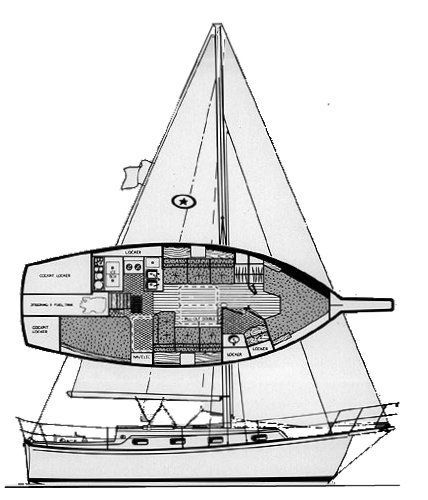
Johnson’s long-keel underbody with a cutaway forefoot, protected prop in an aperture, and a semi-balanced rudder hung on the trailing edge of the keel favors tracking, protection, and load-carrying over raw speed. Most hulls were standard full-keel; a small batch (roughly 10%) left the factory with a centerboard to reduce draft even further for creek-crawling. The standard rig is a true cutter—yankee, staysail on its own stay, and mainsail—giving flexible sail plans as wind builds. Hulls are solid fiberglass; decks are cored, with robust deck hardware and external chainplates that simplify inspection. These choices matter to owners: the long keel and encapsulated ballast resist damage and reduce maintenance points (no keel bolts to fret over), the cutter rig spreads loads and aids balance, and the simple, solid layup is easy to repair anywhere, supporting long-term durability and residual value.
.
Performance
No one buys an Island Packet to win Wednesday nights, and the 31 is honest about that. Expect a hull speed around 7 knots and best days in the high-5s to low-6s. What owners celebrate is the forgiving, low-strain ride: the boat shoulders through chop with a soft motion and tracks straight, which reduces helm fatigue and keeps crews functional on longer legs. In 10–15 knots she’s happiest with yankee and full main; as breeze rises, rolling to the staysail keeps balance sweet. Compared with a Catalina 34 or Hunter 33 of the same era, the IP31 is slower on a beat but less twitchy reaching in lump, and it carries gear and water without getting sullen. Versus blue-water peers like the Pacific Seacraft 31 or Cape Dory 30, the IP31 is similar in pace but feels roomier and a touch more tender initially before stiffening up as she heels onto her shoulder. The boat’s reputation is “comfortable, predictable, stout”—an asset for realistic cruising where crews value arriving rested over arriving first.
Comfort and Accommodations
Interior volume is the IP31’s trump card: a wide beam, high freeboard, and clever layout yield a genuinely livable 31-footer—large saloon with fold-down table, real galley, proper nav area, enclosed head with shower, and generous storage. Ventilation is excellent thanks to numerous opening ports and hatches. For a couple or young family, it works for extended cruising; for two couples it’s fine for weekends. Joinery is durable and ages gracefully, and many examples have sympathetic refits (cushions, lighting, refrigeration) rather than gut-renovations. Under power, most boats were fitted with a Yanmar 3GM/3GMF in the high-20-hp range—plenty of push for a nearly 11,000-lb cruiser.
Safety and Practicality
The full-foil keel protects running gear, the rudder is shielded in the aperture, and the deck layout—with high bulwarks, wide side decks, and stout handholds—earns confidence in bad weather. The cutter rig’s small, self-tacking-friendly staysail makes heavy-air work civilized for short-handed crews. Systems access is generally straightforward (especially chainplates and steering gear), which keeps labor hours in check. As delivered, the 31 is an eminently capable coastal cruiser; with thoughtful upgrades (ground tackle, comms, charging), many owners use them for Bahamas and Caribbean seasons.
Known Issues with the Island Packet 31
Patterns seen across owner reports and surveys are happily mundane—and usually solvable:
- Portlight and deck-hardware weepage. Original aluminum ports and some deck penetrations can seep with age; rebedding or upgrading ports cures it.
- Fuel tank corrosion on older aluminum tanks. Not universal, but pitting from trapped moisture occasionally forces replacement; access and replacement methods are well-documented in the Island Packet community.
- Chainplates. External chainplates are easy to inspect; watch bedding for leaks and surface corrosion, and rebed/replace as needed—a simpler job than on many cored-deck, hidden-chainplate boats.
Beyond that, routine 40-year-old-boat items—standing rigging age, original wiring/electronics, and sail inventory—drive survey punch lists more than design flaws.
Market Availability and Pricing in the U.S.
The IP31 is long out of production and trades only on the used market. You’ll find the best concentration in the Southeast (Florida and Gulf Coast), the Mid-Atlantic, and New England—exactly where shallow-draft, gunkholing cruisers thrive. Recent U.S. listings (summer 2025) show asking prices clustering in the low-$30,000s to mid-$40,000s, with exceptionally upgraded boats higher. Condition and inventory matter more than model year. The broader Island Packet brand also shows strong regional availability, particularly in Florida and the Mid-Atlantic.
The IP31 competes with other 28–34-foot coastal cruisers. Compared with lighter, fin-keel production boats (Catalina/Hunter), it commands a premium for construction and resale stability but gives up pointing ability and light-air speed. Against traditional cruisers (Pacific Seacraft, Cape Dory), it trades a bit of ultimate seakindliness for more interior volume and shoaler draft.
| Model | LOA | Approx. build years | Typical U.S. used price | Notable differences |
|---|---|---|---|---|
| Island Packet 31 | 31’ (LOD ~30’7”, LOA incl. sprit ~34’) | 1983–1989 | $33k–$50k | Full-foil long keel, cutter; shallow 4’ draft (rare C/B option); big interior volume. |
| Pacific Seacraft 31 | 31’ | late 1970s–2000s | $50k–$100k+ (older Mariah 31s less) | Blue-water pedigree; heavier scantlings; smaller interior than IP31; excellent resale. |
| Cape Dory 30 | 30’ | late 1970s–1980s | $18k–$35k | Full keel; traditional interior; slower but very seakindly and simple systems. |
| Catalina 34 | 34’ | mid-1980s–1990s | $25k–$55k | Fin keel/spade rudder; faster and more weatherly; lighter construction; bigger cockpit. |
| Hunter 33 (Cherubini) | 33’ | late 1970s–early 1980s | $17k–$35k | Fin keel; good value entry cruiser; less tankage and offshore detailing than IP31. |
Maintenance Costs of a Island Packet 31 in the USA
- Mooring/slip: ~$2,000–$4,500/yr in low-cost regions (Gulf, Carolinas) and $4,500–$9,000+ in higher-cost markets (South Florida, Northeast metros).
- Insurance: ~$600–$1,500/yr depending on cruising area, hurricane plan, and survey.
- Engine service (Yanmar 2–3GM): $300–$700/yr for DIY fluids/impellers/filters; $800–$1,500 if yard-performed.
- Bottom (antifouling): $1,200–$2,200 every 12–24 months (paint and labor vary by region and paint type).
- Rigging & sails: Standing-rigging inspection $250–$600; full replacement (if over 15–20 years) $3,000–$6,000. New mainsail or furling yankee each $2,200–$4,500; staysail ~$1,200–$2,500.
- Electronics & energy: Common upgrades (plotter/AIS/solar/MPPT) run $2,000–$6,000 one-time.
- Teak & cosmetics: The wide caprail demands either varnish time (DIY) or $800–$2,000/yr if you pay a brightwork pro.
- Survey & incidentals: Pre-purchase survey $20–$30/ft; annual spares/consumables $300–$800.
The 31 can be largely owner-maintained thanks to simple systems and access; outsourcing brightwork and rigging inspections is common. Overall, annual ownership typically lands in the low-to-mid four figures for hands-on owners in lower-cost regions, and mid-to-high four figures where slips and labor are expensive. For its size/class, operating cost is medium, and historically strong resale helps offset refit spending when kept clean and upgraded thoughtfully.
Conclusion
The Island Packet 31’s strengths are clear: rugged construction, a protective long keel, forgiving cutter rig, shallow draft, and a legitimately livable interior for a 31-footer. Weaknesses are just as honest: she’s not quick upwind, and buyers should budget for age-related renewals (ports, electronics, sails, fuel tank in some cases). For cruisers prioritizing comfort, simplicity, and skinny-water access over VMG, it’s a standout. As a coastal cruiser—and with upgrades, island-hopping—she’s a worthy, value-steady buy with an active community and predictable resale. If your brief reads “go far, go gently, carry our stuff, and not scare the crew,” the IP31 is an under-appreciated sweet spot.
Specifications
| Hull Type: | Long Keel |
|---|---|
| Rigging Type: | Cutter |
| LOA: | 31.00 ft / 9.45 m |
| LWL: | 27.75 ft / 8.46 m |
| S.A. (reported): | 530.00 ft² / 49.24 m² |
| Beam: | 11.60 ft / 3.54 m |
| Displacement: | 11,000.00 lb / 4,990 kg |
| Ballast: | 4,500.00 lb / 2,041 kg |
| Max Draft: | 4.00 ft / 1.22 m |
| Construction: | FG |
| First Built: | 1983 |
| Last Built: | 1989 |
| # Built: | 262 |
| Builder: | Island Packet Yachts (USA) |
| Designer: | Bob Johnson |
| Auxiliary Power (orig. equip.): | Diesel, 27 HP |
| Fuel: | 25 gals / 95 L |
| Water: | 70 gals / 265 L |
| S.A. / Displ.: | 17.20 |
| Bal. / Displ.: | 40.91 |
| Disp. / Len.: | 229.80 |
| Comfort Ratio: | 22.62 |
| Capsize Screening Formula: | 2.09 |
| S#: | 2.40 |
| Hull Speed: | 7.06 kn |
| Pounds/Inch Immersion: | 1,150.18 pounds/inch |
| Rig and Sail Particulars: |
I: 39.50 ft / 12.04 m J: 14.80 ft / 4.51 m P: 34.00 ft / 10.36 m E: 14.00 ft / 4.27 m S.A. Fore: 292.30 ft² / 27.16 m² S.A. Main: 238.00 ft² / 22.11 m² S.A. Total (100% Fore + Main Triangles): 530.30 ft² / 49.27 m² S.A./Displ. (calc.): 17.21 Est. Forestay Length: 42.18 ft / 12.86 m |
Disclaimer
The considerations and analyses presented regarding the Island Packet 31 sailboat are of a general nature and are based on the available information and technical data on this model, interpreted to the best of our knowledge and understanding. It is important to note that the specific characteristics of any particular sailboat may vary due to custom modifications, maintenance performed, and conditions of use over time, among other factors. Therefore, the details and performance of the boat you are considering may not exactly match the information provided here.
We strongly recommend that, before making any purchasing or usage decisions, you conduct a detailed inspection of the boat in question, consult with nautical professionals and other sailors, and consider your personal needs, expectations, and capabilities. Each sailboat may have unique particularities that affect its performance and suitability for different types of sailing and sailors.
The information contained in this analysis should be used as a general guide and not as a definitive reference. Professional evaluation and personal inspection are essential to ensure that the boat meets your specific requirements and expectations.