


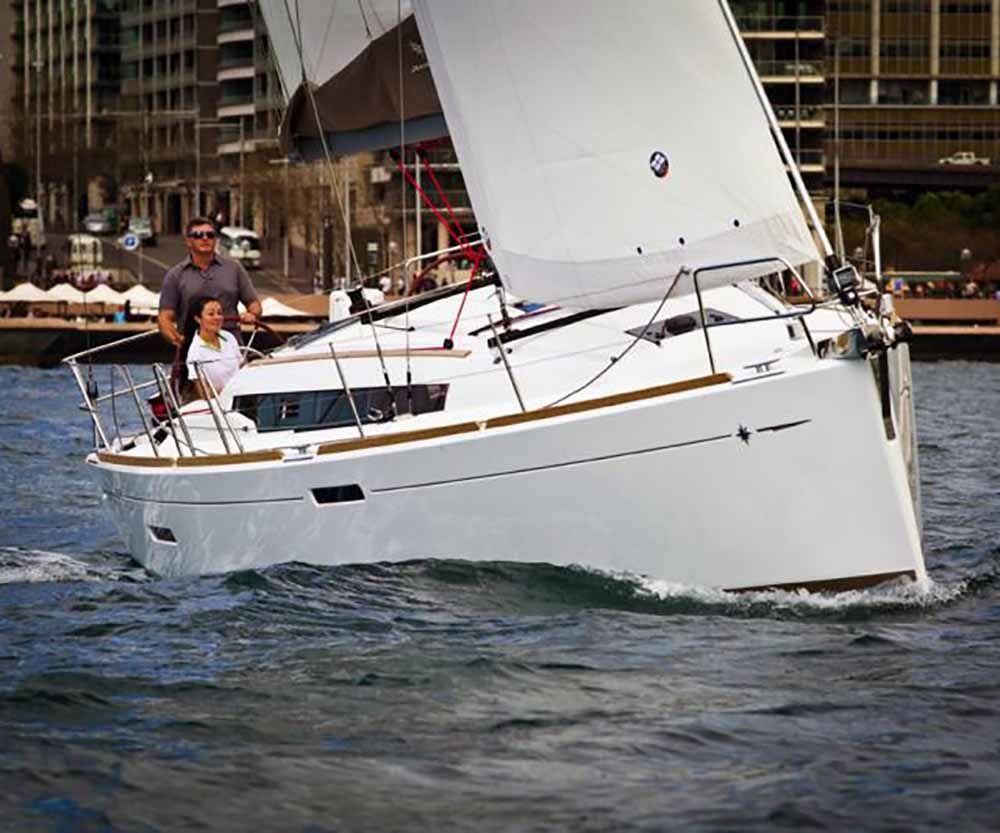
The Jeanneau Sun Odyssey 389 is a modern, family-oriented cruiser that Jeanneau introduced as an evolution of the Sun Odyssey 379: the goal was to keep the comfortable, easy-to-live-aboard layout while sharpening deck ergonomics and sailing manners for real-world cruising. Launched as a 2016 model and penned by Marc Lombard’s design office for Jeanneau, it was offered with multiple keel choices (standard deep, shoal, and a lifting/swing keel) and a variety of sail-handling packages so owners could prioritize simple short-handed sailing or a slightly more performance-biased rig. From launch it aimed squarely at the family cruiser and club-cruiser market—couples and small families who want a boat that’s pleasant at anchor, easy to handle at sea, and available from a large production builder—and over the past decade the 389 has established itself as a steady presence on the used market, appearing both in private-owner listings and in fleet/charter inventories.
Design and Construction
The 389’s hull is a clear example of contemporary cruising thinking: a relatively broad stern with marked chines aft to maximize usable interior and form stability, a moderate displacement in the mid-6-ton range, and options for a conventional fin with bulb, a shoal-draft fin (with twin rudders when specified), or a lifting keel for cruising grounds that need it. Deck and rigging choices follow the same pragmatic pattern—fractional sloop geometry with options from a self-tacking jib to a performance headsail, all intended to let owners trade simplicity for power as they prefer. Jeanneau’s production method mixes solid GRP hull laminates with cored deck structures and factory-installed core hardware; while mass-production brings excellent parts availability and predictable repair paths, buyers should still inspect common production-boat interfaces (deck penetrations, chainplates, and keel-to-hull joints) at survey because these define long-term maintenance exposure. Structurally, the 389 uses the latest iteration of Jeanneau’s manufacturing and naval-architecture thinking—Marc Lombard’s lines tuned for a safe, efficient hull form—so the design prioritizes durability and recoverability over exotic light-air performance.
Performance
On the water the Sun Odyssey 389 sits in that practical middle ground: thanks to the hull form, generous beam and chine, and moderate sail area, it accelerates well off the wind and is forgiving upwind when reefed. Reviews and sea trials note the boat tracks cleanly, feels balanced on the helm, and benefits from the bowsprit option and modern sail controls for reaching and off-wind work; it is not a race machine, but it consistently outperforms many older-generation cruisers in light to moderate conditions and keeps a comfortable average passage speed in real cruising conditions. The keel options change the personality: the deep keel gives best pointing and tighter upwind VMG, while the shoal or swing keels trade a bit of pointing for access to shallow anchorages—useful for coastal sailors. Compared with contemporaries in the 36–39-foot class, the 389 is often praised for its blend of handling and interior volume rather than for outright speed in light airs.
Comfort and Accommodations
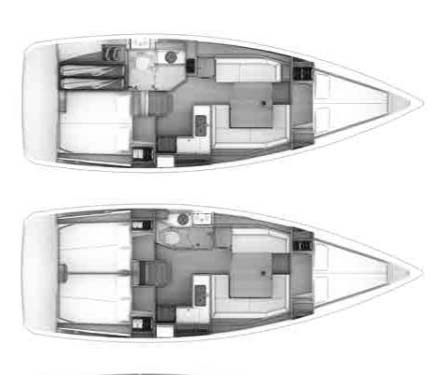
Belowdecks the 389 is arranged with practical cruising in mind: two- or three-cabin plans with a single well-appointed head and a roomy saloon, a forward owner’s berth and an aft cabin that can be used as a private cabin or large storage/utility space. Jeanneau’s layout pushes volume to the ends and uses the wide beam to create a saloon that feels larger than hull length suggests—this is why many owners report comfortable week-long cruises and, with upgrades, extended liveaboard periods. Ventilation and natural light are good for a production boat of this size, and the galley and storage are designed to support provisioning and provisioning habits for cruising couples or small families. A pragmatic point for buyers: because these boats were made for owners who expect to personalize, it’s common to find tasteful but modest refits—electronics, upholstery and galley upgrades—rather than wholesale interior replacements.
Safety and Practicality
Jeanneau designed the 389 with user-friendly safety elements: a lowered bridgedeck and hinged companionway doors improve cockpit-to-saloon separation in rough weather, the cockpit layout concentrates lines and winches for single- or two-handed control, and the range of keel and rudder options gives buyers flexibility for their cruising grounds. Systems access is reasonable for a modern production yacht—the engine bay and service points are accessible without exotic disassembly—but owners should confirm hose and seacock condition, battery configuration and bilge redundancy at survey. With modest upgrades (stronger ground tackle, modern electronics, and checked seacocks) the 389 is quite capable for extended coastal cruising and short bluewater legs; for serious offshore passages owners often invest in additional redundancy and storm preparedness rather than relying on factory equipment alone.
Known Issues with the Jeanneau Sun Odyssey 389
Owner forums and dealer reports show that the 389’s issues are mostly the kind you expect from production cruisers rather than fundamental design failures. Common threads include electrical or pump quirks (water-pump/AC pump anecdotes), routine attention needed at deck-fitting penetrations, and the usual replacement cycles for running and standing rigging after a decade in service. There have also been isolated regulatory or safety advisories reported for certain Jeanneau models in recent years; while these are model-specific and often resolved by retrofit or dealer notice, they underscore the importance of a thorough pre-purchase survey and checking the vessel’s service bulletins. Practical buyer actions therefore include: confirm documented service history for pumps and electrics, inspect the companionway and deck cores at penetration points, and budget to replace rigging or sails on schedule—these are preventive investments, not surprises in most cases.
Market Availability and Pricing in the U.S.
The Sun Odyssey 389 is no longer a “brand new” catalog model in most markets but remains widely available on the used market because Jeanneau built a reasonable number and the design was popular with owner-operators and charter fleets. U.S. inventory is frequently concentrated where large brokerage houses and active cruising communities exist—Florida, the eastern seaboard and California show the biggest volumes in broker searches—and listings are typically a mix of well-maintained owner boats, dealer stock and a smaller number of ex-charter hulls. Recent listing snapshots show a broad asking-price spread, so a realistic U.S. used-market range is about $95,000–$225,000, with many clean, newer 2017–2020 examples clustering in the $160,000–$200,000 band depending on options and location. That range reflects bargain older inventory, mid-market private sales and higher-spec dealer stock; overall the 389 tends to offer a good balance of value and resale liquidity for buyers seeking a modern 38-foot cruiser.
Here’s a comparison with similar models:
| Model | LOA | Approx. Years Built | Typical U.S. used price | Main differences |
|---|---|---|---|---|
| Jeanneau Sun Odyssey 389 | ~38′7″ (11.75 m) | 2016–(late 2010s production) | **$95,000–$225,000** | Modern French design; multiple keel options, roomy saloon, production finish with good dealer support. |
| Catalina 385 | ~39′10″ (11.94 m) | 2012–(later production runs) | $200,000–$350,000 | American-built, heavier displacement feel, very comfortable cockpit and interior ergonomics aimed at U.S. owners. |
| Dufour 382 Grand Large | ~36′ (10.96 m) | 2014–2019 | $100,000–$210,000 | More performance-tilted hull sections and lighter displacement; typically sportier under sail and more race-cruiser leaning. |
| Beneteau Oceanis 37 / 373 | ~37′ (11.3 m nominal) | 2000s–2010s (various iterations) | $110,000–$175,000 | Family-oriented interiors, broad used market with many regional bargains; generally good value for coastal cruising. |
Jeanneau Sun Odyssey 389 vs Catalina 385

The Sun Odyssey 389 and the Catalina 385 present two different answers to the “38–40 foot family cruiser” brief. The Jeanneau is a European-styled, somewhat lighter boat with modern chines and keel options designed to provide a lively, efficient feel and easy deck handling; its interior and systems reflect continental production practices favoring compact efficiency and a choice of performance or comfort packages.
By contrast the Catalina 385 trades a bit of that European lightness for American-market priorities—slightly heavier displacement, a more conservative hull form and an emphasis on cockpit comfort and roomy interiors—so buyers who prioritize mellow motion, big cockpit social space and easy U.S. parts/support will favor the Catalina, while those who want quicker acceleration, a bowsprit/code-0 capability and slightly higher factory performance tuning will lean to the Jeanneau.
► Learn more about the Catalina 385
Jeanneau Sun Odyssey 389 vs Dufour 382 Grand Large
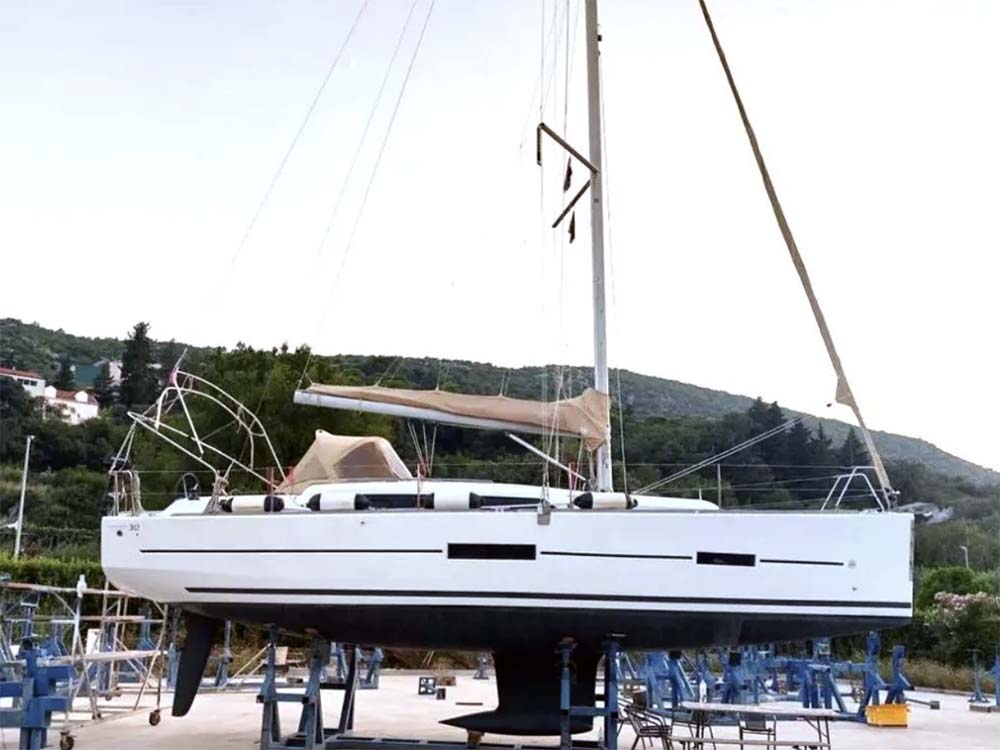
Compared with the Dufour 382 Grand Large, the 389 sits nearer to the cruiser-comfort end of the spectrum while the Dufour pulls toward the performance-cruiser side. The Dufour typically offers sharper underwater sections, lighter displacement and a hull tuned for speed and reactive handling—attributes that reward owners who want club racing or spirited passages—whereas the Jeanneau’s hull shape and optional shoal/ lifting keels give more flexibility for cruising grounds and a gentler motion for living aboard.
From a ownership standpoint this means the Dufour may need more frequent performance upgrades (sail inventory, tune) to extract its best, while the Jeanneau often requires comfort-and-systems upgrades (electronics, energy systems) to suit long-term cruising; both have active resale markets, but they appeal to subtly different buyer priorities.
► Learn more about the Dufour 382 Grand Large
Jeanneau Sun Odyssey 389 vs Beneteau Oceanis 37

The Oceanis 37 family typically competes on interior volume and price, offering very usable cruising layouts at aggressive price points on the used market; the 389 competes by delivering a slightly more modern hull form, more refined deck ergonomics and multiple keel/rig options. For a buyer focused on maximizing interior living space for weekend family cruises at the lowest purchase cost, the Oceanis variants are attractive; for someone who values updated handling, a bowsprit option and a design that balances performance and comfort for coastal passages, the Jeanneau often feels like the more contemporary choice.
In short, Oceanis boats are frequently the budget-savvy, volume-focused option; the Sun Odyssey 389 asks the owner to pay a bit more for a hull and deck package that emphasizes modern seakeeping and flexible sail handling.
► Learn more about the Beneteau Oceanis 37
Maintenance Costs of a Jeanneau Sun Odyssey 389 in the U.S.
Below are typical annual or periodic ownership costs to budget for a 38′ cruiser in the U.S.; each line is bolded and followed by a short comment.
- Mooring / slip — $2,000–$18,000 per year. (Slip pricing varies dramatically by region—Florida and California premium marinas can charge $20–$40+/ft/month; municipal marinas and smaller ports are cheaper.)
- Insurance — $1,000–$6,000 per year. (A rule of thumb is 1–3% of insured value annually; location and coverage level move this number.)
- Engine servicing & routine systems — $500–$3,000 per year. (Annual oil, impeller, filters, belts; more if the saildrive or transmission needs attention.)
- Antifouling & haul-out — $800–$7,000 every 1–2 years. (Prices depend on paint chosen, preparation required and local haul-out rates; some yards price by LOA or by the complexity of preparation.)
- Standing rigging (amortized) — $300–$1,000 per year when amortized; expect a $3,000–$12,000 replacement every 10–15 years depending on terminal type and labor.
- Running rigging & sails (amortized) — $500–$3,000 per year; a full new sail inventory (main + genoa + spinnaker/code-0) can run $8,000–$25,000 depending on materials and cut.
- Electronics & safety gear (amortized) — $300–$2,000 per year; major one-time upgrades—chartplotter, AIS, radar—typically cost $2,000–$10,000 installed.
- Miscellaneous maintenance & consumables — $500–$2,500 per year. (Canvas, through-hull hoses, zincs, small systems parts and labor.)
Significant one-time costs to plan for include major refits (deck re-core, gelcoat or hull repairs), sail inventory refreshes, or a standing rigging replacement—projects that can push totals into the tens of thousands. The 389 is straightforward enough that an owner with reasonable mechanical skills can handle varnish, canvas and cosmetic work, but rigging, electrical system rework and structural tasks will usually require professional services—this choice (DIY vs. professional) is the largest single driver of total ownership cost. Overall, for a modern 38′ cruiser the Jeanneau sits in the medium ownership-cost bracket: not the cheapest to run, but not unusually expensive either, and its market desirability helps preserve resale value if systems and maintenance are documented.
Conclusion
The Jeanneau Sun Odyssey 389 is a persuasive package for buyers who want a modern, manageable cruiser that blends comfortable accommodation, sensible deck ergonomics and respectable sailing manners. Its strengths are the up-to-date hull form and deck layout, flexible keel and sail options, and the practicality of a widely supported production platform; its compromises are the usual tradeoffs of production cruising yachts—some factory-grade fittings and systems that prudent buyers will plan to upgrade, and a design that favors real-world balance over outright regatta performance. If your priority is a 38-foot boat that is easy to handle short-handed, offers a roomy saloon and cockpit for family cruising, and has good resale liquidity in the U.S. market, the 389 is worth serious consideration. For coastal to near-offshore cruising with sensible upgrades it represents a good value; for owners who prioritize maximum speed or a minimalist racing bias there are lighter, faster alternatives—but those come with different maintenance and comfort tradeoffs. In short: for most family coastal cruisers and couples planning longer passages the Sun Odyssey 389 is a practical, well-rounded choice with stable market interest and manageable ownership costs when maintained conscientiously.
Specifications
| Hull Type | Fin w/bulb & dual rudders |
| Rigging Type | Fractional Sloop |
| LOA | 38.50 ft / 11.73 m |
| LWL | 34.08 ft / 10.39 m |
| S.A. (reported) | 754.00 ft² / 70.05 m² |
| Beam | 12.33 ft / 3.76 m |
| Displacement | 15,256.00 lb / 6,920 kg |
| Ballast | 3,900.00 lb / 1,769 kg |
| Max Draft | 6.50 ft / 1.98 m |
| Construction | FG |
| First Built | 2015 |
| Builder | Jeanneau |
| Designer | Marc Lombard |
| Auxiliary Power (orig. equip.) | Yanmar Diesel, 29 HP |
| Fuel | 34 gals / 129 L |
| Water | 53 gals / 201 L |
| S.A. / Displ. | 19.68 |
| Bal. / Displ. | 25.56 |
| Disp. / Len. | 172.07 |
| Comfort Ratio | 23.47 |
| Capsize Screening Formula | 1.99 |
| S# | 2.97 |
| Hull Speed | 7.82 kn |
| Pounds/Inch Immersion | 1,501.44 pounds/inch |
| I | 46.58 ft / 14.20 m |
| J | 13.58 ft / 4.14 m |
| P | 44.58 ft / 13.59 m |
| E | 13.92 ft / 4.24 m |
| S.A. Fore | 316.28 ft² / 29.38 m² |
| S.A. Main | 310.28 ft² / 28.83 m² |
| S.A. Total (100% Fore + Main Triangles) | 626.56 ft² / 58.21 m² |
| S.A./Displ. (calc.) | 16.36 |
| Est. Forestay Length | 48.52 ft / 14.79 m |
| Mast Height from DWL | 55.75 ft / 16.99 m |
Disclaimer
The considerations and analyses presented regarding the Jeanneau Sun Odyssey 389 sailboat are of a general nature and are based on the available information and technical data on this model, interpreted to the best of our knowledge and understanding. It is important to note that the specific characteristics of any particular sailboat may vary due to custom modifications, maintenance performed, and conditions of use over time, among other factors. Therefore, the details and performance of the boat you are considering may not exactly match the information provided here.
We strongly recommend that, before making any purchasing or usage decisions, you conduct a detailed inspection of the boat in question, consult with nautical professionals and other sailors, and consider your personal needs, expectations, and capabilities. Each sailboat may have unique particularities that affect its performance and suitability for different types of sailing and sailors.
The information contained in this analysis should be used as a general guide and not as a definitive reference. Professional evaluation and personal inspection are essential to ensure that the boat meets your specific requirements and expectations.