



The Jeanneau Sun Odyssey 43 is a mid-size cruising yacht conceived to balance comfortable live-aboard space with straightforward, family-friendly sailing. Designed by Daniel Andrieu and produced by Jeanneau in the late 1990s–early 2000s (the Sun Odyssey 43 lineage dates back to earlier Sun Odyssey models in the 1980s and was refreshed through the 2000s), the boat was aimed squarely at owner-cruisers who wanted a roomy interior without sacrificing respectable performance for coastal passages and the occasional offshore hop. Its intent is cruising first — comfortable, safe and easy to handle — rather than pure racing, which is reflected in a relatively beamy hull, moderate displacement and a sloop rig that favors simplicity. Over the years the 43 and its Deck Saloon (DS) sibling have become common on the pre-owned market worldwide and are regularly listed in the U.S., drawing demand from private cruisers, charter fleets and sailing schools that prize interior volume and ease of use.
Design and Construction
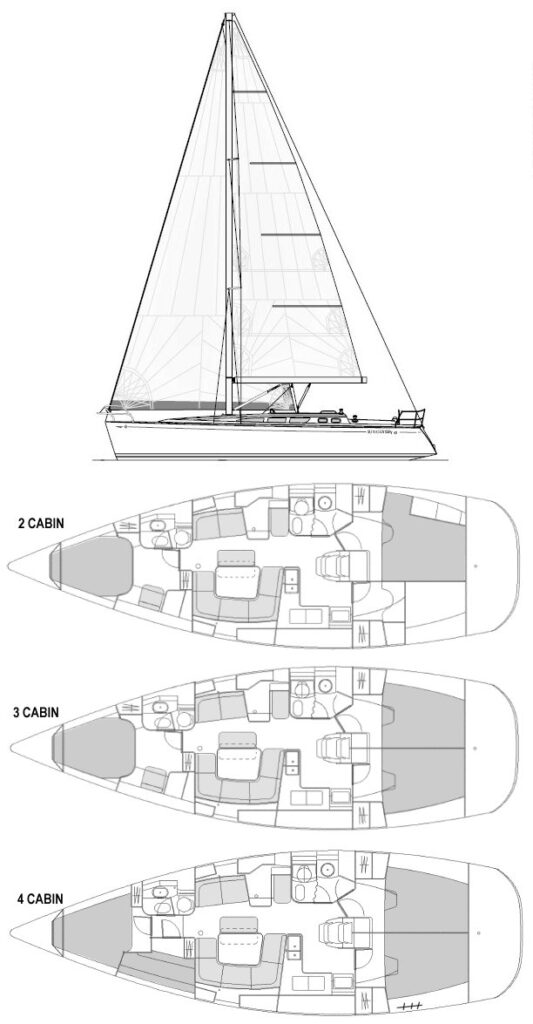
The hull of the Sun Odyssey 43 is a moderate-beam, fin-keel boat with a spade rudder — a configuration that gives a good compromise between directional stability and maneuverability. Jeanneau built the hull in hand-laid fiberglass with internal stiffening and a structural grid; the original design typically carries a fin keel (standard) with a 6.5-foot draft option and a masthead sloop rig, which keeps sail handling familiar to most cruisers. Deck layouts on the DS versions prioritize sightlines and salon light with larger glazed surfaces; that makes for a pleasant interior but requires careful attention to window seals as the boat ages. The construction choices — solid fiberglass hull, cored deck areas, and factory-installed wooden compression pads under the mast and other high-load points — mean repairs and upgrades are straightforward for an experienced boatyard, but they also create a few maintenance priorities (core access, window bonds, and inspection of mast supports) that affect long-term ownership costs and value retention. In short, the build philosophy skews toward comfortable liveability and reparability rather than exotic composites or race-level weight savings.
Performance
On the water the Sun Odyssey 43 sails like a cruising boat that can still be rewarding to steer. In moderate wind she will make pleasant passage-making speeds — plan for 6–8 knots in 12–18 knots of wind under a well-trimmed main and genoa — and she is generally forgiving off the wind. The combination of a fullish waterline and decent ballast gives predictable tracking and decent initial stability, so crew feel secure in confused seas; however, she is not a scissors-edge performer to windward compared with narrower, performance-oriented designs. Compared with contemporaries in the 40–45-foot cruising segment the 43 sits in the middle: faster than older full-keel cruisers, not as quickly accelerating or flat-surfing as modern light-displacement production cruisers. Owners and reviewers tend to praise her for steady behavior and comfortable motion rather than for outright speed, which suits realistic cruising scenarios where comfort and reliability beat sprint performance.
Comfort and Accommodations
One of the Sun Odyssey 43’s strongest selling points is interior volume used intelligently: large cabins, a commodious saloon, and storage sufficient for extended cruising. Layouts vary (two- or three-cabin owner versions are common), but the general pattern is a full-size owner’s cabin aft, a comfortable guest cabin forward, and a wide saloon with a practical galley — an arrangement that works for a couple cruising long-term or a family doing seasonal trips. Ventilation and natural light on DS versions are notably good, and the ergonomics favor comfort over tight race-boat efficiency: seating heights, table size and chart table placement are aimed at daily living as much as sailing. For full-time liveaboard use some owners later upgrade insulation, refrigeration and storage fittings, but many find the stock layout perfectly adequate for weeks-long cruises. Interiors of these models tend to age gracefully if woodwork and joinery are maintained; however, it’s common to see refits that modernize systems and finishes in boats with heavy charter or rental history.
Safety and Practicality
Deck hardware is generally robust and laid out for safe working while under way: wide sidedecks, sensible stanchion spacing and a cockpit designed to keep crew protected in mixed conditions. Boarding and water access are ergonomically sound, though owners replacing or upgrading transom ladders and dinghy mounts is common to suit specific cruising bases. For single- or short-handed crews the sail plan and cockpit control locations make reefing and sail trim manageable without a large crew, especially if roller furling and a reliable winch layout are installed. The boat’s seakeeping and tank capacities make her suitable for coastal and short-offshore passages as-built, but longer offshore work benefits from prudent upgrades (redundant navigation/electrical systems, upgraded seacocks and through-hull inspections, and attention to structural deck-to-hull joint security). Accessibility to systems below deck is reasonable — the engine, tanks and major through-hulls are typically reachable — which keeps servicing simpler and impacts ongoing maintenance positively.
Known Issues with the Jeanneau Sun Odyssey 43
Owners’ forums and service notes highlight a handful of recurring concerns that prospective buyers should inspect carefully. Bonded windows and deck-to-hull joints can develop leaks over time if seals fail or if deck hardware allows water ingress; Jeanneau owner resources and community threads specifically call out water ingress around the mast step and compression post area as something to evaluate during a survey. Core-deck areas and the wooden pads used under compression points can rot if past leaks were left unchecked, and that leads to additional structural repairs. Engine-related items are typical for Yanmar-equipped boats (common on these models): exhaust elbows, raw-water cooling components and routine corrosion points require periodic inspection and possible replacement to avoid catastrophic failure. Gelcoat blistering (osmotic blisters) is occasionally discussed in older hulls, though many owners report that a sound barrier coat or professional maintenance has kept this issue from being systemic on well-kept examples. Practical pre-purchase focus areas are: window bonds and deck seal condition, mast compression post and partner, engine exhaust and cooling hardware, and evidence of regular anti-corrosion maintenance.
Market Availability and Pricing in the U.S.
The Sun Odyssey 43 is no longer in production in its classic form and now appears only on the used market and in charter fleets; in the U.S. it shows up regularly on broker sites and in broker yards, especially on both coasts and in Florida. Regional concentrations of listings are notable in Florida, California and the mid-Atlantic/New England corridors, reflecting both charter returns and owner-sales in big sailing areas. Typical asking prices in current U.S. listings fall roughly in the range $85,000–$150,000, with condition, year, equipment and location dictating where a given hull sits inside that band. Well-maintained, lightly used private boats with upgraded systems command the higher end; ex-charter or hulls needing systems work sit at the lower end. Overall the model offers a competitive value proposition against contemporaries of similar LOA because it packages generous accommodation with practical sailing traits for cruising buyers.
Below is a comparison with similar sailboats from the same era:
| Model | LOA | Approx. years built | Typical used price (U.S.) | Main differences |
|---|---|---|---|---|
| Beneteau Oceanis 423 | ~42 ft | early–mid 2000s | $115,000–$160,000 | Slightly more modern production ergonomics; lighter feel under sail in some rigs; similar cruising focus. |
| Catalina 42 (MkII) | ~42 ft | 1990s–2000s | $75,000–$180,000 | More conservative U.S. design emphasis on simplicity and ruggedness; strong owner community and parts support. |
| Dufour 405 (Grand Large) | ~40.5 ft | mid 2000s–2010s | $100,000–$150,000 | Often a bit lighter and more performance-oriented; modern interiors and deck ergonomics, with slightly less displacement. |
Jeanneau Sun Odyssey 43 vs Beneteau Oceanis 423
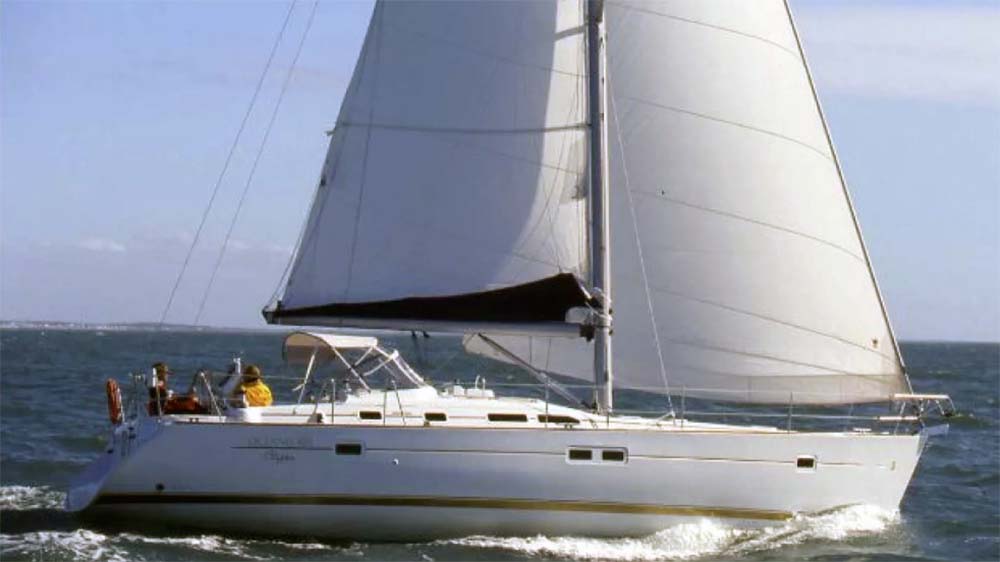
The Sun Odyssey 43 and the Beneteau 423 occupy the same buyer niche — comfortable family cruising with an emphasis on interior volume — but they approach it slightly differently. Jeanneau’s 43 tends to feel a touch heavier and more traditionally built, favoring a solid, reassuring motion and simple systems, while the Beneteau 423 often presents marginally lighter displacement and a more modern deck layout that some owners find easier for sail handling and deck circulation.
Inside, the 43 often offers a slightly more classic joinery feel and roomier aft cabins in typical layouts, which suits couples or families who value privacy and storage; the 423 can be marginally cleverer with cabinet space and may feel a bit more “newer” in ergonomics. From an ownership perspective the Beneteau can be a little more performance-oriented for the same length, but the Jeanneau often trades that for long-term robustness and simpler structural repair paths.
► Learn more about de Beneteau Oceanis 423
Jeanneau Sun Odyssey 43 vs Catalina 42 (MkII)

Comparing the Sun Odyssey 43 to the Catalina 42 highlights cultural design differences: the Catalina leans into proven, conservative U.S. design priorities (simplicity, ease of maintenance, accessible hardware), while the Jeanneau emphasizes Euro-style accommodation and light modernity in the deck saloon variants. Underway the Catalina’s narrower options and American-style tuning can translate into straightforward, predictable handling that owner-mechanics appreciate, whereas the Sun Odyssey’s hull form and sail plan yield a slightly more comfortable motion in a confused sea.
For a buyer focused on aftermarket support and a large domestic owner network, the Catalina is attractive; for someone prioritizing interior light, a spacious saloon and a European feel with good Mediterranean charter pedigree, the Jeanneau is frequently the better match.
► Learn more about de Catalina 42 (MkII)
Jeanneau Sun Odyssey 43 vs Dufour 405 (Grand Large)

The Dufour 405 steers the comparison toward modern performance cruiser territory: Dufour often pushed lighter sections and contemporary underbody shapes that give crisper acceleration and more lively pointing, while the Sun Odyssey 43 was designed to emphasize comfort and a steady ride. If you value quicker responses and slightly sportier passage times the Dufour has the edge; if predictability, interior room and a forgiving motion are priorities, the Sun Odyssey’s heavier stability profile is preferable.
On maintenance and ownership, the Jeanneau’s conventional construction and widely understood repair procedures make it easier for many yard crews to service, while the Dufour’s more contemporary components sometimes require specialized parts or knowledge — a practical consideration when comparing long-term ownership costs and refit logistics.
► Learn more about de Dufour 405 (Grand Large)
Maintenance Costs of a Jeanneau Sun Odyssey 43 in the U.S.
Annual / recurring:
- Slip/mooring: $4,800–$18,000 per year (varies dramatically by location — marina slips in New England and California trend high; more affordable in secondary ports or Florida).
- Insurance: $800–$3,000 per year (dependent on value, cruising area, and owner experience).
- Engine servicing & routine systems: $800–$2,500 per year (oil, filters, impeller, cooling system checks; more if significant repairs arise).
- Antifouling and haul-out: $1,000–$4,000 every 1–2 years (haul, powerwash, paint; region and bottom condition matter).
- Standing & running rigging inspections / amortized replacement: $500–$2,000 per year (annual inspections; full standing rigging replacement typically $5,000–$10,000 every 12–20 years).
- Sails and canvas: $500–$3,000 per year amortized (new main or genoa replacement can cost $4,000–$12,000 depending on cut and materials).
Significant one-time costs:
- Sail replacement (main and genoa): $4,000–$12,000+ depending on cloth and loft.
- Major refit (electrical, plumbing, galley upgrades): $10,000–$50,000 for a thorough modernization.
- Structural repairs (mast step / compression post, core repairs, window rebonding): $2,000–$20,000 depending on extent.
Many routine tasks (oil change, basic antifouling prep, small systems troubleshooting) are owner-doable with mechanical aptitude, which lowers yearly outlay; larger jobs (rigging replacement, core repairs, major sail work, full electronics refits) typically require professional yards and therefore raise total cost. Region and how the boat is used (liveaboard vs. seasonal dayboat) are the biggest drivers of cost variation. Overall, for a 43-footer the expected maintenance level is medium — not as cheap as a small pocket cruiser but reasonable compared with other similarly-sized production cruisers — and a well-maintained example tends to hold resale value well enough to justify the upkeep for a buyer seeking a comfortable coastal/family cruiser.
Conclusion
The Sun Odyssey 43 is a pragmatic, comfortable cruising yacht that fits buyers who prize liveable interiors, straightforward systems and predictable seakeeping over outright racing performance. Its strengths are roomy accommodations, reasonable sailing manners for passage making, and a construction approach that makes repairs and upgrades accessible; its weaknesses are the usual suspects for boats of its age and style — potential window and deck-to-hull bond issues, attention needed at the mast compression point, and routine diesel-engine maintenance. For coastal cruising and family voyaging the 43 represents a compelling value: it’s large enough for serious cruising comfort but not so complex that upkeep becomes out of reach for an informed owner. If you seek a comfortable, reasonably priced platform for coastal and short offshore cruising, the Sun Odyssey 43 is worth seeking out — just buy with a thorough survey and a clear plan for addressing the known maintenance priorities, and its resale prospects within the used cruising market are steady thanks to strong brand recognition and practical appeal.
Specifications
| Hull Type | Fin w/spade rudder |
| Rigging Type | Masthead Sloop |
| LOA | 43.34 ft / 13.21 m |
| LWL | 37.50 ft / 11.43 m |
| S.A. (reported) | 992.43 ft² / 92.20 m² |
| Beam | 13.75 ft / 4.19 m |
| Displacement | 20,503 lb / 9,300 kg |
| Ballast | 6,515 lb / 2,955 kg |
| Max Draft | 6.56 ft / 2.00 m |
| Construction | Fiberglass (FG) |
| First Built | 1986 |
| Builder | Jeanneau |
| Designer | Daniel Andrieu |
| Auxiliary Power | Diesel, 80 HP |
| Fuel Capacity | 53 gals / 200 L |
| Water Capacity | 106 gals / 400 L |
| S.A./Displ. | 21.28 (reported) / 16.40 (calc.) |
| Bal./Displ. | 31.78 |
| Disp./Len. | 173.57 |
| Comfort Ratio | 24.61 |
| Capsize Screening Formula | 2.01 |
| Stability Index (S#) | 2.96 |
| Hull Speed | 8.21 kn |
| Pounds/Inch Immersion | 1,842.38 lbs/inch |
| I | 51.67 ft / 15.75 m |
| J | 15.29 ft / 4.66 m |
| P | 45.11 ft / 13.75 m |
| E | 16.40 ft / 5.00 m |
| S.A. Fore | 395.02 ft² / 36.70 m² |
| S.A. Main | 369.90 ft² / 34.36 m² |
| S.A. Total (100% fore + main) | 764.92 ft² / 71.06 m² |
| Est. Forestay Length | 53.88 ft / 16.42 m |
Disclaimer
The considerations and analyses presented regarding the Jeanneau Sun Odyssey 43 sailboat are of a general nature and are based on the available information and technical data on this model, interpreted to the best of our knowledge and understanding. It is important to note that the specific characteristics of any particular sailboat may vary due to custom modifications, maintenance performed, and conditions of use over time, among other factors. Therefore, the details and performance of the boat you are considering may not exactly match the information provided here.
We strongly recommend that, before making any purchasing or usage decisions, you conduct a detailed inspection of the boat in question, consult with nautical professionals and other sailors, and consider your personal needs, expectations, and capabilities. Each sailboat may have unique particularities that affect its performance and suitability for different types of sailing and sailors.
The information contained in this analysis should be used as a general guide and not as a definitive reference. Professional evaluation and personal inspection are essential to ensure that the boat meets your specific requirements and expectations.