



The MacGregor 26 is a distinctive American trailerable “powersailer” that blurred the line between small sailboats and high-speed motorboats when it was introduced and developed through variants from the mid-1980s into the 2000s. Roger MacGregor and his company built the 26-family to attract owners who wanted a single boat that could cruise under sail yet run at planing speeds under a generous outboard, with water-ballast systems that allowed road transport and shallow-water exploration. Because of those design goals the MacGregor line became extremely popular with budget-conscious weekenders, trailer sailors and owners who prize versatility over pure sailing finesse; production numbers across the 26 variants run into the thousands and the design remains common on the used market. That popularity means plenty of examples for sale and a large owner community — appealing to buyers who value easy access to parts, peer advice and a defined market of like-minded buyers.
Design and Construction
MacGregor’s 26 family is built as a light, planar hull formed from hand-laid fiberglass, fitted with a transom-hung rudder and either a dagger/centerboard or minimal fixed keel depending on the submodel; crucially, the boats rely on water ballast tanks that are filled for sailing and drained for trailering. That water-ballast approach keeps trailering weight down and lets owners launch in shallow ramps, but it also imposes extra systems (intake/discharge valves, ballast tank integrity) that require inspection and occasional service. The hull form emphasizes flat sections and softer chines to plane readily under power, so while the boat is sturdy and relatively easy to repair (fiberglass patching is straightforward), it is not optimized for heavy-sea sailing in the way a heavier displacement keelboat would be. From an architectural viewpoint, reducing fixed lead ballast and using water ballast lowers trailering mass and increases motoring performance — a deliberate tradeoff that raises appeal for mixed-use owners but shifts long-term value drivers to mechanical systems and hull/deck condition rather than deep-keel integrity.
Performance
On the water the MacGregor 26’s behavior depends on whether you judge it as a powerboat with sailing capability or a sailboat that can motor fast. Under power the later 26M/26X variants can reach speeds well above displacement hull pace (owners report high-teens to low-20s mph under a large outboard), which is the primary attraction for many buyers who want quick transfers and shallow-water access. Under sail the same light, relatively flat hull and water-ballast system typically give modest pointing ability and a lively motion in chop compared with heavier fixed-keel cruisers; hull speed still sits in the 6–7 knot neighborhood, but practical cruising pace under sail will usually be lower than an equivalently sized fixed-keel pocket cruiser. Maneuverability with an outboard is excellent for tight harbors and for trailering launches, while reefing and sail handling remain simple for shorthanded crews — a pragmatic mix of strengths for day-cruising, gunkholing and motored weekend runs, and less suited to heavy offshore work or competitive upwind sailing.
Comfort and Accommodations
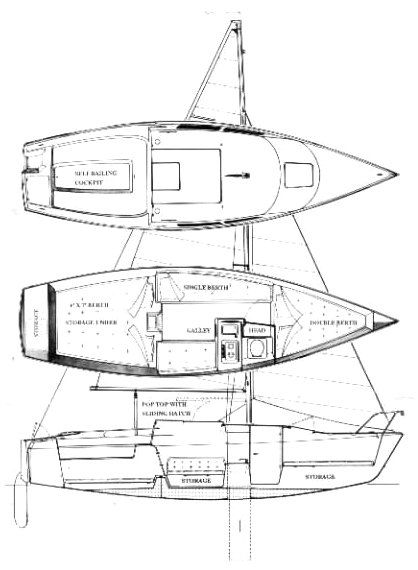
Interior arrangements on the 26 tend toward convertible, multipurpose layouts: benches that form berths, a compact galley area and clever storage tucked into hull contours so a family can sleep and eat aboard for short cruises. Because the boats were marketed to weekenders and trailer sailors, finishes are functional rather than luxurious; owners frequently upgrade cushions, galley hardware and electrical systems to improve liveability. Headroom is limited compared with larger cruisers, but the overall volume and layout make the 26 perfectly serviceable for two adults or a small family on weekend trips; extended live-aboard use is possible but typically requires noticeable comfort upgrades and disciplined storage. In short, the interior supports the boat’s mission — short coastal cruises and motored weekend escapes — rather than longer, blue-water voyaging.
Safety and Practicality
The MacGregor 26 scores high on practicality for trailerable owners: shallow-draft operation, easy engine access (outboard), and the ability to remove ballast for towing are real conveniences that reduce some ongoing costs (land storage, winter haul, etc.). At the same time, the water-ballast tanks and their plumbing represent a maintenance and inspection item that doesn’t exist on a conventional fixed-lead keelboat; leaks, valve failures or frozen plumbing can create annoying or hazardous scenarios if ignored. Build-quality and systems accessibility tend to favor owner maintenance — many owners perform routine service themselves — but if you intend extended coastal passages you should invest in redundant bilge pumping, reliable engine mounting and careful checks of ballast tank integrity. The practical takeaway is that the MacGregor is exceptionally handy for day-to-day use and shallow-water cruising, but buyers who require offshore robustness should expect to retrofit safety upgrades.
Known Issues with the MacGregor 26
Owner forums and survey reports commonly flag a handful of recurring problems typical of trailerable, water-ballast boats rather than unique design failures. Water-ballast leaks and slow ballast-tank seepage into the bilge or cabin are among the most frequent complaints; unaddressed, these can hide structural consequences or lead to interior dampness. Transom and engine-mount wear is also common because many MacGregors depend heavily on a large outboard and repeated motoring loads, and trailers or shore-storage can expose hulls to freeze-thaw or impact damage. Other noteworthy items include wear of valve fittings, occasional delamination around ballast tank seams on very neglected hulls, and the general wear-and-tear of inexpensive original interior fittings and electrics. Recommended pre-purchase and early-ownership improvements are straightforward: pressure-test or inspect ballast tanks, service or replace ballast valves, verify transom and outboard mounts, upgrade pumps and bilge alarms, and modernize a tired electrical panel — these steps materially reduce risk and improve resale value.
Market Availability and Pricing in the U.S.
MacGregor ceased regular production in the 2010s, but because the 26 family was built in very large numbers and evolved through the 26D/26S/26X/26M iterations, a steady supply of used boats remains available across the country. Typical active-market asking prices vary strongly by year, model and condition: broker and listing services commonly show clean, late-model 26M/26X examples in the $12,000–$30,000 range, while older or project boats appear for under $10,000; well-equipped, low-hour units can command higher figures in active coastal markets. MacGregors are most often found where trailer sailing and shallow-water cruising are popular — the Southeast (Florida), the inland-sea states and parts of California — and the condition mix ranges from lightly used, turn-key weekenders to bargain projects. The boat’s value proposition is typically strong for buyers who prioritize motoring performance and trailerability, but resale pricing is condition-sensitive and can be depressed by known water-ballast concerns compared with conventional keelboats of similar LOA:
| Model | LOA | Approx. years built | Typical used price (US) | Principal differences |
|---|---|---|---|---|
| MacGregor 26 (26X / 26M) | ~25.8 ft | 1986–2013 (various) | **$8,000–$30,000** | Trailerable powersailer with water ballast; strong motoring performance, shallow draft, compromises in upwind sailing and ballast systems to maintain. |
| Catalina 25 | ~25.0 ft | 1970s–1990s (various) | **$4,000–$18,000** | Traditional pocket cruiser with wide owner support, multiple keel options and good interior volume for the class. |
| Hunter 25 | ~24.8 ft | 1972–1983 (original) | **$3,500–$18,000** | Conservative coastal cruiser, simpler systems and a reputation for straightforward owner maintenance. |
| O’Day 25 | ~24.8 ft | 1975–1984 | **$3,000–$12,000** | Roomy for its size with centerboard/fixed keel options; often inexpensive and straightforward to maintain when surveyed well. |
MacGregor 26 vs Catalina 25

The MacGregor 26’s hull is built for planing and shallow water with a water-ballast system, while the Catalina 25 emphasizes a conventional displacement hull and fixed or swing-keel options that favor sailing efficiency and interior volume. As a result, the MacGregor delivers faster point-to-point transit under power and easier access to shoal anchorages, whereas the Catalina generally sails higher to windward, feels steadier in a confused sea and offers more straightforward long-term structural simplicity (no ballast plumbing to inspect).
From a rigging and sail-handling perspective the Catalina’s conservative masthead sloop and heavier displacement suit buyers prioritizing sailing performance and simple maintenance; the MacGregor’s fractional rigs and emphasis on motoring mean sail inventories are often lighter and the owner’s comfort comes from hybrid use. Interiorly, Catalinas usually provide a little more storage and finished space for extended cruising, while MacGregors optimize convertible layouts that favor day-use versatility over long-term live-aboard comfort. Maintenance tradeoffs are clear: MacGregors require attention to ballast plumbing and engine/transom systems, while Catalina owners watch keel fittings and typical aging items; both benefit from pre-purchase surveys, but the MacGregor’s mechanical checklist is more specialized. For buyers focused on weekend motoring, rapid transfers and trailering convenience, the MacGregor 26 will feel liberating; for those targeting straightforward sailing performance, resale liquidity among traditional sailors, and simpler long-term maintenance, the Catalina 25 is the steadier bet.
► Learn more about de Catalina 25
MacGregor 26 vs Hunter 25

Comparing the MacGregor 26 to the Hunter 25 highlights a philosophical split between hybrid powersailing and traditional small-boat cruising. The Hunter’s fin-keel or shoal keel, heavier fixed ballast and simpler systems create a more traditional sailing experience — stiffer and generally better upwind than a MacGregor of similar LOA — while the MacGregor emphasizes planing performance under power and extreme trailerability thanks to its water-ballast concept.
For family comfort, the Hunter’s interior often feels more conventionally cruiser-oriented with simple cabinetry and easier long-term upgrades, whereas the MacGregor’s convertible interior is optimized for versatility and short cruises; owners who plan extended weekends under sail usually prefer the Hunter’s predictability. Maintenance considerations favor the Hunter if you dislike plumbing systems — its fewer moving ballast parts mean fewer specialized inspections — but the MacGregor’s mechanicals focus owner attention on outboard/transom integrity and ballast valves. In practical ownership terms, choose the MacGregor if your priorities are motoring speed, shallow-water access and towing; choose the Hunter if you prefer a straightforward sailing platform that trades some trailer convenience for simpler, time-tested sailing characteristics.
► Learn more about de Hunter 25
MacGregor 26 vs O’Day 25
The MacGregor 26 and O’Day 25 target overlapping owner types—small crews wanting a manageable boat—but their routes to that market are different: the O’Day is a conventional displacement cruiser available with centerboard or fixed keel, built for easy sailing and interior comfort, while the MacGregor explicitly trades conventional sailing performance for hybrid motoring ability and trailerable speed. Consequently, the O’Day generally offers better windward ability and a quieter motion in short chop, and it feels more like a small traditional sailboat in terms of hardware and maintenance simplicity; the MacGregor shines for owners who value fast coastal hops, beaching and shallow anchoring.
Interiorly, the O’Day typically provides slightly more practical cruising accommodations for a small family without as many convertible compromises, whereas the MacGregor prioritizes flexible seating/berth conversions to accommodate day-use and motoring gear. Routine upkeep differs: O’Day owners focus on keel/trunk (if centerboard) and typical rigging/electrical work, while MacGregor owners budget for ballast-system checks and robust outboard servicing. Buyers who want classic small-boat sailing and a low-surprise maintenance list tend to prefer O’Day variants; buyers who want a single, trailerable platform that can fast-run under power and explore shallow waters repeatedly will find the MacGregor 26 uniquely suited.
► Learn more about the O’Day 25
Maintenance Costs of a MacGregor 26 in the U.S.
- Slip / mooring (annual): $800–$6,000. Trailer owners who store ashore or on a rack can avoid high-season slips; marina rates spike in Florida, California and the Northeast.
- Insurance (annual): $200–$900. Varies with declared value, navigation limits and region; higher in hurricane-exposed zones.
- Outboard service & fuel (annual): $300–$1,200. Larger outboards used on MacGregors demand more frequent servicing, and fuel consumption at planing speeds increases operating expense.
- Bottom paint & haul-out (every 1–3 years): $700–$3,000. Trailerable owners can reduce some yard labor by doing tasks themselves, but professional haul-outs remain a common cost.
- Ballast system maintenance & repairs (periodic): $200–$2,000+. Valve replacement, tank patching or resealing can be inexpensive for small repairs but climb if ballast tank access or delamination is found.
- Sails & running gear (periodic): $300–$3,000. Many owners keep modest sail inventories; a quality furling jib or new main increases comfort and resale value.
- Trailer upkeep (annual/periodic): $200–$1,500. Tires, wheel bearings, brake service and winter storage for the trailer are ongoing costs that trailer sailors must budget for.
Many routine tasks (outboard basic service, bedding checks, simple electrical work, trailer maintenance) are within reach of competent owners and materially reduce annual costs; specialized structural work (ballast-tank rebuilding, major gelcoat/laminate repairs) requires professional yards and raises one-time bills. Overall, the MacGregor 26’s maintenance cost profile is medium for its size: lower ongoing slip costs are possible for trailering owners, but the water-ballast system and heavier outboard use create some unique service items that balance those savings. For buyers who will do much of the work themselves the lifecycle cost is attractive; for those preferring turnkey marina ownership the specialized maintenance can push total ownership costs up — so factor the ownership style into your budget
Conclusion
The MacGregor 26 is a pragmatic, clearly-defined utility boat: it will reward owners who want fast motoring, trailerability and shallow-water freedom, and it requires buyers to accept compromises in pure sailing performance and an extra maintenance focus on ballast and propulsion systems. Its strengths are versatility and accessibility — quick transits, easy launching and a large used-boat market — while its weaknesses are ballast plumbing exposure, less refined upwind sailing and sensitivity to transom/outboard wear. For weekenders, gunkholers and owners who prize motoring speed and beach access over offshore capability, the MacGregor 26 is often an excellent, good-value choice; for buyers whose priority is consistent upwind sailing, offshore comfort or minimal mechanical systems, a conventional fixed-keel pocket cruiser will usually be the safer, lower-maintenance option. When evaluated with a careful survey that checks ballast integrity, transom and outboard mounting, and general hull condition, a well-found MacGregor 26 can be a highly practical and enjoyable boat for coastal recreational use and rapid, trailerable adventures.
Specifications
| Hull Type | Daggerboard |
|---|---|
| Rigging Type | Fractional Sloop |
| LOA | 25.83 ft / 7.87 m |
| LWL | 23.50 ft / 7.16 m |
| S.A. (reported) | 236.00 ft² / 21.93 m² |
| Beam | 7.92 ft / 2.41 m |
| Displacement | 2,850.00 lb / 1,293 kg |
| Ballast | 1,200.00 lb / 544 kg |
| Max Draft | 5.33 ft / 1.62 m |
| Min Draft | 1.25 ft / 0.38 m |
| Construction | FG |
| Ballast Type | Water |
| First Built | 1986 |
| # Built | 6000 |
| Builder | Macgregor Yacht Corp. (USA) |
| Designer | Roger Macgregor |
| Sailboat Calculations | |
| S.A. / Displ. | 18.83 |
| Bal. / Displ. | 42.11 |
| Disp. / Len. | 98.04 |
| Comfort Ratio | 11.56 |
| Capsize Screening Formula | 2.24 |
| Hull Speed | 6.50 kn |
| Pounds/Inch Immersion | 665.03 pounds/inch |
Disclaimer
The considerations and analyses presented regarding the MacGregor 26 sailboat are of a general nature and are based on the available information and technical data on this model, interpreted to the best of our knowledge and understanding. It is important to note that the specific characteristics of any particular sailboat may vary due to custom modifications, maintenance performed, and conditions of use over time, among other factors. Therefore, the details and performance of the boat you are considering may not exactly match the information provided here.
We strongly recommend that, before making any purchasing or usage decisions, you conduct a detailed inspection of the boat in question, consult with nautical professionals and other sailors, and consider your personal needs, expectations, and capabilities. Each sailboat may have unique particularities that affect its performance and suitability for different types of sailing and sailors.
The information contained in this analysis should be used as a general guide and not as a definitive reference. Professional evaluation and personal inspection are essential to ensure that the boat meets your specific requirements and expectations.