


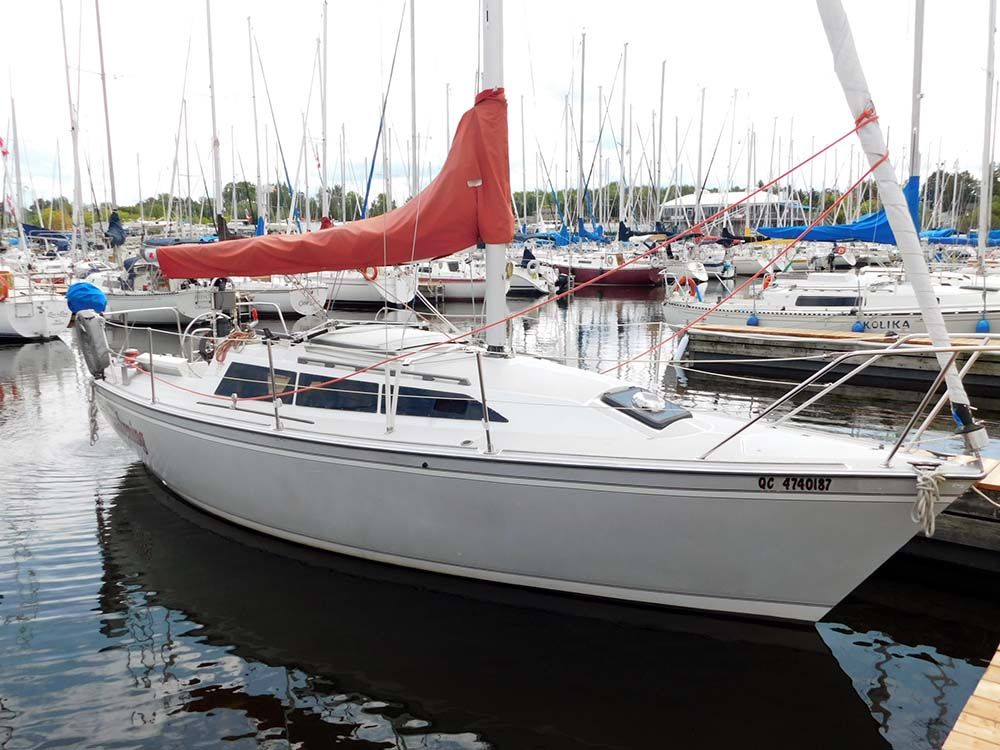
The O’Day 272 is a compact coastal cruiser introduced in the mid-1980s as a family-friendly, easy-to-handle 27-foot sailboat. Designed by C. Raymond Hunt and built by O’Day Corp. (a Lear Siegler division) between 1985 and 1989, it arrived at a time when buyers wanted solid, shoal-draft boats that could be sailed single-handed or by a small family crew. The design purpose leans toward cruising rather than club racing: modest sail area, a shallow wing keel for minimal draft, and a roomy 9-foot beam for interior comfort make it a logical choice for weekenders and coastal cruisers rather than performance-minded sailors. The model is long out of production but remains visible on the used market—typically traded among private owners and broker listings rather than as charter inventory—finding demand mainly with coastal cruisers, families stepping up from dayboats, and lake sailors looking for a manageable small cruiser.
Design and Construction
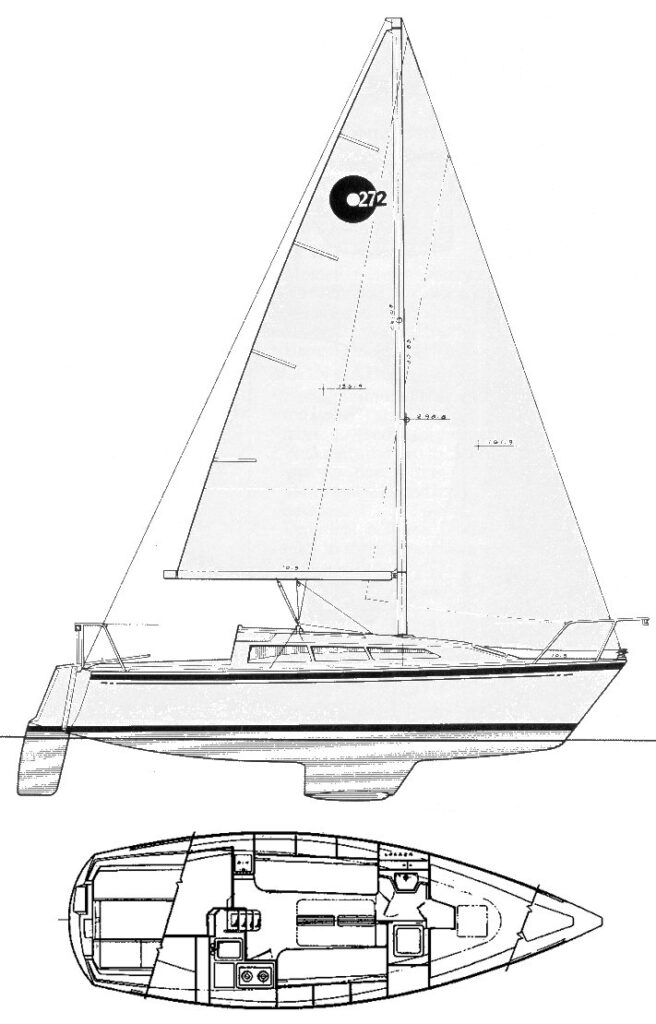
The 272 is a fiberglass monohull with a transom-hung rudder and an externally fastened wing keel that keeps draft shallow (about 2.92 ft). That shallow keel plus a relatively full 9.0-ft beam gives the hull a stable, forgiving motion and contributes to interior volume—tradeoffs typical of Hunt-designed cruising hulls of the era. Displacement is about 5,375 lb with roughly 1,930 lb of ballast (≈36% ballast ratio), which on paper points to a boat that heels steadily and recovers predictably rather than one that snaps upright like a modern racer. The rig is a masthead sloop (practical, simple sailplan) and most boats left the factory set up for an outboard for auxiliary power, with inboard options available on some LE examples. Construction is conventional hand-laid fiberglass with molded liners and wood trim; that makes repairs straightforward (gelcoat/fiberglass patching and refastening deck hardware are standard shop jobs) and keeps long-term maintenance accessible to owner/DIY types. Architectural choices—moderate beam, substantial ballast, and molded interior—help the 272 age reasonably well but also create the usual maintenance checklist: bedding and backing for deck fittings, periodic rig checks, and vigilance for gelcoat blisters.
Performance
On the water the 272 behaves like a true coastal cruiser: hull speed is about 6.4 knots, and in moderate winds she will make comfortable passages at 5–6 knots when trimmed well. The wing keel and fuller underwater sections sacrifice a little pointing ability compared with deeper-keeled, lighter 27-footers, so upwind angles tend to be conservative and leeway a touch higher in chop; in trade that translates to straight, predictable handling rather than razor-sharp performance. Because the design displaces a bit more than ultra-light 27-foot racers, it tends to ride waves with a steadier motion—valuable for family comfort—but may pound when the sea is short and steep, an effect some owners have reported with shoal wing keels. Manoeuvring under power is simple with an outboard, though owners who prefer tighter low-speed control sometimes retrofit small inboards or long-shaft four-strokes. Overall reputation among owners is that the boat is well-mannered and easy to single-hand, making it a reliable, if not sporty, coastal cruiser.
Comfort and Accommodations
The interior is one of the 272’s selling points for its size: the 9-ft beam is used to generate a roomy saloon with settees that double as berths, a forward V-berth that will comfortably sleep two, and quarter-berths in some LE (Limited Edition) arrangements. A modest galley and an enclosed head make weekend cruising straightforward for a couple or small family; tankage (water ~25 US gallons) supports short cruising stints without constant scrounging. Storage is decent for a 27-footer—locker space under berths and in the cockpit lockers—though long-term liveaboard comfort will be tight for more than two people. Ventilation and natural light are acceptable for a boat of this era but many owners have refreshed cabinetry and upholstery to modernize ergonomics; such refits are common and generally lift resale appeal. The molded liners and practical joinery tend to age predictably—wood trim and upholstery show wear first—so expect cosmetic upgrades on many second-hand examples.
Safety and Practicality
Deck layout and cockpit are sized for family sailing: the cockpit gives decent seating and a protected helm for short-handed sailing, while the shallow draft and wing keel let you explore shoal harbors and anchorages that deeper-keel boats can’t reach. Accessibility to the water is straightforward for swimming and tending a dinghy, but the shallow keel makes grounding scenarios more likely in inexpert hands—procedures for refloating should be part of a new owner’s checklist. Chainplate and deck-fitting integrity is an important safety consideration on older examples: well-bedded hardware and backing plates reduce leak risk and protect the underlying core/bulkheads. Systems are generally simple—mechanical outboard, analog engine controls where present, and basic electrical—which keeps troubleshooting and maintenance within the capability of many owners, though older wiring and electronics often get upgraded. For true offshore passagemaking the 272 would need modest structural/systems upgrades (e.g., stronger rigging, modern electronics, and sturdy stowage), but as a coastal cruiser she is fundamentally practical and safe when properly maintained.
Known Issues with the O’Day 272
Owners and surveyors commonly flag a handful of recurring issues on O’Day 272s. Chainplate and deck-hardware leaks that allow water into the core or bolt areas show up repeatedly in owner reports—re-bedding hardware and installing proper backing plates are standard preventive repairs. Some owners have reported pounding in short, steep seas when sailing on a wing-keel hull; that is a behavioral trait of shoal-draft, flatter-section boats rather than a structural defect. Osmotic blistering is not universally reported but appears intermittently across the maker’s late-70s/80s models; serious osmosis is uncommon but when present it drives significant hauling and repair costs. Other practical issues are age-related: tired standing or running rigging, dated electrical systems and instruments, leaky hatches or companionway seals, and worn sails. Common owner upgrades and pre-purchase fixes include: re-bedding chainplates and deck fittings, replacing old standing rigging, investing in a modern long-shaft four-stroke outboard (or repowering to a small diesel), and updating electronics and sails—steps that materially reduce ownership headaches and improve resale.
Market Availability and Pricing in the U.S.
The 272 is out of production and only appears on the used market. Listings are most frequently found in traditional boating regions—New England, the Mid-Atlantic (Chesapeake Bay area), the Great Lakes and the inland lakes circuit, with occasional listings in Florida and the Gulf. Typical asking prices for honest, sail-ready examples in recent broker and classified listings range roughly from $6,000–$15,000, depending on year, equipment, and condition. Lower-cost boats tend to be older or require work; better cared-for LE or inboard-equipped boats push toward the higher end of that band. That price band positions the 272 as an economical option compared with newer small cruisers: it offers good living space and simple systems for buyers who prioritize comfort and low purchase price over performance.
Below is a comparison with similar sailboats from the same era:
| Model | LOA | Approx. Years Built | Typical US Used Price | Main Differences / Notes |
|---|---|---|---|---|
| O’Day 272 | 26.9 ft | 1985–1989 | $6,000–$15,000 | Shoal wing keel, roomy 9′ beam, masthead sloop; built for coastal cruising and family comfort. |
| Catalina 27 | ~27 ft | 1971–1990s (various marks) | $3,500–$12,000 (typical listings) | Very common, large owner network, simple systems; often cheaper to buy but older examples may need more work. |
| Hunter 27 (various) | ~27 ft | 1980s–2000s (various models) | $7,500–$25,000 (wide range) | Often lighter and more modern layouts in later models; Some Hunters are built to budget but offer good systems for the money. |
| Tanzer 27 | ~27 ft | 1970s–1980s | $7,500–$14,000 (typical listings) | Conservative, solid construction; similar market niche and price band to O’Day 272 for good examples. |
O’Day 272 vs Catalina 27

The O’Day’s wing keel and Hunt hull lines give it a slightly more modern cruising motion and a deliberately shoal draft compared with many Catalina 27s, which are available with deeper fin keels or stubbier shoal keels depending on year. That means the O’Day will win for gunkholing and exploring shallow anchorages while the Catalina can often point a touch better and may be marginally faster upwind depending on keel variant.
Internally, both boats prioritize comfortable accommodation, but the O’Day’s molded-liner approach and 9-ft beam squeeze extra usable saloon space into the length, making it marginally better for a couple or small family who want room for gear. From an ownership standpoint the Catalina benefits from the largest buyer pool and parts familiarity, while the O’Day trades that liquidity for a slightly more refined small-cruiser feel and shoal-water access.
► Learn more about de Catalina 27
O’Day 272 vs Hunter 27

Compared with many Hunter 27 variants, the O’Day emphasizes simple, conservative sailing characteristics—stable motion and predictable helm—whereas later Hunters sometimes prioritized interior innovations and cockpit ergonomics to appeal to weekenders wanting modern comforts. Performance differences are modest: Hunters with deeper keels or lighter displacement may feel livelier in breeze, but the O’Day’s ballast ratio and hull form favor steadier passages and easier single-handing.
For maintenance and systems, Hunters often show a wider range of build approaches (some cost-conscious choices), so a careful survey is critical for either boat; the 272’s simpler systems and widespread community knowledge make it straightforward for owner-mechanics to maintain, while a Hunter can offer newer-style conveniences at the cost of potentially more specialized parts.
► Learn more about de Hunter 27
O’Day 272 vs Tanzer 27

The Tanzer tends to be a straightforward, conservative cruiser much like the O’Day, but differences show in underbody shape and feel: many Tanzer 27s are praised for balanced handling and build toughness, while the 272’s wing keel gives it an edge in shallow water. In practical terms both boats will satisfy a family wanting weekend and coastal cruising, but the 272’s slightly broader beam makes its interior feel airier and better suited to two-person live-aboard comfort for short trips.
On the resale and maintenance side, Tanzer and O’Day examples often occupy similar price bands; buyers focused on low-cost entry should compare individual condition, rigging age, and whether chainplate/deck fittings have been re-bedded—these items have more impact on ownership cost than small differences in hull shape.
► Learn more about de Tanzer 27
Maintenance Costs of O’Day 272 in the U.S.
Typical annual and periodic ownership costs for a 27-foot older cruiser are modest compared with larger yachts, but age drives many line items. Below are typical items and rough annual ranges (regional variance noted):
- Slip / Mooring / Storage: $1,200–$7,000 per year — marina slip costs vary widely (low in inland or Great Lakes areas, high in prime Northeast/Florida summer slips); winter haul/yard storage adds $500–$2,000.
- Insurance: $300–$900 per year — depends on coverage, use (coastal vs. inland), and owner experience.
- Engine servicing / fuel (outboard): $150–$800 per year — routine lower-cost service for an outboard; inboard conversions raise costs substantially.
- Antifouling / bottom paint: $300–$1,200 every 1–2 years — depending on whether you haul and paint yourself or use a yard.
- Standing & running rigging maintenance: $100–$800 annual for inspections and minor parts; full standing rigging replacement typically $1,000–$3,000 every 15–25 years depending on wire type and labor.
- Sails: $0–$3,500+ — small repairs and annual tuneups are cheap, but a full main and jib replacement can be $1,500–$4,000 depending on cloth and cut.
- Routine consumables and small systems (batteries, pumps, electronics bulbs): $200–$1,000 per year.
- Survey/one-time upgrades: $500–$3,000+ — pre-purchase survey, re-bedding, battery, and small electronics upgrades. Significant one-time refits (e.g., osmosis repairs, keel work, or major repower) can be $3,000–$15,000+ depending on scope.
Region matters: New England owners should budget more for winterization, shrinkwrapping and haul/launch; Florida owners often pay a premium for marina space and may face higher insurance premiums for year-round exposures. The 272 is eminently owner-serviceable for many tasks (bedding, sail repair, varnish, simple electrical work), which helps reduce recurring costs; however, structural or rig-level work usually requires professionals. Overall, maintenance costs versus vessel size and role are medium—not as cheap as a daysailer but far lower than larger cruisers—and resale value typically offsets reasonable investment when upkeep is documented and obvious problem areas have been addressed
Conclusion
The O’Day 272 is a sensible, affordable coastal cruiser for a buyer who values comfort, shallow-water capability and easy single-handed sailing over outright performance. Its strengths are a roomy 9-ft beam for the length, simple and intuitive systems, and a hull form that favors a steady motion in typical cruising conditions. Weaknesses to weigh in a pre-purchase survey are the usual suspects for an older fiberglass boat: chainplate/deck fitting integrity, age of rigging and sails, and localized hull issues (blisters or keel/fastening concerns). For weekend couples and small families who want a forgiving, inexpensive entry into coastal cruising or lake sailing, the 272 is worth serious consideration—especially if you find a well-maintained example with recent re-bedding and updated rigging. As a used-boat purchase it offers good value: modest initial outlay, straightforward maintenance, and a steady market of buyers who appreciate a comfortable, manageable 27-footer.
Specifications
| Hull Type | Wing Keel |
| Rigging Type | Masthead Sloop |
| LOA | 26.92 ft / 8.21 m |
| LWL | 22.92 ft / 6.99 m |
| S.A. (reported) | 299.00 ft² / 27.78 m² |
| Beam | 9.00 ft / 2.74 m |
| Displacement | 5,375 lb / 2,438 kg |
| Ballast | 1,930 lb / 875 kg |
| Max Draft | 2.92 ft / 0.89 m |
| Construction | Fiberglass (FG) |
| First Built | 1985 |
| Last Built | 1989 |
| Builder | O’Day Corp. (USA) |
| Designer | Hunt & Associates |
Accommodations | |
| Water Tank | 25 gal / 95 L |
Sailboat Calculations | |
| S.A./Displ. | 15.64 |
| Bal./Displ. | 35.91 |
| Disp./Len. | 199.29 |
| Comfort Ratio | 18.45 |
| Capsize Screening Formula | 2.06 |
| S# | 2.55 |
| Hull Speed | 6.42 kn |
| Pounds/Inch Immersion | 737.06 lb/in |
Rig and Sail Particulars | |
| I | 30.83 ft / 9.40 m |
| J | 10.50 ft / 3.20 m |
| P | 26.08 ft / 7.95 m |
| E | 10.50 ft / 3.20 m |
| S.A. Fore | 161.86 ft² / 15.04 m² |
| S.A. Main | 136.92 ft² / 12.72 m² |
| S.A. Total | 298.78 ft² / 27.76 m² |
| S.A./Displ. (calc.) | 15.63 |
| Est. Forestay Length | 32.57 ft / 9.93 m |
Disclaimer
The considerations and analyses presented regarding the O’Day 272 sailboat are of a general nature and are based on the available information and technical data on this model, interpreted to the best of our knowledge and understanding. It is important to note that the specific characteristics of any particular sailboat may vary due to custom modifications, maintenance performed, and conditions of use over time, among other factors. Therefore, the details and performance of the boat you are considering may not exactly match the information provided here.
We strongly recommend that, before making any purchasing or usage decisions, you conduct a detailed inspection of the boat in question, consult with nautical professionals and other sailors, and consider your personal needs, expectations, and capabilities. Each sailboat may have unique particularities that affect its performance and suitability for different types of sailing and sailors.
The information contained in this analysis should be used as a general guide and not as a definitive reference. Professional evaluation and personal inspection are essential to ensure that the boat meets your specific requirements and expectations.