


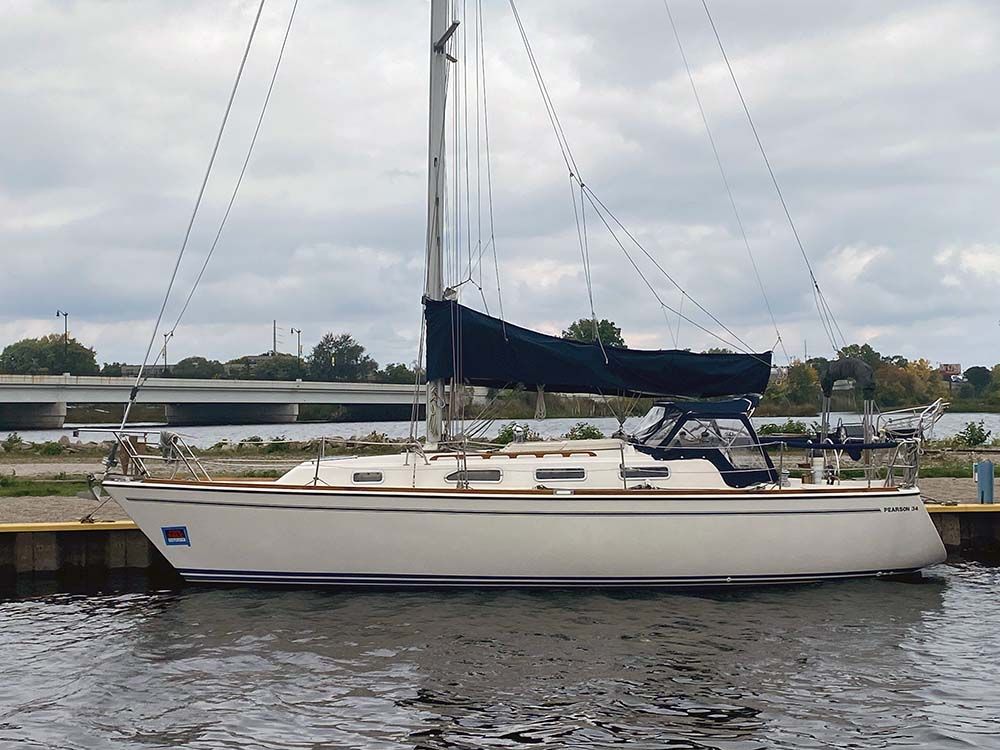
The Pearson 34-2 is a late-1980s/early-1990s production cruiser from the revived Pearson line, conceived as a performance-minded coastal cruiser that leans more toward comfortable family sailing than club racing. Designed by William (Bill) Shaw and built by Pearson Yachts between roughly 1989 and 1991, the 34-2 was intended to give a small liveaboard feel and modern handling in a manageable, single-masted package; it arrived at a moment when sailors wanted more interior volume and easier short-handed sailing without surrendering sailing ability. The model has a modest but steady presence on the used market: you’ll mostly see them traded among private owners and small brokers rather than in large charter fleets, and demand tends to come from couples or families seeking an affordable coastal cruiser rather than from schools or large charter operators.
Design and Construction
The 34-2’s engineering choices are conservative and practical. Hull and deck are fiberglass (hand laid), the standard keel on the 34-2 advertised in many listings is a wing (shoal) keel that gives a shallow 4-foot draft while keeping ballast low, and the rig is a traditional masthead sloop with a keel-stepped mast and all lines led back to the cockpit on many boats — a layout that favors simple sail handling and short-handing. The boat’s displacement (~11,800 lb) and relatively wide beam (~11.5 ft) create a stable platform with sensible interior volume for a 34-foot hull. These choices make the boat forgiving under sail, easier to maintain than exotic composites, and straightforward to repair if you encounter blistering, gelcoat chips, or delamination in localized areas. At the same time, the wing keel trades a little upwind bite and leeway resistance for a shallower draft and access to anchorages that deeper-keel designs can’t reach.
From an architectural viewpoint the Pearson follows classic cruising principles: moderate beam carried fairly far aft for interior room and form stability, a reasonable ballast ratio for steady behavior, and a relatively long waterline for its LOA to nudge hull speed upward. For owners that value durability and easy patch repairs, the solid fiberglass hull and traditional fittings are a plus — there’s no exotic cored hull or proprietary core system to worry about on most examples — but any buyer should still inspect deck penetrations and fittings for soft spots or past repairs, since routine maintenance is the main determinant of long-term value.

Performance
On the water the 34-2 behaves like a competent coastal cruiser: it cruises happily in the high 6s to low 7s knots under a good sail plan and will reach hull speed around 7.1 knots (calculated from LWL ≈ 28.17 ft: 1.34 × √28.17 ≈ 7.11). In moderate upwind conditions the wing-keel version points reasonably well and owners commonly report comfortable pointing at 30–35 degrees apparent in decent sails; in heavier seas the hull’s displacement and fairly full sections give a predictable, comfortable motion rather than a sporty, flat-planing ride. The sloop rig is simple to tune and the layout with lines to the cockpit makes reefing and headsail changes straightforward for short-handed crews. Compared with racier 34-foot designs of the same era (C&C variants or performance-oriented contemporaries) the 34-2 is steadier and more forgiving but won’t win many club races unless heavily optimized.
Comfort and Accommodations
Interiorly the 34-2 stacks up as a roomy, practical 34: headroom in many inventory descriptions is over six feet, and standard fitouts show a full galley, private head with shower, a forward V-berth and a convertible main settee that makes the boat comfortable for a couple or small family on extended weekends. Storage tends to be generous for the size class and the teak finishes common to Pearsons of this era age attractively when maintained; however, many boats you’ll see on the market have aftermarket refits — updated upholstery, modern galley appliances, and electronics — because owners often refocus older interiors for comfort rather than originality. For live-aboard cruising over months, the hull and tankage sizes are workable for a couple but a family living aboard long-term will quickly want to upgrade water capacity and possibly refrigeration. The interior is therefore best described as “very good for coastal cruising and weekend-to-weeklong cruises,” with occasional refits needed to bring systems up to modern standards.
Safety and Practicality
Deck ergonomics are sensible: with the mast stepped through the deck, a cockpit-forward sail plan, and many lines led aft, the 34-2 is easy to manage from the helm, even with two people. The wing keel reduces draft risk in shoal water and makes grounding less catastrophic than a deep fin can be, but it does complicate some bottom repairs and can trap weed or lines more readily than a plain fin. Access to the water is practical on many examples (folding transoms, swim ladders) and standard hardware is robust; nevertheless, critical through-hulls, seacocks and cutlass bearings should be closely inspected on any candidate. Overall the boat is well suited to coastal and near-offshore work as built, and with sensible upgrades (modern electronics, routine standing-rigg checks, and a good survey) it is a solid choice for coastal cruising and limited offshore passages.
Known Issues with the Pearson 34-2
Owners and surveyors commonly flag a handful of recurring issues on older Pearsons that buyers should watch for. Osmotic blistering and gelcoat imperfections turn up in community reports on some late-70s to 90s fiberglass boats if bottoms were not treated or repainted, so check the hull below the waterline carefully. Standing rigging often approaches the end of its service life on boats of this vintage and is a typical replacement item found on surveys; mast step and chainplate areas deserve scrutiny for corrosion or past repairs. Other documented issues include shaft/cutlass-bearing wear and alignment or sterngear concerns on some Pearson models, and the usual aging-boat problems — deck core repairs around fittings, leaking dorades/hatches, and tired cockpit hardware. Common practical upgrades recommended by owners include a modern chartplotter/AIS, replacement of older standing and running rigging, a newer prop or feathering prop upgrade and service to shaft bearings, and a thorough haul-out with new bottom paint where needed. These are generally straightforward, budgetable items rather than design-fatal flaws, but they do affect immediate buying cost and survey negotiations.
Market Availability and Pricing in the U.S.
The Pearson 34-2 is no longer in production and exists exclusively on the used market; listings appear sporadically across the U.S., with a concentration in traditional sailing regions such as New England, the Great Lakes, and parts of the Pacific Northwest and the inland lakes. Recent listing snapshots show a wide spread in condition and asking price — older or project boats below $10,000 up to well-maintained, freshly refitted examples in the high-three-figures. Based on contemporary listings and broker pages, a realistic, consolidated range for U.S. listings today would be roughly $8,500–$39,000, depending on year, equipment, and condition. That range places the 34-2 as an affordable option for buyers seeking a comfortable coastal cruiser with reasonable sailing ability; it competes favorably on price with several other 34-foot cruisers but can lag slightly in resale velocity compared with the massively popular Catalina 34 line.
Below is a comparison with similar sailboats from the same era:
| Model | LOA | Approx. Years Built | Typical Used Price (U.S.) | Main Differences |
|---|---|---|---|---|
| Pearson 34-2 | 34.5 ft | 1989–1991 | $8,500–$39,000 | Wing-keel options, conservative cruiser-oriented design, solid fiberglass hull, comfortable interior for the era. |
| Catalina 34 | 34.5 ft | mid-1980s onward (MkI/MkII variances) | $30,000–$75,000 | Very popular, roomy interior, strong resale market, more factory variations and options over the years. |
| Hunter 34 | 34.42 ft | 1983–1987 (various Legend versions) | $10,000–$60,000 | Often emphasizes interior volume and ease of handling (B&R rigs on some), more modern conveniences in later variants. |
| C&C 34 | ~33.5 ft | late 1970s–1980s (original design) | $12,000–$60,000 | Generally racier handling and lighter displacement in some variants; often favored by sailors who want performance alongside cruising ability. |
Pearson 34-2 vs Catalina 34

The Pearson 34-2’s wing-keel, moderate displacement and classic Shaw lines bias it toward steady, predictable cruising and easier access to shoal anchorages; its masthead sloop rig and simpler deck layout make short-handed sailing straightforward. Catalina 34s tend to offer comparable interior volume but with a broader presence of factory options and a larger resale market, meaning aftermarket upgrades and parts are often easier to source.
In practical ownership terms, a buyer who prioritizes an affordable, well-built coastal cruiser with conservative systems will appreciate the Pearson’s straightforward engineering; a buyer seeking the broadest aftermarket support, more modern interior options, and potentially stronger resale liquidity may favor a Catalina.
► Learn more about de Catalina 34
Pearson 34-2 vs Hunter 34

Compared with the Hunter 34, the Pearson generally presents a more traditional keel and ballast arrangement and a design focus on seakindly motion and build simplicity, whereas Hunters of the era push for interior ergonomics and sometimes incorporate B&R-style rigging for easier tuning. Hunters often appeal to owners who want maximum interior comfort and factory creature comforts; the Pearson appeals to those who want a slightly stiffer, conservative sailing platform that is easier to repair and refit.
For buyers thinking about maintenance and upgrades, the Pearson’s conservative systems usually lower the barrier to DIY projects and long-term ownership costs, while a Hunter—depending on the variant—can demand more attention to specific factory systems and may offer less tolerance for deferred maintenance.
► Learn more about de Hunter 34
Pearson 34-2 vs C&C 34
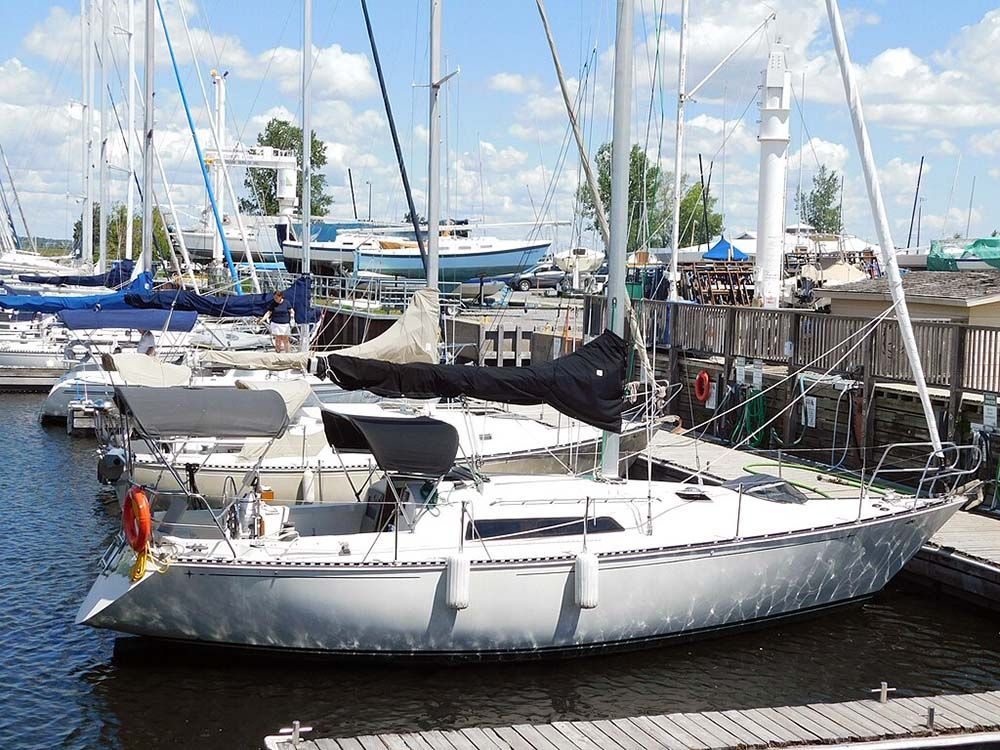
The C&C 34 (original lines by Rob Ball and later 34+ variants) sits closer to the performance cruising spectrum: lighter sections, higher aspect keels on some models, and a tuning culture that favors club racing and higher speeds. The Pearson trades some of that performance for volume, a more forgiving motion in a seaway, and typically a simpler set of systems that age more gracefully for cruising use.
Buyers who value weekend racing and sharper upwind performance will often prefer a C&C, while those who value a stable, comfortable boat with straightforward maintenance and shoal-water capability will find the Pearson more aligned with practical family cruising priorities.
► Learn more about de C&C 34
Maintenance Costs of a Pearson 34-2 in the U.S.
Below is a practical, itemized view of typical annual and periodic maintenance expenses you should expect (ranges depend heavily on region and condition):
- Mooring / slip — $1,500–$12,000+ per year depending on location; high-demand marinas in California or South Florida sit at the top of the range, small town marina fees or seasonal Great Lakes slips are at the low end.
- Insurance — $500–$1,500 per year (roughly 1–2% of insured value as a rule of thumb; older boats with fewer safety upgrades may be toward the lower end if value is low).
- Engine servicing & winterization — $300–$1,200 annually depending on whether you do oil/filter, injectors, cooling system service, and annual winterization/yard work.
- Antifouling paint & haul-out — $600–$2,500 every 1–2 years depending on haul-out fees, paint choice, and repair scope.
- Standing rigging replacement (periodic) — $1,500–$4,500 (every 10–15 years typical; depends on size, material, and whether chainplates or fittings need repair).
- Sails / running rigging — $500–$1,500 per year averaged for maintenance; full replacement cycle for main+headsail often $3,000–$10,000 depending on cloth and cut (one-time major expense).
- Electronics & upgrades (one-time or periodic) — $1,000–$8,000 (chartplotter, AIS, radar, autopilot service/upgrades if desired).
Regional differentiation matters: slip and haul-out costs are the biggest variables (New England and California can be two to four times the cost of smaller marinas in inland regions), while parts and labor for basic engine/mechanical work are broadly similar coast-to-coast. A rule of thumb many owners use is to budget roughly 5–10% of the boat’s value annually for upkeep and deferred improvement; for a typical 34-2 in the mid-range used market that usually translates to a medium ongoing cost compared with other boats of similar size. Owner-mechanics can lower annual bills substantially, but major jobs (rigging, standing-rig replacements, mast work, hull structural repairs) generally require professionals and should be budgeted as one-time capital expenses.
Conclusion
The Pearson 34-2 is a pragmatic, well-built small cruiser that gives buyers a comfortable interior, manageable systems, and sailing behavior suited to coastal cruising and family weekends. Its strengths are a sensible, repairable construction; a shoal-draft wing-keel option that opens up more anchorages; and a layout that makes single- or short-handed sailing realistic. Weaknesses are mostly age-related and maintenance-driven: older electronics, potentially tired rigging, and the ever-present need to inspect for osmosis and deck-fitting integrity. For a buyer looking for a reasonably priced, straightforward 34-footer for coastal cruising, the Pearson 34-2 is very much worth considering — it’s not the fastest boat in the marina, but it often represents good value and predictable ownership costs. If your priority is racing or maximum speed and pointing, look elsewhere; if you want a comfortable, durable coastal cruiser with decent resale prospects within its niche, the 34-2 is a practical and often sensible choice.
Specifications
| General | |
|---|---|
| Hull Type | Wing Keel |
| Rigging Type | Masthead Sloop |
| LOA | 34.50 ft / 10.52 m |
| LWL | 28.17 ft / 8.59 m |
| S.A. (reported) | 550.00 ft² / 51.10 m² |
| Beam | 11.50 ft / 3.51 m |
| Displacement | 11,800.00 lb / 5,352 kg |
| Ballast | 4,950.00 lb / 2,245 kg |
| Max Draft | 4.00 ft / 1.22 m |
| Construction | FG (fiberglass) |
| Ballast Type | Lead |
Production & Design | |
| First Built | 1989 |
| Last Built | 1991 |
| Builder | Pearson Yachts (USA) |
| Designer | William Shaw |
Auxiliary Power / Tanks (original equip.) | |
| Make | Yanmar |
| Model | 3GM30F |
| Type | Diesel |
| HP | 30 |
| Fuel | 22 gals / 83 L |
Accommodations & Tanks | |
| Water | 70 gals / 265 L |
Sailboat Calculations & Ratios | |
| S.A. / Displ. | 17.04 |
| Bal. / Displ. | 41.95 |
| Disp: / Len | 235.65 |
| Comfort Ratio | 23.45 |
| Capsize Screening Formula | 2.02 |
| S# | 2.32 |
| Hull Speed | 7.11 kn |
| Pounds/Inch Immersion | 1,157.53 pounds/inch |
Rig and Sail Particulars | |
| I | 44.25 ft / 13.49 m |
| J | 14.00 ft / 4.27 m |
| P | 38.50 ft / 11.73 m |
| E | 12.50 ft / 3.81 m |
| S.A. Fore | 309.75 ft² / 28.78 m² |
| S.A. Main | 240.63 ft² / 22.36 m² |
| S.A. Total (100% Fore + Main) | 550.38 ft² / 51.13 m² |
| S.A./Displ. (calc.) | 17.05 |
| Est. Forestay Length | 46.41 ft / 14.15 m |
| Mast Height from DWL | 46.66 ft / 14.22 m |
Disclaimer
The considerations and analyses presented regarding the Pearson 34-2 sailboat are of a general nature and are based on the available information and technical data on this model, interpreted to the best of our knowledge and understanding. It is important to note that the specific characteristics of any particular sailboat may vary due to custom modifications, maintenance performed, and conditions of use over time, among other factors. Therefore, the details and performance of the boat you are considering may not exactly match the information provided here.
We strongly recommend that, before making any purchasing or usage decisions, you conduct a detailed inspection of the boat in question, consult with nautical professionals and other sailors, and consider your personal needs, expectations, and capabilities. Each sailboat may have unique particularities that affect its performance and suitability for different types of sailing and sailors.
The information contained in this analysis should be used as a general guide and not as a definitive reference. Professional evaluation and personal inspection are essential to ensure that the boat meets your specific requirements and expectations.