


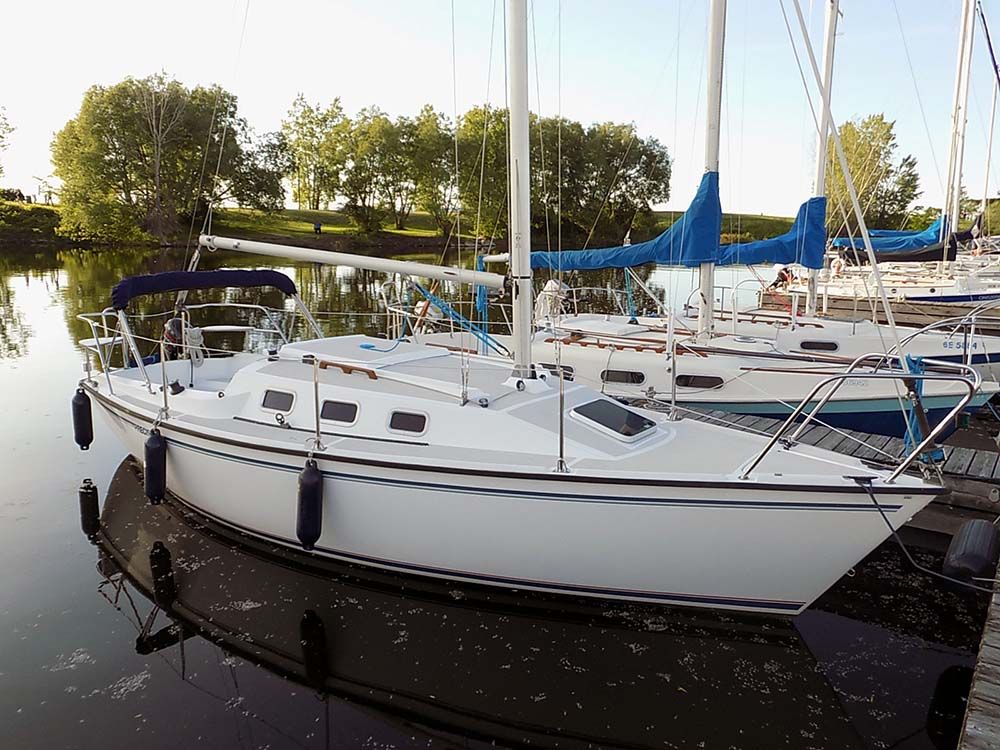
The Precision 23 is a compact, trailerable coastal cruiser that was conceived as a comfortable, easy-to-handle family boat rather than a stripped-out club racer. Designed by Jim Taylor for Precision Boatworks and introduced in the mid-1980s, the model reflects a clear design brief: combine predictable, safe sailing manners with respectable performance and the convenience of shallow-water access and trailering, so small crews and couples can get afloat quickly and cheaply. Over decades the 23 built a steady following among coastal cruisers and trailer sailors—owners prize its build quality and sensible ergonomics—so it shows up regularly on the used market as a practical choice for private owners rather than heavy charter fleets.
Design and Construction
The hull is a moderate-displacement fiberglass monohull with a stub keel and a retractable centerboard that gives around 5.3′ draft with the board down and under 2′ with it up; that arrangement makes the boat trailerable and allows beaching or shallow-water cruising while still offering reasonable windward performance when the centerboard is lowered. The fractional sloop rig keeps sail handling simple and efficient—shorter headsails, an easily managed mainsail and the option for modest reefing make short-handed sailing straightforward. Construction on these boats is hand-laid fiberglass with carefully finished joinery consistent with Precision Boatworks’ reputation for good shop practices, so the structural layout favors longevity and repairability: a solid laminate hull, encapsulated ballast and accessible through-hulls simplify both survey work and later upgrades.
Those choices produce clear tradeoffs for a buyer. The shallow, retractable-centerboard concept sacrifices some of the ultimate pointing ability and motion comfort of a deep-keel cruiser, but it rewards owners with much greater geographic flexibility and low ramp-launching weight. From a maintenance perspective the boat’s straightforward systems and conservative engineering mean most repairs are conventional fiberglass, hardware or small-engine work—issues that are easier and cheaper to address than the complex systems you’d find on larger yachts.

Performance
On the water the Precision 23 sails like a lively coastal cruiser: it gets up to speed in light airs, accelerates responsively off the wind and tracks well with a properly trimmed main and jib. It won’t outpoint a high-aspect, deep-keeled sloop in close-hauled conditions, but with the centerboard down it tacks efficiently enough for coastal passages and weekend racing; the fractional rig helps keep the center of effort manageable and reduces weather helm as conditions build. For day sailing and family weekenders the boat’s balance and helm feel are often praised—comfortable in a chop and forgiving when overpowered—making it a reliable platform for sailors who want spirited performance without constant sail juggling.
Comfort and Accommodations
The interior is compact but well thought out for a 23-footer: a forward V-berth, convertible settees and a small quarter berth allow the boat to sleep three to four adults, while a modest galley and a chemical or port-a-potti head support short cruises. Headroom and storage are limited compared with larger coastal cruisers, but the finish quality and layout economy make good use of the available volume—Precision’s careful joinery and ergonomic cockpit are tangible advantages for owners who value tidy, functional interiors. For a couple or a small family the boat works very well for weekend or week-long coastal cruising; longer-term liveaboard use is possible but requires compromises in provisioning, ventilation and storage that typically push owners toward modest refits (additional shelving, improved ventilation and upgraded galley equipment).
Safety and Practicality
Deck and cockpit ergonomics favor safe, uncomplicated handling: reefing lines and primary controls can be led to the cockpit, and the fractional rig reduces the need for large headsail changes. The shallow draft options and the robust stub keel with centerboard make groundings less catastrophic than on a deep-keel yacht, and the relatively light displacement reduces inertia when maneuvering under power in tight slips. Systems are generally accessible—engine well or outboard mounting, through-hulls and tank locations are straightforward—which keeps routine maintenance costs and survey complexity lower than many larger cruisers. While the hull shape and systems are suitable for coastal and near-shore passages, buyers planning offshore work should factor in upgrades to safety gear, seacocks and navigation equipment before committing to long passages.
Known Issues with the Precision 23
Owners and surveyors commonly report a few recurring items to watch for:
- modest gelcoat crazing or minor blistering on older hulls—inspection and localized repairs are usually enough unless there’s active osmosis;
- core or deck hardware take-off points that need reinforcement if a boat has seen heavy usage or if aftermarket winches and blocks were added without backing plates;
- aging standing rigging and running rigging—these are routine replacements on many older boats and often part of a sensible pre-buy refit;
- outboard bracket wear or stern-mount issues (many boats use a small outboard), which are straightforward to remedy but should be checked during a survey.
Commonly recommended improvements include upgrading chainplates and backing plates where owners have fitted larger hardware, replacing old sails with a quality main and a reefable headsail, and fitting modern electronics and safety equipment. None of these are structural red flags for the design—more typically they’re a matter of deferred maintenance or owner preference.
Market Availability and Pricing in the U.S.
The Precision 23 remained in production for many years and shows up reliably on the used market; it’s a steady offering among trailer-sailors and family coastal cruisers, particularly in regions where launching and trailering are common. Typical asking prices vary with year, condition and outfitting; recent U.S. listings cluster around $12,000–$22,000 for well-equipped, later models, with lower-condition boats offered for less and exceptionally maintained examples toward the top of that range. Regional patterns show frequent listings in the Southeast (Florida/Gulf), the Mid-Atlantic and Great Lakes—areas with strong trailer-sailer communities and easy ramp access.
Below is a comparison with similar sailboats from the same era:
| Model | LOA | Typical Years | Typical US Used Price | Principal Differences |
|---|---|---|---|---|
| Catalina 250 | ~25 ft | 1990s–2000s | $10,000–$25,000 | Heavier keel options and more interior volume; less trailer-friendly but more comfortable for extended cruising. :contentReference[oaicite:4]{index=4} |
| Hunter 23 / 23.5 | ~23–23.5 ft | 1980s–1990s | $4,000–$12,000 | Roomier layouts and conventional ballast; good entry-level cruisers with generally lower asking prices. |
| O’Day 23 | ~23 ft | 1970s–1980s | $3,000–$10,000 | A classic small cruiser with simple systems; older examples can be very affordable but often need updating. |
Precision 23 vs Catalina 250

The Precision 23 emphasizes trailerability, a shallow-draft centerboard and a conservative displacement that make ramp launches and shoal exploration easy, whereas the Catalina 250 offers more interior volume, heavier ballast and a design tuned toward comfortable family cruising without as much emphasis on trailering.
For buyers this means the 23 trades some cabin space and heavy-weather comfort for flexibility: you can store it on a trailer and explore shallow bays, while the Catalina typically provides a roomier interior and steadier motion in a seaway—attributes that favor longer cruises and overnight comfort.
► Learn more about de Catalina 250
Precision 23 vs Hunter 23 / 23.5

Compared with the Hunter variants, the Precision 23 generally sails with a crisper feel and a more modern hull form from its Taylor design line, while Hunters often give a little more interior space for the same length and can present slightly simpler systems for the budget buyer.
From an ownership perspective, the Precision rewards sailors who value performance and build quality in a compact package; Hunters may appeal to buyers prioritizing cabin volume and the lowest initial purchase price, but often at the cost of slightly less refined sailing manners.
► Learn more about de Hunter 23
Precision 23 vs O’Day 23

The Precision tends to be better built, with more modern lines and a rig that favors easy short-handed sailing; older O’Day 23 examples bring a nostalgic simplicity and very low entry price but often require more restoration and systems updating.
Practically, a buyer looking for a reliable weekend cruiser with respectable performance and fewer surprises at survey will usually favor the Precision 23, while a buyer on a tight budget who enjoys project-style restoration might choose an O’Day and accept the extra work.
► Learn more about de O’Day 23
Maintenance Costs of an Precision 23 in the U.S.
Typical annual / recurring costs (each item bolded with a short comment):
- Mooring/Marina or Trailer Storage: $800–$5,000+ per year — depends on slip fees in coastal metros vs inexpensive rack/trailer storage inland.
- Insurance: $250–$900 per year — lower hull value usually keeps premiums modest, but location and usage matter.
- Engine / Outboard Service: $150–$700 per year; overhauls or replacement $800–$3,000 — many owners use small outboards, which are inexpensive to service but have limited lifespans if used for planing and long runs.
- Antifouling & Haulout: $300–$1,200 per season — frequency and cost vary by water type and local yard rates.
- Rigging and Sails: $100–$600 annually for upkeep; full sail replacement $800–$2,500+ — fractional rigs are economical to maintain but sails still age and often get updated.
- Hull and Deck Maintenance / Repairs: $100–$1,500+ yearly variable — small fiberglass repairs, teak work and hardware replacement add up over time.
- Miscellaneous (electronics, safety gear, survey): $200–$2,000+ as needed — electronics upgrades and safety inspections are commonly ticked off before extended cruises.
Regional differences matter: Northern yards add winterization and shrink-wrap; tropical or salt-heavy environments increase corrosion and paint frequency. Significant one-time costs to budget for include major sail replacement, an electronics refit (chartplotter, VHF/AIS) or an outboard replacement—each can run well into the low thousands. The boat is friendly to owner-maintenance for plumbing, basic electrical, rigging tune and small fiberglass work, which helps keep recurring costs in the medium range for its size; resale values for well-maintained examples generally compensate owners who invest in regular maintenance and sensible upgrades.
Conclusion
The Precision 23 is a neatly resolved small cruiser: it blends sensible, conservative construction with a sail plan and hull that deliver enjoyable coastal performance. Its strengths are trailerability, good build quality for the class, easy single- or two-handed handling, and a level of interior finish that punches above its size. Tradeoffs include limited cabin volume and the usual compromises of a centerboard-equipped boat—reduced ultimate motion comfort compared with larger, deep-keel cruisers and the need to monitor centerboard hardware and thru-hulls. For a buyer seeking a practical, all-round weekend boat that doubles as a short-cruise pocket cruiser and is relatively economical to own and maintain, the Precision 23 is a strong candidate and typically represents sound value; for someone whose priorities are extended liveaboard comfort or offshore passagemaking without upgrades, other, larger designs would likely be a better match.
Specifications
| Hull Type | Keel/Cbrd. |
| Rigging Type | Fractional Sloop |
| LOA | 23.42 ft / 7.14 m |
| LWL | 20.00 ft / 6.10 m |
| S.A. (reported) | 248.00 ft² / 23.04 m² |
| Beam | 8.50 ft / 2.59 m |
| Displacement | 2,450.00 lb / 1,111 kg |
| Ballast | 850.00 lb / 386 kg |
| Max Draft | 5.33 ft / 1.62 m |
| Min Draft | 1.92 ft / 0.59 m |
| Construction | FG |
| Ballast Type | Lead |
| First Built | 1986 |
| Last Built | 2019 |
| # Built | 500 |
| Builder | Precision Boat Works (USA) |
| Designer | Jim Taylor |
| S.A. / Displ. | 21.89 |
| Bal. / Displ. | 34.69 |
| Disp. / Len. | 136.72 |
| Comfort Ratio | 10.41 |
| Capsize Screening Formula | 2.53 |
| S# | 4.26 |
| Hull Speed | 5.99 kn |
| Pounds/Inch Immersion | 607.43 pounds/inch |
| I | 26.25 ft / 8.00 m |
| J | 8.33 ft / 2.54 m |
| P | 26.25 ft / 8.00 m |
| E | 10.50 ft / 3.20 m |
| S.A. Fore | 109.33 ft² / 10.16 m² |
| S.A. Main | 137.81 ft² / 12.80 m² |
| S.A. Total (100% Fore + Main Triangles) | 247.14 ft² / 22.96 m² |
| S.A./Displ. (calc.) | 21.81 |
| Est. Forestay Length | 27.54 ft / 8.39 m |
| Mast Height from DWL | 35.33 ft / 10.77 m |
Disclaimer
The considerations and analyses presented regarding the Precision 23 sailboat are of a general nature and are based on the available information and technical data on this model, interpreted to the best of our knowledge and understanding. It is important to note that the specific characteristics of any particular sailboat may vary due to custom modifications, maintenance performed, and conditions of use over time, among other factors. Therefore, the details and performance of the boat you are considering may not exactly match the information provided here.
We strongly recommend that, before making any purchasing or usage decisions, you conduct a detailed inspection of the boat in question, consult with nautical professionals and other sailors, and consider your personal needs, expectations, and capabilities. Each sailboat may have unique particularities that affect its performance and suitability for different types of sailing and sailors.
The information contained in this analysis should be used as a general guide and not as a definitive reference. Professional evaluation and personal inspection are essential to ensure that the boat meets your specific requirements and expectations.