


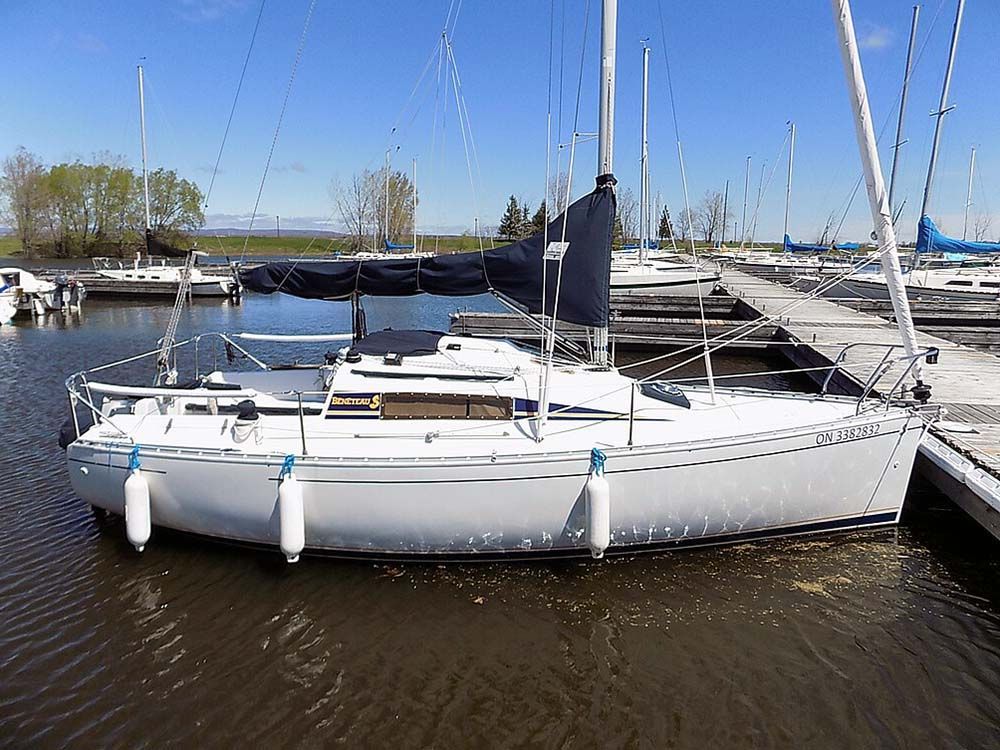
The Beneteau First 235 is a compact cruiser-racer introduced in 1986 by renowned French yacht builder Beneteau and designed by Jean-Marie Finot of Groupe Finot. Developed during a period when trailerable sailboats were gaining popularity, the First 235 was aimed at sailors who wanted the versatility of a small boat without sacrificing the excitement of performance sailing. With over 700 units produced until the early 1990s, it remains a beloved choice for coastal cruisers, weekend racers, and sailing enthusiasts who value portability, simplicity, and spirited sailing.
Intended for both novice sailors and seasoned skippers looking for a fun and responsive boat, the First 235 successfully blends affordability, clever design, and practical performance in a hull that can be easily trailered and launched.
Design and Construction
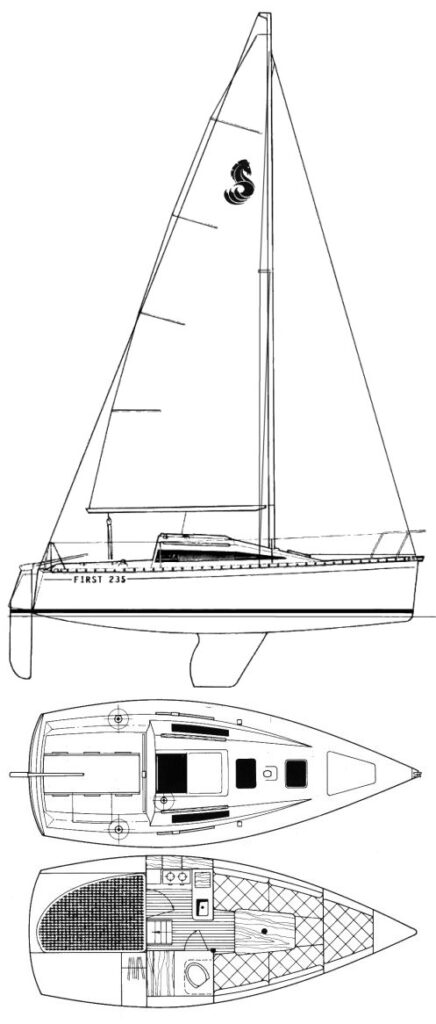
The First 235 features a fiberglass monohull with sleek, modern lines that have aged remarkably well. At 23.5 feet (7.2 meters) in length with a beam of 8’2″ (2.49 meters), it strikes a balance between compactness and usable space. The hull design incorporates a moderately plumb bow, a wide beam carried aft, and a slightly rounded sheer, offering both good interior volume and efficient waterline length for speed.
Several keel configurations were offered: a swing keel for shallow water access and trailer convenience, a fixed fin keel for better performance upwind, and a wing keel variant popular in U.S. markets. The boat’s twin rudders — rare for vessels of this size — provide excellent control when heeled and allow for shallower draft options without compromising handling.
Rigging is a fractional sloop, which allows for better mainsail control and simplifies sail handling, particularly under varying wind conditions. The deck layout is straightforward, with all lines led aft, enabling singlehanded sailing with ease. Construction quality reflects Beneteau’s production standards of the era: robust for coastal use, with solid glass below the waterline and cored deck structures above.
Performance
Despite its modest size, the First 235 sails like a larger and more performance-oriented yacht. Its light displacement (approximately 2,400 lbs or 1,090 kg) combined with a relatively generous sail plan results in a high Sail Area to Displacement (SA/D) ratio, giving it excellent light-air responsiveness. Hull speed is around 6.0 knots, but in favorable reaching conditions, it often exceeds this thanks to its slippery hull and generous beam aft.
The twin rudder setup gives the boat balanced and responsive handling, even when heeled over, and contributes to a forgiving and confident ride in gusty conditions. The boat tracks well and points higher than expected for its class, especially with the fin keel. Though not intended as a competitive racing platform, it performs admirably in club races and casual regattas.
Downwind, it’s lively and fun, benefiting from the hull form and wide stern, which adds planing potential and improves stability in following seas. While it can’t match the upwind punch of a purpose-built racer, it remains engaging and satisfying to sail.
Comfort and Accommodations
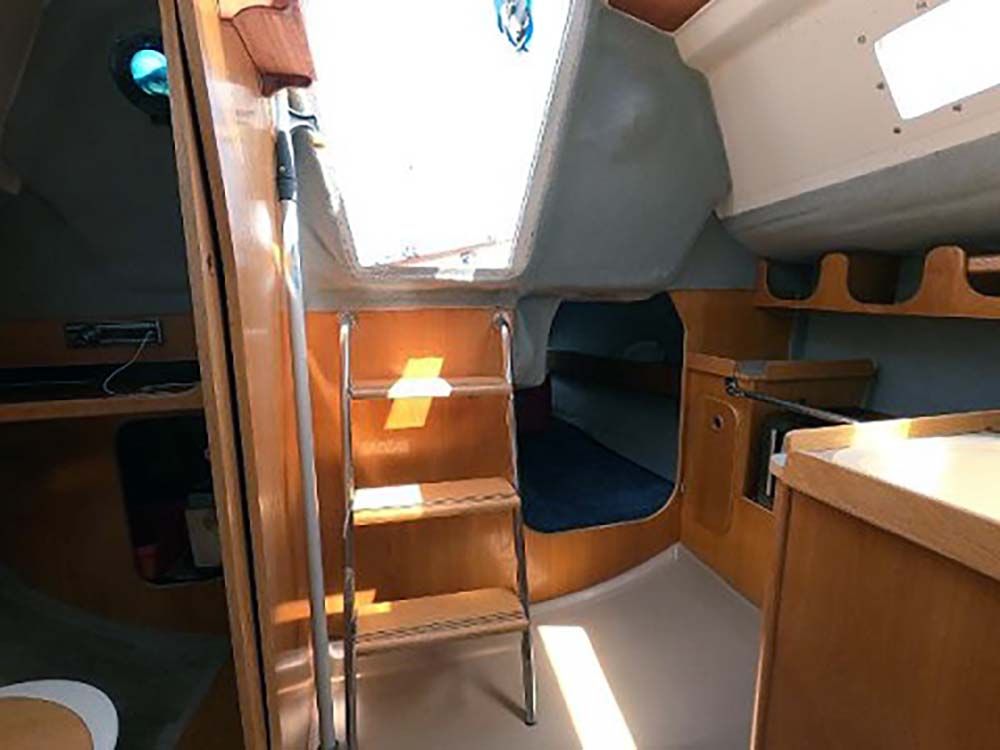
Interior space is surprisingly generous given the boat’s 23.5-foot length. The layout typically features a V-berth forward, two quarter berths aft, a small galley to port, and a portable marine toilet (head) to starboard. The open-plan layout enhances the sense of space, and though standing headroom is limited (approximately 5’0″–5’4″ depending on placement), it feels airy and uncluttered for a boat of this size.
It’s officially rated to sleep four adults, but it’s more realistically comfortable for two or three on overnight trips. Storage is minimal but smartly distributed, with compartments under berths and cabinetry in the galley area. A sliding hatch and multiple opening ports provide decent ventilation.
Amenities are basic — a simple alcohol stove, limited freshwater capacity (typically 10–15 gallons), and no fixed refrigeration — but are sufficient for weekend cruising. The accommodations reflect the boat’s mission: functional, compact, and surprisingly livable for short trips.
Safety and Practicality
The First 235 is particularly well-suited for coastal cruising, lakes, and inshore waters. Its trailerable size and optional swing keel make it easy to transport, launch, and store, which is a major advantage for sailors without permanent moorings. Setup and rigging are straightforward, allowing one or two people to prepare the boat quickly.
On deck, non-skid surfaces and sensible handholds contribute to safe movement, while the deep cockpit provides a secure space for crew and passengers. Sail handling is made simple with the controls within easy reach, and reefing can be done efficiently thanks to the slab reefing system.
However, this is not a bluewater boat. While stable and well-behaved in coastal chop, it lacks the displacement, tankage, and structural reinforcement for offshore conditions. In protected waters, though, it’s a solid and confidence-inspiring platform.
Known Issues with the Beneteau First 235
Most issues reported with the Beneteau First 235 are related to age and owner maintenance rather than inherent design flaws. However, there are a few commonly noted concerns:
- Keel pivot wear (swing keel models): Over time, the pivot mechanism for the swing keel can wear or seize if not properly maintained. Regular inspection and lubrication are essential.
- Water intrusion through deck fittings: Like many boats of this era, poorly bedded or aging deck hardware can lead to leaks, particularly around stanchions and ports.
- Rudder system wear: The twin rudder system works well when maintained, but the mounting brackets and bushings may develop play or corrosion, especially in saltwater environments.
- Limited tankage and systems: As a design choice, the boat was not equipped with pressurized water, holding tanks, or electrical systems beyond the basics, which may limit extended cruising without upgrades.
- Headroom and condensation: Some owners report issues with condensation inside due to limited insulation and tight spaces, especially during colder nights.
None of these issues are unique to the First 235, but prospective buyers should carefully inspect swing keel hardware, rudder mounts, and any signs of water ingress when evaluating a used model.
Market Availability and Pricing in the U.S.
The Beneteau First 235 is no longer in production—this model was built between 1986 and 1991, with approximately 680 hulls completed in France and the U.S. Today, it circulates exclusively on the used market.
In the United States, First 235s most frequently surface in regions with active sailing communities and favorable climates—Florida, California (notably San Diego and Long Beach), and parts of New England. A reasonable current price range is roughly $8,000–$15,000, depending on condition, location, and included equipment.
Overall, the First 235 is regarded as offering excellent value for money. Its thoughtful design (including features uncommon in its size—separate head/nav station, proper galley, aft berth) makes it desirable and fairly easy to resell compared with niche or less-equipped pocket cruisers.
Comparison with similar sailboats:
| Model | LOA (ft) | Approx. Build Years | Typical Used Price (USD) | Key Differences |
|---|---|---|---|---|
| Beneteau First 235 | 23.3 | 1986–1991 | $8,000–$15,000 | Performance-oriented, advanced interior (nav/head, galley, aft berth), sleek Finot design |
| Catalina 25 | 25 | 1977–1991 | $5,000–$12,000 | Ample market availability, family-oriented, slower, simpler layout |
| Hunter 23 | 23 | 1980s–1990s | $6,000–$10,000 | Modern cruising layout, lighter build, modest performance |
| Tanzer 26 | 26 | 1970s–1980s | $7,000–$13,000 | More interior space, heavier, moderate performance |
Beneteau First 235 vs Catalina 25

The First 235’s hull and deck geometry were drawn with performance in mind—flatter sections aft and a more modern underwater profile—so in light airs and when racing it accelerates and tacks more crisply than the fuller-bilged, more conservative Catalina 25. Catalina’s heavier, fuller hull and higher initial stability make it feel more forgiving for a novice or a family with small children; it heels more gently and tracks steadily, which translates into a calmer platform for cruising and for owners who value easy handling over outright speed.
Rigging choices reinforce those tendencies: the First’s fractional rig gives a larger mainsail/lighter headsail balance that’s easier to tune for speed, while the Catalina’s masthead setup is robust and simple to maintain, albeit with more sheet work in stronger winds. Interior layouts reflect the priorities—Beneteau usually squeezes in a sport-oriented cockpit and efficient, bright interiors that maximize sailing visibility, whereas the Catalina emphasizes roomy berths and stowage, making weekends aboard noticeably more comfortable for a family. From an ownership perspective the Beneteau rewards owners who want lighter, more responsive sailing and who will invest modestly in sail and rig tuning; the Catalina rewards those seeking low-stress cruising and easier single-handing without chasing lap times. Maintenance-wise, Catalinas tend to be straightforward and forgiving (simple hardware, plentiful parts), while the First may require more attention to rig tuning and deck fittings to preserve its performance edge.
Typical use follows naturally: the First 235 is better suited to club racing and spirited coastal daysails that prioritize responsiveness, while the Catalina 25 excels at relaxed weekend cruising and family comfort. Resale considerations also diverge — performance buyers target the First, while the Catalina’s reputation for comfort and simplicity keeps it attractive to entry-level cruisers.
► Learn more about de Catalina 25
Beneteau First 235 vs Hunter 23

Comparing the First 235 to the Hunter 23 highlights a contrast between sporty European lines and American-cruiser ergonomics; the First’s slimmer entry and more modern underwater shape give it livelier acceleration and a more sensitive helm, whereas the Hunter’s fuller sections prioritize interior volume and easy, stable tracking. The Hunter often carries features aimed squarely at comfort—bigger cockpit lockers, a layout organized around sociable use, and systems designed for low maintenance—so a couple or small family will find it easier to live aboard for weekends without constant tinkering.
Rigging again separates them: the First’s fractional rig makes mainsail-trim central to performance and rewards owners who understand sail shape, while the Hunter’s more conservative rig and sail plan simplify reefing and reduce the need for frequent sail changes. Handling under sail follows those design choices: the First is more rewarding to trim and faster to accelerate off the wind, the Hunter is steadier and more predictable in chop, which matters when you want stress-free cruising rather than chasing speed. Interior comfort on the Hunter typically feels roomier and more cruise-oriented at anchor, whereas the First offers a lighter, airier cabin that sacrifices some storage for weight savings and sailing visibility. Maintenance burdens are comparable, but because Hunters were often specified with cruising conveniences, owners should expect more systems to inspect (pumps, lockers, fittings), while the First’s emphasis on simplicity in some build areas can reduce long-term upkeep if sailed actively.
For use cases, the First 235 is naturally better for club racing and owners who want a responsive coastal cruiser; the Hunter 23 is better for couples/families prioritizing weekend comfort and minimal on-water fuss. Buyers should therefore match their priorities: if day-to-day ease and interior comfort beat outright handling, the Hunter is the practical choice; if excitement on the water and tuning potential matter more, the First delivers better.
► Learn more about de Hunter 23
Beneteau First 235 vs Tanzer 26

The First 235 and Tanzer 26 share a trailerable, coastal-cruiser spirit, but they diverge where performance and accommodation priorities meet—the First is lighter and tuned toward nimble handling, while the Tanzer’s deeper, more conventional fin keel and fuller displacement provide a steadier, more sea-kindly motion in moderate chop. In practice that means the Tanzer often feels more secure on longer coastal passages and when loaded for cruising, whereas the First will reward lighter crews with quicker tacks and a more lively pointing ability.
The rigs reflect different eras: the First’s fractional rig is easier to depower with mainsail adjustments and benefits owners who enjoy sail trim work; the Tanzer’s masthead configuration is simple and robust, offering reliable performance with fewer demands on constant tuning. Belowdecks the Tanzer 26 typically offers more standing headroom and a slightly more commodious layout for four cruising comfortably, translating into better live-aboard practicality for family weekends; the First’s interior prioritizes weight savings and ergonomics for day-sailing and short cruises. From a maintenance standpoint, the Tanzer’s straightforward mechanicals and fewer performance-grade fittings can mean lower upkeep for a cruising-focused owner, but older Tanzers may need attention to aging hardware and keel bolts; the First, while generally modern, benefits from proactive rig and deck inspection to keep its sailing character.
Typical use cases diverge: owners wanting a small family cruiser that can handle occasional longer passages with a comfortable motion will prefer the Tanzer, while those who intend to race in club fleets or value spirited day sailing will prefer the First. Ultimately the practical ownership trade-off is between the Tanzer’s comfortable, slightly heavier cruising platform and the First 235’s sharper, lighter sailing character — choose the one that matches whether your priorities are passagemaking comfort or on-water agility.
► Learn more about de Tanzer 26
Maintenance Costs in the U.S.
Typical annual maintenance costs for a ~24-ft sailboat such as the Beneteau First 235 include:
- Mooring/slip fees: $800–$2,500 per year, varying widely by region (lower in the Gulf Coast, higher in New England or California).
- Bottom cleaning & antifouling: Haul-out $10–$20 per foot; antifouling paint $100 per foot. For a ~24-ft hull:
- Haul-out: $240–$480
- Paint: $2,400 (if full quality paint)
- Engine servicing (outboard, 100-hr): $200–$500 annually depending on labor and parts
- Waxing/detailing: $30–$50 per foot (≈ $720–$1,200)
- Rig/sails inspection: Professional rig check $1,000+; sail repairs/replacement: single sail can cost $500–$2,000.
- Insurance: $300–$800 depending on value and region.
- Miscellaneous (batteries, safety gear, small gear, dock lines): $300–$600.
One-off/replacement costs:
- New mainsail or genoa: $1,500–$3,000 each.
- Electronics (e.g., GPS/chartplotter): $500–$2,000.
- Refits (interior, hardware): thousands, depending on extent.
DIY vs professional: Many owners of First 235s can tackle tasks like bottom cleaning, waxing, minor rigging themselves—to save 50–80% of cost. However, tasks such as antifouling, sail repair, rig tuning are best left to professionals (due to expertise, specialized tools), and these increase costs significantly.
Summary Assessment:
- Low-to-medium annual maintenance cost within this size class—especially if owner-maintained; if using professionals and in premium regions, it’s medium to upper-medium.
- Given typical purchase price ($8k–$15k) plus moderate upkeep, the resale value remains strong if well maintained. The First 235’s design and owner forums support decent liquidity in the used market.
- In conclusion: maintenance cost is reasonable for its size and utility, and resale value generally compensates well for the investment—particularly for owners mindful of upkeep.
Conclusion
The Beneteau First 235 is an impressively designed pocket cruiser-racer that offers a well-rounded package of performance, livability, and portability. Its strengths lie in its agile sailing characteristics, clever use of space, and approachable systems, making it ideal for sailors who want to enjoy a responsive and fun boat without the complexity and cost of larger yachts.
While it does have limitations — notably in offshore suitability, headroom, and cruising systems — those are expected in this class and are offset by its versatility and charm. Whether for day sailing, weekend getaways, or casual racing, the First 235 remains a rewarding and accessible choice for both beginners and experienced sailors seeking freedom on the water.
👉 Save the full technical sheet of the Beneteau First 235 by downloading the PDF version
Image Gallery

Specifications
| Hull Type: | Fin w/transom hung rudder |
| Rigging Type: | Fractional Sloop |
| LOA: | 23.33 ft / 7.11 m |
| LWL: | 20.25 ft / 6.17 m |
| Sail Area (reported): | 248.00 ft² / 23.04 m² |
| Beam: | 8.17 ft / 2.49 m |
| Displacement: | 2,826.00 lb / 1,282 kg |
| Ballast: | 825.00 lb / 374 kg |
| Max Draft: | 3.80 ft / 1.16 m |
| Construction: | Fiberglass (FG) |
| First Built: | 1986 |
| Last Built: | 1991 |
| Number Built: | 680 |
| Builder: | Beneteau |
| Designer: | Group Finot |
Sailboat Calculations | |
| S.A. / Displ.: | 19.90 |
| Bal. / Displ.: | 29.19 |
| Disp. / Len.: | 151.93 |
| Comfort Ratio: | 12.57 |
| Capsize Screening Formula: | 2.31 |
| Stability Number (S#): | 3.75 |
| Hull Speed: | 6.03 kn |
| Pounds/Inch Immersion: | 591.14 pounds/inch |
Rig and Sail Particulars | |
| I: | 28.61 ft / 8.72 m |
| J: | 7.87 ft / 2.40 m |
| P: | 26.41 ft / 8.05 m |
| E: | 10.30 ft / 3.14 m |
| S.A. Fore: | 112.58 ft² / 10.46 m² |
| S.A. Main: | 136.01 ft² / 12.64 m² |
| S.A. Total (100% Fore + Main): | 248.59 ft² / 23.09 m² |
| S.A. / Displ. (calc.): | 19.95 |
| Est. Forestay Length: | 29.67 ft / 9.04 m |
Disclaimer
The considerations and analyses presented regarding the Beneteau First 235 sailboat are of a general nature and are based on the available information and technical data on this model, interpreted to the best of our knowledge and understanding. It is important to note that the specific characteristics of any particular sailboat may vary due to custom modifications, maintenance performed, and conditions of use over time, among other factors. Therefore, the details and performance of the boat you are considering may not exactly match the information provided here.
We strongly recommend that, before making any purchasing or usage decisions, you conduct a detailed inspection of the boat in question, consult with nautical professionals and other sailors, and consider your personal needs, expectations, and capabilities. Each sailboat may have unique particularities that affect its performance and suitability for different types of sailing and sailors.
The information contained in this analysis should be used as a general guide and not as a definitive reference. Professional evaluation and personal inspection are essential to ensure that the boat meets your specific requirements and expectations.