



The Beneteau Oceanis 37 is a modern cruising sailboat introduced in 2008 by the renowned French builder Beneteau and designed by the accomplished duo of Jean-Marie Finot and Pascal Conq (Groupe Finot-Conq). Part of the Oceanis line, it was designed as a performance cruiser—balancing comfortable accommodations with respectable sailing ability. It quickly gained traction in the charter market and among private owners looking for a manageable boat with the space of a much larger vessel. Today, it remains a sought-after model on the pre-owned market, appealing especially to cruising couples, small families, and sailing schools due to its ease of handling, stylish design, and functional interior.
Design and Construction
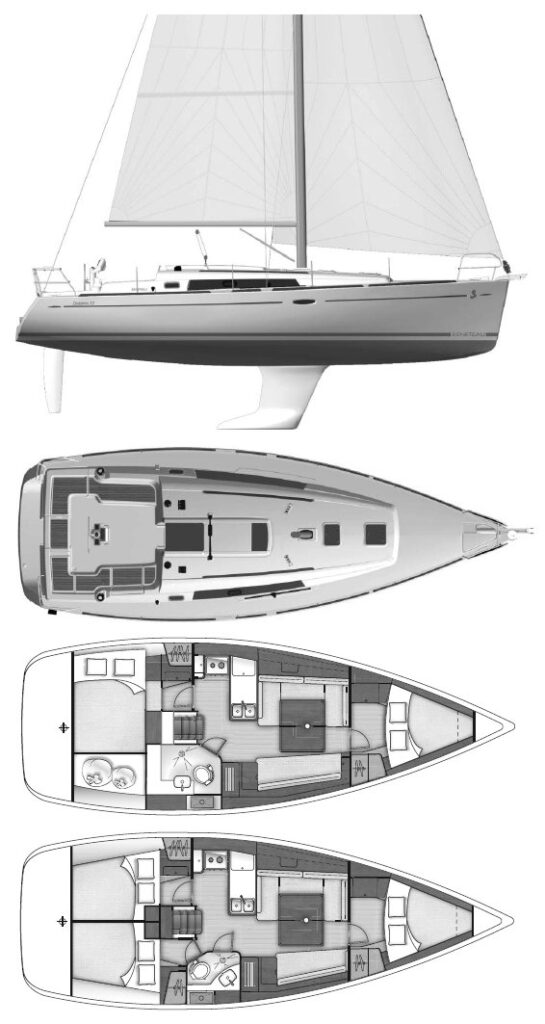
The Oceanis 37 features a contemporary hull shape with a plumb bow, a broad beam carried well aft, and a relatively flat underbody—all contributing to good form stability and interior volume. The standard configuration includes a fin keel with a bulb and a balanced spade rudder, offering a blend of performance and directional control. The rig is a fractional sloop with a generous mainsail and smaller headsail, optimized for easy handling with a furling genoa and optional in-mast furling.
Constructed primarily from hand-laid fiberglass with a balsa-cored deck, the boat strikes a balance between strength, weight, and cost. The use of modern composites enhances stiffness and reduces maintenance, while the deck layout—featuring a large cockpit and twin wheels (in later models)—improves ergonomics and helm visibility. The boat’s architectural choices reflect a clear emphasis on coastal cruising with occasional offshore capabilities, making it attractive to those seeking minimal upkeep and high residual value.
Performance
Under sail, the Oceanis 37 is lively and responsive. With a reported sail area of around 760 sq ft and a Displacement/Length ratio in the mid-170s, it offers moderate performance in a variety of wind conditions. It performs best in light to moderate winds, where the broad stern and hull shape help it maintain good speed and tracking. In heavier seas, the boat remains manageable, though its wide beam can lead to a bit more motion off the wind.
Compared to contemporaries like the Jeanneau Sun Odyssey 36i or Catalina 375, the Oceanis 37 is slightly quicker in lighter air, thanks to its modern hull lines and efficient rig. Many owners praise its easy helm, straightforward sail handling, and balance—especially when properly trimmed. It’s not a racer, but it’s no slouch for a comfortable cruiser.
Comfort and Accommodations
Inside, the Oceanis 37 benefits from Beneteau’s design ethos of maximizing space and light. Available in two- or three-cabin versions, it caters to both liveaboards and charter needs. The two-cabin layout offers an expansive storage area aft and a larger head, making it ideal for private owners. The saloon is bright and airy with large ports, ample headroom, and elegant wood finishes (usually in light Alpi mahogany or cherry).
Storage is generous, especially under settees and in the galley, and the overall layout is ergonomically sound for use at anchor or under sail. The galley is well-positioned near the companionway for ventilation, and the nav station is compact yet functional. The interior has aged well, though some cosmetic wear is typical in high-use boats. Refits may include updated upholstery or LED lighting, but major overhauls are generally unnecessary.
Safety and Practicality
On deck, the Oceanis 37 is set up for easy handling, even with a small crew. All lines are led aft to the cockpit, and the deck is clean and uncluttered for safe movement under sail. The high coamings, handrails, and integrated swim platform all enhance safety and usability. The cockpit is spacious, with good drainage and comfortable seating for extended time underway.
The boat is capable of offshore passages with minimal modification, though most are used for coastal cruising or island hopping. System access is relatively good, especially for routine engine checks and plumbing. However, like many production boats, tight quarters around the engine and tanks can make certain repairs more time-consuming.
Known Issues with the Beneteau Oceanis 36 CC
Owner reports and forums highlight a few recurring issues with the Oceanis 37:
- Deck fittings and leaks: Some boats have experienced water intrusion through deck fittings or stanchions due to bedding failure—common in boats over 10 years old.
- In-mast furling: Boats with this option may face furling issues if not maintained properly or used in high winds with excessive sail.
- Electronics: Early models may have outdated electronics; upgrades to modern chartplotters and AIS are often undertaken.
- Engine access: The Volvo Penta 29hp engine is generally reliable, but routine maintenance (especially belt or impeller changes) can be tight on space.
- Gelcoat crazing: Aesthetic hairline cracks may appear with age and UV exposure but are mostly superficial.
Recommended upgrades often include upgraded sails, new house batteries, solar panels, and more robust autopilots for extended cruising.
Market Availability and Pricing in the U.S.
The Oceanis 37 is no longer in production, having been succeeded by the Oceanis 38 in 2014. On the U.S. brokerage market, it is commonly found in coastal states with strong sailing communities—particularly Florida, the Chesapeake Bay, and Southern California. Most available boats were originally private-owned or ex-charter units from the Caribbean.
Prices typically range from $85,000 to $125,000, depending on year, equipment, and condition. Boats with newer electronics, upgraded sails, or dodgers/biminis command higher prices. Well-kept examples are in steady demand, especially among coastal cruisers looking for a turnkey platform.
Compared to similar models from Catalina, Jeanneau, and Hunter, the Oceanis 37 offers a strong value proposition: modern styling, good resale value, and practical performance.
Here’s a comparison with similar models:
| Model | LOA | Year | Typical Used Price | Key Differences |
|---|---|---|---|---|
| Beneteau Oceanis 37 | 37.7 ft | 2008–2014 | $85,000–$125,000 | Modern design, good interior volume, agile performance |
| Catalina 375 | 38.5 ft | 2008–2012 | $95,000–$130,000 | Heavier displacement, more traditional styling, solid systems |
| Jeanneau Sun Odyssey 36 Mk I | 36.5 ft | 2006–2013 | $80,000–$110,000 | Sleek lines, competitive performance, lighter displacement |
| Hunter 38 | 38.2 ft | 2004–2011 | $80,000–$115,000 | Spacious interior, in-mast furling standard, lower sail area |
Beneteau Oceanis 37 vs Catalina 375
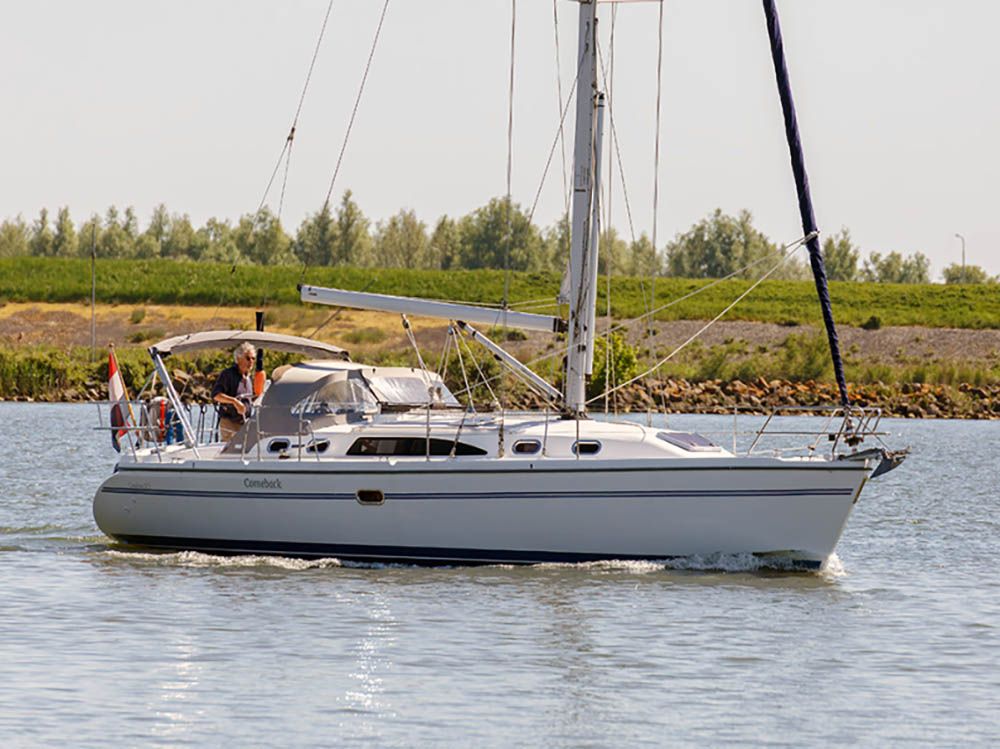
The hull of the Oceanis 37 leans toward a moderate displacement with good form stability, while the Catalina 375 is heavier and broader in beam, trading some performance edge for extra interior volume. In rigging, the Oceanis tends to have a more performance-oriented sail plan (with a slightly more efficient sail area to displacement ratio), whereas the Catalina emphasizes ease of handling with more conservative sail area and robust systems. As a result, the Oceanis 37 will usually outperform the Catalina 375 in moderate to light airs—being more responsive, better pointing and having crisper helm feedback—while the Catalina may feel more stable and less “busy” in heavier seas. Interior layouts reflect the trade-offs: the Catalina offers slightly more living volume, storage, and a more comfortable motion for cruising families, whereas the Oceanis gives up some space for better sailing behavior.
Maintenance burdens are somewhat higher on the Oceanis because its systems and rig are tuned more finely, so owners should budget for more frequent adjustments; by contrast, the Catalina’s heavier build and simpler systems tend to be a bit more forgiving. In practical use, the Oceanis 37 is ideal for owners seeking spirited cruising and occasional club racing, while the Catalina 375 is a safer choice for those who prioritize comfort, ease and relaxed family cruising over performance.
► Learn more about the Catalina 375
Beneteau Oceanis 37 vs Jeanneau Sun Odyssey 36 MK I

Both the Oceanis 37 and the Sun Odyssey 36 are designed for cruising with some performance ambitions, but their emphases differ subtly: the Oceanis often has a somewhat sleeker underwater profile, sharper entry lines and slightly higher sail-area-to-displacement, while the Sun Odyssey favors a softer motion and more forgiving demeanor under sail. In handling, the Oceanis 37 will reward trimming and tuning, showing more responsiveness in gusts or shifting wind, whereas the Jeanneau will feel steadier and a bit more damped in heavier chop—thus more comfortable for a cruising crew less focused on performance. Inside, the Sun Odyssey 36 often offers layouts optimized for livability with generous cabins, more modular interiors and comfortable circulation, while the Oceanis may demand more compromise in passageways but will still deliver well-appointed cabins and functional galley space.
From a maintenance standpoint, both boats are similar in scale, but because the Oceanis tends to be sailed harder, rigging and sail wear may be more aggressive, meaning vigilant upkeep is necessary. For typical use, the Oceanis 37 is better suited to cruisers who want a performance edge without giving up comfort, while the Sun Odyssey 36 is tailored to those who lean more heavily toward relaxed cruising with occasional spirited passage days.
► Learn more about the Jeanneau Sun Odyssey 36 Mk I
Beneteau Oceanis 37 vs Hunter 38

The Oceanis 37 carries a sleeker hull relative to the Hunter 38, which is broader and heavier; this often gives the Oceanis better performance, particularly in moderate wind, while the Hunter may feel more stable underfoot when loaded for cruising. The rigging on the Oceanis is generally more performance oriented, with sail plans tuned for responsiveness; by contrast, the Hunter is often set up with more conservative configurations that favor ease of handling and lower stress on gear. In practice, the Oceanis 37 will accelerate more readily, respond more sharply to helm input, and reward better sail trim, while the Hunter 38 will deliver a more forgiving ride, especially when cruising with a full load or in sea state. Internally, the Hunter 38 tends to offer more standing headroom, larger cabins and a more commodious layout for crew or families, while the Oceanis sacrifices some volume for better sailing geometry and optimized space usage.
Regarding maintenance, the Hunter’s more robust, heavier build may require less finicky rig adjustments, but wear on sails, hardware and gear is still significant on both; the Oceanis owner should expect somewhat higher running costs if pushing performance. For use cases, the Oceanis 37 is better for sailors seeking a true performance-cruiser that can do coastal passages and occasional club competition, while the Hunter 38 is more suited to crews who want a stable, comfortable platform with decent performance but less demand for tuning or aggressive sailing.
► Learn more about the Hunter 38
Maintenance Costs of a Beneteau Oceanis 37 in the U.S.
- Mooring / Slip Fees: Typical annual cost $1,200–$10,000.
(Marina slips in high-demand areas—southern California, Miami, the Hamptons—push toward the top end; seasonal or municipal moorings and anchor-out lifestyles reduce this dramatically. Expect New England summer-season premiums and Florida year-round high rates.) - Insurance: Typical annual cost $400–$2,500.
(Depends on insured value, cruising area, deductible, and owner experience. Offshore cruising endorsements or charter use raise premiums; inland or protected-bay operation is cheaper.) - Engine servicing & routine mechanicals: Annual $300–$1,500.
(Regular oil/filter changes, fuel/water separator, impeller replacement and winter checks. Older engines or repowers increase this figure significantly.) - Antifouling, haul-out & bottom care: Every 1–2 years $600–$3,500.
(Haul, pressure-wash, bottom paint and zincs; costs spike if blisters, gelcoat or osmosis treatments and fairing are required. High-end yards and metropolitan areas charge more.) - Standing rigging replacement (periodic): One-time every ~10–15 years $1,500–$5,000.
(A major scheduled cost—wire or rod replacement and end-fittings. Prices vary with mast height, rig type and whether the spar must be removed.) - Running rigging & deck hardware (ongoing): Annual amortized $100–$800.
(Sheets, halyards, blocks and winch service—frequent for performance or heavily used boats; minimal for lightly sailed boats.) - Sails (repair and replacement): Annualized $0–$6,000+ (new mainsail or headsail $1,200–$4,000 each).
(Repairs are inexpensive; full replacements are the major intermittent cost. Cruisers who race or sail frequently should budget more.) - Electrical, electronics & nav upgrades: One-time/upgrades $500–$10,000+.
(Chartplotter, AIS, radar, autopilot work and battery bank replacements vary widely. Modernization can be a significant discretionary cost.) - Winterization / storage / shrinkwrap: Seasonal $200–$3,000.
(Region-dependent: New England winter storage is costly; in-mast shrinkwrap, heated storage or yard services increase bills.) - Consumables and small repairs: Annual $300–$1,200.
(Hoses, zincs, fittings, small electrical or plumbing repairs and routine cosmetic upkeep.) - Survey, yard inspection & unexpected structural work: As needed $500–$10,000+.
(Surveys uncover deck-core issues, chainplate beds, or rudder/keel concerns. Remediation costs vary from minor (~$500) to extensive structural repairs (several thousands).)
Regional differentiation summary:
- High-cost regions (Southern California, Miami/South Florida, popular Northeast harbors): plan toward the high end of ranges for slips, haul-outs and labor.
- Moderate-cost regions (Chesapeake, parts of the Gulf Coast, Great Lakes marinas): midrange costs with seasonal peaks.
- Lower-cost regions (secondary coasts, inland lakes, smaller harbors): mooring and yard labor often substantially cheaper; haul-out and storage may still vary seasonally.
Significant one-time or periodic costs to budget separately:
- Full sail inventory replacement (mainsail, genoa, spinnaker) — $3,000–$12,000 depending on cloth and whether performance sails are chosen.
- Standing rigging replacement — see above $1,500–$5,000.
- Electronics refit / autopilot replacement — $1,500–$8,000 (depending on brand and scope).
- Major fiberglass or deck core repairs / keel work — can exceed $5,000–$20,000 for extensive structural remediation.
- Engine repower — commonly $8,000–$20,000+ including labour (depends on new motor choice and extent of refit).
Owner-maintained vs. professional services:
- Many Oceanis 37 owners can perform routine tasks themselves (polishing, varnish, small electrical fixes, oil changes, winterizing) which reduces annual costs materially. Hands-on owners who are mechanically capable can shave thousands per year.
- Specialized work—standing rigging replacement, major sail repairs, complex electrical installs, hull structural repairs and professional bottom work—requires professional yards and certified technicians. Using pros increases cost but reduces risk and affects resale value positively when documented. Buyers should realistically assess their skills: owner-maintenance lowers cash outflow but increases time investment and potential for mistakes that could cost more later.
How these factors impact overall ownership cost:
- Frequency of sailing, local labor rates and whether the owner chooses to invest in preventative maintenance drive long-term expense. A lightly sailed, well-maintained Oceanis kept in a lower-cost region may have modest annual bills; a frequently raced or offshore-outfitted boat in an expensive marina will see much higher recurring and periodic costs. Investing in preventative maintenance (rig checks, re-bedding chainplates, refreshing seacocks) typically lowers long-term repair bills and preserves resale value.
Assessment and resale considerations:
- For a 37-foot production cruiser, expect medium ownership costs overall: higher than a small weekend sailboat but lower than larger yachts that require multi-ton systems. If the boat is well maintained, recent refits (sails, electronics, rigging) tend to preserve or enhance resale value and often justify the investment; neglected boats that defer maintenance usually sell at a discount that may not cover necessary repairs. In short, proactive maintenance and selective professional work pay off: they keep operating costs predictable and help protect the Oceanis 37’s resale value, making ownership economically sensible for buyers who budget realistically and decide between DIY work and professional service based on skill and location.
Conclusion
The Beneteau Oceanis 37 hits a sweet spot for cruisers seeking modern looks, reliable performance, and livable space without stepping into much larger or more expensive territory. Its strengths lie in its ease of handling, attractive interior, and solid resale value—especially among weekend sailors, coastal cruisers, and part-time liveaboards.
For those considering the Oceanis 37, it remains a smart investment in the used market. It’s not the fastest or most luxurious in its class, but its blend of comfort, usability, and modern design makes it a serious contender—and perhaps an underrated gem among production cruisers of its generation.
If you’re looking for a stylish, manageable, and comfortable coastal cruiser with proven resale value and minimal compromise, the Oceanis 37 is absolutely worth your shortlist.
Specifications
| Hull Type | Fin w/spade rudder |
| Rigging Type | Fractional Sloop |
| LOA (Length Overall) | 37.67 ft / 11.48 m |
| LWL (Waterline Length) | 34.08 ft / 10.39 m |
| Beam | 12.83 ft / 3.91 m |
| Max Draft | 4.58 ft / 1.40 m |
| Displacement | 14,008 lb / 6,354 kg |
| Ballast | 4,253 lb / 1,929 kg |
| Construction | Fiberglass (FG) |
| First Built | 2006 |
| Builder | Beneteau |
| Designer | Finot / Conq Assoc. |
Engine and Tanks | |
|---|---|
| Make | Yanmar |
| Type | Diesel |
| HP | 29 |
| Fuel Capacity | 34 gals / 129 L |
| Water Capacity | 91 gals / 344 L |
Sail and Rig Dimensions | |
| I | 45.83 ft / 13.97 m |
| J | 15.00 ft / 4.57 m |
| P | 43.00 ft / 13.11 m |
| E | 12.83 ft / 3.91 m |
| SA Foretriangle | 343.73 ft² / 31.93 m² |
| SA Mainsail | 275.85 ft² / 25.63 m² |
| Total Sail Area | 619.58 ft² / 57.56 m² |
| Estimated Forestay Length | 48.22 ft / 14.70 m |
Performance Metrics | |
| SA/Displacement Ratio | 17.12 |
| Ballast/Displacement Ratio | 30.36% |
| Displacement/Length Ratio | 157.99 |
| Comfort Ratio | 20.58 |
| Capsize Screening Formula | 2.13 |
| Hull Speed | 7.82 knots |
| Pounds/Inch Immersion | 1,562.33 lb/in |
| S# (Stability Index) | 3.27 |
Disclaimer
The considerations and analyses presented regarding the Beneteau Oceanis 37 sailboat are of a general nature and are based on the available information and technical data on this model, interpreted to the best of our knowledge and understanding. It is important to note that the specific characteristics of any particular sailboat may vary due to custom modifications, maintenance performed, and conditions of use over time, among other factors. Therefore, the details and performance of the boat you are considering may not exactly match the information provided here.
We strongly recommend that, before making any purchasing or usage decisions, you conduct a detailed inspection of the boat in question, consult with nautical professionals and other sailors, and consider your personal needs, expectations, and capabilities. Each sailboat may have unique particularities that affect its performance and suitability for different types of sailing and sailors.
The information contained in this analysis should be used as a general guide and not as a definitive reference. Professional evaluation and personal inspection are essential to ensure that the boat meets your specific requirements and expectations.