


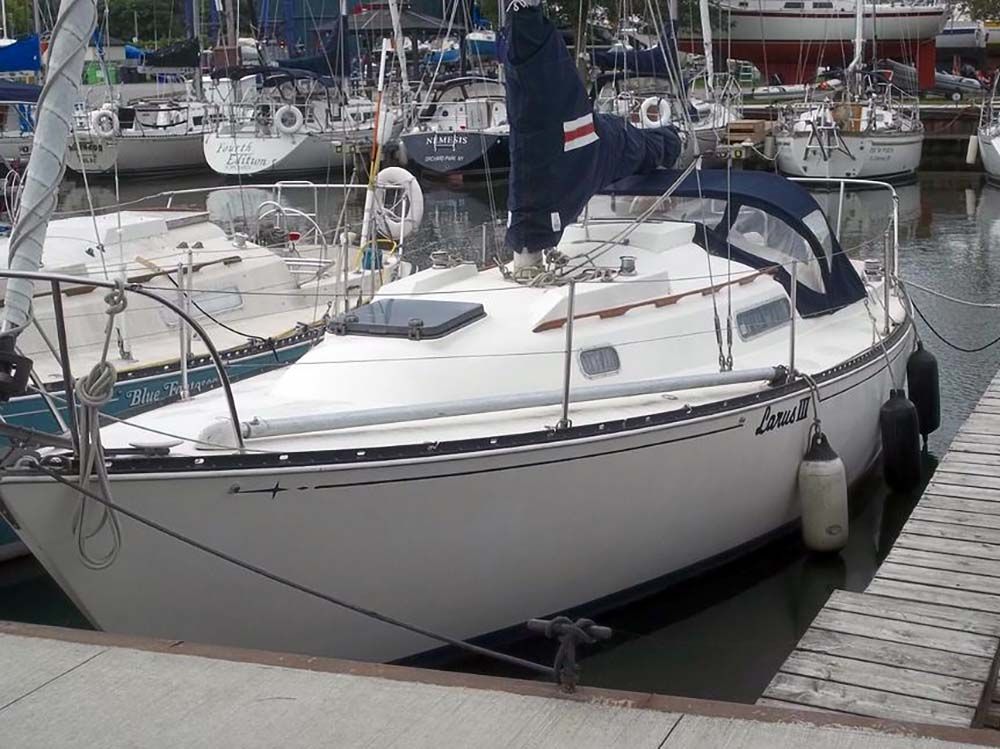
The C&C 30 is a classic 30-foot racer-cruiser that sits in the sweet spot between club competition and comfortable coastal cruising. Launched in the 1970s by C&C Yachts and shaped under the C&C design office (with early lines overseen by George Cuthbertson and later development by Robert W. Ball), the original Mk I enjoyed a long production run and strong owner following—more than 800 boats were built between the early 1970s and mid-1980s. Designed to be fast for its size yet forgiving, it was aimed at active weekend sailors who wanted a capable club racer that would still take a family on multi-day trips. Over the decades the 30 has remained visible on the used market: it appeals to owners who value solid construction and sailing performance, and it still turns up regularly among private sellers, broker listings and regional fleets.
Design and Construction
C&C drew the 30 as a masthead-sloop with a relatively fine entry and a moderate-to-full keel/fin combination that evolved during the Mk I run (early hulls had swept keels and an aft-swept rudder arrangement; later boats received modest rudder and rig changes). This hull and appendage philosophy gives the boat a predictable helm and a balance between pointing ability and downwind control. The majority of the Mk I hulls are solid fiberglass below the waterline with changes and small upgrades through the production life; later C&C models and variations experimented with different core materials and keel shapes. These construction choices make the 30 robust and straightforward to repair compared with some cored designs, but the age of the fleet means individual maintenance histories vary widel.
From an architectural standpoint, C&C emphasized a stiff hull and generous ballast (for the era) to deliver good righting moments and race-friendly sail area. The deck layout is racer-friendly: short cockpit lines to sheeting, accessible winches, and room for crew work. For a potential buyer this translates into two practical considerations: (1) the boat is relatively easy to tune and upgrade for performance sailing, and (2) the conservative structural approach used on early hulls typically lowers long-term repair complexity and helps preserve residual value if the boat was well maintained.
Performance
On the water the 30 is widely described as lively and capable of punching above its class—able to carry canvas and accelerate in puffs, yet not twitchy in a seaway when well trimmed. In moderate winds she will often outpace heavier contemporaries, and the hull form resists hobby-horsing, which helps comfort on longer coastal legs. Offshore in a confused sea the boat’s moderate beam and ballast produce a steady motion that many owners find confidence-inspiring; in strong conditions experienced crews can push the boat hard under reduced sail and still maintain control. Reports from reviews and owner groups consistently praise its balance and ability to handle a range of conditions without excessive weather helm or hobby-horsing.
Compared with modern 30-foot cruisers the 30 is perhaps not as spacious or as forgiving downwind in light air, but its underbody rewards a crew that understands trim and sail selection. For buyers who plan a mix of club racing and coastal cruising, the C&C 30 offers a performance edge with manageable systems and handling characteristics that suit a small crew.
Comfort and Accommodations
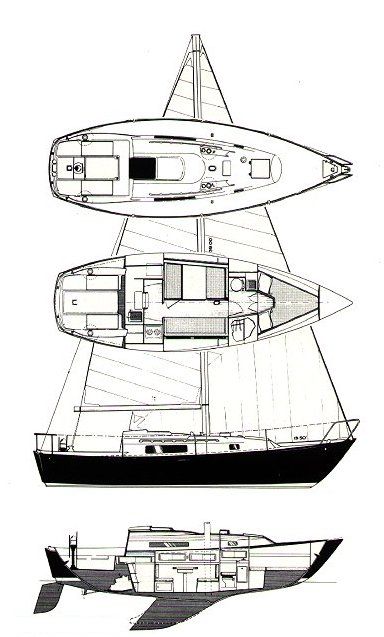
Belowdecks the 30 reflects its era: efficient use of volume rather than voluminous living quarters. Typical arrangements put a forward V-berth, a main salon with settees that double as sea berths, a compact galley and a quarterberth or storage area aft. Storage tends to be clever but not abundant, and headroom is appropriate for a 30-foot design—comfortable for weekend cruising, less generous for long-term liveaboard life unless the owners are prepared to accept cozy quarters and clever storage upgrades.
Ventilation and natural light are adequate for coastal cruising, and the interior finishes on well-kept boats often age gracefully; however, many boats in the market show the common pattern of targeted refits—new cushions, updated galley gear, and modern electronics—so expect to see variation between “period original” and “refitted” examples. For a couple or small family the layout is practical: comfortable for weekends and short cruises, and workable for longer passages if systems and storage have been thoughtfully upgraded.
Safety and Practicality
Deck ergonomics and cockpit design on the 30 favor active sailing: a cockpit that keeps crew within reach of winches and lines, secure handholds, and a relatively low center of gravity make movement aboard safer in most conditions. The original rig and winch setup allow easy reefing and sail handling with a short crew, which is a plus for single- or two-handed owners. For offshore work, owners often recommend some targeted upgrades—stoutstanding lifelines, updated navigation electronics, and checked/strengthened chainplate and mast step areas—but the hull’s inherent seaworthiness gives a solid baseline for coastal or limited offshore passages.
Access to systems (engine, tanks, steering mechanics) is straightforward on most examples, which reduces annual yard bills for routine maintenance. That said, the age of the fleet means that ease of maintenance depends heavily on how previous owners treated core items like through-hulls, seacocks and chainplate bed-sealing.
Known Issues with the C&C 30
Because these boats are several decades old, a handful of recurring maintenance topics appear in surveys and owner forums. Osmotic blistering and localized gelcoat issues are often mentioned for boats kept in saltwater without periodic attention—this is not unique to the 30, but given the boat’s age it’s commonly flagged in surveys. Chainplate leaks, mast step or companionway moisture and related rot have been reported in some cases where bedding and sealing were overlooked; a thorough survey should check bulkheads and deck/hull fittings.
Many early 30s were delivered with the Atomic 4 gasoline engine, a unit that many buyers elect to repower with a modern diesel (Yanmar/Volvo) for reliability and fuel-type convenience—this replacement can be costly and should be budgeted for if the current engine is original. Rudder pintle/shaft wear and higher-than-expected moisture readings in deck or cabin tops have also turned up on surveys; such defects are typically repairable but can be time-consuming. In practice, common recommended upgrades on older boats include renewed through-hull bedding, new or serviced standing rigging, updated electronics, and a careful look at propeller and shaft condition.
Market Availability and Pricing in the U.S.
The original C&C 30 Mk I is out of production and appears only on the used market; a later Mk II and specialized “Mega/One-Design” variants exist but are less common. The Mk I shows up often in broker and private listings in the Northeast (New England), the Great Lakes, and on both U.S. coasts—the pattern reflects where the C&C community and active clubs remain strongest.
Pricing for the classic Mk I examples varies with condition, refit history and region, but current listings typically cluster in the low four-figure to mid-five-figure range; a practical price band to use when shopping is $8,000–$30,000 for Mk I examples in the U.S., with exceptional refitted or special variants above that range.
Below is a short comparison table that places the C&C 30 against three peers that buyers commonly consider. (Prices are typical used ranges on U.S. listings at the time of this review.)
| Model | LOA | Year (approx.) | Typical used price (USA) | Main differences |
|---|---|---|---|---|
| Catalina 30 | ~29.9 ft | 1970s–1990s (Mk I–MkIII) | $8,000–$40,000 | Roomier interior, more cruising-oriented, widespread parts & community support. |
| Hunter 30 | ~29–31 ft (various Hunter 30 models) | 1970s–1990s | $8,000–$30,000 | Often more cruising-focused deck/galley layouts; variable build approaches across models. |
| Pearson 30 | ~30 ft | 1970s | $7,000–$15,000 | Simpler design, often lighter rigs, typically lower asking prices but with smaller owner networks. |
C&C 30 vs Catalina 30

The C&C 30 was drawn with a racer’s sensibility, prioritizing a stiffer hull and a keel/rudder configuration that rewards active trimming and tactical sailing; the Catalina 30, by contrast, leans more toward comfortable cruising with a broader interior and often a more forgiving, less race-oriented underbody. In practice that means an owner who wants lively club racing and sharper pointing will feel at home on the C&C, whereas a family desiring extra locker space and a softer motion in short-handed cruising will often prefer the Catalina. The Catalina’s community and aftermarket support for cruising upgrades is broad, which helps owners with liveaboard conversions and comfort refits; the C&C community, however, tends to be concentrated among performance-minded sailors who value tuning and hull integrity.
Maintenance expectations differ: Catalinas frequently show simple corrosion and wear issues, but their more common configurations (inboard diesels, accessible systems) and high parts availability often lower yard time for routine work. The C&C can be easier to keep structurally sound because of its conservative laminate schedules, but older C&Cs sometimes need attention to things like chainplate bedding, mast step areas and any original gasoline engines—issues that, if addressed proactively, preserve the model’s performance advantage and resale appeal.
► Learn more about de Catalina 30
C&C 30 vs Hunter 30

A C&C 30 and a Hunter 30 live in the same size category but embody different design priorities: C&C skewed to race-cruise performance and head-turning helm balance, while Hunter models often prioritized cockpit comfort, simplified sail handling and cruising ergonomics. For a buyer who plans to race in club fleets and wants a responsive, tuneable platform, the C&C’s underbody and rigging layout provide tangible advantages; if the primary use is relaxed family weekends, the Hunter typically offers more creature comforts and easier single-handing features.
From an ownership and maintenance perspective, Hunters can be attractive because many were built with cruising conveniences in mind and often have less extreme sailplans, which reduces wear on standing rigging and sails. The C&C’s upside is its conservative structural approach—owners and surveyors often praise the hull integrity—so while a Hunter might be cheaper to fit out for comfort, a C&C that’s been properly maintained tends to hold performance value and attract buyers seeking a sporty 30-footer.
► Learn more about de Hunter 30
C&C 30 vs Pearson 30

Compared to the Pearson 30, the C&C typically presents a more performance-oriented package: sharper underbody sections in the C&C give it an edge in pointing and acceleration, while the Pearson often offers a simpler, lighter layout better suited to economical cruising. Buyers who place a premium on sailing performance, club racing or a more precise helm will prefer the C&C; those who want the least complicated ownership experience and lower operating costs may gravitate toward a well-kept Pearson.
In terms of practical ownership, Pearsons are often found at lower price points and are simple to maintain, which appeals to cost-conscious buyers or DIY owners. The C&C, while potentially more demanding in terms of tuning and periodic racing-style upkeep, returns value in its stronger market recognition among racers and the potential to be upgraded for better resale in the performance niche.
► Learn more about de Pearson 30
Maintenance Costs of a C&C 30 in the U.S.
Typical annual and periodic costs for an older 30-footer like the C&C 30 vary by region and owner approach, but the following annotated list gives practical ranges you can use to budget.
- Slip / Marina fees: $1,000–$8,000 per year. Coastal marinas (New England, Florida, California) push the high end; inland lakes and the Great Lakes are at the low end. Expect seasonal vs year-round billing to change totals.
- Insurance: $300–$1,500 per year depending on coverage limits, navigation area and owner experience. Higher values if kept in saltwater and used offshore.
- Haul-out, bottom prep & antifouling (every 1–3 years): $800–$3,500 depending on haul fees, paint chosen and extent of work; strip and barrier systems cost more. Budget higher if you trailer or winterize inland.
- Engine service / repower reserve: Routine diesel service $300–$1,200 per year; a repower (if needed) can run $8,000–$20,000+ depending on new engine selection and work required. Atomic 4 to diesel swaps are typically at the high end.
- Sails and rigging: Annual inspections and small repairs $200–$800; new standing rigging every 10–20 years $1,500–$4,000; a complete new mainsail or headsail can be $1,500–$4,000 each depending on material.
- Electronics & safety gear refresh: $500–$5,000 over several years for chartplotter, AIS, VHF, autopilot service or replacement. Modernizing electronics is a common value-add for older 30s.
- Miscellaneous maintenance / consumables: zincs, filters, small carpentry, canvas, annual hull cleaning—plan $500–$2,000 per year depending on saltwater use and DIY level.
Regions with high marina costs or long seasons push the total annual running cost up; owners who do a large proportion of maintenance themselves (DIY) can often keep annual operating costs in the $3,000–$6,000 range, while boats kept professionally serviced and moored year-round can easily exceed $8,000–$10,000remains economical for budget-minded sailors.
f you’re comfortable with mechanical and rigging work, the C&C 30 is very much a DIY-friendly platform—systems are accessible and the conservative construction helps—but expect to hire professionals for heavier tasks (engine repower, major osmosis treatment, complex structural repairs). Overall maintenance costs for a C&C 30 are medium for its size: not as cheap as a stripped-down project boat, but lower than that of larger, more complex yachts. When maintained and documented, the model’s resale value tends to reward sensible investment in rigging and systems
Conclusion
The C&C 30 is a compelling compromise for buyers who want a true racer-cruiser in the 30-foot class: it combines proven structural pedigree, rewarding sailing characteristics and a market that recognizes well-maintained examples. Strengths include its solid construction, sensible underbody and an engaging sailing feel; weaknesses are mainly age-related—engine repowers, potential gelcoat/osmosis attention and routine updates to rigging and electronics. For a sailor who plans a mix of club racing and coastal cruising, the C&C 30 is often worth seeking out, provided a careful survey confirms no expensive structural issues.
As a purchase proposition the boat represents good value for performance-minded buyers: it’s generally affordable on the used market, parts and expertise are available, and a conscientious refit will typically preserve or increase resale value. For pure liveaboard comfort or bluewater-heavy programs you might prefer a larger, roomier cruiser, but for coastal cruising with a sporty edge the C&C 30 remains a practical, rewarding choice.
Specifications
| Hull Type | Fin w/spade rudder |
| Rigging Type | Masthead Sloop |
| LOA | 30.00 ft / 9.14 m |
| LWL | 24.92 ft / 7.60 m |
| S.A. (reported) | 459.00 ft² / 42.64 m² |
| Beam | 10.00 ft / 3.05 m |
| Displacement | 8,000.00 lb / 3,629 kg |
| Ballast | 3,450.00 lb / 1,565 kg |
| Max Draft | 5.00 ft / 1.52 m |
| Construction | FG |
| Ballast Type | Lead |
| First Built | 1973 |
| Last Built | 1985 |
| # Built | 800 |
| Builder | C&C Yachts (CAN) |
| Designer | C&C |
| Auxiliary Power / Fuel | Various, 20 gals / 76 L |
| Water Tanks | 42 gals / 159 L |
| Headroom | 6.08 ft / 1.85 m |
| Hull Speed | 6.69 kn |
| S.A. / Displacement | 18.42 |
| Ballast / Displacement | 43.13% |
| Comfort Ratio | 21.77 |
| Capsize Screening Formula | 2.00 |
| Sail Number (S#) | 2.51 |
| Pounds / Inch Immersion | 890.42 lb/in |
| Rig Dimensions (I/J/P/E) | I: 39.00 ft, J: 13.50 ft, P: 34.00 ft, E: 11.50 ft |
| Sail Area Fore | 263.25 ft² / 24.46 m² |
| Sail Area Main | 195.50 ft² / 18.16 m² |
| Sail Area Total | 458.75 ft² / 42.62 m² |
| Estimated Forestay Length | 41.27 ft / 12.58 m |
| Mast Height from DWL | 42.50 ft / 12.95 m |
Disclaimer
The considerations and analyses presented regarding the C&C 30 sailboat are of a general nature and are based on the available information and technical data on this model, interpreted to the best of our knowledge and understanding. It is important to note that the specific characteristics of any particular sailboat may vary due to custom modifications, maintenance performed, and conditions of use over time, among other factors. Therefore, the details and performance of the boat you are considering may not exactly match the information provided here.
We strongly recommend that, before making any purchasing or usage decisions, you conduct a detailed inspection of the boat in question, consult with nautical professionals and other sailors, and consider your personal needs, expectations, and capabilities. Each sailboat may have unique particularities that affect its performance and suitability for different types of sailing and sailors.
The information contained in this analysis should be used as a general guide and not as a definitive reference. Professional evaluation and personal inspection are essential to ensure that the boat meets your specific requirements and expectations.