



The Hunter 36 is a family-oriented cruising sailboat that first appeared as a John Cherubini–designed production yacht in the early 1980s; it was built as a purposeful cruiser with enough performance to satisfy weekend racers and blue-water aspirants alike. Over the decades the “36” name has been reused by Hunter for different designs (Vision, Legend, and the later 36-2/36 models by Glenn Henderson), so buyers will often encounter several distinct hulls under the same model number; this review focuses on the original Cherubini 36 while calling out how later Hunters shifted toward wider beams, more modern rigs and cockpit-centric controls. The original Hunter 36 was aimed at owners who wanted a solid, comfortable cruiser with a respectable turn of speed and conventional, serviceable systems—people who sail weekends, cruise the coast and occasionally step out to offshore passages. Today examples of the model (and its later namesakes) show up regularly on the used market: older Cherubini boats trade for modest sums and newer Vision/Legend/36-2 examples command higher prices, and demand tends to come from private cruisers, coastal live-aboards and club racers rather than large charter fleets.
Design and Construction
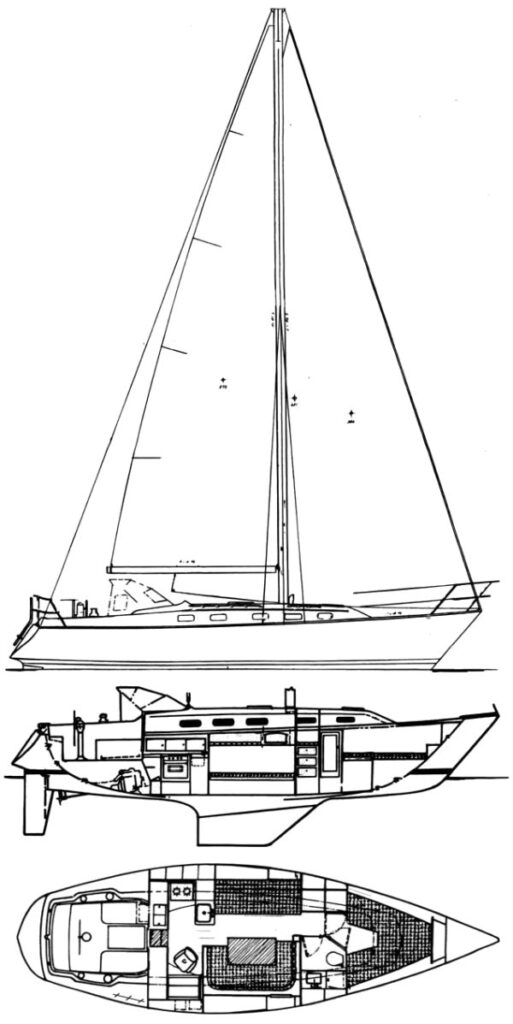
The original Hunter 36 is a solid fiberglass monohull with a fin keel and an internally mounted spade rudder, paired with a conventional mast-and-boom sloop rig (the Cherubini boats are typically masthead sloops). That combination provides a predictable balance between stiffness and maneuverability: a substantial ballast ratio and moderate beam yield good initial stability, while the fin keel and spade rudder give relatively quick steering response—traits appreciated when threading marinas or dancing through harbor chop. Construction is production-style hand-laid fiberglass with wood trim below, and later Hunters adopted wider beams and B&R fractional rigs with more deck hardware routed aft for shorthanded sailing; understanding which sub-model you’re looking at matters because layout, keel depth and rigging details change maintenance and sailing expectations. From an owner’s perspective the solid-hull construction simplifies long-term upkeep—fiberglass repairs, blister treatment and keel-bolt inspections are straightforward comparative to cored-deck problems—while interior joinery and systems are easy to access for routine work. These hull and rig choices translate into a craft that is durable, repairable in modest yards, and retains value as a sensible coastal cruiser rather than a high-performance specialty boat.
Performance
On the water the Cherubini Hunter 36 is best described as an honest cruiser with surprising vigor: its waterline and sail area produce theoretical hull speeds in the high-6s to low-7s (knots) and owners routinely report comfortable 6–7 knot cruising in moderate conditions. The fin keel and spade rudder let the boat point respectably to windward for its era, and the displacement delivers a steady, sea-kindly motion when the sea builds—less lively than modern light-displacement 36-footers but more forgiving in confused chop. In light airs the boat will lag behind newer, more powerful fractional rigs, yet when the breeze pipes up the hull carries momentum well; the later Hunter Legends and 36-2 models trend toward lighter sections and larger sail areas, giving them an edge in acceleration and race-course responsiveness. Handling is predictable: wheel steering and moderate helm loads suit owners who favor comfortable cruising and occasional club events rather than aggressive inshore racing. Overall the 36 sits in the middle of the market—faster and stiffer than many 1970s production cruisers, but softer and less “race tuned” than contemporary performance cruisers.
Comfort and Accommodations
Below decks the Hunter 36 was laid out with cruising comfort in mind: roomy saloon settees, a full-length galley, sizable water and fuel tanks on many examples, and often a private aft cabin or large v-berth forward depending on the interior plan. Headroom and storage are generous for a production 36 of that era, which makes provisioning and live-aboard tasks straightforward for couples and small families; many owners report the saloon becomes the social center on weekend cruises, and the galley arrangement is practical for actual meal prep underway. Ventilation relies on ports and deck hatches typical of the 1980s build era, so modest upgrades (screens, a 12V fan or LED lighting) make a big comfort difference for modern owners. The interior ages well if kept dry—dense joinery and conservative layouts mean refits are often cosmetic (cushions, upholstery, galley surfaces) rather than structural. For long-term liveaboard use the boat can work with careful gear staging and upgrades to systems, but it’s happiest as a serious weekend-to-coastal cruiser rather than an unabashed ocean-crossing liveaboard without investment in systems upgrades.
Safety and Practicality
Deck ergonomics on the original Hunter 36 emphasize safe crew movement: a reasonably deep cockpit, secure toerails, and a wheel layout that keeps lines and winches within reach for shorthanded crews. The fin keel and moderate draft balance harbor access with offshore manners, but prospective buyers should inspect keel bolts and keel-to-hull bedding as part of any survey—these are routine but important checks on older production keelboats. Systems access—engine compartments, tanks and electrical panels—is generally straightforward, which reduces yard time and contractor costs when servicing the Yanmar/Perkins style diesels commonly fitted. For coastal cruising and moderate offshore passages the boat is more than capable with standard gear; for serious blue-water work owners typically upgrade tankage, add water-maker or heater options, and beef up storm-sail and rigging inventories. In short, the 36 is a practical, safe platform for coastal family cruising and occasional offshore work when prepared properly, and it is easily managed by small crews.
Known Issues with the Jeanneau Hunter 36
Like many production boats from the 1980s, common issues are predictable and usually manageable: deck hardware and portlight leaks that need careful rebedding, surface blistering in older gelcoat areas (less common on solid-hull Cherubini boats but worth inspecting), and routine aging of standing and running rigging. Inboard engines on older Hunters often need attention—regular fuel, cooling and exhaust work—and owners replacing older electrics and instruments is a frequent theme on the for-sale ads. Keel-bolt corrosion and the condition of the rudder bearings or shaft seals are typical survey items; while not catastrophic, they can be a significant mid-level expense if deferred. Recommended upgrades for buyers include a modern electrical panel and battery bank, new chainplates/portlight rebedding where suspect, updated navigation electronics, and a fresh suit of sails if the current inventory is over a decade old—these investments materially improve reliability and resale appeal. Overall the boat’s faults are not unusual for its age and are usually fixable with targeted work rather than expensive structural surgery.
Market Availability and Pricing in the U.S.
The original Hunter 36 is out of production, but Hunters of various “36” vintages—Cherubini 1980 models, Vision/Late-90s, Legend (2001) and the 36-2 (2008)—are commonly offered in the U.S. used market. Geographic distribution is broad: Cherubini boats tend to appear in older East Coast and Great Lakes listings, while Vision/Legend/36-2 examples turn up in Florida, the Southeast and West Coast brokerage inventories. Condition ranges widely from economical project boats to well-equipped coastal cruisers and turnkey refits. Based on recent U.S. listings across major broker sites, expect an asking-price band roughly $12,000–$135,000, with Cherubini-era boats at the low end and later, well-equipped Legend/36-2 examples toward the top. Compared to contemporaries, the Cherubini Hunter 36 can offer strong value for buyers seeking a comfortable, sea-kindly cruiser at a modest price; the later Hunters command more for modern ergonomics and factory options, and resale liquidity is best in active coastal and Great Lakes markets where Hunter support and owner familiarity are strongest.
Below is a reasoned comparison table showing three commonly considered alternatives in the same length/class; entries give typical used price ranges (U.S.) and the principal differences that matter when choosing.
| Model | LOA | Approx. build years | Typical U.S. used price | Principal differences |
|---|---|---|---|---|
| Hunter 36 (Cherubini) | ~36 ft | 1980–1983 | $12k–$40k (Cherubini examples); higher for later Hunter 36 variants. | Solid fiberglass, traditional cruiser balance, good tankage and storage; straightforward systems. |
| Catalina 36 | 36 ft | 1982–2008 (various marks) | $25k–$100k depending on year/condition. | Very large owner base, roomy interior, forgiving motion; many inboard/instrument options. |
| Beneteau Oceanis 361 / 361 Clipper | ~36 ft | Late 1990s–2000s | $65k–$120k typical | More modern hull sections, lighter displacement, performance-oriented cruising comforts but higher spec costs. |
| Hunter 36 Legend | ~35.7 ft | 2001 (and similar years) | $50k–$120k (condition & gear dependent) | Wider beam, B&R rig, cockpit comforts and factory options that favor shorthanded cruising. |
Hunter 36 vs Catalina 36

The Hunter 36 (Cherubini) and the Catalina 36 occupy much of the same market: comfortable family cruisers around 36 feet, but they approach the brief differently. The Hunter emphasizes a slightly stiffer, performance-minded hull for its era with a fin keel and a tendency to accelerate well in stronger breeze; the Catalina often trades a bit of nimbleness for a more voluminous, forgiving hull form and enormous owner support network. The Hunter’s deck layout and systems generally favor easier access for maintenance and slightly sportier handling under sail, while the Catalina’s interior space and storage often beat the Hunter for extended family provisioning and cruising comfort.
For a buyer who plans frequent short passages, club racing and values responsive helm feel, the Hunter will feel rewarding; for someone prioritizing roomy accommodations, widespread parts availability and a “small big-boat” feel, the Catalina is compelling. Maintenance considerations diverge: the Hunter’s simpler, serviceable systems reduce shop hours, while many Catalinas with inboards and popular upgrades can incur more routine engine and electrical service. Resale liquidity favors Catalina in markets where its fleet is large, but a clean Hunter priced attractively moves fast in active local fleets.
► Learn more about de Catalina 36
Hunter 36 vs Beneteau Oceanis 361

Comparing the Cherubini Hunter 36 to a Beneteau 361 (or similar Oceanis models) highlights differences born of design era and intended buyer: the Beneteau takes advantage of later hull-form advances to offer longer waterlines, flatter aft sections and larger interior volume, delivering better light-air performance and more modern ergonomics. The Hunter’s conservative hull and heavier displacement give it a steadier motion in confused seas and simpler systems that many DIY owners prefer; the Beneteau, by contrast, will typically feel quicker off the wind and more responsive in light airs but may demand higher rig and sail maintenance to extract that performance. Inside, the Beneteau usually presents brighter, more open accommodations with a contemporary layout that favors social use and easy movement, while the Hunter’s joinery and storage are robust and sometimes more conservative in finish.
Ownership costs split by focus: the Beneteau’s systems and higher spec level can raise annual upkeep and replacement-part bills, whereas the Hunter’s straightforward equipment often keeps running costs lower if the owner does routine maintenance. For buyers chasing weekend racing plus comfortable cruises, the Beneteau’s modern performance helps; for those favoring a stable, roomy traditional cruiser with less mechanical overhead, the Hunter is a practical, cost-sensible choice.
► Learn more about de Beneteau Oceanis 361
Hunter 36 vs Hunter 36 Legend

Comparing the original Hunter 36 with the later Legend 36 is effectively a “same brand, different generation” conversation: the Legend adopts modern hull forms, a wider beam and the B&R fractional rig to make shorthanded handling easier and to boost interior volume and cockpit ergonomics. The Cherubini hull remains the more traditionally balanced cruiser with straightforward maintenance and a proven offshore pedigree, while the Legend prioritizes on-deck comfort, lighter helm loads and factory options that appeal to family cruisers who rarely want to wrestle with large headsails. Under sail, the Legend’s rig and increased sail area profile often translate to better light-air performance and simpler mainsail control for short-handed crews; the original 36, with its heavier lines, rewards seamanship and carries momentum in seas better with heavier loads. Inside, the Legend often feels roomier and more modern, but the Cherubini’s joinery and tankage can be more utilitarian and robust—an advantage for owners planning serious passage work.
Maintenance-wise, the Legend’s extra systems and options can increase service items, whereas the original 36’s fewer complexities usually reduce dock-side bills. Buyers who want a more contemporary, easy-to-sail family cruiser will lean to the Legend; those who value a straightforward, sea-proven platform at a lower purchase price will find the original Hunter 36 compelling.
► Learn more about de Hunter 36 Legend
Maintenance Costs of a Hunter 36 in the U.S.
A typical annual or periodic cost breakdown (ranges approximate; regional differences are significant):
- Slip/Mooring: $2,000–$6,000/year in high-demand coastal marinas; $1,200–$3,000/year on inland lakes or more basic marinas. Costs vary heavily by region and amenities.
- Insurance: $400–$1,200/year for comprehensive hull and liability on a well-maintained 36-footer; age, cruising area and declared value shift premiums.
- Engine service (inboard diesel): $400–$1,200/year for routine service (oil, filters, impeller checks); major jobs (heat exchanger, injectors) can run $1,000–$5,000 when needed.
- Antifouling + haul-out: $800–$2,000 per haul and bottom job in many U.S. yards; frequency depends on water and usage (annual in warm saltwater, 18–24 months in cold water).
- Rigging and sails: Standing-rigging inspections $300–$700; full rig replacements often $3,000–$6,000 depending on parts and labor; a new cruising sail wardrobe typically $4,000–$8,000.
- Electronics & electrical: Minimal maintenance $100–$300/year; targeted upgrades (chartplotter, AIS, instruments) typically $1,000–$5,000.
- Other (rebedding, thru-hull valves, small structural work): DIY materials $200–$800/year; professional projects (rebedding, keel-bolt service, small osmosis repairs) $500–$5,000 depending on scope.
A 36-foot production cruising boat generally lands in the medium bracket for ownership costs: if you do the majority of work yourself the annual outlay can stay in the mid-four-figures; outsourcing routine yard and systems work pushes that into the high four- to low five-figure range some years. The Hunter 36’s relatively simple systems and good access make it a strong candidate for owner-maintenance (which reduces ongoing costs), and sensible investments in sails, rigging and sealing upfront usually repay through reliability and better resale
Conclusion
The Hunter 36 is a sensible, well-rounded production cruiser that balances sea manners, interior comfort and maintainability in a package attractive to coastal cruisers and small families. Its strengths are a sea-worthy hull form, practical interior volume for its era, straightforward systems that an owner-mechanic can maintain, and good resale prospects where Hunter models are well known. Weaknesses are largely age-related—worn rigging, dated electronics and the typical deck-hardware leaks and rebedding jobs—but these are predictable and fixable with a focused survey and modest refit budget. For buyers seeking a comfortable coastal cruiser that can handle occasional offshore work without exotic maintenance demands, it’s a model worth seeking out; for owners prioritizing modern light-air speed or the latest onboard systems, newer hulls (including later Hunter Legends or contemporary Beneteaus) may better match expectations. In short: if you want a robust 36-footer that sails honestly, costs less to own than newer equivalents, and rewards sensible upgrades with reliable service and steady resale, the Hunter 36 is a practical and often cost-efficient choice.
Specifications
| Hull Type | Fin w/spade rudder |
| Rigging Type | Masthead Sloop |
| LOA | 35.92 ft / 10.95 m |
| LWL | 29.50 ft / 8.99 m |
| S.A. (reported) | 604.00 ft² / 56.11 m² |
| Beam | 11.08 ft / 3.38 m |
| Displacement | 13,500 lb / 6,123 kg |
| Ballast | 6,000 lb / 2,722 kg |
| Max Draft | 4.92 ft / 1.50 m |
| Construction | Fiberglass (FG) |
| First Built | 1980 |
| Last Built | 1983 |
| Builder | Hunter Marine (USA) |
| Designer | John Cherubini |
Sailboat Calculations | |
|---|---|
| S.A. / Displ. | 17.11 |
| Bal. / Displ. | 44.44 |
| Disp. / Len. | 234.76 |
| Comfort Ratio | 26.97 |
| Capsize Screening Formula | 1.86 |
| S# | 2.34 |
| Hull Speed | 7.28 kn |
| Pounds/Inch Immersion | 1,167.91 lb/in |
Rig and Sail Particulars | |
| I | 46.50 ft / 14.17 m |
| J | 14.75 ft / 4.50 m |
| P | 41.00 ft / 12.50 m |
| E | 12.75 ft / 3.89 m |
| S.A. Fore | 342.94 ft² / 31.86 m² |
| S.A. Main | 261.38 ft² / 24.28 m² |
| S.A. Total | 604.32 ft² / 56.14 m² |
| S.A./Displ. (calc.) | 17.12 |
| Est. Forestay Length | 48.78 ft / 14.87 m |
| Mast Height from DWL | 50.50 ft / 15.39 m |
Disclaimer
The considerations and analyses presented regarding the Hunter 36 sailboat are of a general nature and are based on the available information and technical data on this model, interpreted to the best of our knowledge and understanding. It is important to note that the specific characteristics of any particular sailboat may vary due to custom modifications, maintenance performed, and conditions of use over time, among other factors. Therefore, the details and performance of the boat you are considering may not exactly match the information provided here.
We strongly recommend that, before making any purchasing or usage decisions, you conduct a detailed inspection of the boat in question, consult with nautical professionals and other sailors, and consider your personal needs, expectations, and capabilities. Each sailboat may have unique particularities that affect its performance and suitability for different types of sailing and sailors.
The information contained in this analysis should be used as a general guide and not as a definitive reference. Professional evaluation and personal inspection are essential to ensure that the boat meets your specific requirements and expectations.