



The Hunter 36 Legend arrived in the early 2000s as Hunter Marine’s answer to cruisers who wanted a modern, voluminous 36-footer with simple handling. Designed by Glenn (Glen) Henderson and introduced around 2001, the Legend is positioned clearly as a cruising boat — not a race machine — aimed at couples and small families who prize interior comfort, easy short-handed sailing and sensible systems for weekend passages and extended coastal cruising. It saw steady uptake in both the U.S. and European second-hand markets because the boat blends generous tankage and a bright, well-appointed interior with deck ergonomics that most production yards could deliver at a realistic price. The basic facts on designer, builder and the Legend’s core specifications are summarized by standard reference sources.
Design and Construction
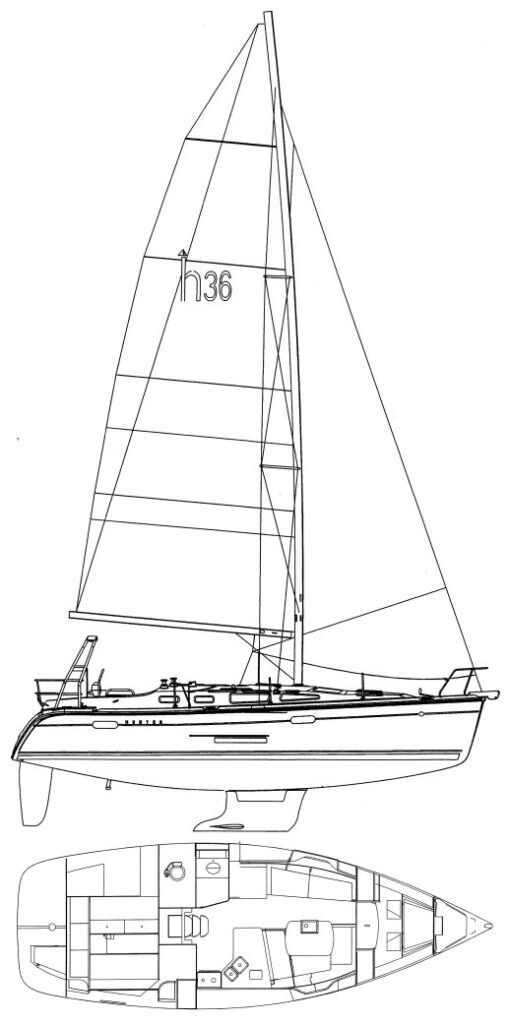
The Legend is a fiberglass monohull with a fin keel and a spade rudder, and it is commonly fitted with Hunter’s backstay-less B&R rig (a swept-back, supported mast that reduces the need for a running backstay). The hull is relatively beamy for its length, which buys interior volume and form stability at the expense of an ultra-narrow, easily driven underbody; displacement and ballast figures show a design aimed at comfortable carrying capacity rather than the lightness sought by performance cruisers. Construction is conventional production GRP with moulded interiors and typical Hunter finishing of the period; tankage and system runs were generous by 36-foot standards, which is one reason liveaboard buyers like the layout. These choices mean straightforward repairs for most yards (fiberglass, thru-hull work, standing rigging) but also flag the usual pre-purchase checks: deck-core integrity at deck penetrations and the mast step area, condition of seacocks and the rudder stock/shaft bearings where loads concentrate on a spade rudder.
Performance
On the water the Legend sits in the cruiser-cruiser category: sail-area/displacement ratios and hull form predict steady performance without racing-boat acceleration, and owner-reports confirm it will happily cruise in the mid-5 to 7 knot band under normal conditions. The fairly generous sail area (typical total area figures are in published specs) and the B&R fractional rig deliver good drive in moderate winds, but the large mainsail means prudent skippers reef earlier than on smaller-mains designs if they want easy, relaxed sailing in a gusty chop. In light airs it won’t outpace newer light-displacement designs, but its heavier feel and ballast deliver a reassuring sense of stiffness when storing canvas and gear for family cruising; reviewers have noted predictable tracking and solid off-wind manners, while also pointing out that the cockpit’s openness and the boat’s motion make her most comfortable as a marina-hopping weekender or coastal cruiser rather than a continuous bluewater boat without upgrades.
Comfort and Accommodations
Where the Legend really scores is below: the interior is bright, airy and intentionally voluminous — cabins and stowage are large for the class, with features that were generous for a production 36 (sprung mattresses, sizable refrigeration, pressurized hot water and often a separate shower stall in many factory spec lists). Tankage is also useful for cruising: fuel and water capacities were sized to support extended trips between harbors. Ergonomically the galley and nav station are laid out for practical use under way or at anchor, and families appreciate the saloon circulation and berthing options. That said, the fit and finish reflect production-boat economics of the era; many owners choose modest refits (ventilation fans, upgraded fridge systems, new upholstery) to bring habitability up to modern live-aboard expectations.
Safety and Practicality
Deck layout is aimed at safe, uncomplicated cruising: a wide cockpit, reachable winches and an uncluttered foredeck facilitate short-handing and make boarding and water access straightforward. The B&R rig removes the backstay and simplifies some sail-shape choices, but it concentrates loads differently into the mast step and chainplates — places to inspect carefully on an older boat. The published capsize screening number and comfort ratios place the Legend comfortably in the coastal-to-offshore cruiser bracket for competent owners, but some purchasers who plan extended ocean passages invest in reinforcement (rigging refresh, upgraded steering components, redundant navigation/electrics) before attempting longer bluewater legs. Access to systems (engine bay, seacocks, batteries) is generally reasonable for a production 36 and helps keep routine servicing costs predictable.
Known Issues with the Hunter 36 Legend
Most of the recurring complaints are age-and-use related rather than unique blind spots in the hull form. Owners’ threads and survey reports commonly call out: the need to monitor deck-core and mast-step seals (to prevent soft spots and leaks), the large mainsail and associated reefing management, and the usual diesel-age issues (starter, heat exchangers and injectors) on older inboards. Some sailors report sensitivity to propeller-placement vs rudder position (slight sluggishness in backing or close-quarters response on certain saildrive setups), and like many production boats from the period you’ll find a range of previous owner upgrades and system quality — from well-refitted examples to those needing a comprehensive systems overhaul. Practical, commonly recommended upgrades include routine standing rigging replacement on schedule, modernizing electronics/navigation for safety and resale, and (where relevant) changing to a more efficient prop or sail inventory tuned to the owner’s preferred wind range.
Market Availability and Pricing in the U.S.
The Hunter 36 Legend is no longer in production and circulates on the used market; examples appear periodically on broker sites and dealer listings, with stronger concentrations in traditional cruising hubs (Florida, Chesapeake/Southeast, New England and the Pacific Northwest). Recent public listings and broker snapshots suggest a practical U.S. asking range of about $50,000–$90,000 depending on year, equipment level and condition, with cleaned-up, well-equipped examples towards the top of that band. That range positions the Legend competitively versus contemporaries: you often pay a premium for newer factory systems or a recent refit, while simpler, project boats trade cheaply. Hunters have a broad owner base and active owner groups, which tends to keep parts and advice available — a positive when you plan to sell later on. Sample listings and market searches show active inventory and brokered sales in the ranges cited.
Below is a reasoned comparison table showing three commonly considered alternatives in the same length/class; entries give typical used price ranges (U.S.) and the principal differences that matter when choosing.
| Model | LOA | Typical build years | Typical US used price | Main differences |
|---|---|---|---|---|
| Hunter 36 Legend | ~35.7′ (35’8\”) | ~2001–mid-2000s | $50k–$90k | Backstay-less B&R rig, very voluminous interior, coastal cruiser with sensible tankage and practical deck layout. |
| Catalina 36 (Mk I/II) | ~36′ | mid-1980s – 2000s (various marks) | $30k–$110k | Classic American cruiser with simple systems and a huge resale pool; generally easier to maintain but older styling and variable equipment. |
| Hunter 356 | ~35.5′ | early-2000s | $45k–$80k | Sister-brand family cruiser with modern conveniences and an emphasis on easy handling; slightly lighter displacement and a focus on short-handed ergonomics. |
| Beneteau Oceanis 361 | ~36.1′ | late-1990s – 2000s | $65k–$110k | European cruiser with comparable volume and often newer factory systems; hull tuning and finish choices differ, with some owners preferring Beneteau’s motion and deck hardware layout. |
Hunter 36 Legend vs Catalina 36

The Legend emphasizes modern (for the era) deck ergonomics and a bright, European-styled interior that was designed around comfort and convenience; Catalinas of similar length tend to be simpler in systems and more conservative in finish, which can translate into lower immediate maintenance costs and an easier used-parts market.
If you prioritize interior volume, factory conveniences and a contemporary layout, the Legend usually wins; if you want the broadest parts market and the lowest bar to DIY maintenance, a Catalina 36 is often the more pragmatic, budget-friendly choice.
► Learn more about de Catalina 36
Hunter 36 Legend vs Hunter 356

Both Hunters aim at family cruising, but the 356 was built with a stronger emphasis on deck ergonomics and simplified short-handed handling; the Legend trades a bit more interior volume and slightly heavier displacement for a different balance of comfort vs. light-air performance.
For buyers who sail mostly as a couple and want a user-friendly deck and fewer systems to modernize, the 356 is attractive; buyers wanting maximum below-decks comfort and tankage for extended cruising legs will often prefer the Legend’s stowage and accommodation layout.
► Learn more about de Hunter 356
Hunter 36 Legend vs Beneteau Oceanis 361

The Oceanis 361 and the Legend occupy similar market positions, but Beneteau variants sometimes offer a slightly different hull tune and factory finish levels that give a softer motion and occasional system upgrades at the factory level.
Choosing between them usually comes down to condition and equipment: the Legend can be a better value if you find a well-maintained example with recent upgrades, while the Oceanis may edge ahead if you want factory-installed systems and a hull feel you prefer for offshore comfort.
► Learn more about de Beneteau Oceanis 361
Maintenance Costs of a Hunter 36 Legend in the U.S.
- Mooring / slip / storage: $2,000–$12,000 per year — cost varies hugely by region (inexpensive club moorings vs. premium marina berths in Florida or California).
- Insurance: $600–$2,500 per year — depends on cruising area, claims history and value/gear aboard.
- Engine servicing (routine): $400–$1,500 annually; major engine work or repower can be $3,000–$12,000.
- Antifouling / haul / bottom work: $600–$3,000 every 1–3 years depending on yard labor rates and condition.
- Standing & running rigging: $0–$300/year for inspections and small repairs; expect $3,000–$8,000 for scheduled standing rigging replacement (~10–15 year cycle).
- Sails: $0–$700/year for care and repairs; replacement inventory (main + jib) typically $3,000–$9,000 depending on quality and reefing systems.
- Electronics & systems: $500–$4,000/year for incremental repairs; a modern electronics refit (radar, chartplotter, AIS, autopilot) is commonly $4,000–$15,000 as a one-time upgrade.
Region matters: marinas and hauling are costliest in high-demand areas (Florida, southern California, parts of New England), while inland or less-developed regions are cheaper. Expect major one-time costs (rig replacement, new sails, a repower or a thorough refit) to dominate ownership budgets on an older boat. Many routine tasks (bottom paint prep, simple plumbing, varnish touch-ups, basic mechanical servicing) can be owner-performed to save money, but major structural work, rigging replacement and complicated diesel or electrical jobs are best left to professionals — which increases cost but preserves resale value. A practical budgeting approach for a well-kept 36-foot cruiser is to plan on medium total annual costs relative to its size (commonly estimated as roughly 5–10% of purchase price per year as a rule-of-thumb), with contingency funds for infrequent but expensive items.
Conclusion
The Hunter 36 Legend is a convincing option for buyers who want a 36-foot cruiser that leans toward comfort, tankage and easy living aboard rather than racing pedigree. Its strengths are a roomy, well-equipped interior, manageable deck ergonomics and a sensible balance of performance and load-carrying for coastal cruising; its weaknesses are largely the predictable maintenance and modernization items that come with a production boat of this era (deck-core attention, rig/engine age, and variability in previous owner care). For couples or small families seeking a practical coastal cruiser with occasional offshore capability — and who are realistic about inspection and sensible upgrades — the Legend is worth seeking out. On the used market it typically represents a fair value: mid-range asking prices and an active owner community help keep ownership practical, and a conscientious maintenance and upgrade plan will preserve resale value when the time comes to sell.
Specifications
| Hull Type | Fin w/spade rudder |
| Rigging Type | B&R |
| LOA | 35.73 ft / 10.89 m |
| LOD | 34.64 ft / 10.56 m |
| LWL | 31.53 ft / 9.61 m |
| S.A. (reported) | 721.00 ft² / 66.98 m² |
| Beam | 12.34 ft / 3.76 m |
| Displacement | 14,220.00 lb / 6,450 kg |
| Ballast | 5,075.00 lb / 2,302 kg |
| Max Draft | 5.00 ft / 1.52 m |
| Construction | FG |
| First Built | 2001 |
| Builder | Hunter Marine |
| Designer | Glen Henderson |
| Auxiliary Power (orig. equip.) | Diesel, 29 HP |
| Fuel | 38 gals / 144 L |
| Water | 75 gals / 284 L |
| Headroom | 6.42 ft / 1.96 m |
| S.A. / Displ. | 19.73 |
| Bal. / Displ. | 35.69 |
| Disp. / Len. | 202.53 |
| Comfort Ratio | 23.59 |
| Capsize Screening Formula | 2.04 |
| S# | 2.71 |
| Hull Speed | 7.52 kn |
| Pounds/Inch Immersion | 1,390.23 pounds/inch |
| I | 44.82 ft / 13.66 m |
| J | 13.16 ft / 4.01 m |
| P | 44.95 ft / 13.70 m |
| E | 15.00 ft / 4.57 m |
| S.A. Fore | 294.92 ft² / 27.40 m² |
| S.A. Main | 337.13 ft² / 31.32 m² |
| S.A. Total (100% Fore + Main) | 632.05 ft² / 58.72 m² |
| S.A./Displ. (calc.) | 17.29 |
| Est. Forestay Length | 46.71 ft / 14.24 m |
| Mast Height from DWL | 55.25 ft / 16.84 m |
Disclaimer
The considerations and analyses presented regarding the Hunter 36 Legend sailboat are of a general nature and are based on the available information and technical data on this model, interpreted to the best of our knowledge and understanding. It is important to note that the specific characteristics of any particular sailboat may vary due to custom modifications, maintenance performed, and conditions of use over time, among other factors. Therefore, the details and performance of the boat you are considering may not exactly match the information provided here.
We strongly recommend that, before making any purchasing or usage decisions, you conduct a detailed inspection of the boat in question, consult with nautical professionals and other sailors, and consider your personal needs, expectations, and capabilities. Each sailboat may have unique particularities that affect its performance and suitability for different types of sailing and sailors.
The information contained in this analysis should be used as a general guide and not as a definitive reference. Professional evaluation and personal inspection are essential to ensure that the boat meets your specific requirements and expectations.