



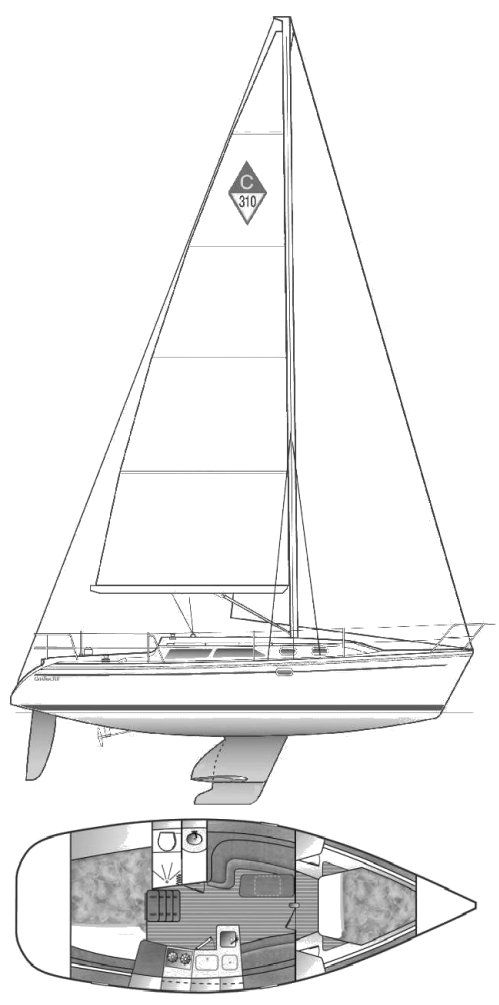
The Catalina 310 is a purpose-built coastal cruiser with enough performance DNA to please an active couple or small family that wants comfortable weekend sailing and occasional club racing. Designed by Gerry Douglas and launched at the end of the 1990s, the 310 was Catalina Yachts’ answer to buyers who wanted a well-appointed, easy-to-handle 30-foot cruiser with modern lines, good interior volume for the size, and simple systems that are economical to own. The model enjoyed steady popularity through the 2000s and today appears regularly on U.S. resale markets—it’s favored by private owners and cruising couples more than by charter fleets, and its practical mix of comfort, modest maintenance needs and a proven build pedigree keeps demand steady among coastal cruisers.
Design and Construction
Catalina sized the 310 around conservative, owner-friendly choices: a fiberglass monohull, available fin or wing keel configurations, and an internally mounted spade-type rudder. The hull and deck join, interior grid and tank placement reflect mainstream production practice—built to be strong, repairable in yard settings, and easy to maintain by an owner who performs routine work. Those structural choices produce a boat that is forgiving in handling and straightforward to survey: cored decks and the common fin/wing keel layout give a useful balance between stiffness, interior volume and draft flexibility, but they also create obvious inspection priorities (deck fittings, chainplates and keel-to-hull interfaces) that will influence long-term maintenance costs and resale. In short, Catalina’s construction approach trades the lightest possible weight for durability and serviceability—exactly the compromise many coastal cruisers value.
Performance
On the water the 310 is known for steady, predictable behavior rather than sharp racing performance: it gets up to speed in light to moderate air, tracks well on a reach, and offers a comfortable motion in a short to moderate chop. With a typical displacement around 10,000–10,700 lb and a beam of roughly 11’6″, the boat balances initial stability and sail area to produce a confident feel for a cruising couple; deeper fin keels improve windward ability while wing or shoal keels give access to shallower harbors at a small cost to pointing. PHRF and owner reports place the 310 in the middle of the pack for 30–32-foot production cruisers—quicker than heavier, more cruising-oriented designs but not as nimble as dedicated racer/cruisers—making it a reliable choice for passage comfort and occasional club racing when equipped with tuned sails.
Comfort and Accommodations
Catalina prioritized a roomy, well-lit interior for the length: a comfortable saloon, good galley ergonomics, a practical nav station and a sensible two-cabin layout make the 310 immediately livable for weekend trips. Tankage and storage were sized with cruising in mind (water capacity and practical locker solutions), so a couple or small family can provision for multi-day trips without contorting the living space. While the boat is not a liveaboard apartment, many owners find that modest upgrades—modern refrigeration, updated cushions, and current electronics—translate directly into better cruising satisfaction and stronger resale value; the original joinery and systems generally age well if maintained.
Safety and Practicality
The 310’s cockpit layout, sensible line runs and moderate freeboard make it safe for short-handed or family sailing: primary controls are within reach, the cockpit drains well, and the steering loads remain manageable for a single or couple crew. Systems access is typical for a production 31-footer—engine and tanks are accessible but compact, so routine maintenance is straightforward while major engine or propulsion jobs may require yard time. As built the boat suits coastal cruising and near-offshore work perfectly; owners planning serious offshore passages commonly add redundant electrics, upgrade navigation/communication gear and review all bedding points and seacocks as part of an offshore upgrade program.
Known Issues with the Catalina 310
Catalina 310s do not suffer from exotic structural problems, but surveyors and owner forums point to recurring, practical items to watch: mast-step and deck-penetration leaks, worn or aged standing rigging, and the usual soft spots around poorly bedded hardware. Practical Sailor and owner threads call attention to mast-step/load-grid checks and careful inspection of chainplates and seaports—issues that are common across many production boats of this era and are typically repairable when caught early. Routine engine maintenance, sail condition, and the occasional re-bedding of deck hardware are the most frequent seller-disclosed items; buyers who budget for these predictable service items (and who insist on a focused pre-purchase survey) are unlikely to encounter surprises.
Market Availability and Pricing in the U.S.
The Catalina 310 is no longer in production but remains widely available on the used market in the U.S. and Canada; examples show up regularly in Florida, New England and along the Gulf and West Coast via broker stock or private sales. Condition on listings varies—from very well maintained, lightly updated boats to project boats priced to move—so regional pricing reflects local demand and marina economics. Based on recent U.S. listings and dealer inventory, a practical pricing band for survey-passed, equipped examples is roughly $45,000–$75,000, with lower prices for boats needing work and higher prices for refitted boats with new electronics, rigging and sails. The 310 tends to offer a strong value proposition compared with some European imports—parts and dealer familiarity in the U.S. help keep ownership friction low and resale desirable for buyers who want a comfortable, reliable 30-foot cruiser.
Below is a comparison with similar sailboats from the same era:
| Model | LOA | Approx. years built | Typical used price (U.S.) | Main differences |
|---|---|---|---|---|
| Catalina 310 | 31.0 ft | Introduced 1999; produced through the 2000s | **$45,000–$75,000** | U.S.-market production cruiser: roomy interior for the size, available fin or wing keel, strong dealer/owner support. :contentReference[oaicite:7]{index=7} |
| Beneteau First 31.7 | ~31.5 ft | Late 1990s–mid-2000s | $35,000–$80,000 (condition/equipment dependent) | More performance-oriented hull and rig; lighter displacement and sportier trim than many cruising-first 31s. :contentReference[oaicite:8]{index=8} |
| Dufour 32 Classic | ~32 ft | Mid-late 1990s–early 2000s | $30,000–$55,000 (varies widely by location) | European-built coastal cruiser with a comfortable saloon and keel options; often a better value in European markets. :contentReference[oaicite:9]{index=9} |
| Jeanneau Sun Odyssey 32i | ~31.5 ft | Mid-2000s | $45,000–$70,000 (depending on year/equipment) | Refined interior ergonomics and injection-molded deck options; slightly heavier and more cruising-focused than performance-tilted designs. |
Catalina 310 vs Beneteau First 31.7

Compared with the First 31.7, the Catalina 310 is more cruising-centric in layout and systems accessibility: the 310’s interior and mechanical arrangements are designed around ease of use and maintenance, which many U.S. cruising buyers value. The First is the more performance-oriented option—lighter displacement and more aggressive hull lines mean better light-air acceleration and club-race competitiveness for an owner willing to tune and maintain it.
For a buyer balancing weekend cruising comfort with occasional racing, the Catalina is the lower-stress option that trades off some outright speed for user-friendliness and U.S. support; the Beneteau will reward owners who prize sharper sailing and are prepared for a bit more hands-on optimization.
► Learn more about de Beneteau First 31.7
Catalina 310 vs Dufour 32 Classic

The Catalina 310 emphasizes approachable U.S. production-cruiser values: roomy saloon, simple systems layout and easy access to parts and service in American marinas. Its hull and deck layout favor relaxed coastal cruising and reduced ownership friction, which is a strong selling point for buyers who prioritize straightforward servicing and established domestic support networks.
By contrast, the Dufour 32 Classic is a European take on the same size—often giving slightly more “wedged” interior space utilization and a hull tuned for a livelier feel under sail. That can translate to a marginally sportier ride for those who want it, but it usually comes with extra logistics (import, parts sourcing) that factor into ownership decisions for U.S. buyers.
► Learn more about de Dufour 32 Classic
Catalina 310 vs Jeanneau Sun Odyssey 32i

The Sun Odyssey 32i brings a distinctly French focus on interior refinement and a slightly more modern production fit-and-finish—Jeanneau’s injection-molded deck variants and Philippe Briand lines give it a polished onboard feel. That often results in a more comfortable motion and slightly better accommodation ergonomics for family cruising, particularly if interior appointments and creature comforts are prioritized.
The Catalina 310, meanwhile, preserves simpler systems and a strong domestic support network, which can lower the total cost of ownership in the U.S. market; choose Jeanneau for slightly more boutique comforts and a typically European seating/finish aesthetic, choose Catalina for practical, accessible cruising and easier local servicing.
► Learn more about de Jeanneau Sun Odyssey 32i
Maintenance Costs of a Catalina 310 in the U.S.
- Mooring / Slip or Marina Fees: $2,400–$9,000 per year (highly dependent on region—New England and California near the top).
- Insurance: $400–$1,500 per year, varying with cruising area, coverage limits and owner experience.
- Engine servicing (annual): $300–$1,000 for routine service; more if saildrive or transmission service is required.
- Antifouling / haul-out and bottom paint: $600–$2,500 per haul; warmer, fouling-prone waters require more frequent attention.
- Standing rigging inspection / replacement amortized: $0–$2,000 per year on average; full replacement typically $3,000–$6,500 every 10–15 years.
- Running rigging, sails and canvas: $200–$2,000 per year for repair/maintenance; a main and genoa replacement can run $4,000–$8,000 or more.
- Electronics / batteries (amortized): $200–$1,500 per year; modern nav and comms upgrades are common one-time investments.
- Survey / unexpected repairs (when buying): $1,000–$10,000+ depending on discovered issues (deck repairs, keel interface work or major systems replacements).
Regional differences are significant: New England and California labor/yard fees trend high, while haul-out frequency and antifouling expenses climb in Florida/gulf waters. Typical one-time big tickets include full standing rigging swaps, major electronics refits, or hull/keel work uncovered by a survey. Many routine maintenance tasks (zincs, oil/filters, small rigging chores) can be owner-managed, but composite repairs, major engine work and electrical rewiring will usually need professionals—this mixed profile places the Catalina 310 in the medium range of annual ownership costs for a 30–32-foot cruiser. Overall resale value for well-maintained examples often compensates for periodic investments because buyer demand remains steady.
Conclusion
The Catalina 310 is a pragmatic, well-rounded coastal cruiser: it combines a forgiving hull, roomy for-its-size accommodations and production-style simplicity that appeals to U.S. buyers who value ease of ownership. Strengths include a sensible interior layout, a solid reputation for predictable handling, and strong parts/support networks in the U.S.; trade-offs are the usual maintenance priorities for production boats of the era (deck-penetration bedding, rigging refreshes and periodic systems upgrades). For a cruising couple or small family who wants comfortable, economical coastal cruising with the occasional club race or longer weekend passage, the 310 is worth actively considering—especially if you find a well-surveyed example with recent rigging and updated systems. In that ownership niche the Catalina 310 often represents a good balance of cost, comfort and resale resilience.
Specifications
| Hull Type | Fin w/bulb & spade rudder |
|---|---|
| Rigging Type | Masthead Sloop |
| LOA | 31.00 ft / 9.45 m |
| LWL | 26.50 ft / 8.08 m |
| S.A. (reported) | 493.00 ft² / 45.80 m² |
| Beam | 11.50 ft / 3.51 m |
| Displacement | 10,300.00 lb / 4,672 kg |
| Ballast | 4,000.00 lb / 1,814 kg |
| Max Draft | 5.75 ft / 1.75 m |
| Construction | Fiberglass (FG) |
| Ballast Type | Lead |
| First Built | 1999 |
| Last Built | 2011 |
| Builder | Catalina Yachts (USA) |
| Designer | Gerry Douglas |
| Auxiliary Power | Universal M25XP Diesel, 26 HP |
| Fuel Capacity | 27 gals / 102 L |
| Water Capacity | 55 gals / 208 L |
| S.A./Displ. | 16.72 |
| Bal./Displ. | 38.83 |
| Disp./Len. | 247.09 |
| Comfort Ratio | 22.10 |
| Capsize Screening Formula | 2.12 |
| S# | 2.18 |
| Hull Speed | 6.90 kn |
| Pounds/Inch Immersion | 1,088.91 lb/inch |
| I | 42.75 ft / 13.03 m |
| J | 11.75 ft / 3.58 m |
| P | 37.25 ft / 11.35 m |
| E | 13.00 ft / 3.96 m |
| S.A. Fore | 251.16 ft² / 23.33 m² |
| S.A. Main | 242.13 ft² / 22.49 m² |
| S.A. Total (100% Fore + Main Triangles) | 493.29 ft² / 45.83 m² |
| S.A./Displ. (calc.) | 16.73 |
| Estimated Forestay Length | 44.34 ft / 13.51 m |
| Mast Height from DWL | 46.75 ft / 14.25 m |
Disclaimer
The considerations and analyses presented regarding the Catalina 310 sailboat are of a general nature and are based on the available information and technical data on this model, interpreted to the best of our knowledge and understanding. It is important to note that the specific characteristics of any particular sailboat may vary due to custom modifications, maintenance performed, and conditions of use over time, among other factors. Therefore, the details and performance of the boat you are considering may not exactly match the information provided here.
We strongly recommend that, before making any purchasing or usage decisions, you conduct a detailed inspection of the boat in question, consult with nautical professionals and other sailors, and consider your personal needs, expectations, and capabilities. Each sailboat may have unique particularities that affect its performance and suitability for different types of sailing and sailors.
The information contained in this analysis should be used as a general guide and not as a definitive reference. Professional evaluation and personal inspection are essential to ensure that the boat meets your specific requirements and expectations.